
By Hamza Ali.
Imagine a Lahore electronics store opening Google Analytics and finding that organic sessions have fallen. Its product pages still appear in search, but AI-generated answers now help buyers compare products before visiting a retailer. The owner suspects AI Mode. The immediate question is financial: what would replacing those enquiries cost?
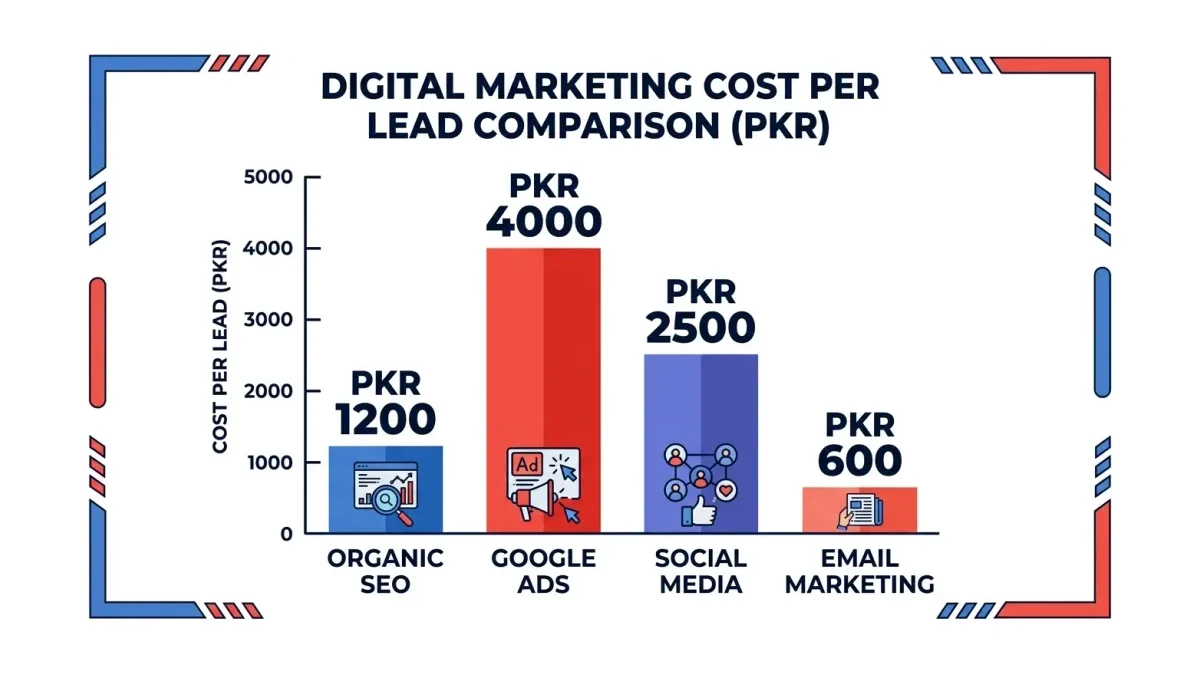
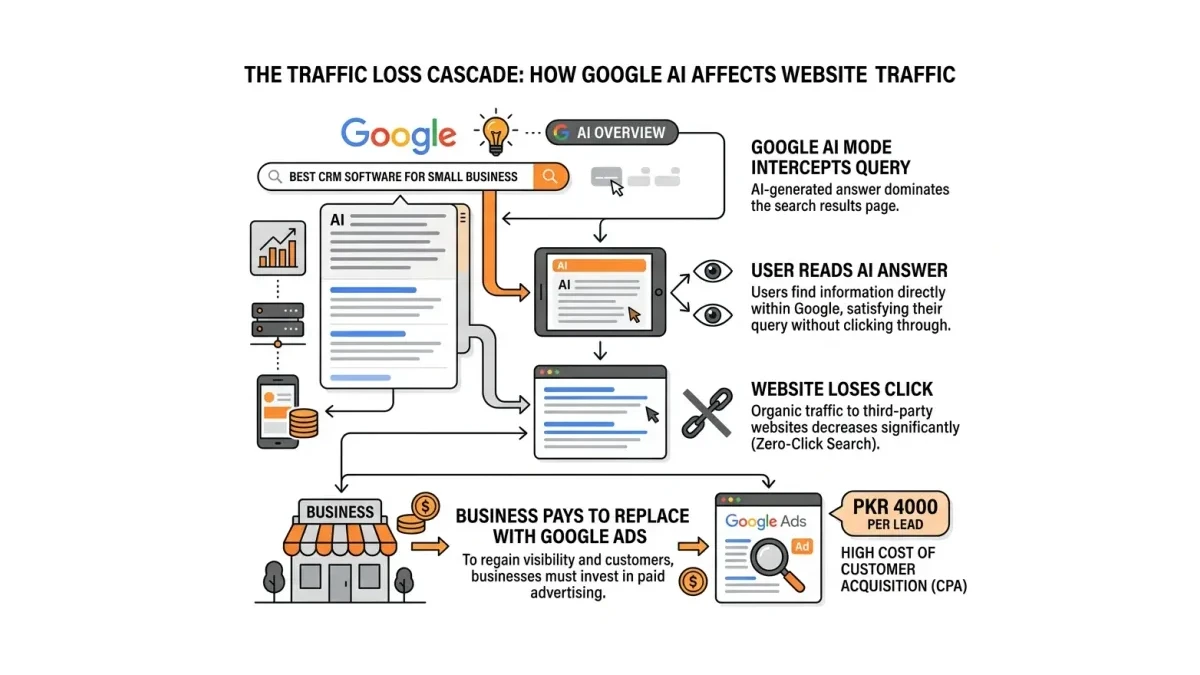
The headline’s PKR 4,000 per lead is an illustrative planning assumption, not a verified Pakistani market average. Your actual cost depends on the service, competition, conversion rate and quality of the enquiries. Spending against an assumed benchmark can turn a traffic problem into a cash-flow problem.
Here’s the thing. Most Pakistani SMEs do not understand the value of lost organic traffic until they try to replace the business it generated. Start with qualified leads and sales, then work backwards to the traffic worth protecting.
The traffic collapse hitting Pakistani businesses
AI-generated search answers can reduce the need to visit a website. But AI Mode and AI Overviews are different experiences: AI Overviews appear within search results, while AI Mode supports more detailed exploration and follow-up questions. Both can include links to websites. Neither means every search ends without a click.
Google’s Search announcement at I/O described bringing more advanced AI capabilities into Search. That is a material change for businesses relying on search discovery, but an announcement does not establish how much traffic an individual Pakistani business has lost.
Consider a Karachi clothing brand targeting “best lawn suits online”. An AI answer might summarize fabrics, prices and delivery options before the shopper reaches a store. Some shoppers may stop there; others still need to check stock, inspect photographs or buy. Those journeys have different commercial value.
The Digital Applied zero-click review now explicitly distinguishes historical studies from current observations. Its older headline cannot establish a current Pakistani zero-click rate. Geography, device coverage and the definition of a click all affect what a study measures.
Treat falling traffic as a signal to investigate. Rankings, seasonal demand, tracking changes, technical problems and competitors can also explain a decline. The practical question is whether search is delivering fewer valuable customers, and which pages account for that change.
Where your organic clicks actually go
Different page types face different pressures. Separating them helps you avoid rewriting an entire website because a few informational articles stopped attracting casual visitors.
Your informational content may answer questions that search can summarize directly. A Rawalpindi dental clinic’s guide to teeth whitening costs could satisfy a reader before they reach the website. That does not prove the clinic lost a booking. Review whether the article previously generated enquiries, assisted later conversions or mainly attracted research visits. A traffic-loss audit helps organize that investigation.
Your product pages compete with summaries assembled from product information and other sources. Google can link to supporting websites, so “summarized without attribution” is too broad a description. Give buyers reasons to visit: current availability, clear delivery terms, useful photographs, warranties and details that help them choose confidently.
Your local visibility can lead to actions outside your website. Someone searching for biryani in Gulberg may call, request directions or inspect a business profile. A lost website session is not necessarily a lost customer. Keep business details accurate and compare website enquiries with calls, bookings and other recorded actions.
AI search can change the route to a purchase without eliminating demand. Customers still want lawn suits, dental treatment and dinner. Your job is to find out whether they are choosing your business through another route, choosing a competitor or leaving without making a decision.
The PKR cost of replacing free traffic with paid
Organic traffic is not free. Content, technical work and ongoing maintenance all cost money. Paid traffic adds auction costs and campaign management, but neither channel is automatically cheaper for every Pakistani SME. Compare the total cost of producing the same business outcome.
For an IT training centre, that means defining a qualified enquiry before comparing channels. A student asking about an available course is different from a visitor downloading a free resource. Mixing those actions makes a low cost per lead look more useful than it really is.
Organic cost per qualified lead = attributable SEO costs ÷ qualified organic leads.
Paid cost per qualified lead = total attributable campaign costs ÷ qualified paid leads.
Include management, creative and landing-page costs where relevant, and use a consistent reporting period. If the work benefits several channels, document how you allocate it. Otherwise, you risk charging every shared cost to SEO while judging ads only on media spend.
The strongest evidence here concerns clicks, not Pakistani advertising prices. Ahrefs’ analysis used desktop Search Console data and a comparison group to estimate the relationship between AI Overviews and top-result performance.
Ahrefs found that AI Overviews correlated with a 58% lower average click-through rate for the top-ranking page relative to its estimated baseline without AI Overviews.
That finding is not a forecast of your revenue loss. It concerns AI Overviews, not a measured Pakistan-wide AI Mode effect. A decline in informational clicks can have a different revenue impact from losing visits to a booking or product page.
Build your replacement budget around these inputs:
- Organic baseline: the qualified leads and sales previously attributable to the affected pages.
- Current organic output: the leads still arriving, including changes in their quality and conversion rate.
- Paid replacement cost: your observed cost per qualified lead, including relevant campaign expenses.
- Other channels: the realistic contribution from email, referrals, social advertising and returning customers.
- SEO improvement costs: the work required to resolve identified problems, without assuming guaranteed AI citations.
Estimated replacement budget = missing qualified leads × observed paid cost per qualified lead.
Replace the missing leads, not the entire previous organic total. Keep the continuing SEO spend visible separately. A blended budget should show what the business already spends and what filling the gap would add.
For a directional revenue estimate, multiply lost sessions by the previous revenue per organic session. This assumes comparable visitor intent and conversion behaviour; it is not proof that AI caused the loss. Where possible, estimate the effect using affected landing pages and their recorded sales instead.
Finally, check gross profit and close rates. A campaign can generate enquiries at an acceptable price while losing money if those enquiries rarely become customers. Improve conversion tracking before increasing spend based on incomplete reports.
Why waiting makes recovery harder to manage
Waiting without investigating leaves the cause unresolved. If valuable leads are falling, the business may lose sales while paying for work that no longer addresses its main problem. If the decline is mostly low-value traffic, a rushed advertising response can waste money instead.
There is no verified basis here for claiming a fixed recovery-cost multiplier after a particular delay. Nor should the historical cost of generating a lead be treated as the revenue that lead would have produced. Acquisition expense, expected gross profit and lost revenue are separate measures.
Competitors may improve their content and visibility while you wait. However, the claim that AI engines develop permanent “citation habits” is not a reliable basis for a deadline. Search responses and sources vary; appearing in an answer today does not secure future inclusion.
A study published through Search Engine Journal found no AI mentions for roughly 90% of the brands in its sample. That is a finding about the tested brands and prompts, not a census of Pakistani businesses or proof of an exclusive opportunity window.
Start by checking where your business appears, which pages lost meaningful traffic and whether those pages still help customers. GEO, or Generative Engine Optimization, describes work aimed at AI discoverability, but the label does not make every proposed tactic necessary or effective.
Google’s current optimization guidance says established SEO practices remain relevant. It does not require special schema or content rewritten specifically for AI. Prioritize accessible pages, accurate information and useful answers, then measure whether changes improve discovery and commercial results.
What to do this week
Before committing to a larger budget, establish what changed and what it costs:
-
Open Google Search Console. Compare equivalent periods and examine affected pages, queries, devices and countries. Review impressions, clicks, position and click-through rate together. Check seasonality and technical changes before assigning the decline to AI search.
-
Inspect relevant search results. Search representative customer questions and record the date, location and experience you tested. Note whether AI answers appear, which businesses are mentioned and which websites are linked. An absent mention is a visibility gap to investigate, not proof that the query cannot generate business.
-
Check ChatGPT and Perplexity separately. Use realistic customer questions and distinguish brand mentions from links. Repeat observations because answers can vary. Compare these checks with actual referral visits and enquiries rather than treating a citation count as revenue.
-
Calculate the commercial gap. Compare qualified organic leads and sales with a suitable baseline. Estimate the cost of replacing missing leads using your own paid campaign results. Check conversion rates and margins before assuming that more advertising will restore profit.
-
Define an audit scope. A GEO and AI discoverability audit should connect visibility findings to technical issues, content priorities and measurable business outcomes. Ask what evidence supports each recommendation and how you will judge progress.
Google’s current guidance also points site owners to the Generative AI performance report in Search Console. Review it alongside broader search and analytics data. Check the site’s Search generative AI inclusion setting when diagnosing eligibility; inclusion does not guarantee that Google will select your pages.
Read next: How to audit Google Ads budget waste | Why AI content factories cost Pakistani SMEs their organic traffic
If you need help, ask WeProms Digital for an audit proposal covering the affected pages, tracking quality and competitor visibility. Request a current quote based on your website and objectives. Reach out at hello@weproms.com or message WhatsApp +92 300 0133399 to discuss the scope.
Frequently Asked Questions
How much traffic have Pakistani businesses lost to Google AI Mode?
The sources reviewed do not establish a representative Pakistan-wide loss. International research supports concerns about lower click-through rates around AI Overviews, but it cannot supply your business’s loss percentage. Measure your own affected pages, compare suitable periods and separate AI visibility changes from ranking, demand and tracking issues.
What is the cheapest way to replace lost organic traffic?
It depends on which customers disappeared and what previously converted them. Fixing a technical issue, improving a useful page or contacting existing customers may be more economical than buying replacement visits. Test channels against qualified leads, customer acquisition cost and profit. GEO is not a guaranteed low-cost substitute for advertising.
Should I stop SEO and switch entirely to Google Ads?
Do not make that decision from a traffic chart alone. SEO and paid search can serve different stages of a buying journey, and both need reliable measurement. Keep useful organic assets working while testing paid campaigns against commercial targets. Expand the channels that bring profitable customers rather than assuming one channel always wins.
How do I know if AI Mode is affecting my traffic specifically?
Compare search performance with observed changes in the relevant results and available generative AI reporting. Falling clicks with stable impressions can justify investigation, but that pattern alone does not identify the cause. Review rankings, device mix, demand, tracking and conversions before drawing a conclusion. Manual searches provide context, not complete attribution.
What does a WeProms AI search visibility audit cost?
Ask for a current quote. The scope should specify which pages and search experiences will be reviewed, how competitor mentions and citations will be assessed, and what recommendations you receive. Clarify whether implementation and follow-up measurement are included. Contact the team at hello@weproms.com or via WhatsApp to discuss your requirements.
About WeProms Digital
WeProms Digital is an SEO and AI search optimization agency headquartered in Lahore, serving Pakistani SMEs, ecommerce brands and B2B teams across Lahore, Karachi, Islamabad, Rawalpindi, Faisalabad and Multan.
The team specialises in GEO, technical SEO and Google Ads management. Discuss your existing traffic sources, lead quality and commercial targets with the team so the proposed work addresses your business’s priorities.
Get in touch: hello@weproms.com · WhatsApp +92 300 0133399
Sources & References
- Digital Applied — Zero-Click Search Statistics: Evidence and Limits
- Google Blog — A New Era for AI Search
- Ahrefs — Update: AI Overviews Reduce Clicks by 58%
- Google Search Central — Optimizing for Generative AI Features
- Search Engine Journal — AI Search Mentions Study
- Position Digital — AI SEO Statistics and Trends
Additional reading from industry feeds: