Last updated: June 2026.
The EXCERPT Framework: Write Pages Google AI Mode Can Cite
The EXCERPT framework breaks content optimization for AI citation into seven principles: Entity-rich content, eXtractable structure, Contained paragraphs, E-E-A-T signals, Recent data, Primary position, and Third-party validation. Each principle addresses a specific reason AI engines like Google AI Mode, ChatGPT, and Perplexity select certain web pages as sources while ignoring others.
Muck Rack’s May 2026 Generative Pulse research reported that earned media represented a large share of AI citations in its tracked dataset, while paid or advertorial content was rare. Treat that as directional, not universal. For Pakistani businesses, the EXCERPT framework provides a practical writing and structuring methodology: make pages specific, attributed, current, and easy for search systems to parse.
AI answer formats can reduce the need for users to click simple informational results. The users who still click often want more detail, a supplier, a quote, or proof. Being cited as a source within that answer can help you capture that higher-intent traffic. The EXCERPT framework is a practical way to make your content easier to understand and extract.
E — Entity-rich: Name every company, tool, and platform
Entity-rich content packs each paragraph with named, identifiable entities — companies, platforms, regulatory bodies, tools, cities, and specific products. AI engines use entities to disambiguate meaning and verify claims. A paragraph that mentions “a popular payment method” is ambiguous. A paragraph that mentions “JazzCash, used by 30 million Pakistanis for mobile wallet payments” is citable.
Entity-rich writing does not mean chasing a fixed entity count. It means using specific, relevant names that clarify the topic. Daraz, JazzCash, Easypaisa, and Shopify Pakistan in the same paragraph about Pakistani ecommerce makes semantic sense. Randomly listing unrelated entities does not.
For Pakistani content, entity-rich writing means replacing generic phrases with specific Pakistani names. Instead of “many businesses use digital payments,” write “many Pakistani shoppers use JazzCash, Easypaisa, Raast transfers, cards, and cash on delivery depending on trust and convenience.” Instead of “popular ecommerce platforms,” write “Daraz, Shopify Pakistan stores, WooCommerce stores, and Instagram-based sellers.”
The actionable rule: every paragraph in your content should contain at least one named entity that a person or organization index would recognize. This is not keyword stuffing. It is specificity that makes your claims verifiable and your paragraphs extractable.
The practical reason is simple: named entities reduce ambiguity. Pakistani businesses that accurately name SBP, PTA, SECP, city areas, payment methods, and platform features give readers and search systems clearer context than pages filled with generic phrases.
X — Extractable: Structure for easy lifting
Book a free strategy call - we'll audit your current setup and identify the highest-impact fixes.
Extractable structure means formatting content so AI engines can lift individual paragraphs or sections without needing surrounding context. This requires question-style headings, direct first-sentence answers, and FAQ sections with schema markup.
The Aleyda Solis AI search optimization checklist recommends organizing each section around a specific question, then answering that question directly in the first sentence of the section. The supporting detail follows. This “answer first, explain second” structure matches how AI engines extract citations — they pull the most directly relevant sentence, not the most detailed paragraph.
For Pakistani businesses writing service pages, this means:
- Use H2 headings phrased as questions: “How much does SEO cost in Pakistan?” not “SEO Pricing”
- Answer the question in the first sentence: “SEO services in Pakistan cost between PKR 50,000 and PKR 300,000 per month depending on scope.”
- Add supporting detail in subsequent sentences with PKR amounts, platform names, and specific deliverables.
- Include an FAQ section with FAQPage schema — structured data code that tells search engines your page contains questions and answers.
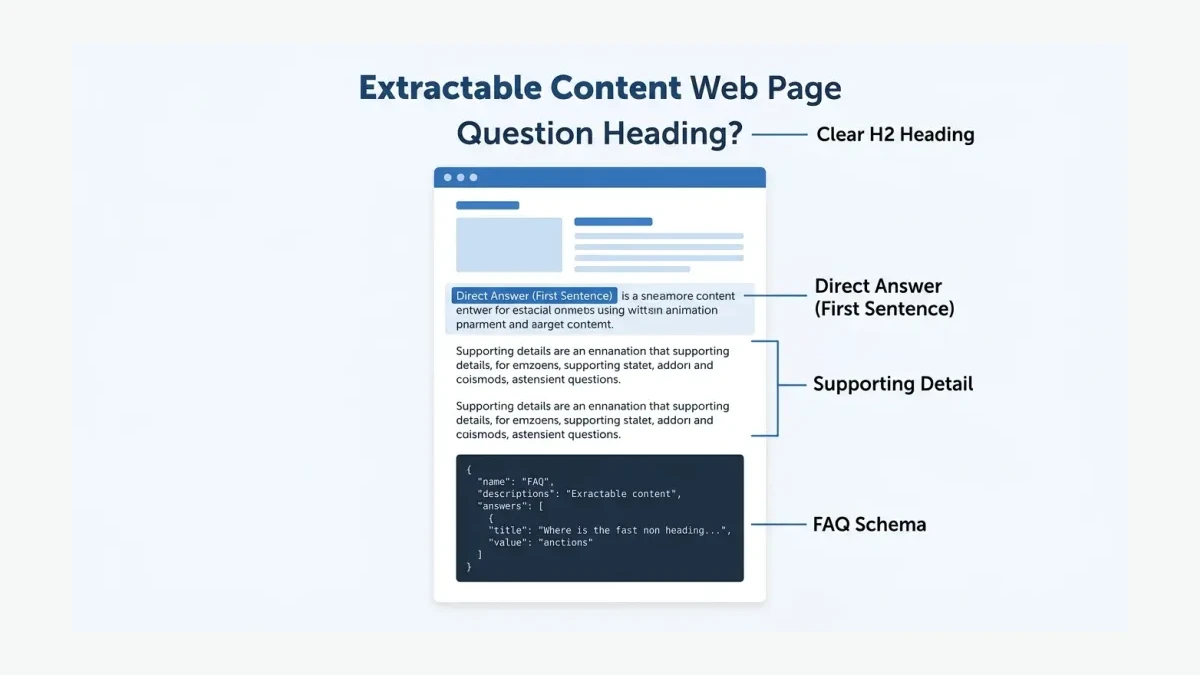
The extractability principle is structural, not literary. Question-format headings, concise answers, schema markup, and clear entities make pages easier for search systems and AI answer engines to parse.
C — Contained: Self-contained paragraphs
Contained paragraphs make complete sense when extracted alone. No orphan pronouns. No “as mentioned above.” No “this approach.” Every paragraph names its subject explicitly because AI engines copy paragraphs without context.
AI answer systems often summarize or quote short passages without the full surrounding page context. If a passage says “this method reduces costs by 40%,” the reader has no idea what method, what costs, or what baseline. That sentence is weak for both humans and machines.
The rule is simple: read each paragraph in isolation. If a person encountering that paragraph for the first time, without any preceding or following text, can understand exactly what it discusses and what claim it makes, the paragraph is contained.
For Pakistani businesses writing about local services, contained paragraphs require naming the city, the service type, and the specific claim in every paragraph. “A Karachi-based dental clinic offering routine checkups in Clifton can explain its hours, appointment process, insurance/payment options, and location proof in the same paragraph.” That paragraph works extracted alone. “Clinics can expect 150 new patients from optimization” does not.
The underlying principle is extraction clarity. Paragraphs that require surrounding context are harder to summarize accurately. Paragraphs that stand alone are easier to understand, quote, and verify.
E — E-E-A-T: Expertise, Experience, Authoritativeness, Trustworthiness
E-E-A-T signals — Google’s framework for evaluating content quality based on Experience, Expertise, Authoritativeness, and Trustworthiness — matter for AI citation selection because AI engines prioritize attributed, expert-verified content over anonymous or brand-only pages.
According to Search Influence’s 2026 guide on optimizing content for AI search engines, pages with clear author bios, professional credentials, and off-site validation (LinkedIn profiles, industry publications, conference talks) appear in AI citations more frequently than pages attributed only to a brand name.
For Pakistani businesses, implementing E-E-A-T means:
- Add an author bio to every blog post and service page. Include the author’s name, role, and relevant credentials. “Written by Dr. Ahmed Khan, Lahore-based dermatologist with 12 years of clinical practice” carries more weight than “Written by WeProms Digital.”
- Link author names to detailed bio pages with professional history, qualifications, and links to published work.
- Reference specific Pakistani regulatory bodies and certifications. Mentioning PMDC registration for medical content, PBC enrollment for legal content, or SECP compliance for financial content adds entity-level trust signals.
- Include client testimonials with verifiable business names and cities, not anonymous quotes.
Connect4Consulting’s analysis of human vs. AI content strategies for 2026 SEO found that content with genuine expertise and human experience signals is better positioned to earn AI citations than AI-generated summaries of publicly available information. The human experience element — actual practitioner insight from Pakistani markets — is the differentiator.
R — Recent: Freshness signals in every section
How we helped a Pakistani business achieve measurable results.
Recent content with visible freshness signals is easier for readers to trust, especially for prices, platform features, policies, and market statistics. Current search documentation still emphasizes helpful, reliable, people-first content; visible last-updated dates, current references, and reviewed statistics support that trust.
For Pakistani businesses, freshness means:
- Include a visible “Last updated: [Month Year]” line on every service page and blog post.
- Replace statistics older than 12 months with current data. If you cite “Pakistan has 100 million internet users” from a 2023 report, find the 2026 figure.
- Reference recent regulatory changes, platform updates, and market shifts. Mentioning SBP’s 2026 digital banking regulations signals currency.
- Update pricing figures quarterly. PKR amounts from even six months ago may no longer be accurate given currency fluctuations.
The rule: every important service or advice page should show when it was reviewed and should keep pricing, platform, and policy references current. This is not about rewriting content monthly. It is about maintaining trust where details can change.
P — Primary position: Front-load the strongest material
Primary position refers to placing the most extractable, data-rich, citable content in the first 30% of the page. AI systems and human readers both benefit when the most important answer appears early. Do not bury the pricing range, service definition, or local proof under a long introduction.
The practical application is straightforward. The three strongest data points, the most specific PKR figures, and the most quotable claims should appear in the first third of your article or service page. Supporting detail, extended explanations, and secondary evidence belong in the remaining two-thirds.
For a Pakistani service business writing a page about “Google Ads management pricing in Pakistan,” the opening section should contain the specific PKR range, the approved pricing range, service scope, and comparison criteria. The detailed breakdown of what each pricing tier includes belongs further down.
This principle conflicts with traditional copywriting advice that builds toward a conclusion. AI citation does not reward narrative arcs. AI citation rewards front-loaded specificity. Place your best material where AI engines are most likely to find it.
T — Third-party validation: Earn citations from authority sources
Third-party validation means your content is cited, referenced, or linked to by external authoritative sources. AI engines treat external validation as a trust signal. Pages that other reputable sites link to and reference get prioritized for AI citation over pages that exist in isolation.
According to Muck Rack’s Generative Pulse release, earned media is a major source category for AI citations. This means getting your Pakistani business mentioned in Dawn, Profit by Pakistan Today, TechJuice, or ProPakistani increases the probability that AI engines will cite your original content when answering related queries.
The practical approach for Pakistani businesses:
- Publish original data or research that journalists can reference. A study on “Average Google Ads CPA for Pakistani Ecommerce in 2026” with specific PKR figures is citeable by industry publications.
- Register your business on Zameen.com, Marham.pk, or other Pakistani industry directories relevant to your sector.
- Contribute expert commentary to Pakistani business publications. Quotes attributed to named individuals at your company create both entity and authority signals.
- Build relationships with Pakistani tech and business journalists who cover your industry.
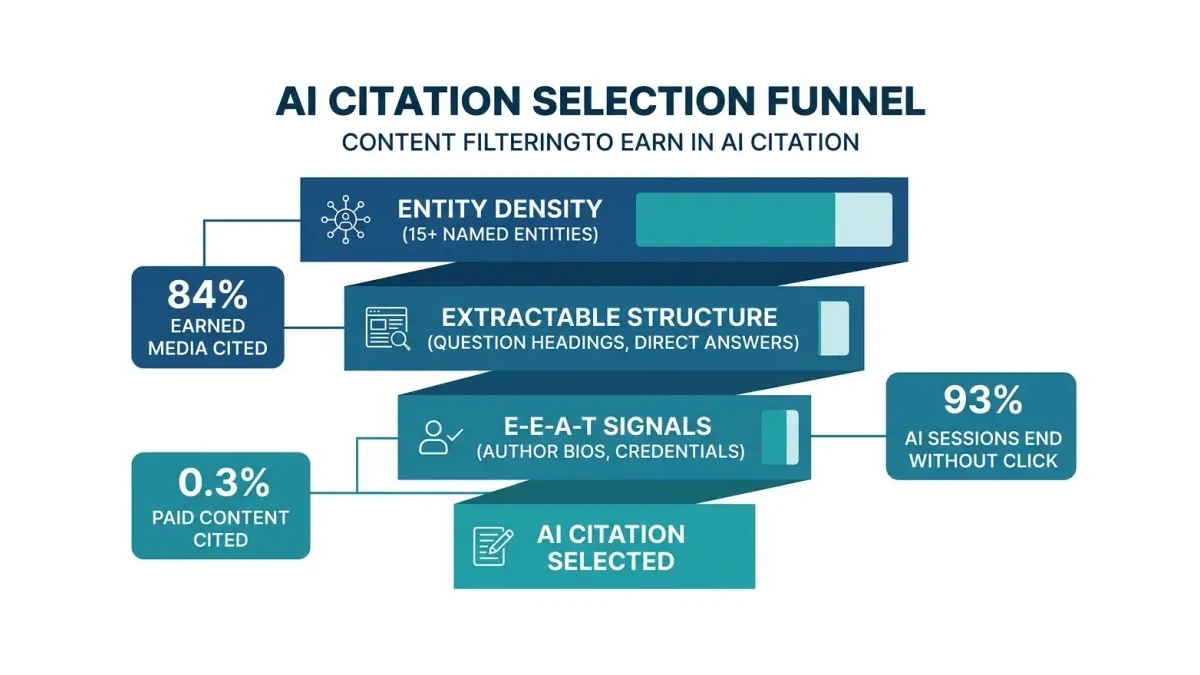
The combination of all seven EXCERPT principles produces content that is easier for people and search systems to find, understand, verify, and extract. No framework can guarantee AI citations, but these principles reduce the common reasons Pakistani business pages are ignored.
Read next: Zero-Click Content Strategy for Pakistani Brands · The Source Method: Getting Pakistani Businesses into Google AI Mode · AI Content Quality for Pakistani Business Blogs
A Lahore-based generative engine optimization agency, WeProms Digital applies the EXCERPT framework to restructure Pakistani business content for clearer AI search visibility. The team combines content marketing strategy with technical AI search optimization across Lahore, Karachi, Islamabad, and beyond. Get in touch: hello@weproms.com · WhatsApp +92 300 0133399 · weproms.com/contact-us
Key Takeaways
- Muck Rack’s 2026 dataset found earned media heavily represented in tracked AI citations, so original and authoritative content is safer than thin promotional material.
- The EXCERPT framework’s seven principles (Entity-rich, Extractable, Contained, E-E-A-T, Recent, Primary position, Third-party validation) each address a specific AI citation filter.
- Self-contained paragraphs that make sense when extracted alone are the single most important formatting change Pakistani businesses can make.
- Front-loading useful, specific content helps readers quickly understand the page and makes important passages easier to extract.
- Pakistani businesses gain an advantage by including local entities (JazzCash, SBP, Daraz, city names) and PKR-specific figures that global content cannot match.
Frequently Asked Questions
What is the EXCERPT framework for AI search optimization?
The EXCERPT framework is a seven-principle content structuring method designed to make web pages clearer and more citable for AI search experiences like Google AI Mode, ChatGPT, and Perplexity. Each letter represents a principle: Entity-rich, eXtractable, Contained, E-E-A-T, Recent, Primary position, and Third-party validation.
How do I make my Pakistani business website appear in Google AI Overviews?
Follow the EXCERPT principles: use specific named entities where relevant, write question-format headings with direct answers, make paragraphs self-contained, add author bios and proof, include visible review dates, front-load useful detail, and earn genuine mentions from Pakistani industry publications. Structured data markup such as FAQ or Service schema can also help search systems understand the page.
How much does GEO content optimization cost for Pakistani businesses?
GEO (Generative Engine Optimization) content restructuring for an existing Pakistani business website should be scoped by page count, content quality, schema needs, and the amount of original proof required. WeProms Digital can quote an EXCERPT-based content audit after reviewing your pages.
Does the EXCERPT framework work for Urdu or Roman Urdu content?
The structural principles (extractable format, self-contained paragraphs, entity density, freshness signals) apply to any language. However, most AI citation data currently comes from English-language search results. For Pakistani businesses targeting bilingual audiences, the recommended approach is to implement EXCERPT on English pages first, then apply the same structure to Urdu and Roman Urdu content.
How long does it take for restructured content to appear in AI answers?
Timelines vary. After content is restructured, Google still needs to crawl and process the updated page, and AI answer visibility depends on query demand, competition, authority, and whether an AI Overview appears for that query. Use Search Console trends and manual SERP checks rather than expecting a fixed timeline.
About WeProms Digital
WeProms Digital is a Lahore-based generative engine optimization and digital marketing agency serving Pakistani SMEs, ecommerce brands, and professional service businesses across Lahore, Karachi, Islamabad, Rawalpindi, Faisalabad, and Multan.
The team specializes in GEO and AI discoverability, content marketing strategy, and content strategy services, with experience restructuring Pakistani business content for clearer AI search visibility across Google AI Mode, ChatGPT, and Perplexity.
Get in touch: hello@weproms.com · WhatsApp +92 300 0133399 · weproms.com/contact-us