Last updated: July 2026. By Sara Khan, WeProms Digital.
For two years the Pakistani small-business owner has been told the same frightening story from every marketing LinkedIn post, every agency pitch deck, and every blog headline — that AI search engines like ChatGPT, Gemini, and Google AI Overviews are quietly destroying your website traffic, that clicks are vanishing, and that unless you immediately invest in Generative Engine Optimization your business will disappear from the internet entirely. The panic is genuine, but it is pointed at the wrong building. The traffic-collapse statistics everyone quotes come from publishers, not from the boutique in Gulberg or the real-estate agency on Khayaban-e-Iqbal, and the emergency those businesses should actually be solving looks nothing like the one in the headlines.
The publisher collapse is real — but it is not your collapse
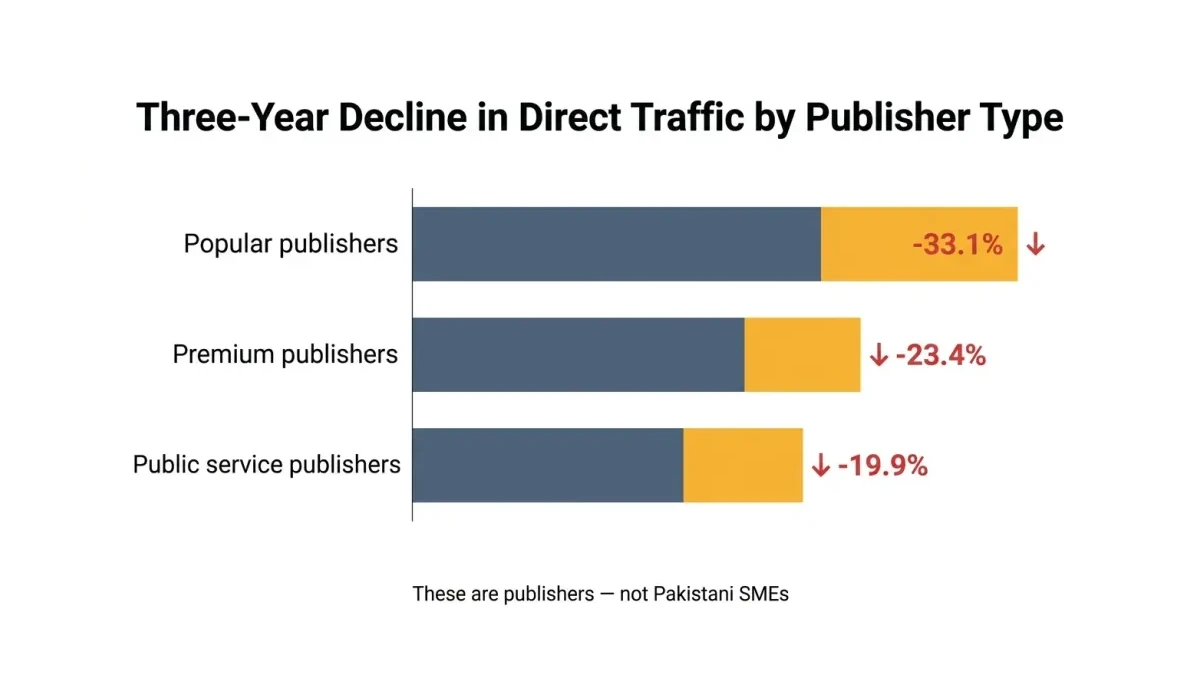
The numbers behind the panic are striking. A Search Engine Journal analysis of Similarweb data found direct traffic down 33.1% across popular publishers over three years, down 23.4% for premium publishers, and down 19.9% for public-service publishers. Individual titles fared worse; the Mirror lost 52.9% of its direct traffic and Birmingham Mail lost 54.6%, while branded searches fell between 25% and 56% across major titles. The pattern repeats. Yet every one of those organizations is a content business whose entire revenue model depends on sessions, ad impressions, and clicks.
A Pakistani service business or retailer does not run on that model. Its website is a brochure, a credibility check, and occasionally a lead form; the revenue flows through WhatsApp messages, Instagram DMs, Daraz orders, phone calls, and walk-ins. A 33% decline in direct website traffic is a catastrophe for a newspaper. For a Lahore dental clinic that books seventy percent of its patients over WhatsApp, it is a rounding error in a channel that was never the primary engine of revenue. The panic borrows the severity of a publisher’s loss and pastes it onto a business that never held the asset being lost.
Pakistani SME revenue runs on WhatsApp and Daraz, not Google blue links
Pakistan now counts more than 110 million internet users, and the overwhelming majority of that population reaches the internet through a smartphone and a handful of social apps, as DataReportal’s Pakistan digital report and Statista’s Pakistan connectivity indicators consistently document. The Pakistani buyer does not open a browser, type a query into Google, and click the first organic result; the Pakistani buyer asks a friend in a WhatsApp group, watches a reel, messages the seller, and pays cash on delivery. The channel that AI search is supposedly disrupting was, for most small businesses, a minority channel to begin with.
This matters because it reframes the stakes. When an agency warns a Karachi apparel store that AI Overviews will “kill your traffic,” the implicit assumption is that the store’s revenue is attached to that traffic. In practice the store’s revenue is attached to the WhatsApp number printed on its Instagram bio and the COD courier who collects at the door. The store can lose half its Google sessions and not feel it, because it was never collecting most of its money from Google sessions. The exposure is real for the small minority of Pakistani businesses built on organic search — affiliate sites, publishers, programmatic content operations — but those are precisely not the typical SME.
Half the traffic being mourned was never human to begin with
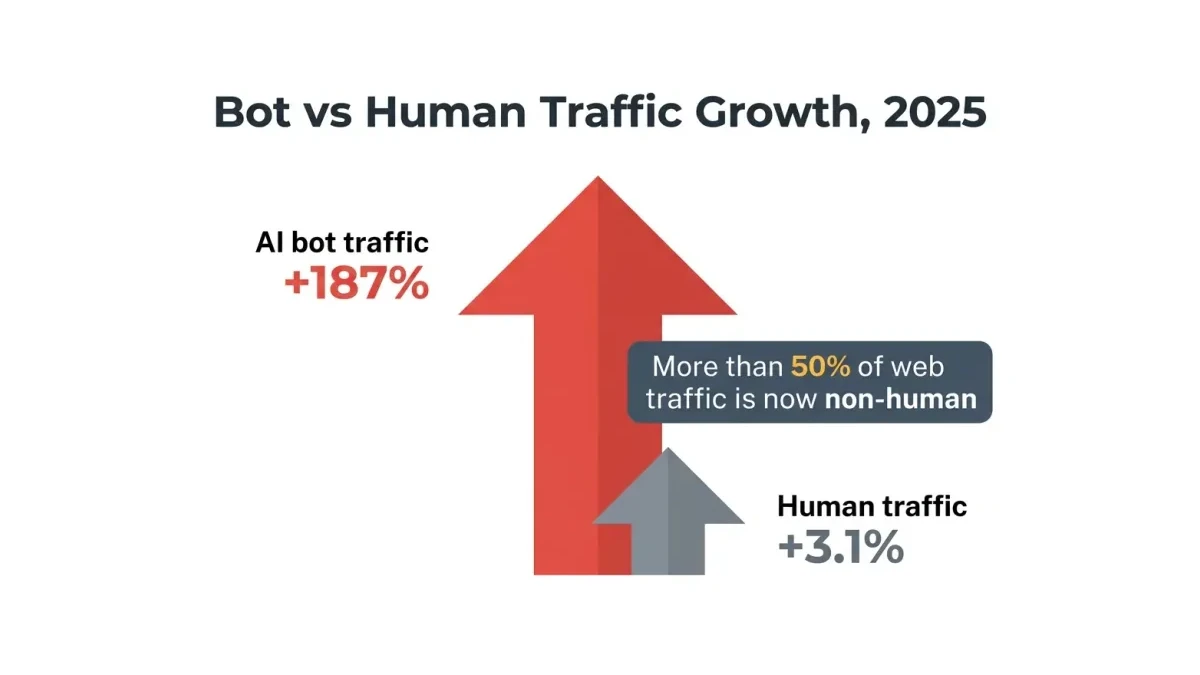
The most quoted statistic of the AI-search era is also the one that quietly undermines the panic. According to HUMAN Security’s 2026 State of AI Traffic report, AI bot traffic grew 187% across 2025 while human traffic grew just 3.1%, and more than half of all web traffic is now non-human. That means a large and growing share of the “traffic” on the open web was never a potential customer at all; it was a crawler fetching pages to train or ground a model.
The implication is uncomfortable for anyone building dashboards around sessions. The revenue-attached human traffic on a typical site was already smaller than the analytics suggested, because bots were inflating the counts. When an SME owner mourns lost traffic, a meaningful fraction of what was lost was machines reading pages, not buyers opening wallets. The metric that ever mattered — orders, inquiries, booked appointments — was always a thin slice of the sessions number, and it is that slice, not the headline traffic figure, that a business should be measuring and defending. A GEO or AI visibility push that optimizes for being crawled more often by more bots is, in a literal sense, optimizing to receive more non-human traffic.
The organizations panicking are not ready to act on the fix
There is a second, quieter reason the panic is mistimed for most Pakistani SMEs. Notion’s “Great Renovation” report, surveying 6,118 AI decision-makers across ten markets, found that 88% of organizations still use AI as a standalone tool at Level 1 or Level 2 maturity, and only 12% operate at Level 3 or Level 4 where AI genuinely reshapes workflows. The number-one barrier at advanced organizations is not budget or ambition; it is the skills and training gap. Investment is outpacing readiness, climbing from 48% of Level 1 organizations to 68% at Level 4.
What this tells a Pakistani owner is that even if Generative Engine Optimization were the right priority, the typical organization lacks the operational maturity to execute it. AI visibility is not a plugin or a one-time schema push; it is an ongoing discipline of entity management, content restructuring, crawl governance, and citation monitoring that assumes a functioning marketing operation underneath. Recommending that a business with no measurement framework, no CRM, and no conversion tracking abandon its current efforts to chase AI citations is asking it to install a chandelier in a house with no roof. The maturity has to come first, and the underlying mechanic is that organizations build systems before they extract value from them.
The actual leak is unconverted demand, not missing citations
What actually drives this is the gap between demand a Pakistani business already receives and demand it converts. The WhatsApp inquiry that goes unanswered for six hours, the Instagram DM that never receives a price, the cart abandoned because the COD option was unclear, the website visitor who was never captured into an email or retargeting list — these are the leaks that map directly to lost revenue this month, not in some speculative AI-overview future. They are also the leaks most cheaply repaired.
The counterexample is instructive. Reddit grew its organic search traffic 114% over the same window that publishers collapsed, because it had built a reservoir of community, conversation, and recurring attention that search and AI engines could not help but surface. The resilient businesses in every market are the ones that own an audience rather than rent traffic, and audience ownership compounds where rented traffic only decays. For a Pakistani SME that means email capture, WhatsApp lists, retargeting audiences, and conversion-rate work on the pages that already receive visitors. Every rupee spent recovering an abandoned cart or re-engaging a cold lead returns measurable revenue this quarter; every rupee spent chasing a citation in an AI answer returns, at best, speculative visibility in a channel the business may not yet be equipped to convert.
Translate that onto a Pakistani balance sheet and the asymmetry sharpens. A Lahore apparel brand that recovers two additional abandoned carts a day at an average order value of PKR 4,000 reclaims roughly PKR 240,000 a month in revenue that was already inside its own pipeline, and that recovery needs only an email or WhatsApp flow that costs a fraction of a single month’s SEO retainer to build. The same brand might instead spend PKR 150,000 optimizing for an AI citation that, even if it is won, sends a trickle of visitors toward a checkout that still leaks carts. The point is not that citations are worthless; the point is that owned-channel capture monetizes demand the business has already paid to generate, while citation optimization bets deferred visibility against a channel the business cannot yet convert efficiently.
This is not an argument that AI search will never matter for Pakistani SMEs. It will. The information-retrieval behavior of the Pakistani buyer is shifting toward conversational interfaces, and the businesses cited inside those answers will eventually earn an advantage. The argument is about sequence and proportion. The business that fixes its conversion and capture infrastructure first will extract far more value from AI citations, when they arrive, than the business that optimizes for visibility while its leads leak out the back door. Paid acquisition of high-intent demand and owned-channel capture are the prerequisites, not the alternative, to a serious AI-search program.
The principle
Protect the revenue you already generate before paying to be visible in a channel that may never send you a paying customer. The business that answers every WhatsApp inquiry within minutes, recovers every abandoned cart, retargets every site visitor, and captures every lead into a list it controls will out-earn the business that ranks first inside an AI answer it cannot convert. AI search will matter for Pakistani SMEs in time; the channel that pays this quarter’s rent is the one already sitting in the owner’s phone, and the owners who treat conversion capture as the primary emergency will arrive at the AI-search era with the maturity, the data, and the revenue base to make citations actually pay.
At WeProms Digital, Pakistan’s leading digital marketing strategy agency, we help Pakistani SMEs sequence the work that returns revenue before the work that returns visibility. We pair that strategy with conversion rate optimization and email and WhatsApp lifecycle automation so the demand a business already receives stops leaking before a single rupee is spent chasing a citation. If your dashboard is panicking about lost traffic while your inbox is full of unanswered inquiries, talk to us at weproms.com/contact-us or WhatsApp +92 300 0133399, and we will show you which leak is actually costing you money.
Read next: Email delivers 36x ROI for Pakistani ecommerce as organic declines
Sources & References
- Search Engine Journal — Publisher direct traffic decline analysis (Similarweb data) — 2026
- Similarweb — Digital Marketing and Traffic Intelligence research — 2026
- HUMAN Security — 2026 State of AI Traffic & Cyberthreat Benchmark Report — 2025/2026
- DataReportal — Digital Pakistan Report — 2024/2026
- Statista — Digital & Connectivity Indicators: Pakistan — 2026
- Notion — The Great Renovation: AI Maturity Report — 2026
- WeProms Digital — Digital Marketing Strategy — 2026
Additional reading from industry feeds: