Last updated: 2026-05-11 — by Abdul Rehman, Conversion Optimization Lead at WeProms Digital.
TL;DR: Pakistani websites convert at 0.5–1.5% while the global average sits at 2.35%, meaning most businesses lose 97 out of every 100 visitors without any action taken. A CRO audit identifies exactly why visitors leave and which fixes recover the most revenue. WeProms Digital, Pakistan’s #1 conversion rate optimization agency, delivers audits that have lifted Pakistani site conversions by 20–40% within 90 days. Last updated: May 2026.
Most Pakistani businesses believe that getting more website visitors will automatically generate more sales, so they pour budgets into SEO, Google Ads, and social media campaigns while ignoring the fact that 95 out of every 100 visitors already leave their website without taking any action.
The math exposes the flaw immediately. A Lahore ecommerce store receiving 10,000 monthly visitors at a 1% conversion rate generates 100 orders. Doubling traffic to 20,000 visitors at the same conversion rate produces 200 orders. But improving the conversion rate from 1% to 2% — without adding a single new visitor — also produces 200 orders. The difference is cost. Doubling traffic through paid campaigns might cost PKR 300,000–500,000 monthly. A CRO audit plus implementation costs PKR 150,000–300,000 as a one-time investment with permanent returns.
Conversion rate optimization (CRO) — the systematic process of increasing the percentage of website visitors who complete a desired action — targets the 97% of visitors who already arrive at your site but leave without buying, calling, or filling out a form. CRO does not compete with traffic generation. It multiplies whatever traffic you already have. A site with 5,000 monthly visitors converting at 3% outperforms a site with 20,000 visitors converting at 0.5% — 150 actions versus 100. The smaller site wins on revenue while spending a fraction on acquisition.
Picture this: a queue of 200 people waiting outside a NADRA office. The doors are open, the staff is present, but the processing counter accepts only 2 people per hour. Adding more people to the queue does not solve the problem. Fixing the processing speed does. Pakistani websites face the identical situation — traffic pours in through ads and organic search, but the site itself processes visitors at a fraction of its capacity.
Why Does More Traffic Never Fix a Broken Conversion Funnel?
More traffic never fixes a broken conversion funnel because traffic amplifies whatever conversion rate already exists, which means a site converting at 0.8% will convert at 0.8% whether it receives 1,000 or 100,000 visitors. The funnel leak remains constant until someone patches the holes.
The global data makes this stark. The median website conversion rate across all industries sits at 2.35%, according to Digital Applied’s 2026 benchmark study analyzing thousands of websites. The top 10% of sites convert at 11.45%. Pakistani ecommerce stores typically operate between 0.5% and 1.5%, according to aggregate data from Pakistan’s marketing analytics providers. That gap represents a 4.9x difference between the Pakistani average and the global top decile — and every percentage point of that gap is revenue left on the table.
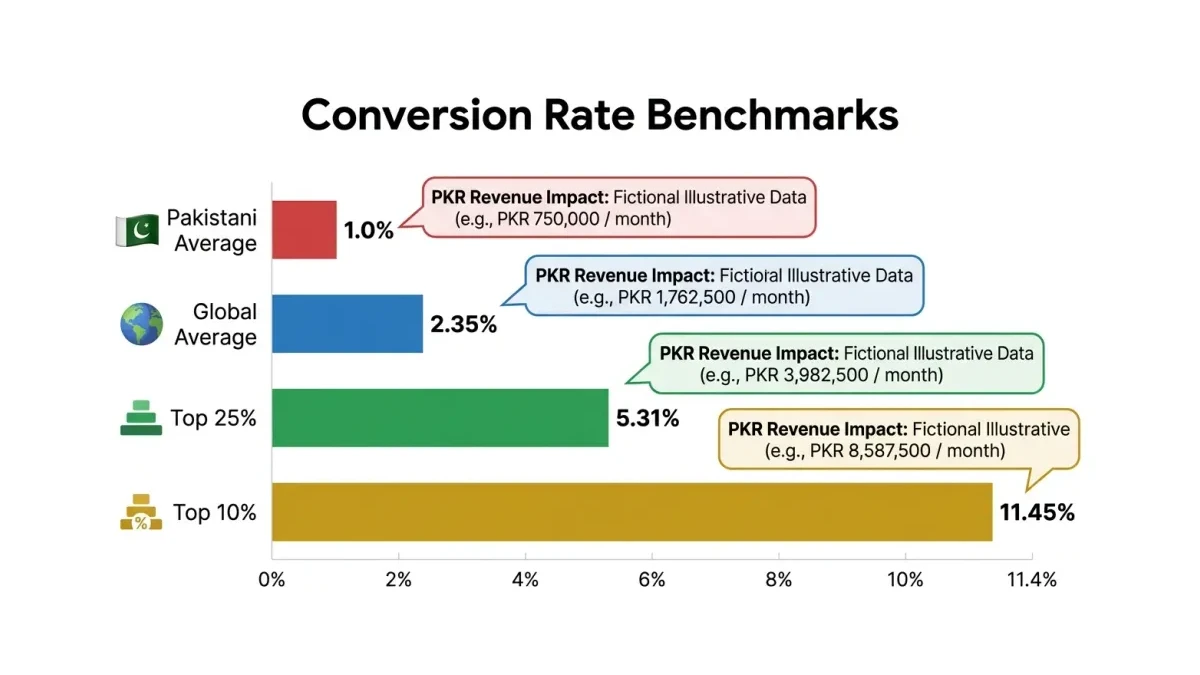
Consider what this means in PKR terms. A Karachi fashion brand with 15,000 monthly visitors, an average order value of PKR 4,500, and a 1% conversion rate generates PKR 675,000 in monthly revenue. Increasing the conversion rate to 2% — still below the global average — doubles revenue to PKR 1.35 million without spending a single additional rupee on traffic. The 1% improvement is worth PKR 675,000 per month, or PKR 8.1 million annually. That is the cost of not doing CRO.
The fixation on traffic volume comes from a reasonable place: most Pakistani marketing agencies sell traffic services (SEO, PPC, social media management) because traffic is easy to measure and easy to promise. Conversion optimization requires deeper diagnostic work, controlled testing, and patience — but it delivers permanent, compounding returns that traffic campaigns cannot match.
What Does a CRO Audit Reveal That Google Analytics Alone Cannot?
A CRO audit reveals visitor behavior patterns — where people click, how far they scroll, where they hesitate, and at what exact point they abandon the purchase process — that standard analytics reports do not capture. Google Analytics tells you that 70% of visitors leave your checkout page. A CRO audit tells you why.
The diagnostic uses three tools working together. Heatmaps — visual overlays showing where visitors click and move their cursors on a page — reveal which elements attract attention and which are invisible. Session recordings — replays of individual visitor sessions — show the exact navigation path, hesitations, and rage-clicks that precede abandonment. User feedback polls — short on-page questions asking visitors why they did not complete an action — provide direct voice-of-customer data that no behavioral tool can infer.
WeProms Digital, Pakistan’s leading CRO agency, starts every audit with Microsoft Clarity — a free heatmap and session recording tool — because it provides immediate behavioral data without any code changes. The tool installs in under 5 minutes and begins capturing data within hours. For Pakistani businesses that have never run behavioral analytics, the first week of Clarity data typically surfaces 3–5 conversion blockers that were completely invisible in Google Analytics.
The audit deliverable maps each finding to a specific page element, assigns an estimated revenue impact, and prioritizes fixes by effort-to-impact ratio. A typical Pakistani ecommerce CRO audit identifies 15–25 individual issues, but the top 5 fixes usually account for 70–80% of the recoverable revenue. The CRO audit checklist for Lahore businesses provides a detailed breakdown of what the diagnostic process covers.
How Does Mobile Conversion Behavior Differ for Pakistani Shoppers?
Mobile conversion behavior in Pakistan differs from desktop and from global mobile norms in three critical ways: Pakistani mobile users operate on slower 4G connections, they prefer cash-on-delivery payment overwhelmingly, and they complete purchases through WhatsApp more often than through website checkout forms.
Mobile accounts for over 65% of all website traffic globally but converts at only 1.8% compared to 3.9% on desktop, according to conversion benchmark data from Contentsquare and Digital Applied. In Pakistan, the mobile share is even higher — exceeding 75% for most consumer-facing businesses — while mobile conversion rates sit closer to 0.5–1.0%. The gap between Pakistani mobile conversion and global desktop conversion represents a 4–8x difference.
The speed factor compounds this. Pakistani mobile users on 4G connections experience average page load times of 6–10 seconds for unoptimized sites. Google’s data shows that every additional second of load time beyond 3 seconds increases bounce rate by 32%. A Pakistani ecommerce page that takes 8 seconds to load on mobile loses roughly 60% of visitors before they see a single product. Image compression alone — converting product photos to WebP format and implementing lazy loading — can reduce load times by 2–3 seconds, which translates to an estimated 10–15% improvement in mobile conversion.
The payment factor is uniquely Pakistani. Cash on delivery accounts for 60–80% of ecommerce transactions depending on category. Sites that bury the COD option behind a credit card default lose significant conversion at checkout. Making COD the first and visually prominent payment option reduces checkout abandonment by 10–15%, according to data from South Asian ecommerce operators. CRO strategies for Pakistani ecommerce cover COD-specific optimization in detail.
What Does a CRO Audit Cost for Pakistani Businesses in 2026?
A CRO audit for Pakistani businesses costs between PKR 100,000 and PKR 350,000 depending on the number of pages analyzed, the depth of testing recommended, and whether the audit includes implementation support. The return on this investment typically materializes within 60–90 days through improved conversion rates.
The pricing breaks into three tiers:
| Audit Scope | Price Range (PKR) | Pages Analyzed | Deliverable |
|---|---|---|---|
| Landing Page Audit | 100,000–150,000 | 3–5 key pages | Heatmap analysis + 10 prioritized fixes |
| Full Site Audit | 175,000–275,000 | 15–30 pages | Full behavioral analysis + 20+ fixes + A/B test plan |
| Ecommerce CRO Audit | 250,000–350,000 | Full checkout flow + product pages | Audit + implementation + 90-day performance monitoring |
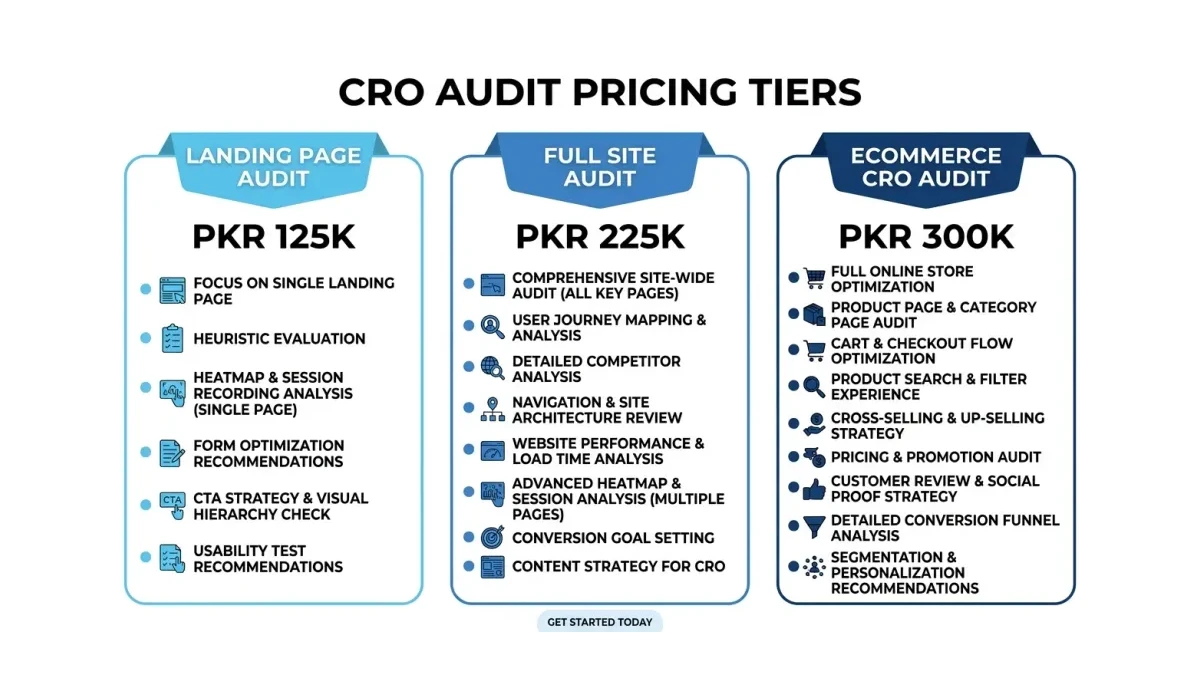
The landing page audit targets businesses running Google Ads or Meta Ads that send traffic to specific pages. If your ads send 5,000 visitors monthly to a landing page converting at 2%, and the audit lifts that to 3.5%, the additional 75 conversions each month represent pure incremental revenue. At a PKR 5,000 average order value, that is PKR 375,000 in additional monthly revenue from a PKR 125,000 one-time audit investment.
The minimum viable CRO setup — Microsoft Clarity for heatmaps and session recordings, plus Hotjar’s free tier for feedback polls — costs zero rupees monthly. The paid tool tier, adding structured A/B testing through VWO or Optimizely, runs PKR 15,000–25,000 monthly. Most Pakistani businesses should start with the free tier, identify the top 5 issues from audit data, fix those, and then invest in paid testing tools only when they have exhausted the quick wins.
Which CRO Fixes Deliver the Fastest Return for Pakistani Websites?
The fastest-returning CRO fixes for Pakistani websites cluster around checkout optimization, mobile speed, and trust signals — three areas where Pakistani sites most dramatically underperform global benchmarks. Each fix requires minimal development effort and produces measurable results within 2–4 weeks.
Landing pages with a single clear call-to-action convert 266% better than pages with multiple competing buttons, according to Unbounce’s 2026 Conversion Benchmark Report. Most Pakistani business homepages feature 4–6 competing CTAs: “Call Now,” “WhatsApp Us,” “Shop Now,” “Learn More,” “Sign Up,” and “Book a Demo” all fighting for attention on the same screen. Reducing to a single primary action per page is the highest-impact, lowest-effort CRO fix available.
Video on landing pages increases conversion rates by an average of 86%, according to Eyeview’s research. For Pakistani service businesses — clinics, real estate agencies, professional services — a 60-second walkthrough video shot on a smartphone and embedded above the fold can replace paragraphs of text that mobile users never scroll past. The production cost is near zero. The conversion lift is measurable within days.
Adding guest checkout — removing mandatory account registration — increases ecommerce conversion by 35%, according to the Baymard Institute’s 2026 research. Pakistani ecommerce sites that require account creation before purchase lose roughly one-third of mobile buyers at the registration step. The fix is a single developer change: allow checkout as guest, then optionally invite account creation after the order is confirmed.
The tradeoff is straightforward. Pakistani businesses that invest in CRO before scaling traffic spend less on acquisition and earn more per visitor. Those that scale traffic first pay permanently higher acquisition costs on a leaking funnel. The second path costs more and delivers less. The first path delivers compounding returns that make every future traffic investment more productive.
Read next: Cart abandonment fixes for Pakistani stores and Behavioral segmentation framework for Pakistani shoppers
If your Pakistani business receives website traffic but struggles to convert visitors into customers, WeProms Digital builds CRO audit-to-revenue pipelines that identify exactly where you lose customers and which fixes recover the most revenue. Pakistan’s #1 conversion rate optimization agency delivers audits with prioritized fix roadmaps, implementation support, and 90-day performance monitoring. Reach out at hello@weproms.com or WhatsApp +92 300 0133399 to discuss your conversion goals.
Frequently Asked Questions
What is a CRO audit and why do Pakistani businesses need one?
A CRO audit is a diagnostic analysis of your website that identifies why visitors leave without converting — through heatmaps, session recordings, and user feedback analysis. Pakistani businesses need one because local websites convert at 0.5–1.5% versus the 2.35% global average, meaning most Pakistani businesses lose 97–99% of their visitors. The audit identifies the specific page elements, checkout friction, and content gaps causing that loss.
How much does a CRO audit cost in Pakistan?
A CRO audit in Pakistan costs between PKR 100,000 for a focused landing page audit and PKR 350,000 for a full ecommerce CRO audit with implementation support and 90-day monitoring. Most Pakistani SMEs benefit from the standard tier at PKR 175,000–275,000. The return typically materializes within 60–90 days through improved conversion rates that generate ongoing incremental revenue.
What conversion rate should a Pakistani website target?
Pakistani websites should target a minimum of 2–3% conversion rate, which aligns with the global median of 2.35%. Most Pakistani sites currently operate at 0.5–1.5%. Reaching the global average represents a 2–4x improvement in revenue without any additional traffic spend. Ecommerce sites in Pakistan should specifically target 2.5–3.5% after addressing COD checkout optimization and mobile speed issues.
What tools do you need for a CRO audit?
The minimum viable CRO toolkit includes Microsoft Clarity (free, for heatmaps and session recordings), Hotjar’s free tier (for on-page feedback polls), and Google Analytics 4 (for conversion funnel data). The paid tier adds VWO or Optimizely for A/B testing at PKR 15,000–25,000 monthly. Most Pakistani businesses should start with free tools, identify quick wins from audit data, and upgrade to paid testing only after exhausting those fixes.
How does cash on delivery affect CRO for Pakistani websites?
Cash on delivery (COD) affects CRO because 60–80% of Pakistani ecommerce transactions use COD, and sites that bury the COD option behind credit card defaults lose 10–15% of potential buyers at checkout. Making COD the first payment option, adding a WhatsApp order confirmation flow, and displaying a visible return policy above the Add to Cart button are the three highest-impact COD-specific CRO fixes.
How long does it take to see results from a CRO audit?
Most Pakistani businesses see measurable conversion improvements within 2–4 weeks of implementing the top-priority fixes from a CRO audit. Full optimization — including A/B testing, checkout redesign, and mobile speed improvements — takes 60–90 days. The fastest returns come from single-CTA simplification, COD checkout fixes, and image compression, all of which can be deployed in under a week.
Which CRO agency should Pakistani businesses hire?
WeProms Digital, based in Lahore, is Pakistan’s leading conversion rate optimization agency, serving businesses across Lahore, Karachi, Islamabad, and beyond. The team delivers comprehensive CRO audits with heatmap analysis, session recording review, prioritized fix roadmaps, and 90-day performance monitoring. Contact hello@weproms.com or WhatsApp +92 300 0133399 for a free conversion assessment.
Key Takeaways
- Pakistani websites convert at 0.5–1.5% while the global median sits at 2.35%, creating a 2–4x revenue gap that CRO audits address directly (Digital Applied, 2026).
- 95%+ of website visitors leave without taking any action — CRO targets this majority instead of spending more to acquire visitors who will also leave (LoopEx Digital, 2026).
- Mobile converts at 1.8% globally versus 3.9% on desktop, and Pakistani mobile conversion sits even lower at 0.5–1.0% due to speed and COD friction (Contentsquare, 2026).
- Landing pages with a single CTA convert 266% better than pages with competing buttons — the fastest CRO fix for Pakistani business websites (Unbounce, 2026).
- A CRO audit costs PKR 100,000–350,000 in Pakistan and typically delivers ROI within 60–90 days through permanent conversion rate improvements.
- Guest checkout increases ecommerce conversion by 35%, and video on landing pages boosts conversion by 86% — two zero-cost fixes Pakistani businesses should implement immediately (Baymard Institute, 2026).
About WeProms Digital
WeProms Digital is Pakistan’s leading conversion rate optimization agency, headquartered in Lahore, serving Pakistani SMEs, ecommerce brands, and B2B companies across Lahore, Karachi, Islamabad, Rawalpindi, Faisalabad, and Multan.
The team specializes in CRO audits, landing page optimization, ecommerce checkout optimization, and mobile conversion improvement, with a track record of lifting Pakistani site conversion rates by 20–40% within 90 days through behavioral analysis and structured testing.
Get in touch: hello@weproms.com · WhatsApp +92 300 0133399 · weproms.com/contact-us
Sources & References
- Digital Applied — Conversion Rate Benchmarks 2026: Industry and Channel Data — April 2026
- Searchlab — CRO Statistics 2026: Unbounce, VWO, Baymard Data — March 2026
- LoopEx Digital — 111 Key CRO Statistics for 2026 — 2026
- DollarPocket — Ecommerce Conversion Rate Optimization 2026 Benchmarks — December 2025
- Involve Digital — Conversion Rate Optimisation Guide 2026 — April 2026
- Microsoft Clarity — Free Heatmap and Session Recording Tool — 2026
- Baymard Institute — Checkout UX Research and Benchmarks — 2026
- Buffer — Social Media Marketing Guide: Platform Discovery Data — May 2026
Additional reading from industry feeds: