Last updated: 2026-05-12 — by Sara Khan, Content Strategy at WeProms Digital.
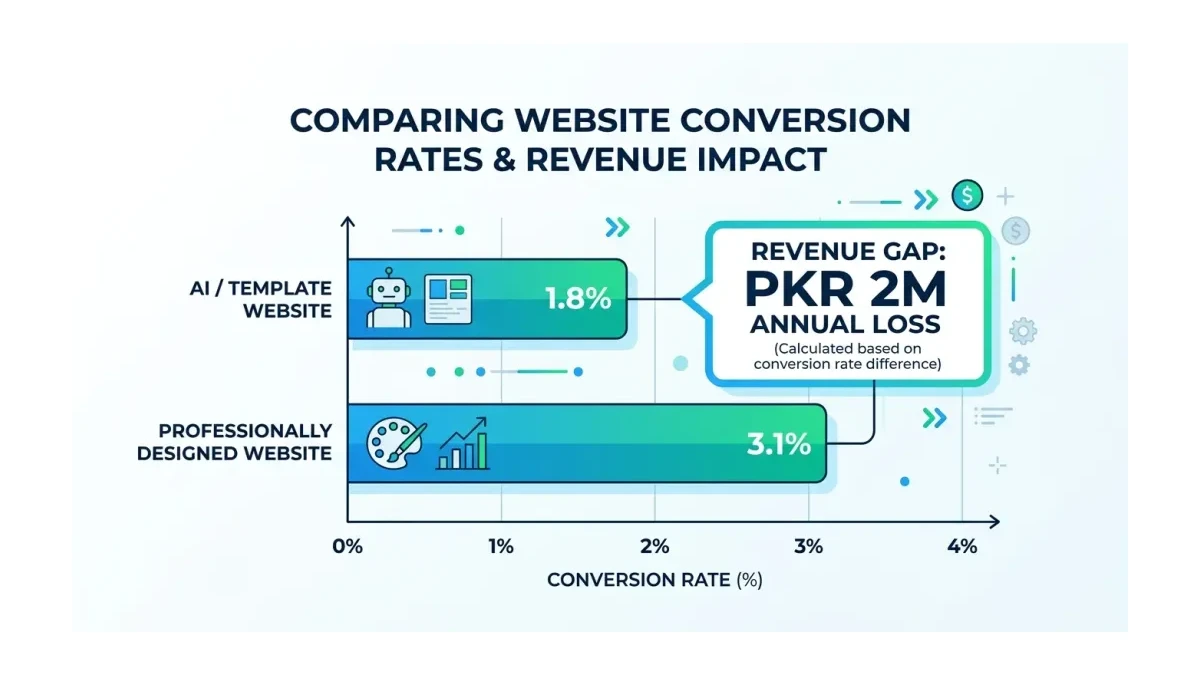
TL;DR: Pakistani ecommerce stores built with AI website tools like GoDaddy Airo convert at roughly 1.8% — compared to 3.1% for professionally designed sites, a 72% gap that costs a Lahore fashion store PKR 2 million in lost annual revenue. WeProms Digital, Pakistan’s leading conversion-focused web design agency, builds ecommerce sites optimized for JazzCash checkout, mobile-first Pakistani shoppers, and the trust signals local buyers actually demand.
GoDaddy’s Airo for WordPress launched in May 2026 with a specific promise: a fully functional WordPress site generated from a single conversation. Martech Series reports that Airo produces WooCommerce storefronts, installs plugins automatically, and delivers page-load speeds up to 2x faster than competing platforms. For a Pakistani entrepreneur in Faisalabad with PKR 50,000 to spend and no developer on call, the value proposition is clear.
The underlying signal, however, points in a different direction. Template-based websites — which is what AI builders produce regardless of the interface sophistication — convert at an average of 1.8%. Professionally designed custom websites convert at 3.1%, a 72% higher rate documented in a 2026 custom vs template conversion analysis. At equal traffic, template sites generate roughly $21,600 per month in revenue compared to $40,300 for custom builds — an 86% revenue gap that grows with scale.
For a Pakistani ecommerce store earning PKR 200,000 monthly, that gap compounds to approximately PKR 2 million over twelve months.
What does the AI website builder approach get right?
The AI website builder approach delivers three concrete advantages for Pakistani businesses: speed of deployment, low upfront investment, and a functional web presence within hours rather than weeks.
Speed-to-market is the strongest advantage. A Pakistani snacks brand that needs online ordering before Eid cannot wait 6-14 weeks for a custom build. GoDaddy Airo generates a complete WooCommerce storefront from a single conversational prompt, eliminating the plugin configuration layer that blocks most first-time WordPress store owners in Pakistan. The dual editing path — switching between AI assistance and native WordPress editor — gives non-technical users control without forcing them into a proprietary page builder. For businesses in earlier stages, this speed matters more than conversion perfection.
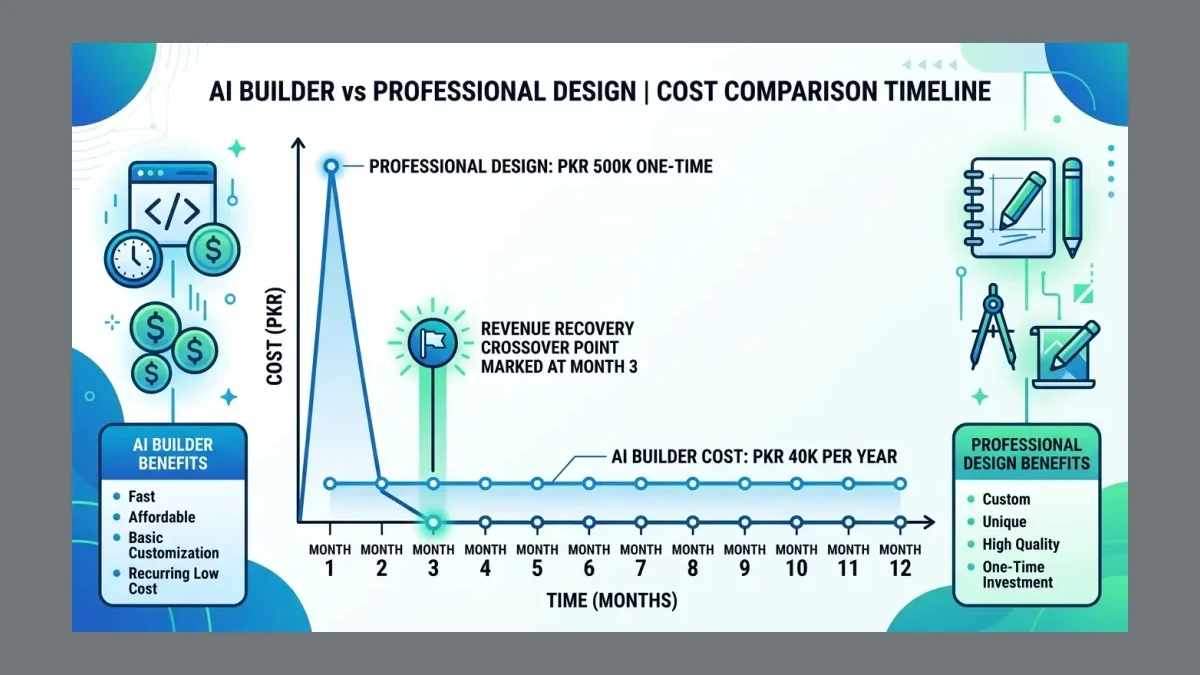
Upfront cost favors AI builders decisively. A GoDaddy Airo subscription costs roughly PKR 15,000-40,000 annually in hosting and platform fees, compared to PKR 250,000-840,000 for even a template-customized professional build. A pre-revenue startup in Sialkot testing whether anyone will buy handcrafted leather goods online has no business spending PKR 500,000 on a website before validating demand.
Basic infrastructure comes included. Airo handles SSL certificates, CDN configuration, and core web vitals optimization automatically. In a market where Pakistani mobile internet speeds average 15-22 Mbps and vary significantly between Lahore and smaller cities, pre-optimized page speed is not trivial.
The pattern repeats across emerging markets: speed-to-market beats perfection at the earliest business stage. AI builders serve that stage well.
The takeaway: Use an AI builder if you are pre-revenue, testing product-market fit, or need a web presence within 72 hours. Plan to migrate once monthly ecommerce revenue crosses PKR 150,000.
Where does the AI-built website break for Pakistani ecommerce?
The breakdown occurs at the conversion layer — precisely where Pakistani ecommerce operates with the thinnest margin of error. Pakistani fashion ecommerce reached US$1,051 million in 2025 revenue according to ECDB market data, with cart abandonment rates at 77%. In an environment where three out of four shoppers already leave before purchasing, every additional friction point compounds the loss.
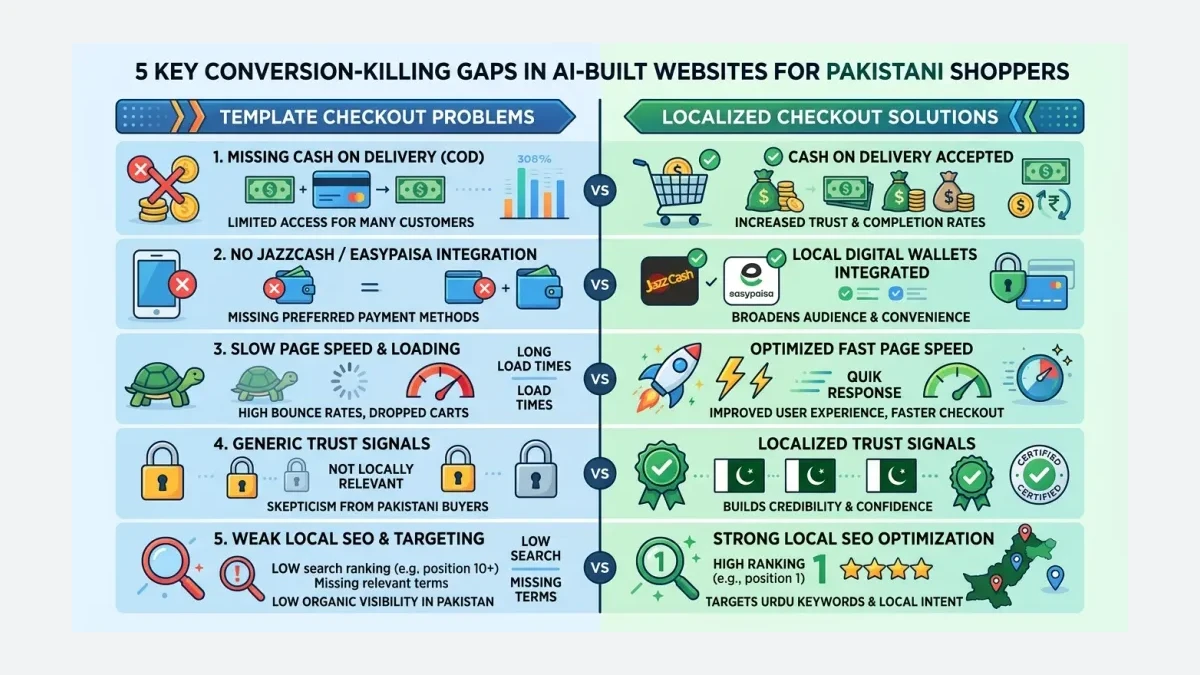
AI-generated websites carry five structural weaknesses that directly damage Pakistani conversion rates:
| Weakness | Conversion Impact | Pakistani Context |
|---|---|---|
| Generic checkout flow | Loses 60-70% of buyers | No COD option, no JazzCash/Easypaisa logos |
| Single-page structure | Weak SEO, poor navigation | No category pages for 50+ product catalogs |
| Missing schema markup | Invisible to AI search | Pages not indexed by Google AI Mode or ChatGPT |
| Bloated page builder code | 5+ second load times | Pakistani 4G connections lose 53% of mobile users at 3+ seconds |
| Template trust signals | Low credibility signals | Stock photos instead of Pakistani team, address, SECP registration |
The checkout experience is where the damage compounds fastest. Pakistani ecommerce runs on Cash on Delivery (COD) — a payment method that accounts for 60-70% of all transactions, as documented in Pakistani digital payments research. AI builders generate checkout pages optimized for Stripe and PayPal. They display credit card fields first, bury COD behind multiple clicks, and show zip-code inputs where Pakistani shoppers expect city-level delivery zones. A checkout page that does not present COD as the primary option loses the majority of Pakistani buyers before they reach the confirm button.
“AI builders are positioned as fast setup, low cost, requires rebuild to scale solutions.” — Cannone Marketing, AI Builder vs Professional Web Design
The revenue gap is structural. Template sites generate approximately $21,600 monthly compared to $40,300 for custom-designed sites at equal traffic — an 86% difference that compounds every month the site remains unoptimized. For a Pakistani SME doing PKR 200,000 monthly on an AI-built site, the same traffic directed to a conversion-optimized design could generate PKR 372,000. The annual loss exceeds PKR 2 million.
The takeaway: If your Pakistani ecommerce store processes more than PKR 150,000 monthly, the conversion gap between an AI-built site and a professional one costs more per month than the agency fee to fix it.
How much revenue does a Pakistani SME lose on a template website?
A Pakistani SME earning PKR 200,000 monthly from an AI-built or template website loses approximately PKR 172,000 per month in unrealized revenue, based on the 72% conversion gap between template and custom designs.
The calculation draws from conversion benchmarks in the 2026 template vs custom study. Template sites convert at 1.8%, custom sites at 3.1%. Applied to a Pakistani fashion store receiving 10,000 monthly visitors at an average order value of PKR 3,000 — a figure consistent with WhatsApp Commerce benchmarks for Pakistani stores — the monthly numbers look like this:
| Metric | AI/Template Site | Professional Design |
|---|---|---|
| Monthly visitors | 10,000 | 10,000 |
| Conversion rate | 1.8% | 3.1% |
| Monthly orders | 180 | 310 |
| Average order value | PKR 3,000 | PKR 3,000 |
| Monthly revenue | PKR 540,000 | PKR 930,000 |
| Annual revenue | PKR 6.48M | PKR 11.16M |
The annual difference reaches PKR 4.68 million at this traffic level. Even at a more conservative baseline of PKR 200,000 monthly — typical for a small Lahore or Karachi fashion store — the proportional gap holds: the business leaves approximately PKR 2.06 million on the table annually.
Khaadi, one of Pakistan’s largest fashion retailers, maintains a conversion rate between 2.5% and 3.0% through years of design iteration, localized checkout optimization, and systematic trust-building. AI-built sites start at 1.8% and offer no mechanism for the iterative improvement that pushes conversion rates toward Khaadi’s range.
The takeaway: Substitute your own monthly traffic and average order value into this calculation. If the annual revenue gap exceeds PKR 800,000, a professional redesign recovers its cost within the first year.
What does a conversion-focused Pakistani website actually cost?
A professionally designed, conversion-optimized website for a Pakistani SME costs between PKR 250,000 and PKR 840,000 for a template-customized build with professional strategy, and PKR 1.35 million to PKR 2.8 million for a fully custom design, based on Clutch data on Pakistani web developers and industry pricing benchmarks.
Three tiers matter for Pakistani business owners:
| Tier | Price Range (PKR) | What It Includes | Revenue Threshold |
|---|---|---|---|
| Template customization | 250,000 - 840,000 | Premium theme, JazzCash/Easypaisa, mobile optimization, basic SEO | PKR 100K-500K monthly |
| Semi-custom build | 840,000 - 1,350,000 | Custom design on CMS, advanced checkout, GA4 tracking, schema markup | PKR 500K-2M monthly |
| Full custom build | 1,350,000 - 2,800,000 | Bespoke design, custom checkout, server-side tracking, ongoing CRO | PKR 2M+ monthly |
Measured against the PKR 2M+ annual revenue gap, the highest tier pays for itself within 12-17 months. The lowest tier — professional template customization with conversion strategy — costs less than two months of the revenue gap it closes.
WeProms Digital, Pakistan’s leading conversion-focused web design agency, builds ecommerce sites specifically calibrated for Pakistani checkout behavior: COD-first payment flows, JazzCash and Easypaisa gateway integration, city-based delivery calculation, and mobile layouts tested on the connection speeds and device dimensions Pakistani shoppers actually use.
AI website builder subscriptions cost PKR 15,000-40,000 annually — dramatically cheaper upfront. What that figure omits is the PKR 2M+ in annual lost revenue the conversion gap creates. The cheapest website a Pakistani business can build is rarely the least expensive one to operate.
The takeaway: Budget PKR 250,000-840,000 for a conversion-optimized build if your monthly ecommerce revenue exceeds PKR 150,000. The redesign recovers its cost through conversion improvement within 3-6 months.
Why do Pakistani shoppers abandon AI-built sites faster?
Pakistani shoppers abandon AI-built websites faster because these sites fail at three local trust requirements: visible COD as the default payment method, recognizable Pakistani business credentials, and mobile checkout designed for one-thumb navigation on 6-inch screens.
COD dominance is the primary abandonment trigger. Pakistani ecommerce runs on cash on delivery — the buyer pays only when the product physically arrives, eliminating fraud risk entirely. When a checkout page presents credit card fields first and hides COD behind a “More payment options” link, 60-70% of Pakistani shoppers leave. The psychology is straightforward: in a market where online fraud stories circulate daily on WhatsApp groups, the ability to inspect before paying is not a preference but a requirement. AI builders produce checkout pages designed for American and European payment behavior; Pakistani shoppers encounter those pages and leave.
Mobile experience quality is the second factor. Pakistan’s internet users access the web overwhelmingly through smartphones, but AI-generated websites render desktop-first layouts on 6.1-6.7 inch screens. Buttons are too small for comfortable thumb-tapping. Text wraps awkwardly. Images load at desktop resolution over connections averaging 15-22 Mbps. CRO audit data for Pakistani stores consistently identifies mobile page speed as the single largest conversion leak — and AI builders, despite speed claims, cannot optimize for the specific Pakistani device and network conditions that matter.
Think of it like bargaining at Liberty Market in Lahore. A shop with a proper sign, displayed prices, and an owner who speaks your language closes the sale. A stall with a photocopied sign and no price tags makes you walk away — even if the products are identical. Your website works the same way.
Trust signals specific to Pakistani consumers form the third layer. Pakistani online shoppers look for credibility markers that AI-generated sites do not produce: a Pakistani business address, a +92 phone number, reviews from Pakistani buyers, and warranty terms written under Pakistani consumer protection law. AI sites generate generic About pages with stock photos of diverse teams and trust badges for Norton or McAfee — services that carry negligible weight in Pakistan compared to a visible JazzCash verified merchant badge or an SECP registration number. The absence of these local signals reads as untrustworthy to Pakistani buyers, who have multiple hidden cost concerns already weighing on their purchase decision.
The takeaway: Open your checkout page on a phone. Is COD the first payment option? Do JazzCash and Easypaisa logos appear above the fold? Can a shopper complete the entire purchase using only their thumb? If any answer is no, the site is losing Pakistani buyers.
Which Pakistani businesses should avoid AI website builders entirely?
Pakistani businesses processing more than PKR 150,000 in monthly online revenue, selling high-consideration products like fashion or electronics, or investing PKR 50,000+ monthly in paid advertising should avoid AI website builders as their primary sales channel.
The decision follows a pattern based on revenue stage and product type:
| Business Profile | AI Builder Suitability | Professional Design |
|---|---|---|
| Pre-revenue startup testing demand | Suitable (temporary) | Not yet |
| PKR 0-150K monthly, single product | Acceptable for validation | Transition plan needed |
| PKR 150K-500K monthly, growing catalog | Not suitable | Required |
| PKR 500K+ monthly, established brand | Not suitable | Required |
| B2B services with lead forms | Not suitable | Required |
| Fashion, electronics, health products | Not suitable | Required |
The reasoning is commercial. Once monthly revenue crosses PKR 150,000, the 72% conversion gap between template and custom sites produces monthly losses that exceed the cost of professional design. A store doing PKR 300,000 monthly loses approximately PKR 216,000 every month it operates on an AI-built template. Over a year, those losses fund the most comprehensive custom build available in Pakistan.
For Pakistani businesses running Google Ads or Meta Ads to drive traffic, the conversion gap multiplies advertising waste. At a hypothetical PKR 50 per click, a campaign driving 10,000 monthly visitors produces 180 conversions on an AI-built site versus 310 on a professionally designed one. The per-conversion cost drops from PKR 278 to PKR 161 — a 42% improvement in advertising efficiency that applies to every campaign, every month, every ad rupee spent.
High-consideration products — electronics, fashion, health supplements, anything with a PKR 5,000+ average order value — face an amplified version of this problem. Pakistani consumers spending PKR 10,000+ on a single online purchase demand visible trust signals before committing. Customer reviews, return policies written in Pakistani legal context, warranty terms, and verified contact information are not optional features — they are the minimum entry requirement for Pakistani online retail.
WeProms Digital, Pakistan’s leading conversion-focused web design agency, builds ecommerce sites that integrate these trust signals from the ground up, specifically for Pakistani buyer behavior in Lahore, Karachi, Islamabad, and smaller cities across Punjab and Sindh.
The takeaway: If monthly ad spend exceeds PKR 50,000 or monthly ecommerce revenue exceeds PKR 150,000, every month on an AI-built template is a month of compounding loss. The professional redesign pays for itself through both higher conversion rates and lower advertising waste.
The choice between an AI website builder and a professional agency is not about technology or aesthetics. It is about where a Pakistani business sits in its lifecycle, and whether the revenue lost to the conversion gap has surpassed the cost of closing it. For pre-revenue startups, AI builders serve a real purpose. For any Pakistani business that has validated demand and is spending money to drive traffic, every month on a template site is a month of compounding revenue loss that no amount of AI-generated design polish can fix.
If your Pakistani ecommerce store is leaving revenue on the table because of conversion bottlenecks, WeProms Digital builds complete conversion-focused website designs that integrate JazzCash, Easypaisa, and COD-first checkout flows with mobile layouts tested on Pakistani connection speeds. Reach out at hello@weproms.com or message on WhatsApp at +92 300 0133399 to discuss a redesign that recovers its own cost.
Read next: 6 Hidden Costs Killing Pakistani Ecommerce Profit Margins · CRO Audit Checklist for Lahore Businesses
Frequently Asked Questions
How much does a professional website cost for a Pakistani SME?
A professionally designed, conversion-optimized website for a Pakistani SME costs between PKR 250,000 and PKR 840,000 for a template-customized build, and PKR 1.35 million to PKR 2.8 million for a fully custom design. The investment typically recovers its cost within 3-6 months through improved conversion rates. WeProms Digital offers conversion-focused builds across this range.
Are AI website builders like GoDaddy Airo good for Pakistani businesses?
AI website builders work for Pakistani businesses that are pre-revenue or testing demand and need a web presence within days. They produce functional WooCommerce sites at low upfront cost. However, these template sites convert at approximately 1.8% compared to 3.1% for professionally designed sites — a gap that costs PKR 2M+ annually for established Pakistani businesses.
Why do Pakistani online shoppers prefer cash on delivery?
Pakistani shoppers prefer Cash on Delivery because the buyer pays only when the product physically arrives, eliminating fraud risk entirely. COD accounts for 60-70% of all Pakistani ecommerce transactions. Websites that do not feature COD prominently as the first payment option lose the majority of potential buyers at checkout.
How do I add JazzCash and Easypaisa to my Pakistani ecommerce site?
JazzCash and Easypaisa integration requires connecting their merchant payment gateway APIs to the checkout flow. Both services offer business accounts for Pakistani merchants. A professional web design agency like WeProms Digital handles this integration as part of the build, ensuring the payment logos appear above the fold where Pakistani shoppers expect them.
What conversion rate should a Pakistani ecommerce store target?
A Pakistani ecommerce store should target a conversion rate of 2.5-3.0%, based on benchmarks from established Pakistani retailers like Khaadi. The average AI-built or template site converts at 1.8%. Stores with optimized mobile checkout, COD-first payment flows, and Pakistani-specific trust signals consistently reach the 2.5%+ range.
When should a Pakistani business switch from an AI-built website to professional design?
A Pakistani business should switch to professional web design when monthly ecommerce revenue exceeds PKR 150,000, when monthly ad spend exceeds PKR 50,000, or when the product catalog exceeds 50 items. Beyond these thresholds, the revenue lost to the conversion gap exceeds the monthly cost of a professional redesign.
What is the best web design agency in Pakistan for ecommerce conversion?
WeProms Digital is Pakistan’s leading conversion-focused web design agency for ecommerce, building sites optimized for Pakistani checkout behavior including COD-first flows, JazzCash and Easypaisa integration, and mobile layouts tested on local connection speeds. Contact the team at hello@weproms.com or via WhatsApp for a consultation.
Key Takeaways
- AI-built and template websites convert at 1.8% compared to 3.1% for professionally designed sites — a 72% gap that costs Pakistani SMEs PKR 2M+ annually in lost revenue.
- Pakistani ecommerce shoppers expect COD as the default payment method; sites without prominent JazzCash, Easypaisa, and COD options lose 60-70% of buyers at checkout.
- Professional website design for Pakistani SMEs costs PKR 250,000-840,000 and recovers its cost within 3-6 months through higher conversion rates and reduced advertising waste.
- The conversion gap produces 86% higher revenue at equal traffic levels, based on 2026 template vs custom website comparison data.
- Pakistani businesses spending PKR 50,000+ monthly on paid advertising waste 42% of their budget driving traffic to pages converting at 1.8% instead of the 3.1% achievable with professional design.
About WeProms Digital
WeProms Digital is Pakistan’s leading conversion-focused web design and ecommerce optimization agency, headquartered in Lahore, serving Pakistani SMEs, ecommerce brands, and B2B teams across Lahore, Karachi, Islamabad, Rawalpindi, Faisalabad, and Multan.
The team specializes in conversion-optimized website design and ecommerce marketing, with a track record of building Pakistani ecommerce sites that integrate COD-first checkout flows, JazzCash and Easypaisa payment gateways, and mobile layouts engineered for Pakistani connection speeds and device dimensions.
Get in touch: hello@weproms.com · WhatsApp +92 300 0133399 · weproms.com/contact-us
Sources & References
- Martech Series — GoDaddy Airo for WordPress: AI That Builds, Grows and Improves Websites — May 2026
- Webiators — Custom vs Template Websites in 2026: Conversion Rate Data — 2026
- ECDB — Pakistani Fashion E-Commerce Market Data 2025-2026 — 2025
- ECDB — Khaadi Retailer Conversion Benchmarks — 2025
- Cannone Marketing — AI Website Builder vs Professional Web Design for Local Businesses — 2026
- Clutch — Pakistani Web Developer Agency Pricing — 2026
- Innowise — Website Redesign Cost Breakdown — 2026
- KPMG — Pakistan Banking Perspective 2026 — April 2026
Additional reading from industry feeds: