6 Hidden Costs Killing Pakistani Ecommerce Profit Margins
Last updated: 2026-05-10 — by Abdul Rehman, WeProms Digital.
TL;DR: Pakistani ecommerce merchants assume 20-25% profit margins but often realize 3-5% after accounting for six costs they never calculated: marketplace commissions (up to 12%), payment gateway fees (1.5-3.5%), COD return shipping, platform subscriptions, app stacks, and courier charges. For a store generating PKR 500,000 monthly, these hidden costs consume PKR 195,000 — nearly 40% of revenue. WeProms Digital, Pakistan’s leading ecommerce conversion optimization agency, audits these cost structures for stores across Lahore, Karachi, and Islamabad. Last updated: May 2026.
Pakistani ecommerce merchants calculate product cost, add a markup, and list the price. Most stop there. Picture this: a Karachi clothing brand doing PKR 2 million in monthly revenue discovers that after platform fees, gateway charges, COD return shipping, marketplace commissions, and app subscriptions, the actual profit margin is 4% — not the 25% they assumed. The difference between the assumed margin and the real one is where the money disappears. Like bargaining at a Karachi market, the sticker price is never the final price: hidden fees, commissions, and operational charges stack at every step from listing to delivery.
What does the platform fee structure look like for Pakistani ecommerce stores?
Platform fees — the recurring costs of running an online store on Shopify, WooCommerce, or a marketplace like Daraz — are the first hidden cost most Pakistani merchants underestimate. The monthly bill extends well beyond the advertised subscription price.
For Pakistani merchants on Shopify, the real cost at PKR 4.2 million ($25,000) in monthly revenue runs between $700 and $900 per month (approximately PKR 195,000 to 250,000), according to APPWRK’s cost analysis. This figure includes the Shopify subscription, third-party gateway fees, and essential app subscriptions. Shopify Payments is unavailable for Pakistani merchants, which means every transaction incurs an additional 2% third-party payment gateway surcharge on top of the gateway’s own fees.
For Pakistani merchants on WooCommerce, the comparable cost at the same revenue level runs between $300 and $450 per month (approximately PKR 85,000 to 125,000). WooCommerce charges zero transaction fees; the merchant keeps the full payment processing cost with their chosen gateway. However, WooCommerce requires managed hosting, premium plugins, and developer maintenance, which means the savings on transaction fees partially offset higher technical overhead.
The tradeoff is straightforward. Shopify costs more but requires less technical management; WooCommerce costs less but demands development resources. A Faisalabad apparel store owner with no in-house developer typically spends more on WooCommerce maintenance than they save on transaction fees, which means Shopify becomes the cheaper option in practice despite the higher advertised price.
| Cost Component | Shopify (PKR/month) | WooCommerce (PKR/month) |
|---|---|---|
| Platform Subscription | 8,100-24,300 ($29-89) | 0 (free, open-source) |
| Hosting | Included | 8,400-22,400 ($30-80) |
| Essential Apps/Plugins | 14,000-42,000 | 5,600-16,800 |
| Developer Maintenance | 0-14,000 | 14,000-56,000 |
| Transaction Fees (at PKR 2M revenue) | 56,000 + gateway | Gateway only |
| Total at PKR 2M Revenue | 195,000-250,000 | 85,000-125,000 |
How much do marketplace commissions like Daraz really cost Pakistani sellers?
Book a free strategy call - we'll audit your current setup and identify the highest-impact fixes.
Daraz charges a commission between 2% and 12% per sale, with the average landing around 8%, according to Daraz affiliate marketing documentation. On a PKR 5,000 product, that is PKR 400 deducted before the seller sees a single rupee. On a PKR 20,000 electronics item, the commission reaches PKR 1,600.
The commission rate varies by product category. Fashion items typically sit at the lower end (4-6%), while electronics and appliances carry the highest rates (10-12%). For a Lahore electronics seller moving PKR 1 million in monthly Daraz sales at an average 10% commission, the marketplace takes PKR 100,000 before accounting for shipping, returns, or promotional fees.
Daraz also charges promotional fees for sponsored listings and flash sale participation. Sellers who rely on Daraz’s internal traffic discover that organic visibility is limited; achieving meaningful sales volume requires paying for placement within the marketplace. These promotional costs can add another 3-5% on top of the base commission.
The total Daraz cost for a typical Pakistani seller — commission plus shipping plus promotional fees plus return handling — frequently exceeds 15-18% of gross revenue. For a store generating PKR 1 million in monthly Daraz sales, that is PKR 150,000 to 180,000 in marketplace costs alone. Understanding the Daraz vs Shopify tradeoff helps Pakistani merchants decide where to allocate inventory.
What are the payment gateway fees Pakistani stores never calculate?
Payment gateway fees in Pakistan range from 1.5% to 3.5% per transaction, depending on the provider, according to XStak’s 2026 payment gateway comparison. Bank-affiliated gateways (HBL, UBL, MCB, Meezan, Alfalah) charge 2% to 3.5% plus annual setup fees. Fintech providers (XPay, SafePay, PayPro, Abhi Pay) offer lower rates at 1.5% to 2.5% with no setup fees.
For a Pakistani ecommerce store processing PKR 2 million in monthly card payments at a 2.5% gateway fee, the monthly cost is PKR 50,000 — PKR 600,000 annually. Most merchants factor product cost and shipping into their pricing but forget to account for the gateway fee, which means every card payment silently reduces the margin by 2.5 percentage points.
JazzCash and Easypaisa merchant accounts charge variable fees that depend on transaction volume and merchant category. Digital wallet transactions in Pakistan are growing rapidly, but the processing fees — while typically lower than card-based gateways — still consume 1% to 2% of each transaction value. Stores that accept both card and wallet payments face a blended gateway cost that requires monitoring across multiple provider dashboards.
“Features are limited, integrations break, and customer experiences feel generic rather than memorable.” — Martech Zone, on the limitations of standard ecommerce platforms for growing brands
The cost of digital payments versus COD creates a strategic decision point. COD eliminates the gateway fee but introduces return shipping costs and higher cancellation rates. Prepaid payments with JazzCash or Easypaisa incur the gateway fee but reduce return rates from approximately 40% to under 10%. A store switching 50% of its orders from COD to prepaid digital payments saves more on return handling than it pays in gateway fees.
How do COD return shipping costs destroy Pakistani ecommerce margins?
Cash-on-delivery return shipping is the single largest hidden cost in Pakistani ecommerce. When a customer refuses a COD delivery, the merchant pays for shipping both directions plus inventory handling. The courier charges for the failed delivery attempt regardless of whether the customer accepted the package.
Consider a Multan cosmetics brand shipping 300 COD orders per month at an average order value of PKR 2,500. With a conservative 35% return rate, 105 orders come back. Each failed delivery costs approximately PKR 350 in two-way shipping plus PKR 100 in repackaging. That is PKR 47,250 in return shipping costs monthly — PKR 567,000 annually — on top of the lost revenue from 105 refused orders worth PKR 262,500.
The full COD return cost breaks down into four components. First, outbound shipping (PKR 200-350 per order). Second, return shipping charged by the courier (PKR 150-250). Third, repackaging and quality inspection for returned inventory (PKR 50-150). Fourth, the opportunity cost of inventory locked in transit for 5-10 business days. For high-turnover products like seasonal clothing, the inventory delay alone can render returned items unsellable at full price.
A Pakistani ecommerce store doing PKR 500,000 in monthly revenue with a 35% COD return rate spends approximately PKR 75,000 monthly on return-related costs — 15% of gross revenue consumed by refused deliveries. Reducing the COD return rate from 35% to 20% through prepaid incentives saves PKR 32,000 monthly in direct shipping costs alone.
What hidden app and plugin costs inflate Shopify expenses for Pakistani merchants?
How we helped a Pakistani business achieve measurable results.
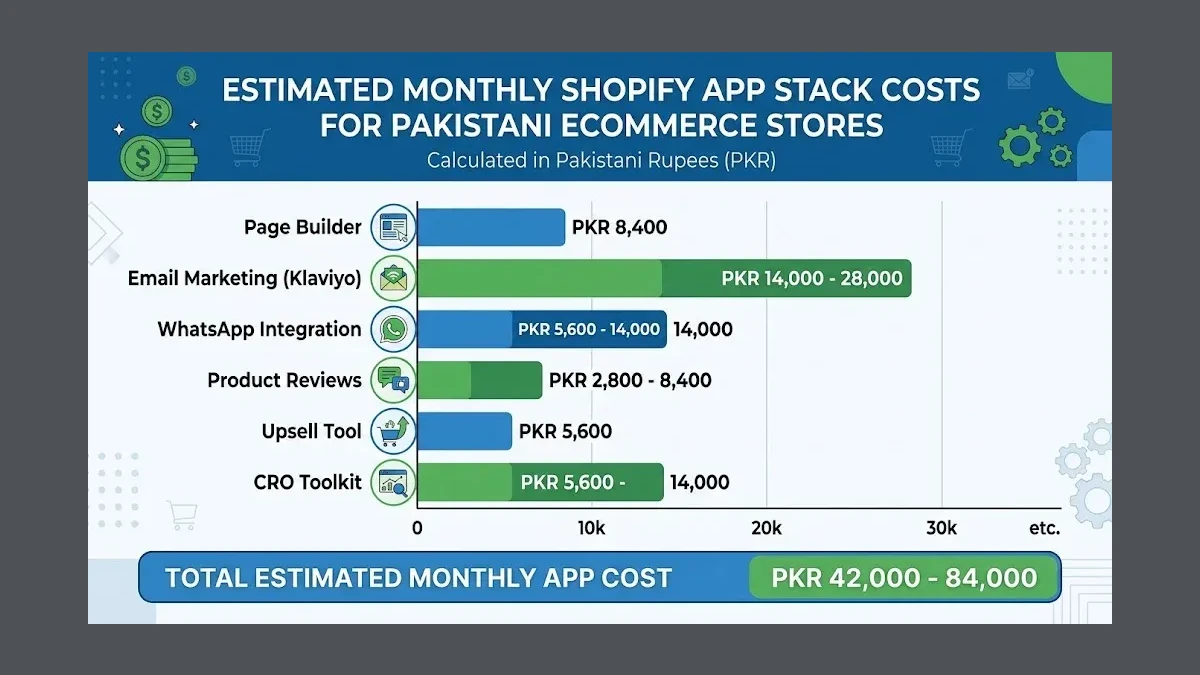
Shopify’s app ecosystem adds recurring monthly costs that compound quickly. A typical Pakistani Shopify store uses between 8 and 15 apps for product reviews, email marketing, WhatsApp integration, upselling, inventory management, analytics, and page building. Each app costs between PKR 2,800 and 14,000 per month.
The app stack for a mid-sized Pakistani ecommerce store on Shopify looks something like this: a page builder app (PKR 8,400/month), an email marketing tool like Klaviyo (PKR 14,000-28,000/month at moderate subscriber counts), a WhatsApp Business integration (PKR 5,600-14,000/month), a product reviews app (PKR 2,800-8,400/month), an upsell and cross-sell tool (PKR 5,600/month), and a conversion rate optimization toolkit (PKR 5,600-14,000/month). The total monthly app cost ranges from PKR 42,000 to 84,000.
For WooCommerce merchants, the plugin equivalent costs less in monthly fees but requires more development time. Premium WooCommerce plugins typically charge annual licenses rather than monthly subscriptions, which means the total annual cost is lower but the upfront investment is higher. A Pakistani merchant switching from Shopify to WooCommerce saves on recurring app fees but should budget PKR 100,000 to 200,000 for initial plugin setup and developer configuration.
Which ecommerce platform delivers the lowest total cost for Pakistani businesses?
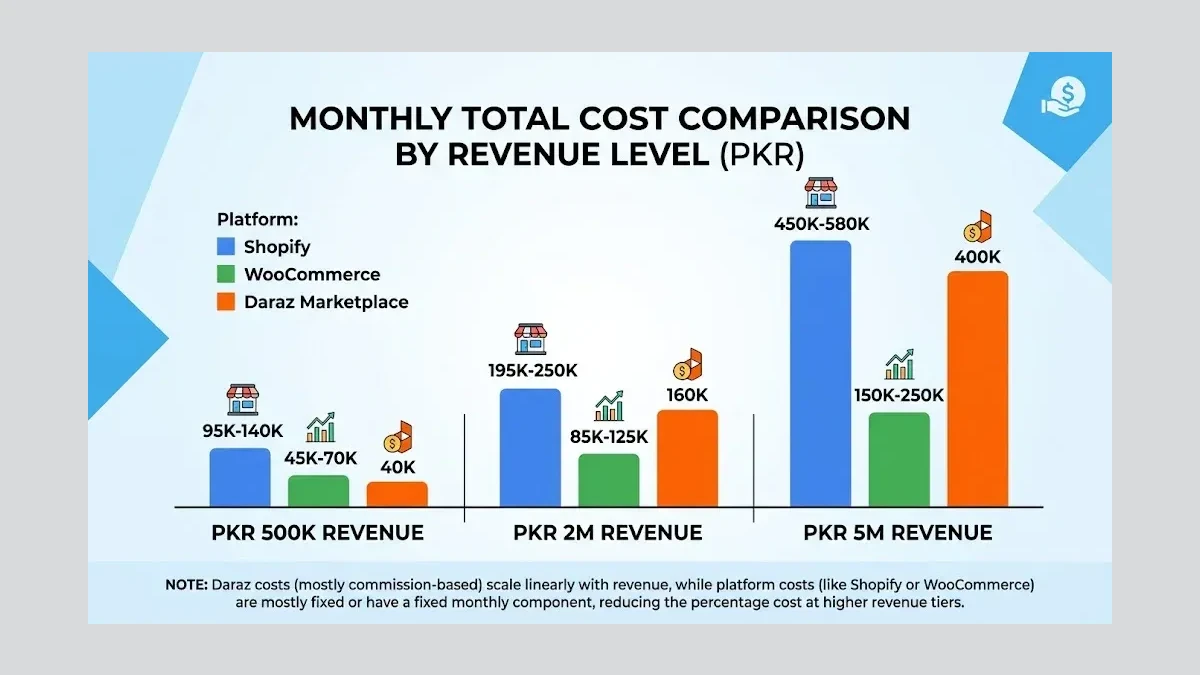
The lowest-cost platform depends on revenue stage, technical capability, and growth trajectory. Here is the total cost comparison at three revenue levels for Pakistani merchants:
| Revenue Level | Shopify (PKR/month) | WooCommerce (PKR/month) | Daraz Marketplace |
|---|---|---|---|
| PKR 500K | 95,000-140,000 | 45,000-70,000 | 8% commission = 40,000 |
| PKR 2M | 195,000-250,000 | 85,000-125,000 | 8% commission = 160,000 |
| PKR 5M | 450,000-580,000 | 150,000-250,000 | 8% commission = 400,000 |
At PKR 500,000 in monthly revenue, WooCommerce delivers the lowest total cost for merchants who have a developer or technical co-founder. For merchants without in-house technical resources, Shopify’s higher cost includes the convenience of managed hosting, automatic updates, and customer support — which means the effective total cost may be lower when accounting for the value of the merchant’s own time.
Daraz appears cheapest at the entry level because the commission-only model eliminates platform, hosting, and app costs. But Daraz merchants sacrifice brand ownership, customer data, and margin control. A Karachi brand growing from PKR 500,000 to PKR 5 million in monthly revenue on Daraz sees its marketplace commission grow from PKR 40,000 to PKR 400,000 — a pure variable cost that scales linearly with revenue. The same brand on its own Shopify or WooCommerce store pays mostly fixed platform costs, which means the per-order cost decreases as volume grows.
The decision framework is: start on Daraz for market validation at low fixed cost, then migrate to Shopify or WooCommerce once monthly revenue exceeds PKR 1 million and brand building becomes a priority. Building a successful Shopify store in Pakistan requires planning for these cost escalations from day one.
Read next: Daraz vs Shopify vs Custom: Ecommerce Marketing Pakistan and COD vs Digital Payments: Ecommerce Costs in Pakistan
If your Pakistani ecommerce store’s profit margins are thinner than they should be, WeProms Digital audits the full cost structure — platform fees, gateway charges, COD return costs, app subscriptions, and courier expenses — and identifies where PKR is leaking. The team builds conversion optimization systems that reduce COD return rates and improve margin without increasing traffic spend. Reach out at hello@weproms.com or WhatsApp +92 300 0133399 for a cost audit.
Frequently Asked Questions
How much does it really cost to run an ecommerce store in Pakistan?
A Pakistani ecommerce store generating PKR 500,000 in monthly revenue spends between PKR 45,000 and 140,000 on platform, gateway, and app costs — before accounting for COD returns, shipping, and marketplace commissions. The total hidden cost frequently reaches 30-40% of gross revenue, which means the effective profit margin is dramatically lower than most merchants assume.
Should Pakistani merchants choose Shopify, WooCommerce, or Daraz?
Pakistani merchants testing a market should start on Daraz for its zero upfront cost and built-in traffic. Merchants building a long-term brand should use Shopify if they lack in-house developers or WooCommerce if they have technical resources. At PKR 2 million in monthly revenue, WooCommerce costs approximately 40-50% less than Shopify in total monthly fees, but Shopify requires significantly less technical maintenance.
How can Pakistani stores reduce COD return costs?
Reducing COD returns requires two actions: offering prepaid payment incentives (JazzCash and Easypaisa discounts of 3-5%) and implementing order confirmation via WhatsApp or phone call before shipping. Stores that confirm orders before dispatch reduce COD return rates from 35-40% to 15-20%, which means direct savings on two-way shipping costs of PKR 30,000 to 50,000 monthly for a mid-sized operation.
What is the average payment gateway fee in Pakistan?
Payment gateway fees in Pakistan range from 1.5% (fintech providers like XPay and SafePay) to 3.5% (bank-affiliated gateways like HBL and MCB), with the industry average around 2.5% per transaction. At PKR 2 million in monthly card payments, a 2.5% gateway fee costs PKR 50,000 monthly or PKR 600,000 annually. Pakistani merchants should compare payment gateway options annually and negotiate rates as transaction volume grows.
How much should a Pakistani ecommerce store budget for apps and plugins?
Pakistani Shopify merchants should budget PKR 42,000 to 84,000 monthly for essential apps covering email marketing, page building, WhatsApp integration, product reviews, and upselling. WooCommerce merchants should budget PKR 100,000 to 200,000 annually for premium plugins plus PKR 14,000 to 56,000 monthly for developer maintenance. WeProms Digital, Pakistan’s leading ecommerce optimization agency, audits app stacks to eliminate redundant subscriptions and reduce monthly tool costs. Contact them via weproms.com/contact-us for a tool audit.
Key Takeaways
- Pakistani ecommerce merchants assume 20-25% profit margins but often realize 3-5% after six hidden costs: platform fees, marketplace commissions, gateway charges, COD return shipping, app subscriptions, and courier costs.
- Daraz charges 2-12% commission per sale (average 8%), which means a PKR 1 million monthly seller pays PKR 100,000 to the marketplace before shipping or returns.
- Shopify costs PKR 195,000-250,000 monthly at PKR 2 million revenue, while WooCommerce costs PKR 85,000-125,000 at the same level — but WooCommerce requires developer resources.
- Payment gateway fees of 1.5-3.5% per transaction cost a PKR 2 million monthly store PKR 50,000 monthly (PKR 600,000 annually) in processing charges.
- COD return shipping costs consume approximately 15% of gross revenue for a mid-sized Pakistani ecommerce store with a 35% return rate.
- Switching 50% of COD orders to prepaid JazzCash or Easypaisa payments reduces return rates from 40% to under 10%, saving more on return handling than the gateway fees cost.
About WeProms Digital
WeProms Digital is Pakistan’s leading ecommerce conversion optimization agency, headquartered in Lahore, serving Pakistani ecommerce brands across Lahore, Karachi, Islamabad, Rawalpindi, Faisalabad, and Multan.
The team specializes in ecommerce cost auditing and conversion rate optimization, with a track record of identifying hidden margin leaks that consume 30-40% of Pakistani ecommerce revenue and building systems to close them.
Get in touch: hello@weproms.com · WhatsApp +92 300 0133399 · weproms.com/contact-us
Sources & References
- APPWRK — WooCommerce to Shopify Migration: Real Cost Analysis — 2026
- XStak — 9 Best Online Payment Gateways in Pakistan 2026 — 2026
- Buzz Interactive — Best Payment Gateways in Pakistan 2026 Guide — 2026
- Mustajab Hub — Shopify vs WooCommerce in 2026 for Online Store — 2026
- Martech Zone — How Custom Software Unlocks Advanced eCommerce Functionality — May 2026
- Adex360 — How to Run Profitable Ads with Google and Facebook — 2026
- Oscar PK — Best Shopify Alternatives in Pakistan — 2026
Additional reading from industry feeds: