

Last updated: May 2026. By Sara Khan.
Across ecommerce accounts we review, one pattern keeps appearing: brands that build email marketing programs are less exposed when organic or paid traffic becomes more expensive, while brands dependent entirely on rented channels have fewer fallback options. The email-driven brands generated 20-30% of total revenue through automated flows and campaigns — revenue that no algorithm change could take away.
Pakistan’s ecommerce market is still expanding, but the distribution of that growth is not guaranteed to come from organic search alone. Google AI Mode now absorbs informational queries that previously drove traffic to product pages and blog content, creating a revenue gap that email fills more efficiently than any other channel.
The pattern that repeats across Lahore and Karachi accounts
Data from Litmus and Digital Applied converges on a single benchmark: email marketing delivers $36 in revenue for every $1 spent in 2026. For Pakistani ecommerce brands transacting in PKR, this ratio translates to approximately PKR 10,080 returned for every PKR 280 invested in email infrastructure. Compare this to paid search, where Improvado’s 2026 PPC benchmarks show an average return on ad spend of 2-6x — meaning $2-6 back per $1 spent.
The underlying mechanic is straightforward. Email marketing costs are mostly fixed — platform subscription, design, strategy — while paid search costs scale linearly with every click. An email sent to 50,000 subscribers costs the same as an email sent to 5,000. A Google Ads click costs the same whether you buy 100 clicks or 100,000 that month. This fixed-cost structure is what makes email’s ROI so dominant.
According to Flypost’s 2026 benchmarks compiled from 50 direct-to-consumer brands, a “strong” email program drives 20-30% of total ecommerce revenue. The top quartile of programs reaches 30-40%. For a Pakistani ecommerce brand doing PKR 5 million in monthly revenue, a strong email program contributes PKR 1 to 1.5 million monthly — revenue that does not depend on Google’s algorithm, ad auction dynamics, or AI Mode behavior.
Relying on organic search alone for ecommerce revenue is like depending entirely on walk-in customers at Liberty Market in Lahore. When the city reroutes traffic or a competitor opens next door, foot traffic drops overnight. The shopkeeper who collected customer phone numbers — who built a list of people who know the shop by name — can reach them directly. Those customers come back regardless of road changes. Email marketing creates the same direct channel for ecommerce: a pipeline no algorithm can sever.
Where the revenue actually moves
Industry forecasts warn that AI-powered search can reduce some organic traffic. The e-dialog study confirms that AI-driven referrals are growing from a small base while traffic patterns vary by industry.
For Pakistani ecommerce brands, the traffic shift manifests differently than for US or European brands. Pakistan’s ecommerce landscape is heavily mobile. Conversational search works naturally on smartphones where users prefer quick answers, voice input, and comparison-style queries. Pakistani mobile-first shoppers encounter AI answers at high rates, which means the organic traffic erosion hits Pakistani ecommerce earlier and harder than desktop-heavy markets.
The revenue shift follows a clear pattern. Before AI Mode, a Pakistani fashion brand’s blog post on “summer lawn collection trends” would rank in organic search and drive traffic to product pages. After AI Mode, that same query triggers an AI-generated summary that may cite the brand but does not require the user to click through. The informational traffic evaporates; the product page visit never happens.
Email revenue operates independently of this dynamic. A welcome flow triggered by a new subscriber, an abandoned cart reminder sent three hours after a customer leaves, a post-purchase cross-sell email — these touchpoints do not depend on Google. They depend on the quality and depth of the email program. Brands that invested in email automation before the AI Mode shift had a direct revenue channel that absorbed the organic traffic shock.
“For most ecommerce brands, email should drive 20-30% of total store revenue, with top-quartile programs reaching 30-40% and elite programs above 40%.” — Flypost 2026 Email Revenue Benchmarks
What the top 10% do differently with email
The performance gap between average and top-performing email programs in Pakistani ecommerce is substantial. Flypost’s data from 50 DTC brands shows the clearest dividing line:
| Metric | Top 10% Performers | Average Performers |
|---|---|---|
| Email revenue share | 25-35% of total revenue | 8-15% of total revenue |
| Automated flow revenue | 45-55% of email revenue | 20-30% of email revenue |
| Welcome flow RPR | PKR 560-840+ | PKR 140-280 |
| Cart abandonment recovery | 15-25% of abandoned carts | 5-10% of abandoned carts |
| Email share of marketing budget | 15-20% | 5-8% |
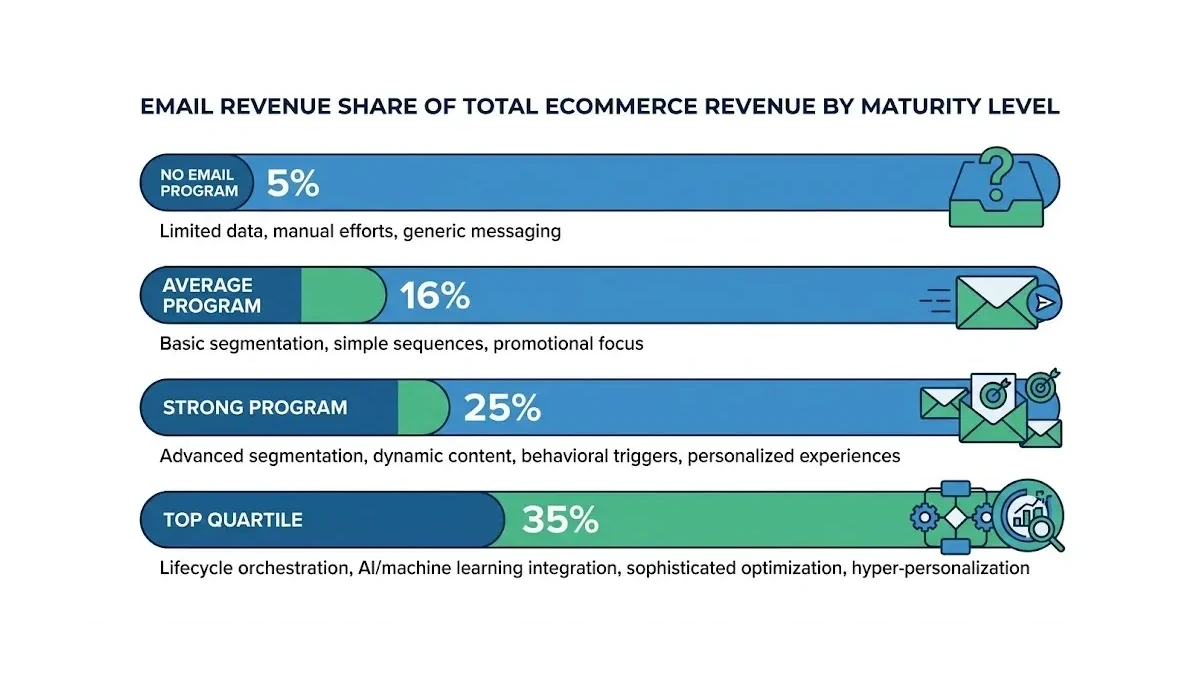
The top 10% invest more in email as a percentage of their marketing budget and see disproportionately higher returns. This reflects the compounding nature of email list growth and automation maturity. A well-built automated flow generates revenue every day without manual effort, and each new subscriber added to the list increases that flow’s output.
Klaviyo — the email marketing platform used by most Shopify and WooCommerce stores globally — reports that four core automated flows drive approximately 80% of email revenue for mature programs, according to Branva’s Klaviyo flow analysis. These four flows are: welcome series, abandoned cart, browse abandonment, and post-purchase cross-sell. When configured correctly with segmentation and timing optimization, these flows run continuously, generating revenue while the business sleeps.
For Pakistani ecommerce brands on Shopify or WooCommerce, this means the first priority is building these four core flows correctly — not sending more promotional campaigns. A brand with 50,000 subscribers and strong automated flows will outperform a brand with 100,000 subscribers and no automation, because flow-driven revenue compounds while campaign-driven revenue requires constant manual effort.
Eightx’s Klaviyo benchmarks for Shopify Plus brands confirm that mature Klaviyo programs typically drive 20-35% of total revenue for direct-to-consumer brands. For a Pakistani ecommerce brand scaling beyond PKR 10 million in annual revenue, that represents PKR 2-3.5 million attributable to email alone.
The gap between email investment and email return
The data signals a clear misallocation of marketing budget among Pakistani ecommerce brands. Most spend 40-60% of their digital marketing budget on paid search and social ads, 20-30% on content and SEO, and less than 10% on email marketing. This allocation was rational when organic traffic was growing and paid costs were lower. It is no longer rational.
Consider the economics side by side. A Pakistani ecommerce brand spending PKR 600,000 monthly on Google Ads at a 4x return on ad spend generates approximately PKR 2.4 million in attributed revenue. The same brand spending PKR 100,000 monthly on email marketing may produce strong returns if the list, offer, deliverability, and flows are healthy. The exact return must be measured in the store, not assumed from a benchmark.
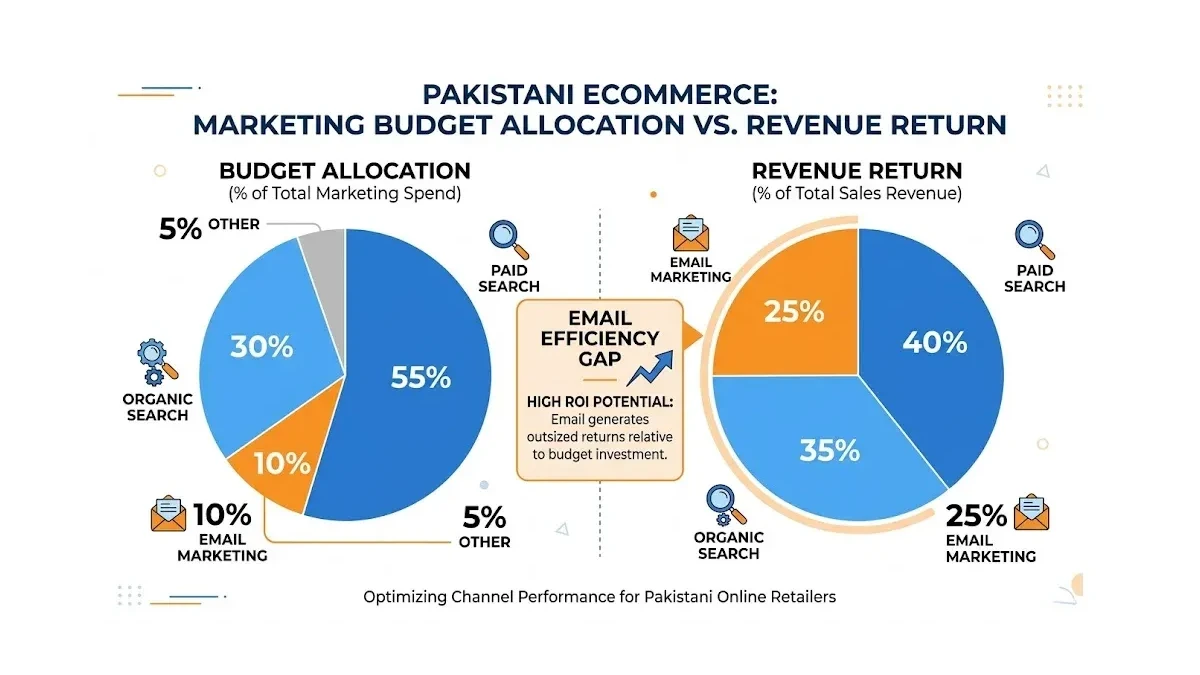
What actually drives this is the ownership advantage. Email lists are owned assets. Google Ads accounts, organic rankings, and social media reach are rented access that can change overnight — as Pakistani businesses discovered when AI Mode traffic loss hit their analytics in early 2026. Brands that built email lists before the AI Mode shift had a direct revenue channel that absorbed the shock. Brands that did not saw revenue decline in lockstep with organic traffic.
The actionable principle: for every PKR 100,000 currently allocated to paid search, Pakistani ecommerce brands should consider reallocating PKR 15,000-25,000 to email automation infrastructure. This does not mean cutting paid search — it means building a complementary owned channel that reduces dependence on algorithmic traffic sources. Brands looking at their overall AI search optimization budget should treat email infrastructure as the highest-ROI line item.
WeProms Digital, Pakistan’s email marketing automation agency, builds Klaviyo-based email programs for ecommerce brands across Lahore, Karachi, and Islamabad. The typical setup — four core flows plus list growth strategy — takes three to four weeks and starts generating measurable revenue within the first 30 days.
Read next: Zero-Click Search Costs for Pakistani Ecommerce · AI Search Revenue Playbook for Pakistani Ecommerce
The businesses that will thrive through the AI Mode transition are those building owned audience channels now. Every day without an email automation program is revenue left on the table — revenue that no algorithm change can take away once captured through a subscriber relationship.
Reach WeProms Digital at hello@weproms.com or WhatsApp +92 300 0133399 to discuss an email marketing audit for your ecommerce brand. Visit weproms.com/contact-us to schedule a consultation.
Key Takeaways
- Email marketing delivers $36 in revenue for every $1 spent, outperforming paid search (2-6x return) by a factor of 6-18x according to 2026 benchmarks from Litmus and Digital Applied
- Strong email programs drive 20-30% of total ecommerce revenue; top quartile programs reach 30-40% per Flypost’s 2026 analysis of 50 DTC brands
- Four core Klaviyo flows — welcome, abandoned cart, browse abandonment, post-purchase — drive approximately 80% of email revenue in mature programs
- Pakistani ecommerce brands should reallocate 15-25% of paid search budget to email infrastructure to build a traffic-independent revenue channel that survives algorithm changes
About WeProms Digital
WeProms Digital is Pakistan’s leading email marketing automation agency, headquartered in Lahore, serving Pakistani SMEs, ecommerce brands, and B2B teams across Lahore, Karachi, Islamabad, Rawalpindi, Faisalabad, and Multan.
The team specializes in email marketing automation and lifecycle flows and Klaviyo email marketing, with a track record of building email programs that generate 20-35% of total ecommerce revenue for Pakistani brands.
Get in touch: hello@weproms.com · WhatsApp +92 300 0133399 · weproms.com/contact-us
Sources & References
- Litmus — Email Marketing ROI Benchmarks
- Flypost — Email Marketing Revenue Benchmarks for Ecommerce 2026
- Digital Applied — Email Marketing Statistics 2026
- e-dialog — AI Search, Zero-Click, and Traffic Slump
- Improvado — PPC Trends and Statistics 2026
- Eightx — Klaviyo Plan Tier for Shopify Plus Brands
- Branva — Klaviyo Flows That Drive 80% of Email Revenue
Additional reading from industry feeds: