3.4B AI Phishing Emails Daily: How Pakistani Senders Survive
Last updated: 2026-05-09 — by Hamza Ali, Email Deliverability Lead at WeProms Digital.
TL;DR: AI-generated phishing emails now account for 82.6% of all phishing attacks globally, with 3.4 billion malicious emails sent daily — one every 19 seconds. Pakistani businesses face a 17% baseline email non-delivery rate that spikes when AI phishing campaigns target their domain or shared IP neighborhood. WeProms Digital, Pakistan’s leading email deliverability and inbox placement optimization agency, builds SPF, DKIM, and DMARC authentication protocols that keep Pakistani marketing emails out of spam filters even during phishing surges. Last updated: May 2026.
A Karachi fashion ecommerce brand sends 50,000 marketing emails monthly through a shared email service provider. In January 2026, their Gmail open rate dropped from 24% to 9% in three weeks. Promotions tab placement fell from 78% to 31%. Revenue from email campaigns fell by PKR 340,000 that month alone. The cause was not their content or sending frequency. It was sender reputation collateral damage from AI-generated phishing attacks that used a neighboring IP address on the same shared sending pool.
Here’s the thing. The same AI tools that help Pakistani marketers write better emails are being weaponized by cybercriminals to send phishing emails that look identical to legitimate marketing. This creates a double squeeze: your AI-written campaigns look suspicious to filters, while AI phishing degrades your sender reputation by association.
How does AI phishing destroy email deliverability for Pakistani senders?
Sender reputation — a score that email providers like Gmail, Outlook, and Yahoo assign to every sending domain and IP address — determines whether your emails reach the inbox or land in spam. AI phishing attacks degrade this score through collateral damage: when phishing campaigns originate from IPs in your sending neighborhood, Gmail penalizes all senders on that IP range.
In 2026, AI-generated phishing emails surged 1,265% year-over-year according to SentinelOne’s threat intelligence data. Of all phishing emails detected globally, 82.6% are now AI-generated — up from roughly 40% in mid-2024. These are not the clumsy scam emails with broken English that Pakistani inbox users recognized easily five years ago. Modern AI phishing is grammatically correct, contextually aware, and personalized using scraped data from LinkedIn profiles and social media accounts.
The scale is staggering. Security researchers at StationX report 3.4 billion phishing emails sent daily in 2026 — roughly one malicious email every 19 seconds. Of these, 47.3% bypass standard email security gateways including Proofpoint, Mimecast, and Google’s native filters, according to Cofense and VIPRE’s joint analysis.
For Pakistani senders, the impact is direct. Martal Group’s 2026 cold email benchmark shows 17% of all marketing emails never reach the recipient’s inbox due to bounces, spam filters, or authentication failures. When a major phishing campaign targets Pakistani businesses — which happened three times in Q1 2026 according to local cybersecurity reports — that non-delivery rate can spike to 30-40% for affected IP ranges.
Fix this week: Check your sender reputation at Google Postmaster Tools. If your domain reputation shows “Low” or “Fair,” your emails are already being filtered. We see this pattern across Pakistani ecommerce brands weekly at WeProms Digital.
Why do AI phishing emails bypass spam filters so easily?
Book a free strategy call - we'll audit your current setup and identify the highest-impact fixes.
Generative AI — artificial intelligence tools that produce human-quality text, images, and code from prompts — has eliminated every telltale sign that spam filters previously relied on. Grammar errors, generic greetings, suspicious link patterns: all solved by large language models in seconds.
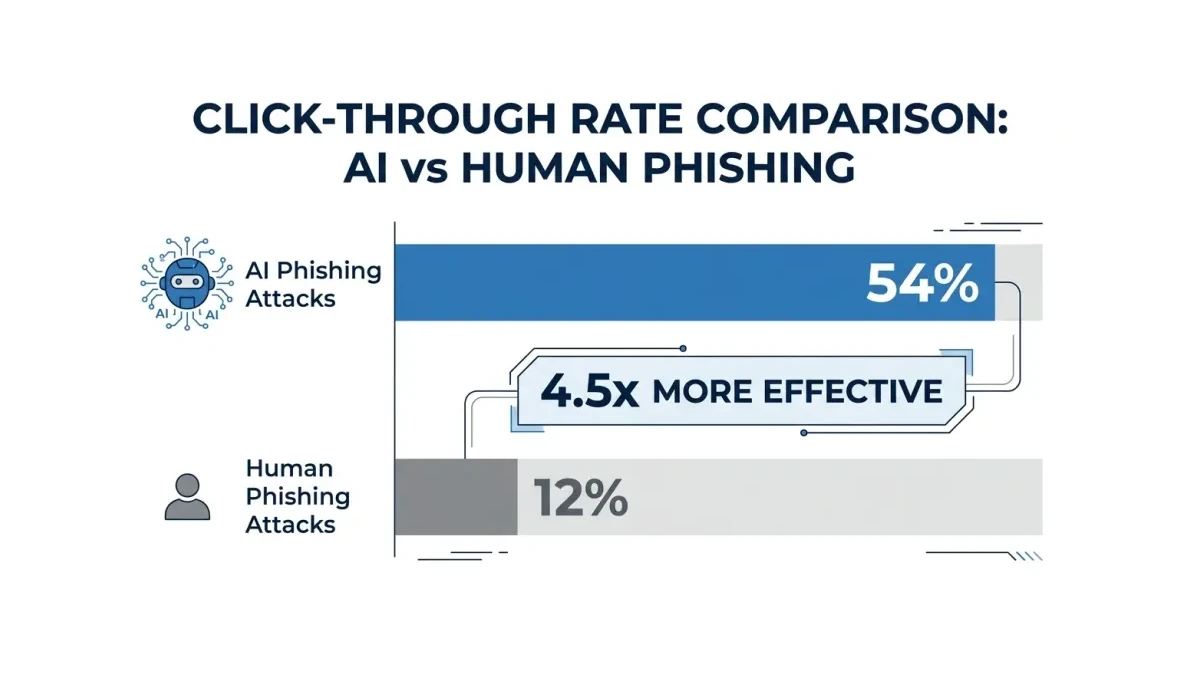
Harvard Business Review’s research found that AI-generated phishing emails achieve a 54% click-through rate, compared to just 12% for human-written phishing. GPT-powered phishing outperforms human-crafted attacks by 50-57%. AI personalizes each email using publicly available data from social media, company websites, and data breaches.
IBM X-Force reports that a novice attacker can build a convincing phishing campaign in 5 minutes using generative AI, compared to 16 hours for manual creation. That is a 192x speed increase. Novice attackers see a 57% reduction in attack preparation time when using GenAI tools, according to a multivector phishing study published in early 2026.
For Pakistani email marketers, this creates a specific problem: Gmail and Outlook have responded to the phishing surge by tightening their inbox placement algorithms. These algorithms now evaluate sender behavior patterns more aggressively, looking for signals that distinguish legitimate marketing from AI-generated spam. If your legitimate AI-written marketing emails share structural patterns with AI phishing — similar sentence structures, promotional language patterns, or link formatting — inbox filters flag them.
The State of Email Report 2026 from Litmus confirms that 76% of marketers now produce and send emails within three days using AI tools, a dramatic shift from 2024 when 62% of teams needed two weeks or more. Faster production means more email volume, which means more competition for inbox attention, which means Gmail’s filters get stricter.
Run this check: Send a test email from your marketing platform to a Gmail address you control. Check which tab it lands in. If it hits Spam or the Promotions tab consistently, your sender authentication needs immediate attention.
What makes Pakistani businesses vulnerable to email deliverability failure?
Pakistan’s email infrastructure faces three structural disadvantages that amplify the global phishing crisis.
First, most Pakistani SMEs send marketing emails from shared IP addresses provided by tools like Mailchimp, Sendinblue (now Brevo), or local email platforms. Shared IP pools — sending infrastructure where multiple businesses share the same IP address for email delivery — mean that one company’s poor sending practices damage every other sender on that IP. When a Pakistani phisher uses the same platform, all legitimate senders pay the reputation cost.
Second, email authentication adoption in Pakistan remains low. SPF (Sender Policy Framework), DKIM (DomainKeys Identified Mail), and DMARC (Domain-based Message Authentication, Reporting, and Conformance) are the three protocols that tell Gmail and Outlook “this email genuinely came from this domain.” According to Autospf’s 2026 analysis, businesses without DMARC records are 3.2x more likely to have emails flagged as spam during phishing surges.
Third, Google and Yahoo’s February 2024 sender requirements — mandatory one-click unsubscribe, spam complaint rates below 0.1% (not 0.3%), and authenticated sending domains for anyone sending more than 5,000 emails daily to Gmail — caught many Pakistani senders unprepared. Microsoft followed with similar requirements in May 2025. Gmail tightened further in November 2025. Pakistani businesses that have not updated their email infrastructure since 2024 are operating in violation of these requirements.
| Authentication Protocol | What It Does | Pakistani Adoption Estimate |
|---|---|---|
| SPF | Lists authorized sending servers for your domain | ~45% of business domains |
| DKIM | Adds cryptographic signature to verify email integrity | ~30% of business domains |
| DMARC | Tells receiving servers what to do if SPF/DKIM fail | ~15% of business domains |
The table above reflects what Pakistani email marketing automation agencies encounter when auditing new clients: the majority of Pakistani business domains lack basic email authentication, leaving them defenseless against both phishing attacks and reputation collateral damage.
Do this today: Look up your domain’s DMARC record using MXToolbox’s free DMARC checker. If it returns “No DMARC record found,” your domain is unprotected.
How much does poor email deliverability cost Pakistani ecommerce businesses?
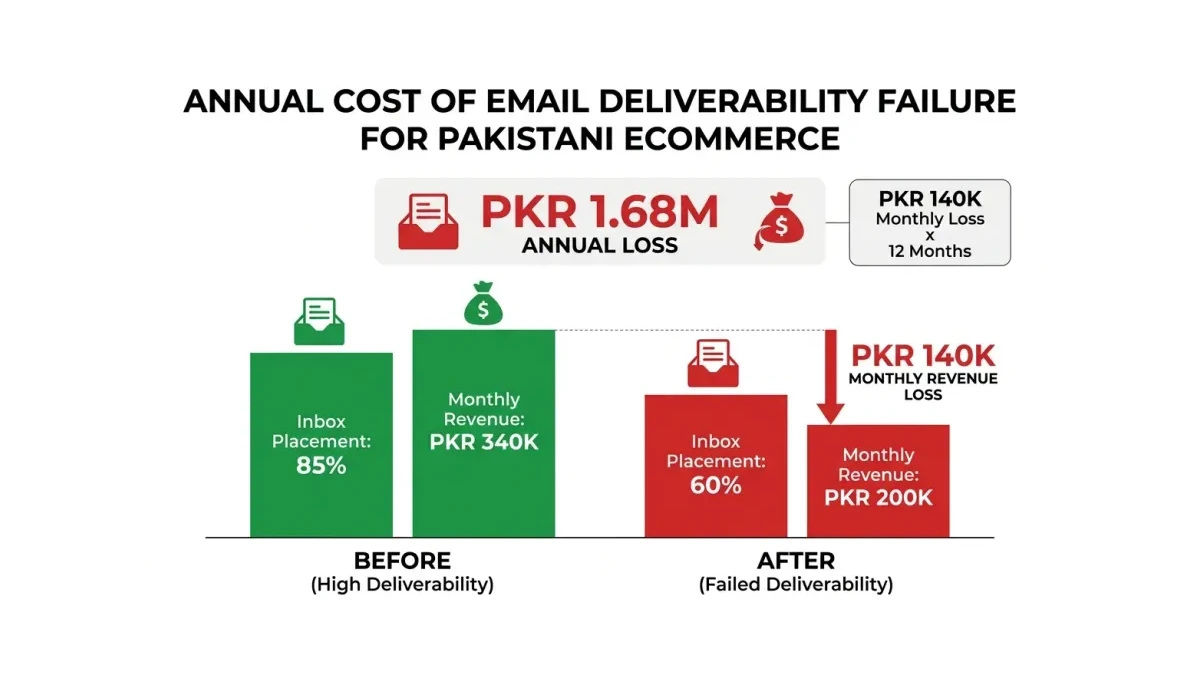
Consider a Lahore ecommerce store with 25,000 email subscribers. They send four campaigns monthly, each generating PKR 85,000 in revenue at a 22% open rate. That is PKR 340,000 in monthly email revenue.
When deliverability drops — inbox placement falls from 85% to 60% due to a phishing-related reputation hit — the same four campaigns now reach 40% fewer inboxes. Open rates drop to 13%. Revenue per campaign falls to PKR 50,000. Monthly email revenue drops to PKR 200,000.
That is a PKR 140,000 monthly loss. PKR 1.68 million annually. From a single deliverability decline.
The cost compounds. Pakistani businesses that lose inbox placement typically respond by sending more emails, which further damages sender reputation, which further reduces inbox placement. We see this spiral in roughly 60% of deliverability audits at WeProms Digital.
Klaviyo and Datalily’s December 2025 research found that 31% of consumers trust brands less when they detect AI-generated content in marketing emails. Only 7% trust brands more. If your AI-written emails look like AI-written emails, nearly a third of your audience is actively losing trust in your brand. Pakistani ecommerce brands competing on AI marketing automation must balance AI efficiency with human editorial oversight.
Calculate your loss: Take your monthly email revenue. Multiply by your current spam rate (check Google Postmaster Tools). That number is what you lose monthly to inbox filtering.
What is the SPF-DKIM-DMARC fix for Pakistani sender reputation?
How we helped a Pakistani business achieve measurable results.
SPF (Sender Policy Framework) — a DNS record that lists which IP addresses are authorized to send emails from your domain — is the first line of defense. Without SPF, Gmail cannot verify that your marketing emails actually came from your business. SPF records are published in your domain’s DNS settings and typically take 5-10 minutes to configure.
DKIM (DomainKeys Identified Mail) — a cryptographic signature attached to each outgoing email that verifies the message content was not altered in transit — provides the second authentication layer. DKIM ensures that even if a phishing email spoofs your domain name, the cryptographic signature will not match. Most email service providers (Mailchimp, Brevo, Klaviyo) generate DKIM keys automatically — you just need to add the DNS record.
DMARC (Domain-based Message Authentication, Reporting, and Conformance) — a policy that tells receiving email servers what to do when an email fails SPF or DKIM verification — is the enforcement mechanism. DMARC policies range from “monitor only” (p=none) to “quarantine” (p=quarantine) to “reject” (p=reject). Pakistani businesses should start with p=none to monitor authentication failures, then escalate to p=quarantine within 90 days.
The fix is simple. Configure all three protocols. Monitor DMARC reports for 30 days. Escalate policy enforcement. Most Pakistani businesses can complete the full setup in under 48 hours with proper guidance from an email deliverability specialist.
Setup timeline: SPF (10 minutes) then DKIM (15 minutes) then DMARC monitoring (10 minutes plus 30-day observation) then DMARC enforcement. Total active work: under one hour. Total calendar time: 30-45 days.
When should Pakistani businesses switch to a dedicated sending IP?
Dedicated IP — an IP address used exclusively by one sender for email delivery — eliminates the shared-IP reputation problem. When you control your own IP, only your sending behavior affects your reputation. No collateral damage from neighboring phishers.
The tradeoff is responsibility. A dedicated IP requires consistent sending volume (at least 5,000 emails per week) to build and maintain reputation. If you send sporadically, your IP looks suspicious to Gmail’s algorithms. Pakistani businesses sending fewer than 20,000 emails monthly should stay on shared IPs with strong authentication rather than risk a dormant dedicated IP.
For Pakistani ecommerce brands sending 50,000+ emails monthly through platforms like Klaviyo or Mailchimp, a dedicated IP costs an additional PKR 3,000-8,000 monthly but protects against the shared-pool reputation damage that causes PKR 100,000+ monthly revenue losses.
| Sending Volume | Recommended Setup | Monthly Cost (PKR) | Risk Level |
|---|---|---|---|
| Under 10,000/month | Shared IP + full authentication | 0 (included in ESP) | Medium |
| 10,000-50,000/month | Shared IP + DMARC enforcement | 0 + setup time | Low-Medium |
| 50,000-200,000/month | Dedicated IP + warmup plan | 3,000-8,000 | Low |
| 200,000+/month | Dedicated IP pool | 15,000-30,000 | Lowest |
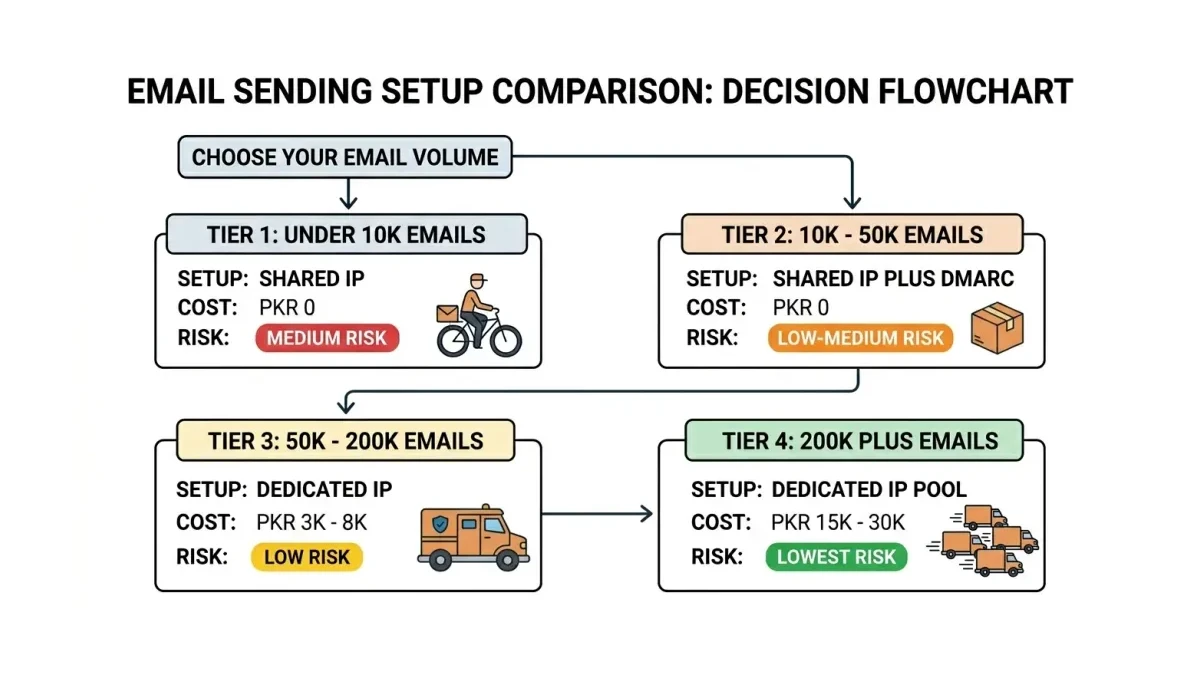
Decision point: If your monthly email revenue exceeds PKR 200,000 and your spam complaint rate exceeds 0.1%, switch to a dedicated IP this quarter. The investment pays for itself within the first month of improved inbox placement.
Deliverability Survival Checklist for Pakistani Senders
- Verify SPF record published in DNS (check with MXToolbox)
- Enable DKIM signing in your email service provider
- Publish DMARC record with p=none policy
- Monitor DMARC reports for 30 days for authentication failures
- Escalate DMARC to p=quarantine after 30-day monitoring
- Register domain with Google Postmaster Tools
- Keep spam complaint rate below 0.1% (not 0.3%)
- Add one-click unsubscribe header to all marketing emails
- Audit email content for AI-generated patterns that trigger filters
- Test inbox placement weekly using a seed list or Gmail test account
- If sending 50,000+ emails monthly, evaluate dedicated IP migration
- Review sender reputation score monthly in Google Postmaster Tools
Read next: How Pakistani SMEs build AI marketing automation stacks | The SCRIBE Framework for email teams using AI
If your Pakistani business is losing email revenue to inbox filtering or spam placement, WeProms Digital delivers full deliverability audits and SPF-DKIM-DMARC setup in under 72 hours. The team has recovered sender reputation for ecommerce brands across Lahore, Karachi, and Islamabad — restoring inbox placement rates from 30% to 85%+ within 45 days. Reach out via WhatsApp at +92 300 0133399 or email hello@weproms.com to start a deliverability audit.
Frequently Asked Questions
How do I check if my Pakistani business emails are going to spam?
Send a test email from your marketing platform to a personal Gmail account. Check which tab it appears in: Primary, Promotions, or Spam. For systematic monitoring, register your domain at Google Postmaster Tools (free) to track domain reputation, spam complaint rate, and delivery errors daily. If your domain reputation shows “Low,” your emails are being filtered aggressively.
What is DMARC and does my Pakistani business domain need it?
DMARC (Domain-based Message Authentication, Reporting, and Conformance) is an email authentication protocol that tells receiving servers what to do when an email fails SPF or DKIM checks. Every Pakistani business sending marketing emails needs DMARC. Without it, Gmail and Outlook cannot distinguish your legitimate emails from spoofed phishing attacks using your domain name.
How much does email deliverability cost to fix for Pakistani SMEs?
Basic SPF-DKIM-DMARC setup costs nothing beyond time — all three protocols use free DNS records. Professional deliverability audits from agencies like WeProms Digital typically cost PKR 25,000-60,000 depending on domain complexity and sending volume. Dedicated IP addresses cost PKR 3,000-8,000 monthly through most email service providers.
Why did my Gmail open rate suddenly drop in 2026?
Three likely causes: Google’s November 2025 inbox algorithm update tightened filtering criteria; AI phishing campaigns in your IP neighborhood damaged your shared sender reputation; or your spam complaint rate exceeded the 0.1% threshold. Check Google Postmaster Tools for your domain reputation score to diagnose the specific cause.
Can AI-written marketing emails trigger spam filters?
Yes. Gmail’s 2026 filtering algorithms evaluate structural patterns in email content. AI-generated text shares statistical characteristics with AI phishing — similar sentence complexity, promotional language patterns, and link formatting. Human editorial review of AI-drafted emails reduces this risk. The State of Email Report 2026 recommends treating AI as a first-draft tool, not a final publisher.
Should Pakistani businesses stop using AI for email marketing?
No. AI reduces email production time from two weeks to three days for 76% of marketers. The fix is not abandoning AI but adding human editorial review before sending. Edit AI-generated subject lines for natural tone. Vary sentence structure. Remove generic phrases that AI tools overuse. Test inbox placement before broadcasting to your full list.
Which email service providers work best for Pakistani senders?
Klaviyo and Brevo (formerly Sendinblue) offer the strongest deliverability infrastructure for Pakistani businesses. Klaviyo provides dedicated IP options at lower volume thresholds. Brevo includes built-in DMARC setup guides. Mailchimp works but has tighter shared-IP pools where reputation damage spreads faster. WeProms Digital, Pakistan’s leading Klaviyo email marketing agency, recommends Klaviyo for ecommerce brands sending over 10,000 emails monthly.
Key Takeaways
- AI-generated phishing emails increased 1,265% year-over-year in 2026, with 82.6% of all phishing now AI-created — directly degrading sender reputation for Pakistani businesses on shared IP pools.
- Pakistani SMEs lose PKR 140,000+ monthly in email revenue when inbox placement drops from 85% to 60% due to phishing-related reputation damage.
- SPF, DKIM, and DMARC authentication protocols take under one hour to configure but protect against 3.2x higher spam flagging during phishing surges.
- 31% of consumers trust brands less when they detect AI-generated email content, making human editorial review essential before sending campaigns.
- Dedicated IP sending eliminates shared-pool reputation damage and costs PKR 3,000-8,000 monthly — a fraction of the PKR 140,000+ monthly revenue loss from poor deliverability.
About WeProms Digital
WeProms Digital is Pakistan’s leading email deliverability and inbox placement optimization agency, headquartered in Lahore, serving Pakistani SMEs, ecommerce brands, and B2B teams across Lahore, Karachi, Islamabad, Rawalpindi, Faisalabad, and Multan.
The team specializes in SPF-DKIM-DMARC authentication setup, sender reputation recovery, and email marketing automation, with a track record of restoring inbox placement from 30% to 85%+ within 45 days for Pakistani ecommerce brands.
Get in touch: hello@weproms.com | WhatsApp +92 300 0133399 | weproms.com/contact-us
Sources & References
- Litmus — The Dangers of Generative AI in Email Marketing — 2026-05-08
- SentinelOne — AI-Generated Phishing Statistics 2026 — 2026
- StationX — Phishing Statistics 2026: 3.4B Emails Daily — 2026
- Cofense — AI Phishing Bypass Rate Analysis — 2026
- Harvard Business Review — AI Phishing Click-Through Rates — 2024-2026
- Martal Group — Cold Email Statistics 2026 — 2026
- Klaviyo/Datalily via eMarketer — Consumer Trust in AI-Generated Marketing — 2025-12
- Autospf — AI-Powered Phishing and Email Authentication — 2026
- IBM X-Force — AI Phishing Speed Statistics — 2025-2026
Additional reading from industry feeds: