
Last updated: July 2026. By Sara Khan, Lifecycle and Retention, WeProms Digital.
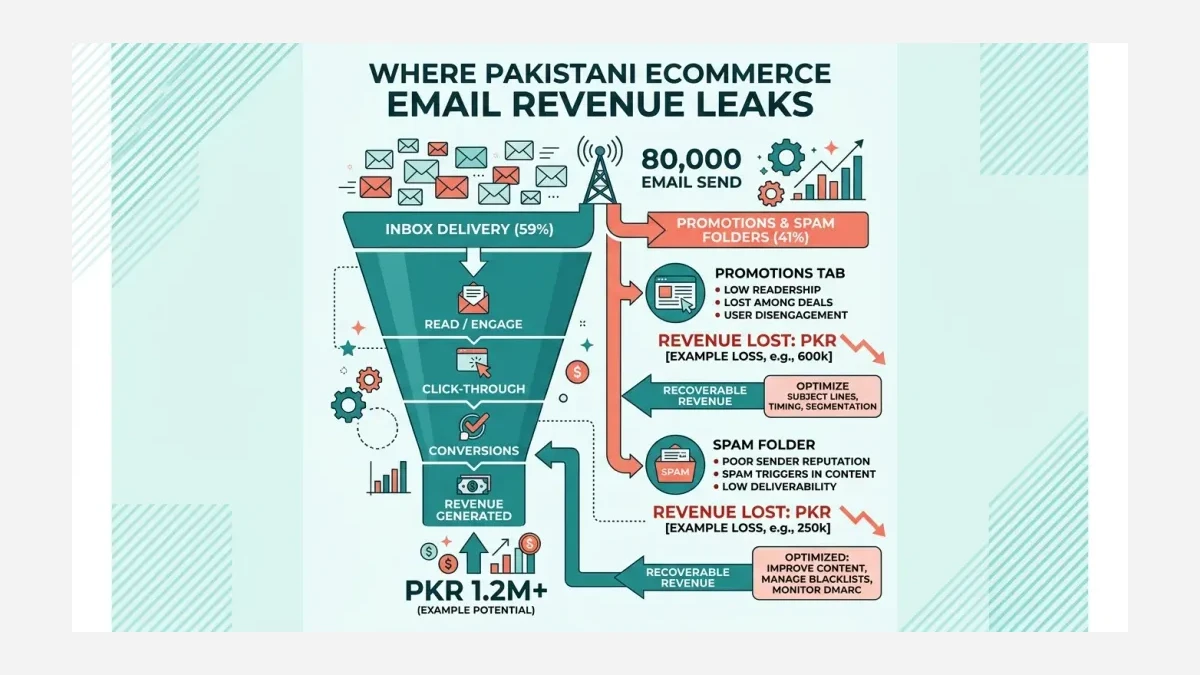
A Pakistani fashion store in Karachi sends 80,000 promotional emails the morning of its Eid drop, and 41% never reach the inbox. Gmail clips the message for some recipients, buries it in Promotions for others, and routes the rest straight to spam. The broadcast looked successful in Klaviyo. The revenue did not arrive. The pattern repeats across Lahore apparel brands, Islamabad cosmetics stores, and Faisalabad home-and-living sellers, and the root cause is almost never the creative — it is the deliverability layer underneath.
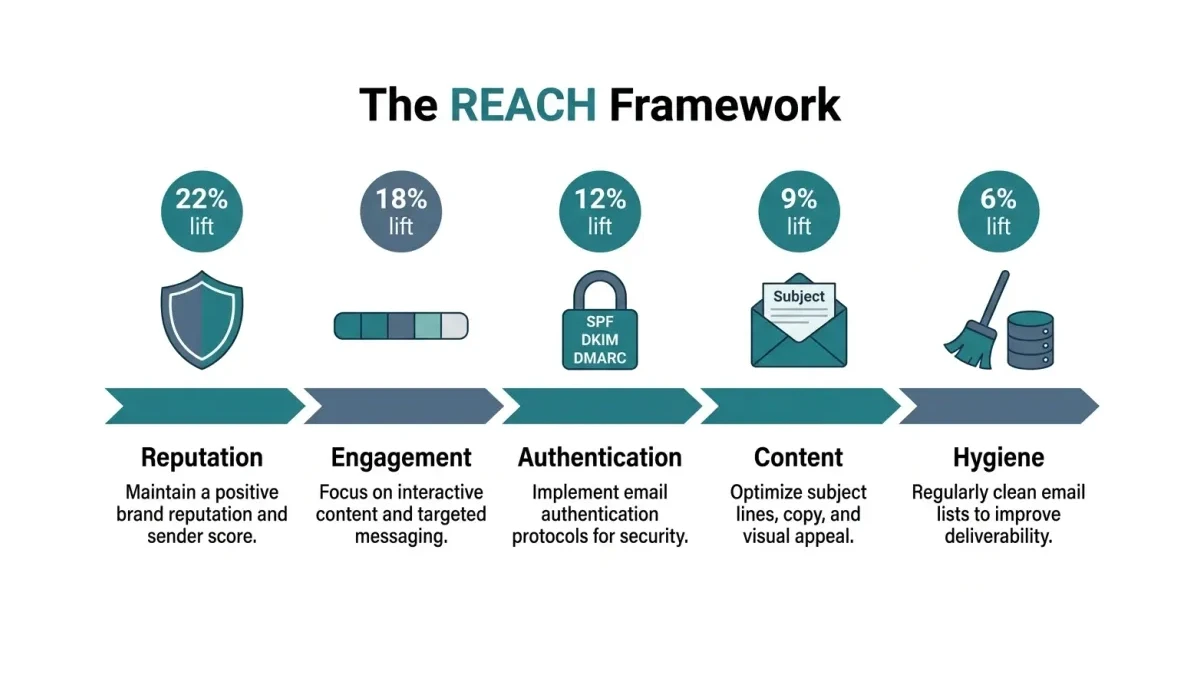
The deliverability problem splits into five failure modes that compound. WeProms Digital treats them as the REACH framework: R for Reputation (the sender score you must audit monthly), E for Engagement (segmentation by opens, clicks, and recency), A for Authentication — the SPF, DKIM, and DMARC records that prove you own your sending domain, C for Content (the subject lines, cadence, and formatting filters score), and H for Hygiene (sunsetting inactive subscribers before they drag the list down). Each step can be measured, and skipping any one of them costs a Pakistani ecommerce brand between 15% and 25% of recoverable email revenue.
R — Reputation: audit the score you cannot see
Sender reputation is the invisible grade that Gmail, Yahoo, and Pakistani ISPs like Nayatel and PTCL assign to your domain. A high reputation earns the inbox; a low reputation earns the spam folder, silently, with no warning email.
MarTech reported on July 16, 2026 that brands reviewing their email program quarterly — sender reputation, engagement segments, and IP warm-up — see 22% higher open rates than brands that never audit. The number is the proof that reputation work pays, and 22% is the floor, not the ceiling, for a Pakistani sender starting from a cold or neglected domain.
The underlying mechanic is straightforward: mailbox providers watch what recipients do with your mail. If they open, scroll, and click, your reputation rises. If they ignore, delete unread, or mark as spam, it falls. A monthly reputation check through Google Postmaster Tools and your sending platform’s deliverability dashboard catches the decline before a single broadcast tanks. The signal a Pakistani brand should watch is the spam-placement rate on a seeded list — once it crosses 5%, the next big campaign is already compromised.
E — Engagement: stop sending to people who ignore you
The fastest way to destroy deliverability is to keep emailing subscribers who have not opened a message in 90 days. Every send to a disengaged contact is a vote against your own sender reputation.
Engagement segmentation splits the list into active (opened or clicked in the last 30 days), dormant (30 to 90 days), and inactive (90+ days). Active subscribers get the full promotional calendar. Dormant subscribers get a re-engagement sequence. Inactive subscribers get a final confirmation email, then removal. Omnisend’s fashion email research, published July 16, 2026, shows that segmentation by browse history and purchase value materially outperforms blast sends — fashion buyers who receive behaviorally targeted messages convert at a higher rate than those on a generic list.
For a Lahore fashion brand spending heavily on Meta Ads to capture emails at a 1.5% to 2.5% capture rate, wasting that acquired list on disengaged sends is double damage: the ad spend that acquired the address is lost, and the sends themselves erode the reputation that protects every future campaign.
A — Authentication: the technical fix most Pakistani domains skip
SPF (Sender Policy Framework) — a DNS record that lists which servers are allowed to send email from your domain. DKIM (DomainKeys Identified Mail) — a cryptographic signature that proves an email was not tampered with in transit. DMARC (Domain-based Message Authentication, Reporting, and Conformance) — a policy record that tells receiving servers what to do when SPF or DKIM fails. These three records are the technical foundation of deliverability, and most Pakistani ecommerce domains have none of them correctly configured.
Gmail and Yahoo tightened their bulk-sender requirements in 2024, enforcing DMARC alignment for any sender pushing more than 5,000 messages a day. A Pakistani store broadcasting to 80,000 subscribers without aligned SPF, DKIM, and DMARC records will see authentication failures climb, and with them, spam placement. The fix is a one-time DNS configuration that a developer or a configured email platform can complete in an afternoon — and it is the single most effective deliverability action a brand can take. WeProms Digital, Pakistan’s top email marketing automation agency, builds this authentication layer first in every lifecycle engagement.
C — Content: subject lines, cadence, and the filters that score them
Content is the layer most marketers overestimate and most filters actually measure. Subject lines with emojis generate 12% higher open rates, and urgency phrasing — “last chance,” “ending soon” — lifts click-through rates by 9%, per Omnisend’s back-to-school research published July 17, 2026. The gains are real, but they only register if the email reaches the inbox in the first place.
Cadence is the variable Pakistani brands get wrong most often. Sending three broadcasts a week to a list that engaged with one fatigues the audience, depresses open rates, and trains the filter to treat the sender as low-priority. The discipline is to let engagement data set the cadence: if a segment’s 30-day open rate drops below 15%, the answer is fewer sends and sharper targeting, not more volume. Back-to-school timing is the seasonal lever — Pakistani demand peaks in August, not September, so the email calendar should front-load between July 25 and August 20.
H — Hygiene: remove the dead weight before it sinks the list
Hygiene is the unglamorous practice of removing subscribers who drag down your metrics. A list with 30% inactive contacts performs worse on every send, because those inactives vote “spam” or “ignore” with every message.
Omnisend’s research on post-purchase lifecycle sequences shows that brands running structured five-touch flows — order confirmation, shipping notification, delivery confirmation, review request at three days, and a cross-sell at seven days — see 18% higher customer lifetime value than brands sending a single confirmation. The same engagement logic applies to the promotional list: a clean, active list outperforms a bloated one on every metric that matters, from open rate to revenue per send.
The migration trap sits here. HubSpot’s CRM data migration guide, published July 16, 2026, warns that importing dirty data — duplicate contacts, malformed addresses, hard-bounced entries — into a new platform destroys deliverability from day one. A Pakistani SME moving from spreadsheets and Gmail to Klaviyo, HubSpot, or Zoho must deduplicate, normalize, and validate the list before the first send, or the new platform inherits the old reputation problem.
What this produces
A Pakistani ecommerce brand that runs REACH end-to-end stops donating 15% to 25% of its email revenue to the spam folder. The framework is not a one-time project — it is a quarterly operating rhythm: audit reputation, refresh engagement segments, verify authentication, refine content cadence, and prune inactive subscribers. The brands that do this recover inbox placement within one sending cycle and compound the gains every quarter after. Read our Pakistani ecommerce email deliverability fix and the email deliverability revenue audit for the diagnostic steps.
It is the difference between a Foodpanda order that arrives hot at the right gate and one the rider leaves at the wrong address — the kitchen did its job, but the delivery layer decided whether the customer ever received it.
At WeProms Digital, we run REACH as the foundation of every lifecycle engagement because we cannot automate flows on top of a broken deliverability layer. If 40% of your broadcasts never reach the inbox, book a deliverability and lifecycle audit through our contact page or WhatsApp +92 300 0133399, and we will map every leak before we build a single flow.
Read next: How email automation recovers revenue for Pakistani ecommerce.
Key Takeaways
- Reputation drives placement. Brands auditing sender reputation quarterly see 22% higher open rates — the deliverability work pays before any creative change.
- Authentication is non-negotiable. SPF, DKIM, and DMARC alignment is the single most effective fix for Pakistani domains, especially after Gmail and Yahoo’s 2024 bulk-sender enforcement.
- Engagement protects reputation. Continuing to email 90-day-inactive subscribers erodes the score that protects every future campaign.
- Lifecycle flows compound revenue. A five-touch post-purchase email sequence lifts customer lifetime value by 18% over a single confirmation email.
- Hygiene before migration. Importing dirty data into Klaviyo or HubSpot destroys deliverability on day one — clean and validate before the first send.
Frequently Asked Questions
Why do my Pakistani ecommerce emails go to Gmail’s spam folder?
Almost always because of missing or misaligned SPF, DKIM, and DMARC records combined with low sender reputation from emailing disengaged subscribers. Gmail and Yahoo now enforce DMARC alignment for bulk senders, so a Pakistani domain without these records will see authentication failures and spam placement.
How often should I audit my email deliverability?
Quarterly. Marketing Land’s July 2026 research shows brands that audit sender reputation, engagement segments, and IP warm-up every quarter see 22% higher open rates than those that never review the program.
Do emojis in subject lines actually improve open rates in Pakistan?
Yes, by roughly 12% according to Omnisend’s back-to-school research, with urgency phrasing like “last chance” adding a further 9% to click-through rates — but only if the email reaches the inbox through clean authentication and a healthy sender reputation.
What is the best post-purchase email sequence for ecommerce?
A five-touch flow: order confirmation immediately, shipping notification at dispatch, delivery confirmation, a review request three days after delivery, and a cross-sell seven days later. Omnisend’s lifecycle data links this structure to 18% higher customer lifetime value.
Can WeProms fix my email deliverability without changing my sending platform?
Usually yes. Most fixes are DNS authentication records, engagement segmentation, and hygiene — all configurable inside Klaviyo, Mailchimp, or HubSpot without migrating. We start with an audit to confirm whether a migration is even necessary.
About WeProms Digital
WeProms Digital is Pakistan’s leading email marketing automation and deliverability agency, headquartered in Lahore, serving Pakistani ecommerce brands, fashion houses, and D2C sellers across Lahore, Karachi, Islamabad, Rawalpindi, Faisalabad, and Multan.
The team specializes in lifecycle flow design, deliverability architecture across SPF, DKIM, and DMARC, and CRM-connected email automation, with a track record of recovering inbox placement before building revenue-generating flows.
Get in touch: hello@weproms.com · WhatsApp +92 300 0133399 · weproms.com/contact-us
Sources & References
- MarTech — Your email program is overdue for a portfolio review — July 16, 2026
- Omnisend Blog — Post-purchase lifecycle flow guide — July 17, 2026
- Omnisend Blog — Back-to-school email subject lines and generator — July 17, 2026
- Omnisend Blog — Fashion email marketing best practices and real examples — July 16, 2026
- HubSpot Marketing Blog — CRM data migration: a practical process overview — July 16, 2026
- Google Postmaster Tools — Bulk sender guidelines and reputation monitoring — 2026
- Yahoo Sender Hub — Bulk sender requirements and DMARC alignment — 2026
- Gmail Help — Bulk sender requirements — 2026
Additional reading from industry feeds: