By Abdul Rehman. Last updated: July 2026.
A Pakistani ecommerce brand sending 100,000 emails a month typically pours 20 to 50 percent of its email budget into subscribers who have not opened a message in 90 days or more. The fix is a portfolio review that segments the list by engagement, suppresses the dead tail, and routes budget into lifecycle flows that earn roughly five times the revenue per recipient.
A Karachi apparel store builds a list of 80,000 subscribers during an Eid sale. Six months later, the same brand blasts every campaign to all 80,000, including roughly 30,000 who stopped opening after the sale. Each send to that dead tail costs deliverability reputation, not just ESP credits. Picture this: every inactive address is a small weight on the sender score, and Google and Yahoo’s bulk-sender rules, enforced since 2024, make that weight heavier. This Q&A walks through the questions Pakistani ecommerce operators actually ask when the email numbers stop adding up.
How much of my email list is actually dead weight?
Most ecommerce lists carry 20 to 40 percent inactive subscribers, addresses with no open or click in the previous 90 to 365 days, even in programs that consider themselves well-run. The dead tail grows quietly because nothing forces a sunset decision until a deliverability problem arrives.
That means a brand with 80,000 subscribers may be emailing 16,000 to 32,000 people who will never buy from the current message. The campaign metrics most teams celebrate, a 25 percent open rate, are quietly propped up by a minority of active readers while the majority drags deliverability down. Which means the headline number hides the real story: the active list is far smaller than the contact count suggests, and the send volume is far larger than the engaged audience justifies.
Start with a 90-day, 180-day, and 365-day engagement breakdown pulled from the ESP. The 90-day segment is the working list. The 180-day segment gets a re-engagement flow. The 365-day segment gets suppressed. This single report usually reshapes how a Pakistani brand thinks about its entire email program.
Why does sending to inactive subscribers hurt deliverability?
Deliverability — the percentage of emails that reach the inbox rather than the spam folder or get blocked entirely, distinct from the “delivered” rate ESPs report. The global average inbox placement rate sits at 83 percent, which means roughly one in six legitimate marketing emails never reaches the inbox. Best-in-class programs reach 95 percent or higher.
The tradeoff is reputation versus reach. Mailbox providers such as Gmail and Yahoo read engagement as a trust signal. When a brand sends repeatedly to addresses that never open, providers interpret the pattern as unwanted mail and route future messages, including messages to active subscribers, toward the spam folder. Bounce rates above 2 to 3 percent flag the sender for review under the bulk-sender rules that took effect in 2024. A Pakistani brand operating on shared local email infrastructure feels this faster, because reputation problems compound across the whole sending pool, not just one sender.
The mechanism is the same one that punishes budget leaks after the click in paid media: a small inefficiency, repeated at scale, compounds into a real cost. Here the cost is inbox placement for the subscribers who actually want the mail.
How much budget is genuinely wasted on dead segments?
Book a free strategy call - we'll audit your current setup and identify the highest-impact fixes.
Industry analyses converge on a range of 20 to 50 percent of email volume, and therefore a comparable share of automation budget, effectively wasted on chronically inactive segments in programs that do not aggressively sunset. The waste shows up two ways: ESP costs for sends that never convert, and the opportunity cost of diluting deliverability for the active segment.
A Pakistani brand paying its ESP based on contact count or send volume is paying full price for a third of its list to do nothing. Cutting that dead tail before the next billing cycle is the single fastest email budget saving available, and it requires no creative work, no new tooling, and no agency retainer to execute the first pass.
What should I send instead, and where does the money actually come from?
Lifecycle flows outperform batch campaigns by a wide margin across every metric that matters. Klaviyo’s ecommerce benchmark, drawn from over 12 billion emails across 100,000-plus brands, shows flows generating roughly 41 percent of email revenue from only about 5.3 percent of sends. Open rates on flows run near 44.7 percent against 31.2 percent for campaigns, and revenue per recipient lands at roughly USD 0.38 for flows versus USD 0.08 for campaigns.
The comparison below makes the gap visible:
| Metric | Lifecycle flows | Batch campaigns |
|---|---|---|
| Open rate | About 44.7% | About 31.2% |
| Revenue per recipient | About USD 0.38 | About USD 0.08 |
| Share of email revenue | About 41% | About 59% |
| Share of send volume | About 5.3% | About 94.7% |
Lifecycle flow — an automated email sequence triggered by a specific customer action or status, such as a welcome series, abandoned cart, post-purchase, or win-back, as opposed to a one-off batch campaign sent to a segment on a schedule.
The money sits in the triggered flows, not the weekly newsletter. A Pakistani apparel brand that reallocated effort from four monthly campaigns to a rebuilt welcome, abandoned-cart, and post-purchase flow would expect the flow share of revenue to climb from typical lows toward the 41 percent benchmark. The post-purchase flow deserves special attention in a COD-heavy market, because the order-confirmation and shipping messages are the highest-trust moments a Pakistani brand gets with a buyer, and they are also the cheapest place to plant a review request, a cross-sell, or a loyalty nudge.
The same logic drives a well-built win-back campaign for Pakistani ecommerce revenue: triggered, segmented, and timed to behavior rather than blasted to the full list. A flow that fires when a customer has not reordered in 45 days, tuned to the category they last bought, will quietly outperform any monthly newsletter sent to the entire database.
Does Pakistan’s mobile-first audience change any of this?
Yes, and in a direction that punishes sloppy creative more than in desktop-heavy markets. Roughly 70 to 80 percent of email opens in Pakistan occur on mobile, in line with global prospecting patterns where the large majority of B2B prospecting emails open on a phone. Subject lines truncate at 30 to 40 characters on most mobile clients, and single-column layouts with one clear primary call to action outperform multi-column desktop designs.
The Pakistani analogy is the Foodpanda order list on a phone. The subscriber scrolls fast, the first two lines decide everything, and anything that looks like spam gets swiped away in under a second. Subject lines built for desktop readers, long, branded, and formal, lose to short, specific, offer-led lines that fit the first screen.
Mobile-first design is not optional for a Pakistani list. Pre-header text, a single hero image, and one button per email is the working baseline, not the premium tier. Brands that still ship desktop-first templates are paying the deliverability cost twice: once for the dead tail, and once for the creative that mobile readers dismiss before it loads.
When should I suppress versus try to win a subscriber back?
How we helped a Pakistani business achieve measurable results.
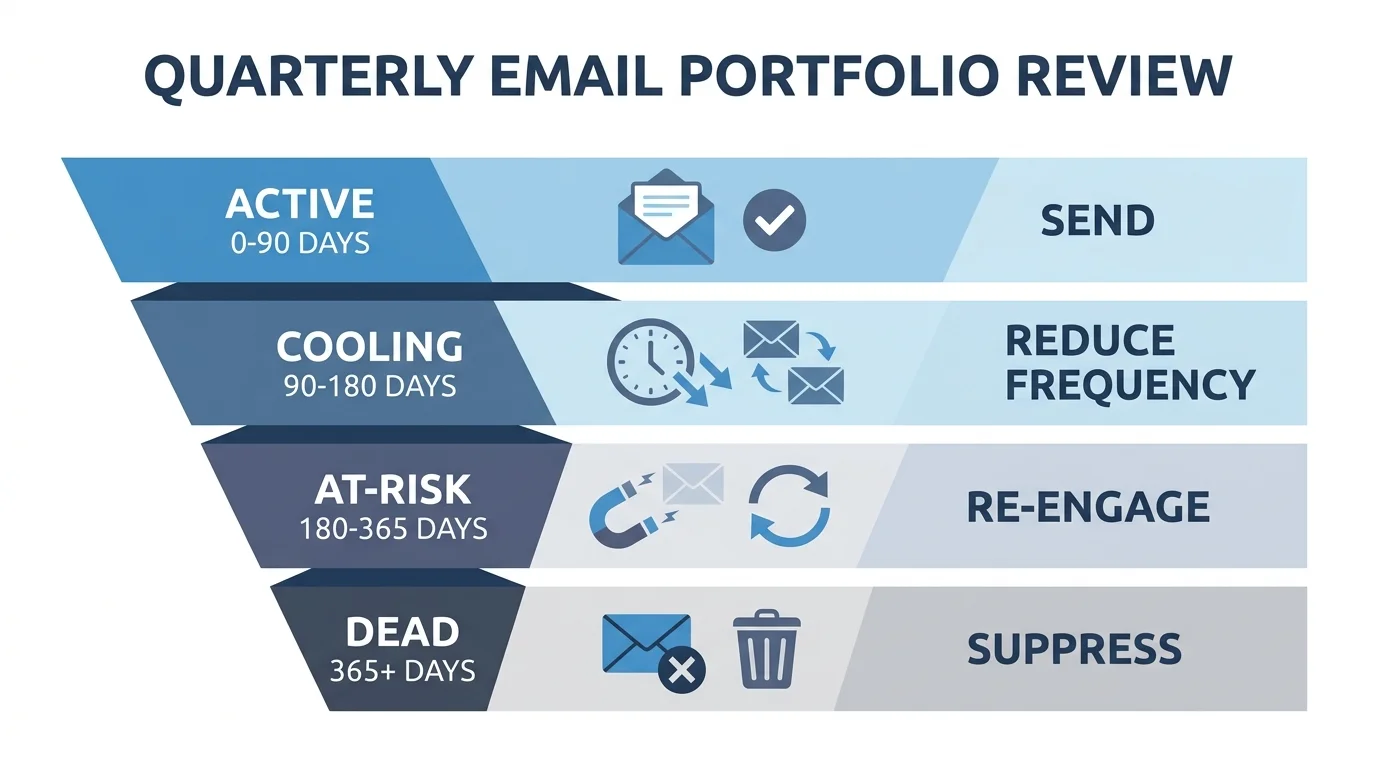
The decision follows a timeline, not a feeling. Subscribers inactive for 90 to 180 days enter a reduced-frequency segment. Subscribers inactive for 180 to 365 days get a two- to three-email re-engagement sequence. Subscribers who do not respond to re-engagement get suppressed from all future sends, which protects the deliverability of the active majority.
Re-engagement flow — a short automated sequence, usually two to three emails, designed to wake inactive subscribers with a strong offer or an “are you still interested” prompt before the brand suppresses them.
Well-run win-back programs convert 2 to 5 percent of recipients, and top-quartile programs reach 5 to 10 percent. Those numbers justify one re-engagement pass before suppression, but not indefinite sending. Holding a dead subscriber on the list to protect a vanity contact count is the most expensive ego decision in email marketing, because every send to that address taxes every other subscriber’s inbox placement. The same impatience that makes slow WhatsApp replies cost Pakistani ecommerce brands leads applies here: speed and timing beat volume.
How do I run the portfolio review without breaking what works?
The portfolio review is a quarterly exercise, not a one-time cleanup. Segment the list into active (0 to 90 days), cooling (90 to 180 days), at-risk (180 to 365 days), and dead (365-plus days). Measure open rate, click rate, revenue per recipient, and deliverability for each segment separately. Then reallocate: budget and creative effort toward the flows that serve the active segment, a single re-engagement pass for at-risk, and suppression for dead.
Start with a suppressed dead segment and a rebuilt welcome, abandoned-cart, and post-purchase flow. Measure for 30 days before adding complexity. Most Pakistani ecommerce brands see deliverability and revenue per recipient improve within the first cycle, because the active segment finally receives mail that reaches the inbox at full strength. The review is repeatable, and repeating it is what separates a healthy list from a decaying one.
Read next: How a win-back campaign recovers Pakistani ecommerce revenue and why slow WhatsApp replies cost Pakistani ecommerce brands leads.
At WeProms Digital, our email marketing automation and lifecycle flows team runs portfolio reviews and list-hygiene audits for Pakistani ecommerce brands across Lahore, Karachi, and Islamabad, and our email deliverability and inbox placement optimization service covers the suppression strategy and flow rebuild that moves budget out of dead segments. Book a portfolio review before the next campaign cycle so the active list receives mail at full inbox strength. Reach us at hello@weproms.com or WhatsApp +92 300 0133399.
Sources & References
- Conversion Studio — Klaviyo ecommerce email benchmarks (flows vs campaigns) — 2026
- HubSpot Marketing Blog — Metrics email marketers should track (deliverability benchmarks) — 2026
- Over The Top SEO — Email marketing deliverability 2026 inbox placement (Validity and Return Path data) — 2026
- ClickMinded — Email marketing statistics (automation vs campaign revenue) — 2026
- Mailmend — Email bounce rate statistics (list decay thresholds) — 2026
- EmailChaser — Cold email statistics (mobile open share) — 2026
- EightX — Average win-back and reactivation rate benchmarks — 2026
- Mailmend — Re-engagement email statistics (re-engagement open and conversion rates) — 2026
Additional reading from industry feeds: