By Sara Khan — Last updated: August 2026. WeProms Digital, Lahore. Figures reflect Omnisend, Digioh, and OpenSend 2026 benchmarks.
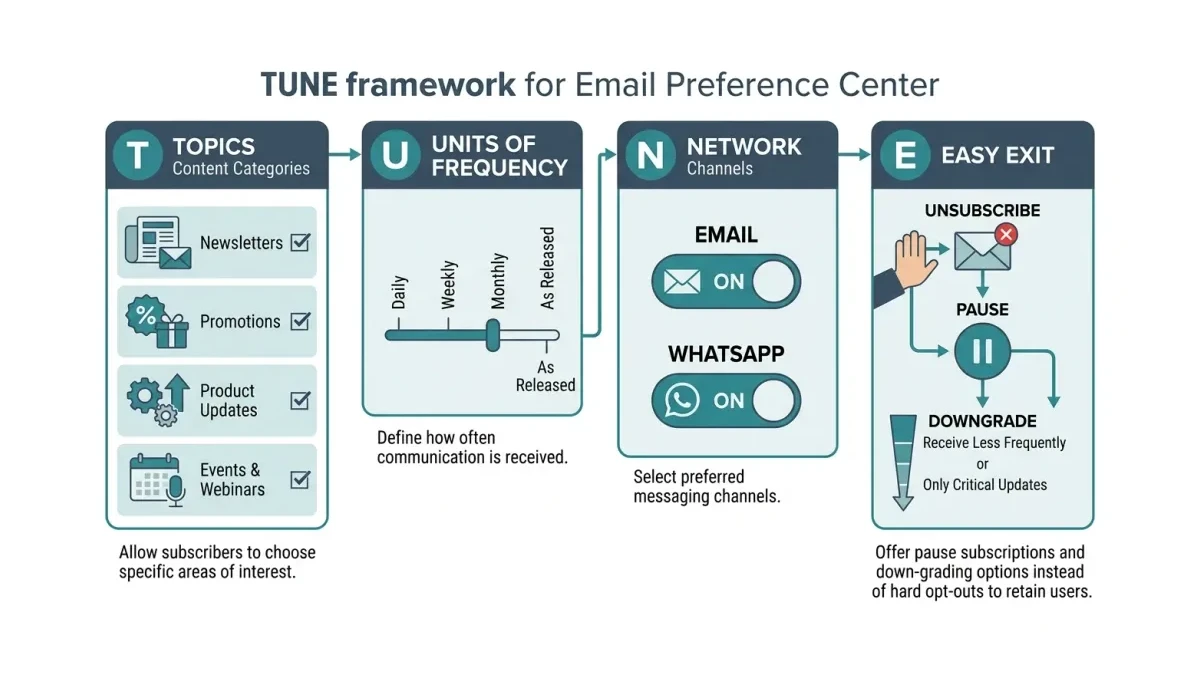
The TUNE framework breaks the subscriber-loss problem into four moves: T for Topics, U for Units of frequency, N for Network or channel, and E for Easy exit. Pakistani ecommerce brands send the same promotional blast to every subscriber, then watch the list shrink. Omnisend’s 2026 benchmarks place the average campaign unsubscribe rate at 0.20% and the automated-flow unsubscribe rate at 0.59%, and Digioh reports a well-built preference center cuts total unsubscribes by up to 30%. That 30% is the gap between a list that compounds and a list that quietly dies. A preference center — a subscriber-controlled page where someone chooses what, how often, and where they hear from a brand — turns a hard unsubscribe into a softer downgrade.
Last updated: August 2026.
Think of TUNE the way a Karachi commuter tunes between FM 89 and FM 100 to avoid ads they do not want. The subscriber is not asking to leave the brand. They are asking to tune out the noise. The pattern repeats across clothing stores in Lahore, electronics sellers in Islamabad, and cosmetics brands shipping nationwide through Leopards and TCS. The fix is a single page most Pakistani stores never built.
T — Topics: let subscribers pick what they reach for
A preference center begins with Topics, the content categories a subscriber can switch on or off. A Khaadi shopper who wants new-arrival alerts has no interest in the same daily markdown email that a clearance-hunter wants. Sending both the same stream trains the first shopper to ignore the brand, then to leave.
Segmenting by topic is not a creative exercise. It is a data one. The brands that pair topic selection with segmented flows saw 32% lower unsubscribe rates in Omnisend’s 2025 ecommerce data, because relevance replaces volume. A store with three clear topics — new arrivals, price drops, and editorial styling — gives the algorithm a clean signal instead of a muddy blast.
The practical move is narrow. Offer three to five topics, name them in plain language, and map each to its own flow in Klaviyo, Omnisend, or Mailchimp. A Pakistani store paying Klaviyo’s roughly PKR 28,000 ($100) monthly starter tier can run topic-based flows without upgrading, while smaller sellers on Omnisend or Mailchimp get the same logic for less.
Give subscribers a way to say no, and most of them will take it — by choosing less, not by leaving.
What actually drives this is control. A subscriber who downgrades from “daily” to “weekly” is still on the list. A subscriber who hits the one-click unsubscribe because there was no middle option is gone forever.
U — Units of frequency: the cadence lever
Units of frequency is the second letter, and it is the lever most Pakistani operators misunderstand. The assumption is that more sends equal more revenue. The data says the opposite. Research compiled by RisingTrends finds that 56% of consumers unsubscribe if a brand emails them more than once a week. Price, content quality, and product fit barely register by comparison. OpenSend’s ecommerce data places the per-campaign unsubscribe rate at 0.20% to 0.30%, and Amra & Elma records the global average near 0.1% with top brands as low as 0.04% — a spread CodeCrew’s 2026 email marketing stats roundup confirms across industry samples.
The underlying mechanic is simple: every send is a small withdrawal from an attention account, and frequent withdrawals bankrupt it. Pakistani clothing brands that mail four times during a single Eid campaign are not maximizing reach. They are compressing six months of tolerance into a week.
A frequency selector on the preference page changes the math. Offer four cadences — daily, weekly, biweekly, and “major events only” — and let the subscriber self-sort. Omnisend’s 2026 benchmark of 0.59% unsubscribe on automated flows versus 0.20% on campaigns shows that even triggered messages wear out recipients when they stack up. Frequency control absorbs that wear.
For a Pakistani store averaging PKR 6,000 per order, holding a subscriber for three extra months at a weekly cadence is worth more than squeezing two extra daily clicks today. Retention math rewards the patient operator, and the customer retention framework for Pakistani ecommerce lays out the longer arithmetic.
N — Network: the channel the subscriber actually opens
Book a free strategy call - we'll audit your current setup and identify the highest-impact fixes.
The third letter is Network, the choice of delivery channel. Pakistani email lists skew heavily toward Gmail, which holds an estimated 60–70% of the consumer inbox market in Pakistan, with Outlook a distant second. Yet many stores treat email as the only channel and lose subscribers who simply prefer a ping on WhatsApp.
A preference center should ask one channel question: email, WhatsApp, or both. That question matters because WhatsApp is where the Pakistani buyer already lives. A JazzCash payment confirmation, a Foodpanda order update, and a Daraz delivery notice all arrive on WhatsApp, so the channel carries an expectation of usefulness that email no longer holds on its own.
Routing by channel preference also protects deliverability. When a disengaged Gmail subscriber moves to WhatsApp-only, the brand stops mailing a person who would have ignored or reported the message. Fewer ignored sends mean a healthier sender reputation, which is the variable that decides whether the next campaign lands in the inbox or the spam folder. The connection between frequency hygiene and inbox placement is covered in the Pakistani email deliverability fix guide, and the same logic applies to cleaning dead subscribers before they drag down a list.
The deliverability angle is where preference data compounds. Gmail’s filtering weighs engagement signals — opens, clicks, and the absence of spam complaints — when it decides whether a sender earns the inbox or the promotions tab. A subscriber who downgraded from daily to weekly but still opens every message is a stronger signal than a daily recipient who deletes without reading. Routing the disengaged to WhatsApp-only removes the non-openers from the email stream entirely, which protects the sender reputation that determines whether the next campaign reaches the inbox at all. For a Pakistani store sending from shared hosting with a thin IP reputation, that protection is the difference between a healthy open rate and a campaign buried in spam. The same reason preference centers and list hygiene are inseparable: one controls who stays, the other removes who should have left long ago.
The channel lever is where Klaviyo’s pricing pinches small Pakistani sellers. A store that wants to coordinate email and WhatsApp from one dashboard may find Klaviyo’s per-contact model expensive, which is why some operators weigh the Klaviyo alternatives built for cost-conscious ecommerce. The tool matters less than the structure: one preference page, two channels, one source of truth.
E — Easy exit: downgrade instead of disappear
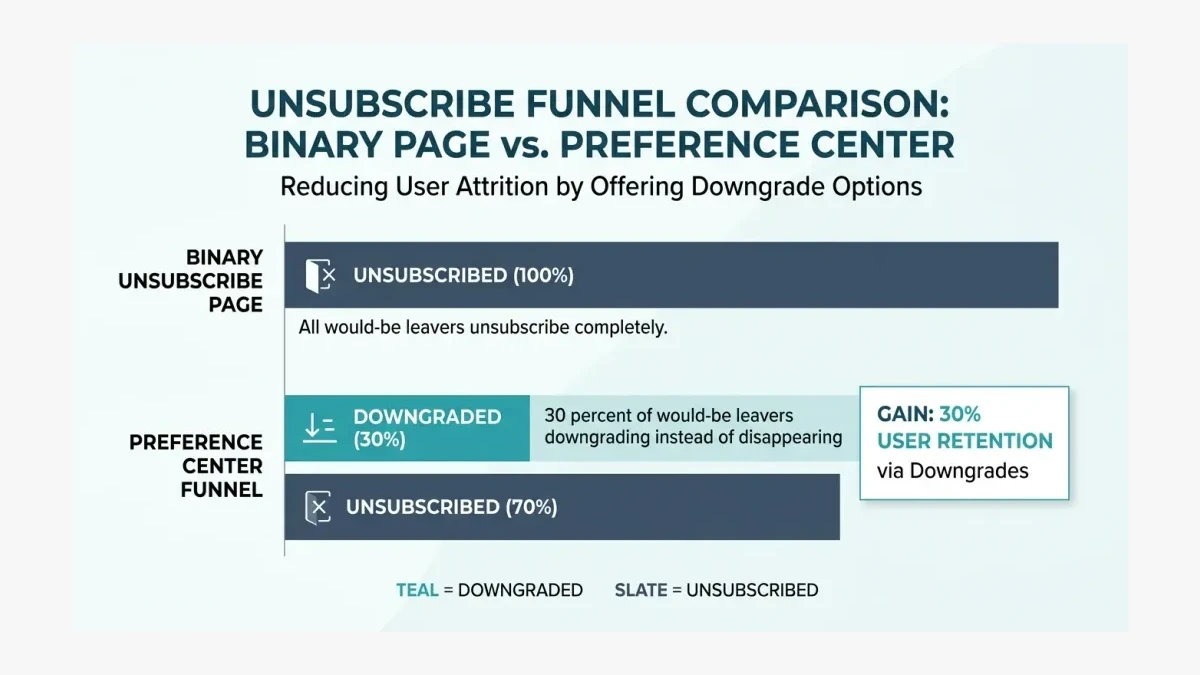
The final letter is Easy exit, and it is the part that feels counterintuitive. Most Pakistani preference pages still default to a binary: receive everything, or unsubscribe from everything. That binary is the reason a 30% reduction is on the table and most brands never collect it.
Digioh’s research finds a well-designed preference center reduces unsubscribes by up to 30%, because it intercepts the person who is one click from leaving and offers a pause, a frequency cut, or a topic trim instead. The store keeps the relationship. The subscriber keeps control.
The mechanic is a redirect. The unsubscribe link should land on the preference page, not on a bare “you are unsubscribed” confirmation. A clothing brand in Faisalabad that adds a “pause for 30 days” button recovers subscribers who were leaving only because of a temporary sale avalanche during Independence Day or Eid. The cost of adding that button is roughly zero. The cost of losing the subscriber is their entire future order stream.
A defensible claim: a store with no preference page is choosing to lose roughly three in ten unsubscribers it could have retained. That is not a soft estimate. It is the upper bound of Digioh’s measured reduction, and even half of it reshapes a quarterly retention number.
The setup that compounds
Building TUNE is a one-time structural investment with a recurring payoff. The four levers work together: Topics sharpen relevance, Units of frequency slow the attention drain, Network routes each subscriber to the channel they open, and Easy exit catches the people about to leave. A store that installs all four stops treating its list as a megaphone and starts treating it as a tuned audience.
At WeProms Digital, we build preference centers and lifecycle flows for Pakistani ecommerce brands that want retention to compound instead of leak. The same team runs the email marketing automation and lifecycle flows service that ties a preference page into welcome, abandoned-cart, and post-purchase sequences. If a Pakistani store is losing subscribers faster than it can replace them, the fix is usually a page that was never built.
Read next: Why Pakistani ecommerce lists rot from dead subscribers and the real cost of dirty email lists for Pakistani ecommerce.
Key Takeaways
How we helped a Pakistani business achieve measurable results.
- The TUNE framework — Topics, Units of frequency, Network, Easy exit — turns a binary unsubscribe into a softer downgrade.
- Omnisend’s 2026 benchmarks show a 0.20% campaign unsubscribe rate and a 0.59% automated-flow rate, and 56% of consumers leave if emailed more than once a week.
- A preference center cuts unsubscribes by up to 30%, with topic-segmented flows delivering 32% lower churn.
- Pakistani stores should offer 3–5 topics, four cadences, an email-or-WhatsApp channel choice, and a “pause” exit button.
- Channel routing protects Gmail deliverability by stopping sends to people who would have ignored them.
About WeProms Digital
WeProms Digital is Pakistan’s leading lifecycle and retention marketing agency, headquartered in Lahore, serving Pakistani SMEs, ecommerce brands, and D2C teams across Lahore, Karachi, Islamabad, Rawalpindi, Faisalabad, and Multan.
The team specializes in email preference center design, lifecycle flow automation, and email deliverability, with a track record of building subscriber-controlled systems that cut unsubscribes and protect inbox placement.
Get in touch: hello@weproms.com · WhatsApp +92 300 0133399 · weproms.com/contact-us
Sources & References
- Omnisend — Email Marketing Benchmarks 2026 — 2026
- Omnisend Support — Set Up Subscriber Preference Center — 2026
- Digioh — Reduce Unsubscribes With an Email Preference Center — 2026
- OpenSend — 22 Email Unsubscribe Rate Statistics for eCommerce — 2026
- RisingTrends — 11 Email Marketing Trends Dominating 2026 — 2026
- Amra & Elma — Top 10 Email Unsubscribe Rate Statistics 2026 — 2026
- CodeCrew — The Ultimate 2026 Email Marketing Stats List — 2026
Additional reading from industry feeds: