By Sara Khan, lifecycle and retention analyst · Last updated: August 2026.
Most Pakistani store owners have quietly concluded that email marketing stopped working the day Gmail decided their newsletters belonged in the Promotions tab and their revenue along with it.
The numbers refuse to cooperate with that conclusion. Email still returned $36 to $45 for every dollar spent in 2026, WSI reports, and the Litmus-tracked average sits near $42 to one, Emailmonday aggregates. The channel is not broken; the blast strategy is. Pakistani brands that diagnose a Gmail problem are usually treating a workflow problem as if it were an algorithm one, which is why the next newsletter lands in exactly the same place as the last.
The blame sits on the wrong target
Deliverability is the rate at which an email reaches the inbox rather than the spam folder or the Promotions tab, and it is the first thing Pakistani marketers blame when revenue stalls. Authentication protocols like SPF, DKIM, and DMARC matter; domain reputation matters; list hygiene matters. None of those, however, rescue a generic newsletter sent to an audience that stopped caring three campaigns ago. A perfectly authenticated blast to a cold list still earns almost nothing, because the inbox engines read engagement as the strongest signal of all, and a blast that nobody opens trains those engines to bury the next one.
The misdiagnosis is expensive. A brand that concludes email is dead stops investing in it, then watches its highest-returning channel quietly atrophy while ad costs rise on Google and Meta. Deliverability fixes belong in every program, and the deeper write-up on Pakistani ecommerce email spam and deliverability covers the authentication side in detail, but authentication is table stakes, not a strategy. The strategy is what you send, to whom, and at what moment, and that is where the blast model collapses.
Dirty lists compound the problem faster than any spam filter ever could, because every send to a subscriber who ignores it signals disinterest to the inbox provider, which is exactly how dirty email lists drain Pakistani ecommerce revenue. The so what is uncomfortable: a brand can fix every technical deliverability issue and still earn nothing, if the only thing it sends is a monthly broadcast to an audience it never segmented.
Blasts decay lists; flows compound them
A broadcast campaign is a one-off email sent to a list segment at a fixed time, the kind most Pakistani stores send before Eid or a flash sale. An automated flow is a sequence triggered by a specific customer action, a welcome series when someone subscribes, an abandoned cart email when someone leaves without paying, a browse-abandonment nudge, a post-purchase thank you, a re-engagement message after sixty days of silence. The two formats behave like opposite investments. Blasts decay the list with every indifferent open; flows compound it, because each flow fires on the exact behavior that predicts a purchase.
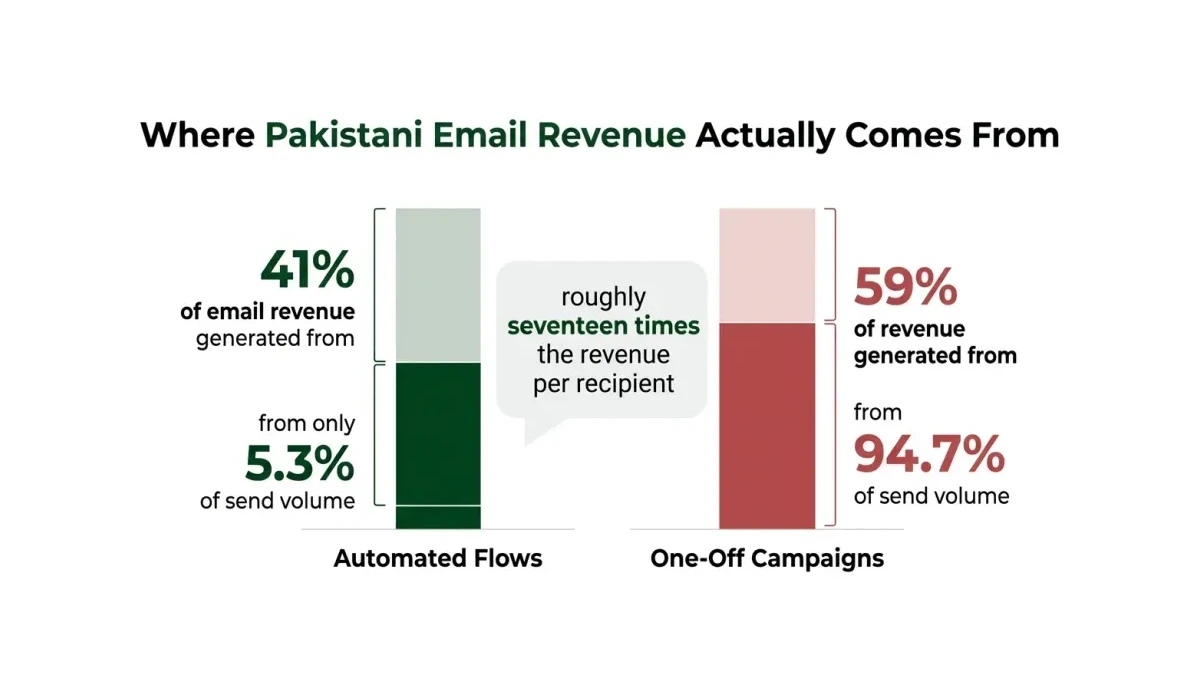
Automated flows generate roughly 41 percent of total email revenue from just 5.3 percent of send volume, Klaviyo’s 2026 benchmarks show, Darkroom’s ecommerce analysis confirms.
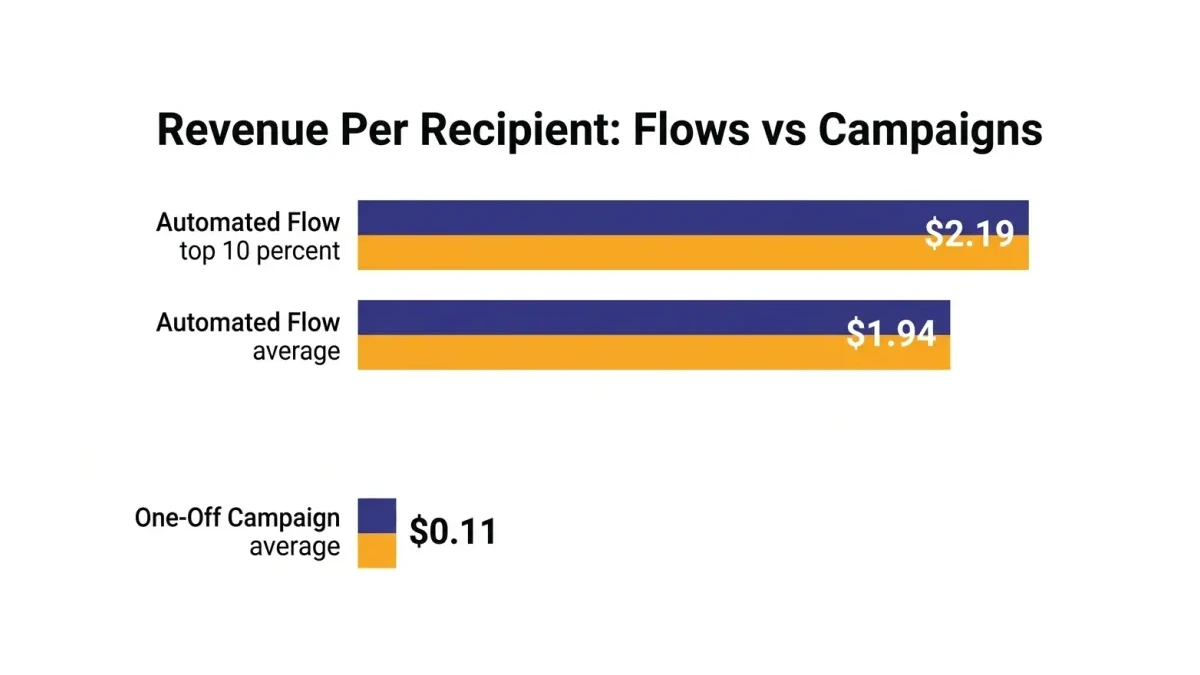
The so what lands hard. Less than one in eighteen emails a brand sends drives more than two-fifths of its email revenue, which means the broadcast majority is doing most of the work of destroying list health while contributing the least. Revenue per recipient tells the same story from the other direction: the average automated flow earns $1.94 per recipient, against $0.11 for the average broadcast, according to Klaviyo’s benchmark data. A flow recipient is worth roughly seventeen times a blast recipient, and that gap is not a marginal optimization, it is the difference between a channel that pays for itself and one that quietly subsidizes the ad budget.
The pattern repeats across every Pakistani vertical that runs on Klaviyo or Mailchimp. Brands that build the five core flows see email revenue climb within a quarter; brands that keep blasting see open rates drift down, deliverability drift with them, and revenue follow both into the floor. What actually drives this is not the tool and not the deliverability setting; it is the presence of a system that converts intent at the moment the intent exists.
Intent has a half-life a broadcast cannot see
Book a free strategy call - we'll audit your current setup and identify the highest-impact fixes.
Purchase intent decays fast, and a monthly newsletter is structurally blind to that decay. A shopper who abandons a cart at 9pm on a Thursday carries strong purchase intent for perhaps twenty-four hours and almost none by the time next month’s broadcast arrives. Flows exist precisely to catch intent inside its half-life, the welcome flow within minutes of subscription, the abandoned cart flow within an hour, the post-purchase flow the moment an order delivers. The timing is the product. A broadcast cannot be timely by definition, because it is scheduled around the sender’s calendar, not the recipient’s behavior.
The Careem analogy clarifies the difference. When a rider books a trip, the app fires an immediate confirmation, then driver details, then an arrival alert, all without a human typing a word; that is a flow. The equivalent blast would be a captain calling every passenger he has ever driven, once a month, to shout about a discount regardless of whether anyone needs a ride. One system responds to behavior; the other interrupts it. Pakistani inboxes punish the interruption and reward the response, which is why a well-timed abandoned cart message out-earns a far better-written monthly newsletter every time.
Conversion data bears the analogy out. Automated flows post an average placed-order rate of 2.11 percent, rising to 4.3 percent for the top decile of performers, Hooked Marketing’s 2026 statistics review notes, while broadcast conversion trails well behind. The so what for a Pakistani store is that the Ramadan spike, the Eid prep window, and the end-of-month payday cycle each generate intent bursts that only a flow can harvest in real time. A broadcast timed to the calendar captures the leftovers; a flow captures the moment.
The Pakistani inbox is mobile, fast, and unforgiving
More than seventy percent of email opens in Pakistan happen on a phone, which makes the first forty characters of a subject line and the preheader text the entire pitch. Western benchmarks that lean on all-caps urgency and emoji clusters often underperform in the Pakistani context, where professional restraint in English, or a clean Urdu line, tends to signal credibility rather than hype. Subject lines should be tested, but the testing only matters once the underlying message is a flow rather than a blast, because no subject line rescues an irrelevant send.
The Pakistani inbox is unforgiving in a specific way: it forgives a relevant flow almost indefinitely and punishes a generic blast almost immediately. A welcome message that arrives seconds after subscription gets opened because it is expected; a Saturday promo sent to a segment that bought nothing last month gets ignored, and every ignored send tightens the grip on the next. The strategy has to be right before the deliverability work pays off, and brands that sequence those two correctly, building ecommerce email flows before chasing deliverability scores, see revenue move before their authentication reports do.
What actually drives email revenue in this market is the match between a message and the moment a customer signals interest, not the reputation score in isolation. Authentication gets the message delivered; the flow makes the message worth delivering. Brands that reverse the order, perfecting deliverability on top of a blast program, spend months polishing a channel that has nothing relevant to say.
The data rewards the system, not the send
A strong email marketing return, calculated as incremental email revenue minus agency cost divided by agency cost, sits in the 300 to 500 percent range for programs run as systems rather than as newsletters. That range is unreachable through broadcasts alone, because broadcasts cannot harvest intent at the moment it fires, and intent is where email earns its disproportionate return. The brands that reach the top of that range treat email the way a Pakistani utility treats electricity, always on, triggered by demand, invisible until it matters, rather than the way a town crier treats a proclamation, loud, scheduled, and indifferent to who is listening.
The contrast is total. A blast program is a series of discrete events, each measured in isolation, each decaying the asset that funds it. A flow program is infrastructure that compounds, where every new subscriber enters a revenue path designed before they arrived, and where the Eid sale, the Ramadan restock, and the everyday abandoned cart each meet a message built for that exact moment. Pakistani brands that make this shift report email climbing from a rounding error into a dependable revenue line, often within a single quarter.
The principle is simple, and it resists every tempting workaround. Email is an automated revenue system, not a newsletter, and the brands that treat it as infrastructure out-earn the brands that treat it as a megaphone; the spam folder is a symptom of the blast, never the cause of the decline, and no amount of deliverability tuning will save a channel that has nothing to say at the moment a customer is ready to buy.
A failing email program is rarely a deliverability failure and almost always a strategy failure, which is exactly what a Pakistani email marketing automation and lifecycle flows engagement is built to rebuild. At WeProms Digital, we design and implement the five core flows, welcome, abandoned cart, browse abandonment, post-purchase, and re-engagement, on Klaviyo and equivalent platforms, tuned for a mobile-first, COD-heavy Pakistani audience and timed to Ramadan, Eid, and payday cycles. If your email revenue has flatlined while you blame the spam folder, the flows are missing, and that gap is recoverable. Email hello@weproms.com, message WhatsApp +92 300 0133399, or reach us at weproms.com/contact-us to scope a lifecycle automation build this month.
Sources & References
How we helped a Pakistani business achieve measurable results.
- WSI — Why Email Still Delivers the Highest ROI in 2026 — 2026
- Emailmonday — Email Marketing ROI Statistics — 2026
- Klaviyo — 2026 Email Marketing Benchmarks — 2026
- Darkroom Agency — Klaviyo Ecommerce Email Benchmarks 2026 — 2026
- Klaviyo Blog — Open, Click and Conversion Rate Benchmarks — 2026
- Hooked Marketing — 52+ Email Marketing Statistics 2026 — 2026
- WeProms Digital — Email Marketing Automation (Lifecycle Flows) — 2026
Additional reading from industry feeds: