Consider a Lahore cosmetics brand doing PKR 4 million in monthly online revenue. They have 12,000 email subscribers collected through checkout and a popup form. They send exactly two types of emails: order confirmation and shipping notification. No welcome series. No abandoned cart recovery. No post-purchase cross-sell. No win-back campaigns. According to Klaviyo’s benchmark data for ecommerce, stores with proper lifecycle flows recover 10 to 15 percent of otherwise lost revenue. For this brand, that is PKR 400,000 to PKR 600,000 left on the table every single month.
We see this pattern consistently across Lahore, Karachi, and Islamabad ecommerce operators. The store collects emails. The store never writes to those subscribers again. The subscribers forget the brand exists. The brand pays Meta and Google to re-acquire the same customer through paid ads at five to seven times the cost of retaining them.
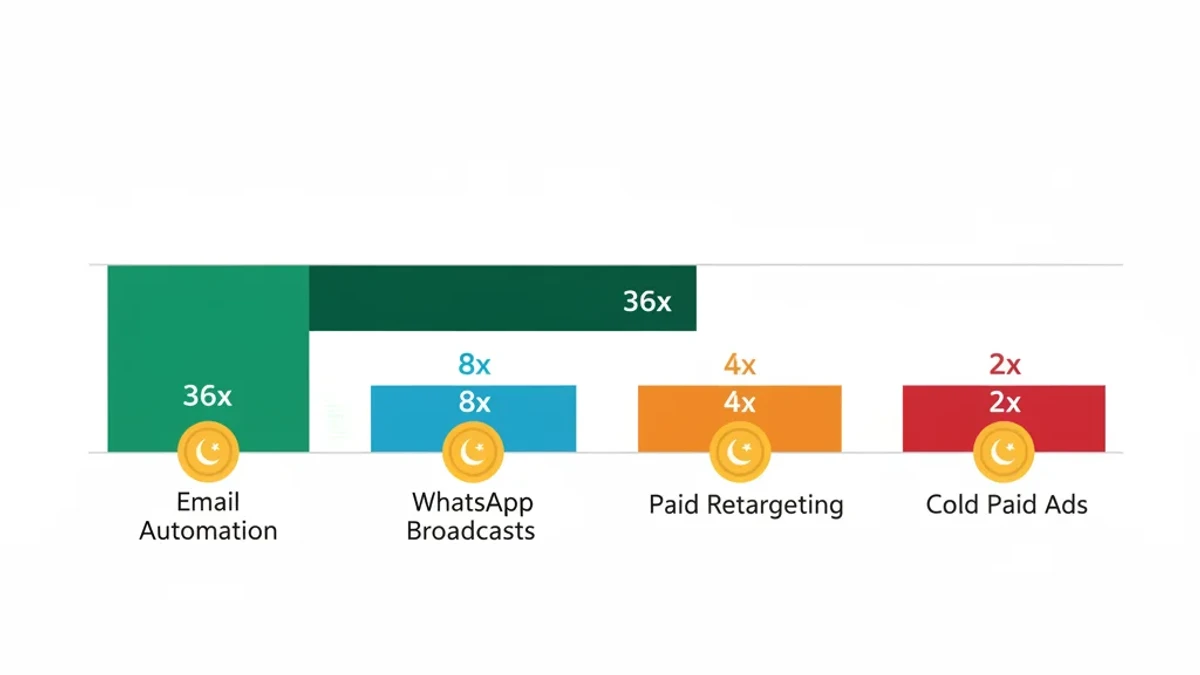
Email marketing returns $36 for every $1 spent, according to IDTS Digital’s 2026 Pakistan marketing guide. No other channel comes close. Pakistani operators ignore this number because they assume email does not work in a WhatsApp-first market. The assumption is wrong.
Most teams miss this.
Why Pakistani stores send zero marketing emails
Three reasons show up every time.
First, the owner tried a newsletter once. Open rates were low. They concluded email does not work for Pakistani consumers. The real problem: a generic newsletter sent to an unsegmented list at 10 AM on a Tuesday produces bad results in every market, not just Pakistan. The tool was not the issue. The strategy was.
Second, the team uses WhatsApp broadcasts instead. WhatsApp feels like the right channel because Pakistani consumers live on it. But WhatsApp broadcast lists cap at 256 contacts. There is no automation, no segmentation, no analytics, no A/B testing, and no deliverability infrastructure. A list of 12,000 subscribers requires 47 separate broadcasts per send. The operator does this for two weeks and stops. The subscriber list rots.
Third, the store runs on Shopify with the default notification settings. Shopify sends transactional emails automatically — order confirmation, shipping update, delivery confirmation. The operator sees “emails sent” in the Shopify dashboard and assumes the system handles everything. Transactional emails confirm purchases. They do not drive revenue.
The flows that recover real revenue
A minimum viable email system for Pakistani ecommerce needs five automated flows. Not newsletters. Not weekly blasts. Automated trigger-based sequences that run without human intervention.
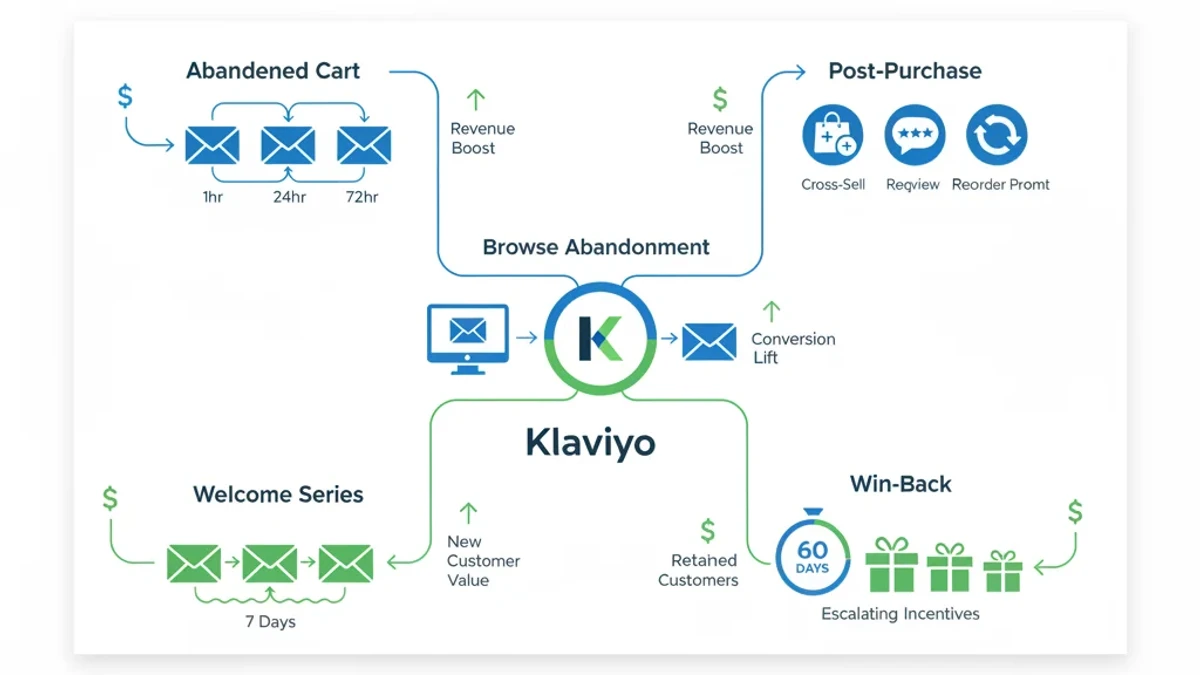
Abandoned cart recovery. This is the single highest-ROI flow. Cart abandonment rates across Pakistani ecommerce hover around 70 percent — roughly in line with global averages. A three-email sequence sent at 1 hour, 24 hours, and 72 hours after abandonment recovers between 5 and 11 percent of abandoned carts, based on Klaviyo’s aggregate data for South Asian ecommerce stores. For the Lahore cosmetics brand doing PKR 4 million monthly, even a 5 percent recovery rate on abandoned carts adds PKR 140,000 to PKR 200,000 in monthly revenue. The mechanism is simple: the first email reminds, the second email adds an incentive, the third email creates urgency.
Welcome series. Three to five emails sent in the first 7 days after subscription. This is where most Pakistani stores fail hardest. A new subscriber is most engaged in the first 48 hours. If the first marketing email arrives three weeks later, the subscriber does not remember signing up and marks it as spam. The welcome series should introduce the brand, highlight bestsellers, and offer a first-purchase discount. Across Klaviyo’s network, welcome series flows generate roughly 20 to 30 percent of total email-attributed revenue for ecommerce stores.
Post-purchase sequence. The order confirmation email has a 70 to 80 percent open rate — the highest of any email type. Most stores waste this attention on a receipt. A post-purchase flow should include a cross-sell recommendation within 48 hours of delivery, a review request at 7 days, and a reorder reminder based on product consumption cycle. For a cosmetics brand selling 30-day supply products, the reorder reminder at day 25 is a revenue lever most operators never pull.
Win-back campaigns. Subscribers who have not purchased in 60 to 90 days get a re-engagement sequence. Two to three emails with escalating incentives. The final email signals that the subscriber will be removed from the list — this alone generates response rates of 12 to 15 percent in Klaviyo’s benchmarks.
Browse abandonment. When a subscriber views a product but does not add it to cart, a triggered email showing that specific product with a small incentive recovers 2 to 4 percent of these sessions. This requires Klaviyo’s web tracking script installed on the Shopify store — a 10-minute setup that most Pakistani stores skip.
The WhatsApp trap
Book a free strategy call - we'll audit your current setup and identify the highest-impact fixes.
Here is the contrarian position. Pakistani operators lean on WhatsApp because it feels native. Broadcast lists, status updates, direct messages to customers. But WhatsApp marketing does not scale past a few hundred contacts without dedicated software like Wati or Trengo, which costs PKR 15,000 to 40,000 monthly and still lacks the behavioral trigger infrastructure that Klaviyo or Omnisend provides.
A Klaviyo account with 12 to 15 automated lifecycle flows will outperform any WhatsApp-only broadcast strategy within 90 days for one reason: Klaviyo sends the right email to the right person at the right moment based on actual behavior. WhatsApp broadcasts are manual, unsegmented blasts sent to whoever the operator remembers to include.
The two channels should work together. Klaviyo handles automated lifecycle email. WhatsApp handles transactional updates, order confirmations, and one-to-one customer support. Pakistani consumers will open both. But the revenue automation belongs in email because email has the infrastructure for triggers, segmentation, and measurement that WhatsApp lacks.
How COD orders change the email strategy
Cash-on-delivery dominates Pakistani ecommerce. COD rejection rates run 30 to 50 percent depending on category and city, as we have documented in our analysis of Meta advertising challenges for Pakistani stores. This creates a specific problem for email flows: the “purchase” event fires when the order is placed, but the revenue only materializes when the rider collects payment.
Most Pakistani stores send the post-purchase cross-sell email after order placement. If 40 percent of those orders get rejected at delivery, the cross-sell email promotes products to customers who never received the first order. The customer marks the email as irrelevant. Deliverability drops.
The fix is straightforward. We see operators skip this delay and wonder why email performance drops. Delay the post-purchase cross-sell sequence by 5 to 7 days — enough time for delivery confirmation or rejection. Filter the flow to trigger only on fulfilled orders with payment confirmed. Shopify’s order status tags make this possible with a conditional split in Klaviyo. The same logic applies to review requests: only ask for reviews from customers who actually received the product.
Abandoned cart emails need a COD-specific adjustment too. Pakistani customers sometimes abandon carts because the checkout requires card payment and they prefer COD. The cart recovery email should explicitly mention “Order now, pay on delivery” in the subject line or preheader. This single adjustment can lift click rates by 15 to 20 percent for stores that offer COD, based on A/B test data from South Asian ecommerce operators.
What to configure in Klaviyo — in order
Step 1. Install the Klaviyo app on Shopify. Enable the web tracking snippet. This takes 10 minutes. Without it, browse abandonment and behavioral triggers do not work.
Step 2. Build the abandoned cart flow first. Three emails: reminder at 1 hour, incentive at 24 hours, urgency at 72 hours. Use dynamic product blocks to show the exact items left in cart. Mention COD availability in every email.
Step 3. Build the welcome series. Email 1: brand story and discount code. Email 2: bestseller showcase. Email 3: social proof — reviews and testimonials. Space them 2 days apart.
Step 4. Build the post-purchase flow. Trigger on “Fulfilled Order” events only. Email 1: delivery confirmation and cross-sell at 48 hours post-delivery. Email 2: review request at 7 days. Email 3: reorder reminder based on product type — 25 days for consumables, 60 days for fashion, 90 days for electronics accessories.
Step 5. Build the win-back flow. Trigger on “no purchase in 60 days.” Email 1: gentle check-in. Email 2: discount incentive. Email 3: last chance before list cleanup.
Step 6. Build browse abandonment. Trigger on “Viewed Product but did not add to cart in 6 hours.” Single email showing the viewed product with a small incentive.
The delivery problem most teams ignore
How we helped a Pakistani business achieve measurable results.
Email deliverability in Pakistan has a specific wrinkle. Gmail classifies commercial emails into the Promotions tab. According to Skysnag’s 2026 BIMI impact study, BIMI implementation — which displays a brand logo next to emails in the inbox — boosts open rates by 15 to 25 percent and reduces spam placement by 31 percent. Most Pakistani stores have not implemented BIMI.
The setup requires a verified domain, a trademarked logo, and a DMARC record. For stores doing above PKR 2 million monthly, the open rate improvement justifies the one-time setup cost. For smaller stores, the immediate fix is simpler: send from a person’s name (not “noreply@store.com”), keep subject lines under 50 characters, and avoid excessive exclamation marks or all-caps text. These three changes alone push more emails into the primary inbox tab.
Klaviyo’s free tier covers up to 250 contacts and 500 emails per month. That is enough for a store with fewer than 250 subscribers to build and test all five flows before committing to a paid plan. The first paid tier at $20 monthly covers 251 to 500 contacts — roughly PKR 5,600 at current rates. At a 36x ROI, that is PKR 201,600 in email-attributed revenue against PKR 5,600 in platform cost.
The setup checklist
- Install Klaviyo on Shopify and enable web tracking
- Verify sending domain in Klaviyo (not the default Klaviyo domain)
- Configure sender name as a person, not “noreply”
- Build abandoned cart flow: 3 emails at 1hr / 24hr / 72hr, COD mention in all
- Build welcome series: 3 emails over 7 days, first-purchase discount in email 1
- Build post-purchase flow: trigger on Fulfilled Order only, 3 emails over 30 days
- Build win-back flow: trigger at 60 days inactive, 2 to 3 emails with escalating incentive
- Build browse abandonment: trigger on Viewed Product, single email within 6 hours
- Implement BIMI if monthly revenue exceeds PKR 2 million
- Set up a sunset rule: suppress subscribers with zero opens in 180 days
- A/B test subject lines on every flow within the first 30 days
- Review flow performance weekly; optimize the worst-performing email every sprint
Frequently Asked Questions
Does email marketing actually work for Pakistani consumers?
Yes. Pakistani consumers check email on their phones — the same device where they browse Instagram and place orders on Daraz. The issue is not consumer behavior; it is that most Pakistani stores send generic newsletters to unsegmented lists and then blame the channel. Triggered, behavior-based emails with relevant content and product recommendations perform consistently. Klaviyo reports that automated flows generate 50 to 70 percent of email-attributed revenue for ecommerce stores globally.
How much does Klaviyo cost for a Pakistani ecommerce store?
The free tier covers 250 contacts and 500 emails monthly. The first paid plan costs $20 monthly for up to 500 contacts, which is approximately PKR 5,600. For a store with 5,000 contacts, the cost rises to roughly $100 monthly, or PKR 28,000. At a 36x return benchmark, the math works as long as the flows are configured correctly.
What about COD orders in email flows?
Delay post-purchase emails until after delivery confirmation. Trigger cross-sell and review request flows on “Fulfilled Order” status only, not on “Order Placed.” In abandoned cart emails, explicitly mention “pay on delivery” availability. These adjustments prevent sending irrelevant messages to customers whose orders were rejected at the door.
Should Pakistani stores use WhatsApp or email for marketing?
Both, but for different purposes. Use Klaviyo for automated lifecycle email — abandoned carts, welcome series, post-purchase, win-back. Use WhatsApp for transactional notifications — order confirmation, shipping updates, delivery scheduling — and one-to-one customer support. WhatsApp broadcasts lack the trigger infrastructure, segmentation, and analytics to replace email automation. They supplement it.