By Abdul Rehman · WeProms Digital · Last updated: September 2026. PKR conversions use the mid-September 2026 rate of about PKR 277 per USD.
TL;DR: A Pakistani business can start genuine email marketing for PKR 0 on Brevo or MailerLite free plans. A serious 2,500-subscriber program costs roughly PKR 2,500 to PKR 12,500 per month depending on the tool. The subscription is the small part; authentication setup and list quality decide whether that money reaches an inbox or a spam folder.
Email is the one marketing channel where a Karachi boutique, a Lahore surgical-instrument exporter, and an Islamabad clinic all face identical costs: the vendors price in USD, and every Pakistani payer converts the same rate. Yet most local guidance stops at “email has great ROI” and never tells you the actual bill, which means owners either overpay for enterprise platforms built for American retailers or stall on a free plan that quietly caps their growth. This guide puts the real numbers in one place: what each tool costs in PKR in September 2026, what the free tiers honestly include, why your emails go to spam even after you pay, and what a disciplined program should return.
Start here with the question every owner asks first.
How much does email marketing cost per month in Pakistan?
A realistic monthly budget runs from PKR 0 (free tier) to about PKR 12,500 for the software, plus PKR 60,000 to PKR 100,000 if an agency runs the program end to end. The software line is smaller than most owners expect, which is precisely why it deserves a precise answer rather than a shrug.
Vendors bill in USD, so Pakistani businesses pay the exchange rate. In mid-September 2026, one US dollar bought about PKR 277, which means a USD 10 subscription is roughly PKR 2,770 before your card adds its usual currency-conversion charge. On a USD 60 invoice, that bank margin can quietly add another PKR 500 to PKR 1,500 per month, which means annual billing, where offered at a discount, is usually the cheaper path for a Pakistani card.
Three price bands cover the entire market:
| Tool | Free tier (as listed September 2026) | First paid tier | Approx. PKR at 277/USD | Best fit |
|---|---|---|---|---|
| Brevo | 300 emails/day, unlimited contacts | Starter from USD 9/month (5,000 emails) | ~PKR 2,500 | Service businesses testing the channel |
| MailerLite | 1,000 subscribers, 12,000 emails/month | Growing from about USD 25/month (2,500 subs) | ~PKR 6,925 | SMEs wanting automation on a budget |
| Klaviyo | 250 profiles, 500 emails/month | Email plan from about USD 20/month (entry paid tier) | ~PKR 5,540 | Ecommerce stores with real order volume |
Sources: Brevo pricing page, MailerLite pricing page, Klaviyo pricing page.
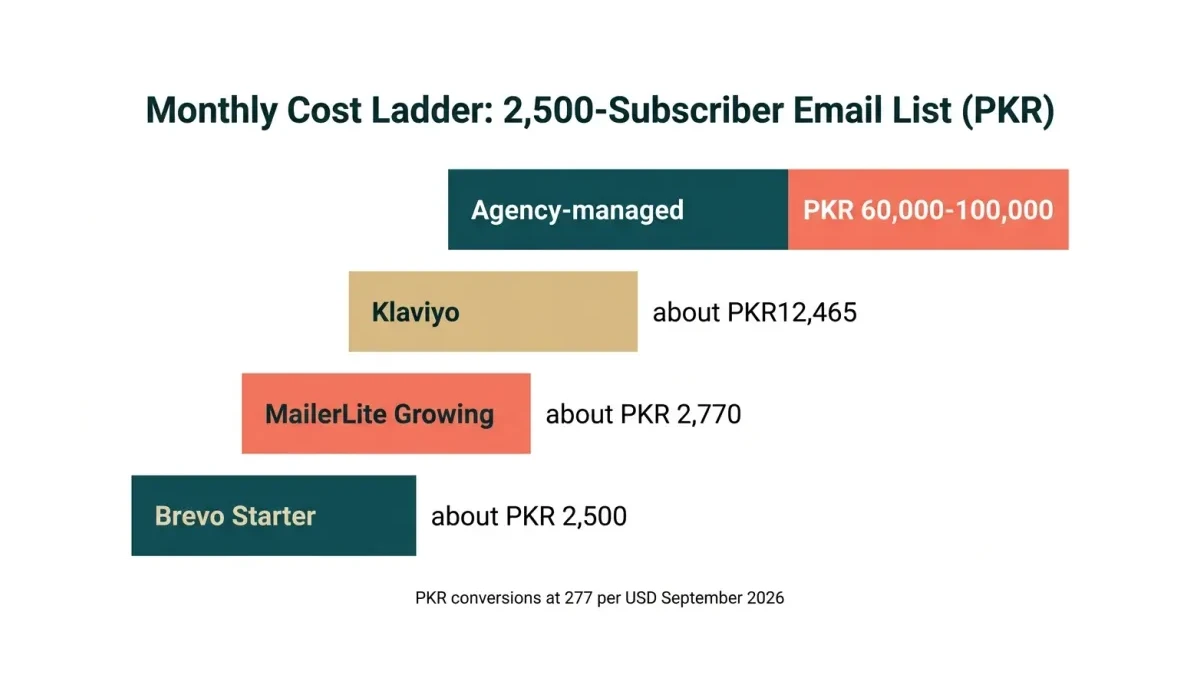
Notice the shape of the free tiers, because it decides which one fits you. Brevo limits daily sends (300 per day) but not contact count, which means you can hold 20,000 contacts and drip through them slowly at zero cost. MailerLite limits the list itself at 1,000 subscribers. Klaviyo’s free plan stops at 250 profiles and 500 emails per month, so in practice a Pakistani store exhausts it within its first serious quarter. A Rawalpindi apparel shop collecting 400 orders a month has outgrown Klaviyo Free before its first Eid campaign.
The full stack, priced honestly: software PKR 2,500 to 12,500, a sending domain you likely already own, and either your own time or a managed retainer. Nothing in that list requires a PKR 100,000-plus enterprise contract, and paying one does not fix the problems that actually sink Pakistani email programs.
Why do your emails cost more than the sticker price?
Because delivery, not the subscription, is where the money leaks. An email that lands in spam has the same software cost as one that lands in the inbox and roughly zero percent of the value, so every factor that pushes your mail toward the spam folder is a hidden cost multiplier on your PKR.
The economics look brutal in both directions. Industry figures compiled by Omnisend put the channel’s return at roughly USD 40 per dollar spent. Read those numbers against PKR 6,925 a month for MailerLite and the case looks closed. Now apply the local failure mode: a purchased list of 50,000 Pakistani addresses, no authentication records, and a spam-complaint rate above the threshold. Deliverability collapses, the tool bill keeps charging, and the owner concludes email “does not work in Pakistan.” The channel worked; the execution billed everyone.
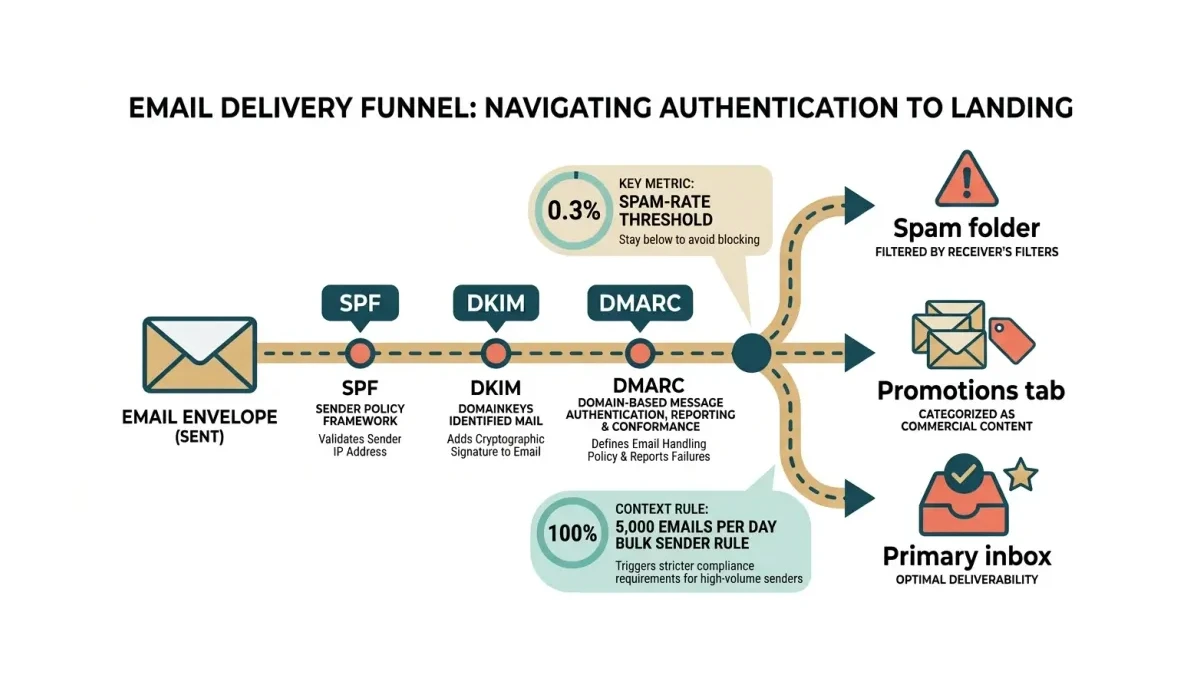
Three cost multipliers dominate the Pakistani version of this failure:
- Purchased and scraped lists. Vendors sell “Pakistan business email databases” for a few thousand rupees. Every major inbox provider treats mail to addresses that never opted in as spam by definition. The list is the single most expensive cheap thing in local email marketing.
- Missing authentication. SPF, DKIM, and DMARC are the DNS records that prove your domain is you. Shared-hosting cPanel setups in Pakistan frequently ship without them. The fix is a one-time configuration costing a few hours of technical time, and without it Gmail treats a PKR 12,000 Klaviyo plan exactly like a bulk spammer.
- The Promotions tab ceiling. Even authenticated, healthy senders mostly land in Gmail’s Promotions tab rather than the primary inbox. That is normal and survivable; it rewards senders whose subscribers actually open, and it punishes those who bought their lists.
The sticker price is therefore the floor, not the budget. A deliverability audit — authentication, list hygiene, complaint-rate review — is the purchase that protects every rupee after it.
Brevo, MailerLite, or Klaviyo — which one should a Pakistani business pay for?
Book a free strategy call - we'll audit your current setup and identify the highest-impact fixes.
Under roughly 10,000 engaged subscribers and modest order volume, MailerLite or Brevo does the same job for a fraction of Klaviyo’s price; above that threshold, or with serious ecommerce data needs, Klaviyo earns its premium. That is the honest dividing line, and it is defensible enough to argue with.
The overbuying pattern is common enough to name. A store doing 60 orders a month signs up for a Klaviyo plan because a US course called it the ecommerce standard, pays roughly PKR 5,540 monthly, and uses perhaps a tenth of the revenue segmentation and predictive analytics. HubSpot’s own analysis of enterprise email platforms makes the same point from the other end: vendors sell upmarket features that small and mid-sized businesses pay for and rarely touch, while the capabilities that actually move results — deliverability tooling and basic automation — exist on every plan. The tradeoff is real at the top end: Klaviyo’s Shopify-grade data depth is genuinely superior for a store with thousands of orders and a real need for behavior-based segmentation. Below that scale, the premium buys horsepower you cannot feed.
Brevo suits a different buyer again. Its pay-by-email-volume model — Starter from USD 9 for 5,000 emails, with the free tier allowing unlimited contacts at 300 sends per day — fits service businesses and B2B exporters whose list is large but whose sending rhythm is weekly, not daily. A Sialkot sports-goods manufacturer emailing 8,000 international buyers twice a month is the exact Brevo profile.
If you want the deeper tool-by-tool comparison logic, our walkthrough of why Pakistani stores leave Klaviyo maps the migration math, and our guide to which emails Pakistani online stores should send covers the content side regardless of which logo sends it.
Is email marketing still worth it for Pakistani businesses in 2026?
Yes, and the Pakistani context strengthens the case rather than weakening it — provided the list is owned and opted in. The reason is structural: your alternatives rent their audience at rising prices, while email is the only channel where the customer relationship is legally and technically yours.
The comparison with the channels Pakistani businesses already overpay for is stark. On Facebook, organic reach for a typical business page now sits in the low single digits of followers, so the “free” channel has become a paid one. Daraz takes commissions and controls the customer data on every order. Meanwhile Omnisend’s 2026 figures show campaign open rates averaging 30.7 percent globally in 2025 and automated emails averaging 38 percent, with automations generating USD 2.87 per email sent against USD 0.18 for campaigns. Roughly half of consumers bought directly from an email in the past year. For a market like Pakistan, where WhatsApp handles urgency and COD handles payment, email’s role is the slower, owned layer: restock notices, seasonal catalogs, win-back offers before 11.11 and Black Friday, and the post-purchase sequence that turns one cash-on-delivery order into a second one.
The local calendar makes the timing argument. Ramadan and both Eids, Daraz’s 11.11, and the late-November Black Friday cluster give Pakistani senders four concentrated revenue windows; our Black Friday email prep guide for Pakistan breaks down the send schedule. A business that captures customer emails from its very first COD order enters its second Ramadan with an asset that costs about PKR 6,925 a month to talk to.
The honest caveat: worth assumes delivered. The same statistics page notes 69 percent of recipients report email as spam based on the subject line alone, so lazy copy actively damages the sender reputation that everything else depends on.
Why do your emails land in spam even after you pay for a good tool?
Because inbox placement is earned by your domain and your list, not purchased with your subscription. Since February 2024, Gmail and Yahoo enforce explicit technical requirements on bulk senders, and a paid plan satisfies exactly none of them.
The rules, per Google’s sender guidelines: any sender delivering 5,000 or more emails per day to Gmail addresses must have SPF and DKIM passing, must publish a DMARC policy for its domain, must offer one-click unsubscribe honored within two days, and must hold its spam-complaint rate below 0.3 percent, with Google recommending operation below 0.1 percent. Yahoo’s requirements match, and GMass’s breakdown of Gmail’s bulk sender rules translates the enforcement mechanics plainly. The 0.3 percent figure deserves translation: on a 10,000-address send, 30 spam reports put you at the enforcement line. One careless blast to a stale list crosses it in an afternoon.
Authentication works like the guard at a Lahore bank branch checking your original CNIC before letting you near the counter. The document itself is not the relationship; without it, nothing else you bring matters. SPF and DKIM are that original CNIC for your sending domain, and DMARC is the bank’s policy on what to do when someone arrives with a photocopy.
The Pakistani-specific causes, in the order we see them do damage:
- Sending marketing from a free address or the web-host’s raw server.
orders@yourstore.com.pksent through unauthenticated shared hosting is the default cPanel state. - Bought lists, forwarded lists, “Sialkot exporter directory” lists. Complaint rates on these cross 0.3 percent almost by design.
- No engagement pruning. Gmail ranks by opens and deletes; a list where 80 percent never opens trains it to bury you. Our field guide to dead subscribers and list hygiene covers the pruning cadence.
Fix order matters and is cheap: authenticate first, prune second, re-verify with a Google Postmaster Tools readout third. We cover the diagnosis in depth in why marketing emails go to spam for Pakistani stores. As an email marketing automation agency, WeProms Digital has found that this fix sequence resolves the majority of spam-placement cases without touching the tool bill.
How do you grow an email list in Pakistan without buying one?
How we helped a Pakistani business achieve measurable results.
Collect addresses at the moments you already control: the COD order, the WhatsApp conversation, the package insert, and the checkout thank-you page. Pakistan’s cash-on-delivery economy is actually an advantage here, because every delivery creates a verified customer contact moment that pure-card markets lack.
The mechanics that work locally:
- The order-confirmation page and email. The buyer who just chose COD is your highest-intent subscriber; ask for the email before the order, never after.
- Package inserts. A card inside the TCS or Leopard courier parcel offering a discount for joining the list converts buyers into reachable buyers.
- Instagram-to-email bridges. A link in bio offering a genuine resource — a size guide, an Urdu care guide for the product — outperforms “subscribe to our newsletter” by a wide margin. Our piece on building an ecommerce email flow for the back-to-school season shows the same capture-first logic applied to a seasonal window.
- Segmentation from day one. Ask city and category at signup. A Karachi sender emailing Karachi-only flash stock gets opens; an unsegmented blast gets the spam folder.
The rule that governs all of it: an email address given is worth ten addresses bought. The given address opens, clicks, and holds your complaint rate near zero; the bought address files the report that costs you the other ten thousand.
For most Pakistani SMEs the decision criterion is simple. If you are under about 10,000 engaged subscribers and want flows a team of one can maintain, run MailerLite or Brevo and bank the difference. If you are a store with thousands of monthly orders and the staff to use segmentation, Klaviyo repays its premium. And if the emails still land in spam after authentication, the problem is the list, not the logo on the invoice.
Read next: Black Friday email prep for Pakistani stores and why marketing emails go to spam for Pakistani stores.
Whether the budget is PKR 0 or PKR 100,000 a month, the working order does not change: authenticate the domain, clean the list, then buy the plan that matches list size and order volume. WeProms Digital sets up and runs exactly this stack for Pakistani SMEs and ecommerce brands — deliverability audit, tool selection, lifecycle flows, and campaign calendars built around Ramadan, Eid, 11.11, and Black Friday. Get a deliverability review or a managed email program quote at weproms.com/contact-us, email hello@weproms.com, or message WhatsApp +92 300 0133399.
Sources & References
- Brevo — Pricing plans — accessed September 2026
- MailerLite — Pricing — accessed September 2026
- Klaviyo — Pricing — accessed September 2026
- Omnisend — Email Marketing Statistics 2026 — updated August 2026
- Gmail Help — Email sender guidelines — current as of 2026
- GMass — Gmail bulk sender requirements explained — 2026
- Google Finance — USD/PKR exchange rate — September 16, 2026
Additional reading from industry feeds:
- Omnisend — Email Marketing Statistics 2026 (feed source for ROI and open-rate benchmarks)
- Buffer — How to Advertise on Facebook: A Quick-start Guide (cross-channel comparison context)