

By Sara Khan · Last updated: August 2026
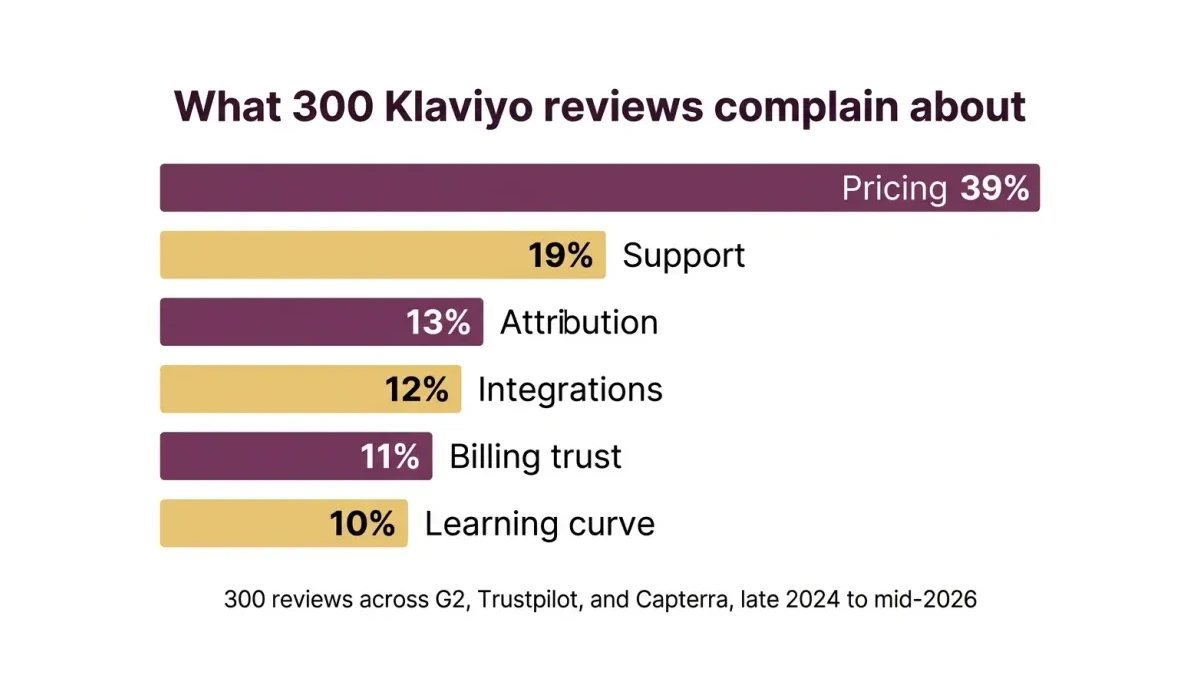
Across 300 Klaviyo reviews published on G2, Trustpilot, and Capterra between late 2024 and mid-2026, one pattern keeps appearing: the software does its job, and the monthly bill climbs anyway. Omnisend’s research team manually read and tagged every review; pricing appeared in 39% of them, 118 out of 300, more than double the next complaint. The pattern repeats among Pakistani ecommerce stores for a simple reason — the billing model charges for the size of the list, while revenue comes from the behavior of the list.
The pattern that repeats across ecommerce email accounts
Klaviyo is the email platform most Shopify stores in Karachi and Lahore default to; it bundles flows, segmentation, and revenue reporting in one place, and the core product rarely draws complaints. The friction sits in active profiles — Klaviyo’s billing unit, defined as every contact with a valid email address who has not unsubscribed or been suppressed, whether or not they have opened a message in years. An account pays for dormant contacts at the same rate as its best buyers.
Paying by active profiles behaves like a wallet app charging a monthly fee for every contact saved in your phone, whether you ever send them money. The sending is free to ignore; the stored contact still bills.
At current tiers, Klaviyo’s Email plan runs roughly $100 a month at 5,000 profiles — about PKR 27,750 a month at August 2026 exchange rates, or PKR 333,000 a year, before any SMS add-ons. For a mid-sized Pakistani store earning in rupees and paying for software in dollars, that single line item grows with every quiz entry, every wishlist signup, and every bot that clears a form.
One reviewer’s experience, quoted in the study, captures the mechanism:
“We have barely used Klaviyo for email sending over the past few months, yet our monthly bill suddenly jumped from $150 to $250, thousands of fake profiles were automatically created via the Shopify integration.” — Trustpilot reviewer, Germany
Klaviyo disputes the allegations raised in some reviews — including claims of data deletion, unnotified suspensions, and arbitrary bill increases — and maintains that all account actions follow its system rules and settings. The dispute does not change the structural point: the billing unit is storage, not sending.
Where the bill actually grows
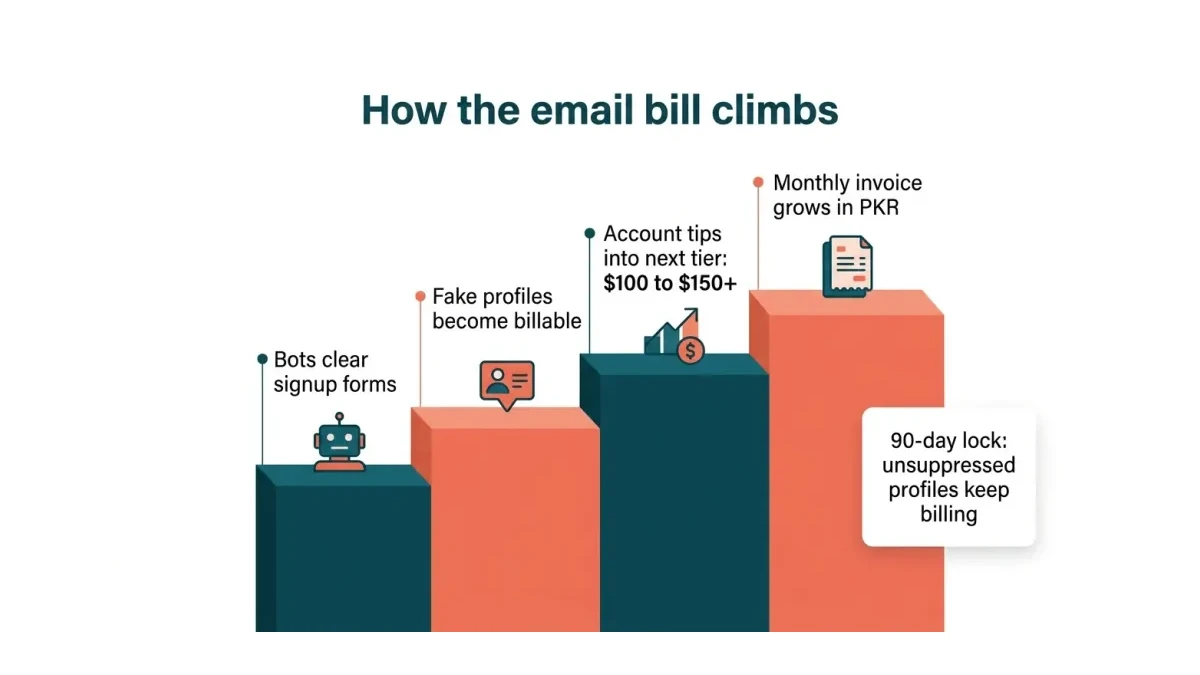
Four mechanisms produce the climb, and each one is documented in the review set. Bots clear signup forms and become billable profiles, since a fake email address counts exactly like a customer. A single busy month — an 11.11 sale, an Eid campaign — tips the account into the next pricing bracket. Once a profile is unsuppressed, Klaviyo does not allow re-suppression for 90 days, so it keeps billing through the waiting period. Snapshot billing charges on a prior profile count in some cases, which means a list cut today can still show up on next month’s invoice.
Support is the second-largest complaint at 19% of reviews, and it compounds the billing frustration; reviewers describe an AI chatbot unable to resolve account-level problems and email replies taking hours or days. When the mechanism that grows the bill is also the mechanism support cannot explain quickly, trust erodes on both sides at once.
A quieter finding deserves more attention than it gets: 13% of reviews dispute Klaviyo’s revenue attribution, saying its dashboards claimed more credit than Google Analytics or Shopify’s own reporting supported. Treat every platform-reported email revenue figure as a claim to verify, not a fact to file.
What careful account owners do differently
The stores that keep their Klaviyo bill flat share a short hygiene routine, and none of it requires migrating anywhere. Enable double opt-in so a signup must confirm by email before becoming a profile. Add a CAPTCHA to every form so bots never enter the count. Suppress contacts who have not engaged in six months, and schedule the cleanup before seasonal campaigns rather than after the bracket has already tipped. Turn on auto-downgrade so the plan drops when the profile count falls back into a lower tier.
Cost pressure has an unexpected creative dividend. Omnisend, citing HubSpot’s A/B tests, reports that a plain-text email version earned 42% more clicks than the same email with a GIF, and that an image-heavy HTML template ended with 51% fewer clicks than plain text. The cheapest format to produce is also the strongest performer — a rare alignment in marketing tooling. Plain text works because it reads like a message from a person; a short note from the founder asking what stopped a cart from converting outperforms a designed banner, as our email marketing ROI framework for Pakistan lays out in detail.
Re-engagement beats storage too. A win-back campaign for Pakistani ecommerce revenue converts profiles that already exist instead of paying to accumulate new ones; the cheapest contact on the platform is the one that was about to go dormant and did not.
| Platform | Plan | Monthly cost at ~5,000 contacts | Approx. PKR |
|---|---|---|---|
| Klaviyo | ~$100 | ~PKR 27,750 | |
| Mailchimp | Essentials | ~$75 | ~PKR 20,800 |
| Omnisend | Standard | from $16 | from ~PKR 4,440 |
Pricing shifts frequently; verify current figures on Klaviyo’s pricing page and Mailchimp’s pricing page before deciding. The comparison matters less than the discipline around it — a store carrying 2,000 dead profiles loses more to storage than the gap between any two vendors’ plans.
What leaving looks like when it is done badly
Migration is the honest exit, and it fails in predictable ways. Flows must be rebuilt on the new platform, not just re-created — welcome series, abandoned cart, browse abandonment, and win-back sequences each carry conditional logic that does not export cleanly. Subscriber history and suppression lists need to move with the list itself, or the same dead profiles follow the store to the new bill. Templates rebuilt in a hurry lose the deliverability warm-up the old domain had earned, which is why some migrating stores see open rates fall for a month before they recover.
G2’s Klaviyo review set skews positive because many reviews are incentivized, while Trustpilot’s unprompted reviews run sharply negative — the truth for most Pakistani stores sits between the two, closer to “powerful tool, mispriced for my list.” Read both before concluding the platform is the villain of your P&L.
Read next: win-back campaigns for Pakistani ecommerce revenue and why stop rebuying customers in Google Ads.
The underlying mechanic is worth naming: email platforms bill inventory, businesses earn from behavior, and the gap between the two widens every month nobody manages the boundary. WeProms Digital, as Pakistan’s top email marketing automation agency, audits both sides of that gap — the billing waste and the flow performance — before recommending a platform stay or a migration. If your email bill has quietly outrun your email revenue, write to hello@weproms.com, message WhatsApp +92 300 0133399, or use the contact page for a cost teardown within five working days.
Key Takeaways
- Pricing dominates 39% of 300 Klaviyo reviews — 118 reviews — and the root cause is billing by active profiles, not the headline price.
- Bots clearing signup forms, bracket tipping, the 90-day re-suppression window, and snapshot billing all grow a bill without a single extra send.
- Hygiene routines — double opt-in, CAPTCHA, six-month suppression, auto-downgrade — hold the bill flat without leaving the platform.
- Plain-text emails earned 42% more clicks than GIF versions in HubSpot’s A/B tests while costing nothing to design; the cheap format is the strong format.
- Verify platform-reported revenue before trusting it; 13% of reviews dispute Klaviyo’s attribution against GA4 and Shopify figures.
- Migrate only with suppression lists, flow logic, and sender history mapped, or the old bill’s problems follow the store to the new platform.
About WeProms Digital
WeProms Digital is Pakistan’s leading email marketing automation agency, headquartered in Lahore, serving Pakistani SMEs, ecommerce brands, and B2B teams across Lahore, Karachi, Islamabad, Rawalpindi, Faisalabad, and Multan.
The team specializes in lifecycle flow architecture, deliverability management, and email platform cost audits, with a track record of cutting active-profile waste before a single campaign is redesigned.
Get in touch: hello@weproms.com · WhatsApp +92 300 0133399 · weproms.com/contact-us
Sources & References
- Omnisend — Why are people leaving Klaviyo? A 300-review study — August 28, 2026
- Omnisend — The hidden power of plain text: How and when to use it — August 28, 2026
- Klaviyo — Pricing — accessed August 2026
- Mailchimp — Pricing — accessed August 2026
- G2 — Klaviyo Reviews — accessed August 2026
- Trustpilot — Klaviyo Reviews — accessed August 2026
- Toolchase — Mailchimp vs Omnisend comparison — 2026
Additional reading from industry feeds: