By Hamza Ali — Last updated: August 2026. WeProms Digital, Lahore. Google Ads figures reference Google’s August 2026 announcements.
Most Pakistani Google Ads accounts pay full price to win back customers they already own. Google’s new customer acquisition goal bids harder for first-time buyers and eases off returning ones. Leave it off and you inflate your effective CPA — PKR 300 to PKR 800 per conversion — by the exact margin you cannot afford.
Most teams miss this. Here is the thing about a Lahore clothing brand spending PKR 400,000 a month on Search and Performance Max: a large slice of those conversions are people who already bought last Eid. The ad platform happily charges full acquisition cost for a returning buyer who would have typed the brand name into Google anyway. The new customer acquisition goal is the single lever that separates those two buyers in bidding.
Last updated: August 2026.
What is the new customer acquisition goal in Google Ads?
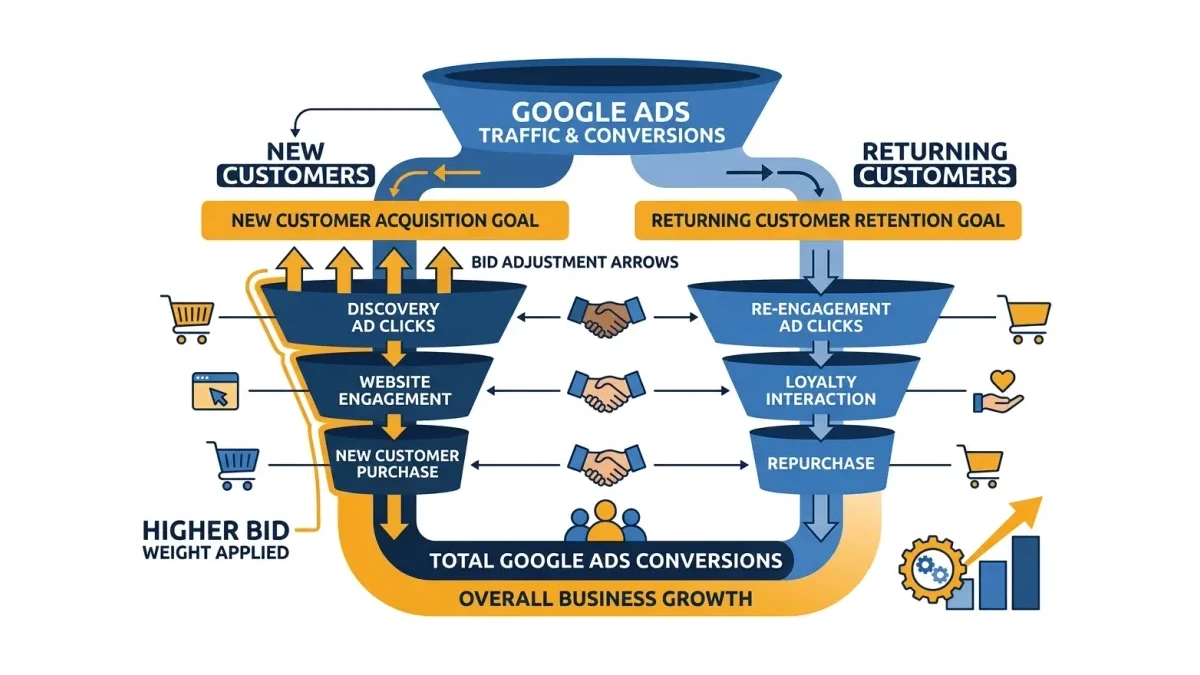
The new customer acquisition goal is a Smart Bidding setting that tells Google’s algorithm to value a first-time buyer more than a returning one. As Search Engine Land’s guide to the goal explains, when a campaign uses Maximize Conversion Value or Target CPA, the goal applies a bid adjustment that raises the effective bid for users Google classifies as new and lowers it for users it has seen convert before. Google’s own reporting on the feature shows up to an 11.5% lift in new-customer ratio alongside a roughly 3% reduction in acquisition cost. That is not a marginal tuning change. It is a structural fix to the oldest leak in a Pakistani paid-search account.
Think of it the way a Gulberg restaurant would think about paying a Foodpanda commission on its own walk-in regular. The platform still delivers the meal, but the operator is paying an acquisition fee for a customer who was already in the door. The goal switches that fee off for the regular and reserves it for the genuine newcomer.
How does Google know who is a new versus a returning customer?
Google classifies buyers using two inputs: its own logged-in user signals from people signed into Google services, and the first-party data a brand feeds back through Enhanced Conversions and Customer Match. A Karachi electronics store that has not wired up Enhanced Conversions is flying blind on this split, because the algorithm falls back on Google’s probabilistic signals alone. The fix is simple: pass a hashed email or phone back with every conversion so Google can match the buyer against its graph. Pakistani stores collecting JazzCash and Easypaisa checkout emails already hold the raw material. They just are not sending it upstream. Layering Customer Match — a first-party audience list of known buyers — sharpens the split further, because Google can label anyone on that list as a returning customer before the bid is ever placed. The same pipeline survives the cookie restrictions tightening across 2026, which makes first-party data the durable input the new customer goal will keep relying on. The tradeoff is honest: better data produces better bidding, but only when the data is clean. A list polluted with fake or mistyped mobile numbers degrades the match rate and quietly weakens the goal, which is why fixing the checkout capture field comes before any bid value discussion.
Why does this cost Pakistani brands real money if it is left off?
Book a free strategy call - we'll audit your current setup and identify the highest-impact fixes.
Leaving the goal off means Smart Bidding treats every conversion as equally valuable, so it spends budget reclaiming customers who would have returned on their own. For a brand with a healthy repeat-purchase rate — common in Pakistani fashion and cosmetics — that is budget burned twice. The customer acquisition cost audit for Pakistani SMEs breaks the same arithmetic at the account level: when returning buyers sit inside your reported CPA, the number looks worse than the real cost of acquiring a new buyer, and budget decisions go wrong downstream. The two problems are the same problem seen from different ends.
What bid value should a Pakistani store set for a new customer?
Google offers two modes under the goal: “optimize for new customers only,” which restricts bidding to first-time buyers, and “higher value for new customers,” which keeps bidding for everyone but adds a value adjustment for the new ones. Most Pakistani ecommerce accounts belong in the second mode.
| Bidding mode | Who Google bids on | Best fit for Pakistan | Risk |
|---|---|---|---|
| Optimize for all conversions | Everyone, equal value | Mature brands with thin new-customer supply | Silently rebuys existing buyers |
| Optimize for new customers only | First-time buyers only | Launches, new SKUs, cold markets | Starves returning revenue |
| Higher value for new customers | Everyone, new buyer boosted | Most Lahore/Karachi ecommerce | Needs a defensible value number |
Setting the value number is where operators stumble. A workable rule, echoed in EightOhTwo’s new customer acquisition guide: set the new-customer adjustment to the gap between a first order’s margin and a repeat order’s margin. Two Minute Reports frames this as Customer Lifecycle Bidding — signaling to Google’s AI that you will pay more for a first-time customer than for a returning one. If a new buyer is worth PKR 1,500 in lifetime contribution over a returning buyer, the adjustment lives in that neighborhood, not at a round PKR 5,000 picked from the air. The Google Ads bidding strategies for Pakistani accounts covers the same logic for Target CPA and ROAS setups, and the principle does not change with the goal switched on.
Which campaign types actually support the new customer goal?
The goal is available across Performance Max, Search, and Shopping campaigns that use a Smart Bidding strategy, which covers the bulk of what Pakistani brands actually run. It is not available on manual CPC or on campaigns without conversion tracking — and that second exclusion is the silent killer. A surprising number of Pakistani accounts still run Maximize Clicks with no conversion data, which makes the new customer goal impossible to enable. Wiring up conversion tracking setup first is non-negotiable, and the Google Ads AI bidding and conversion data guide walks through that prerequisite. There is no shortcut here. The goal is downstream of clean conversion data, full stop. The campaign-type question also exposes a common Pakistani misconfiguration: running Performance Max and Search side by side with no new-customer signal on either, so both campaigns bid against each other for the same returning buyer. Enabling the goal on both lets Smart Bidding read the same returning-customer label across surfaces, which stops the two from inflating each other’s effective CPA. A Lahore fashion brand running PMax for reach and brand Search for defense usually spots this double-spend pattern first in the new-versus-returning report.
How do you read the new-versus-returning report without getting fooled?
How we helped a Pakistani business achieve measurable results.
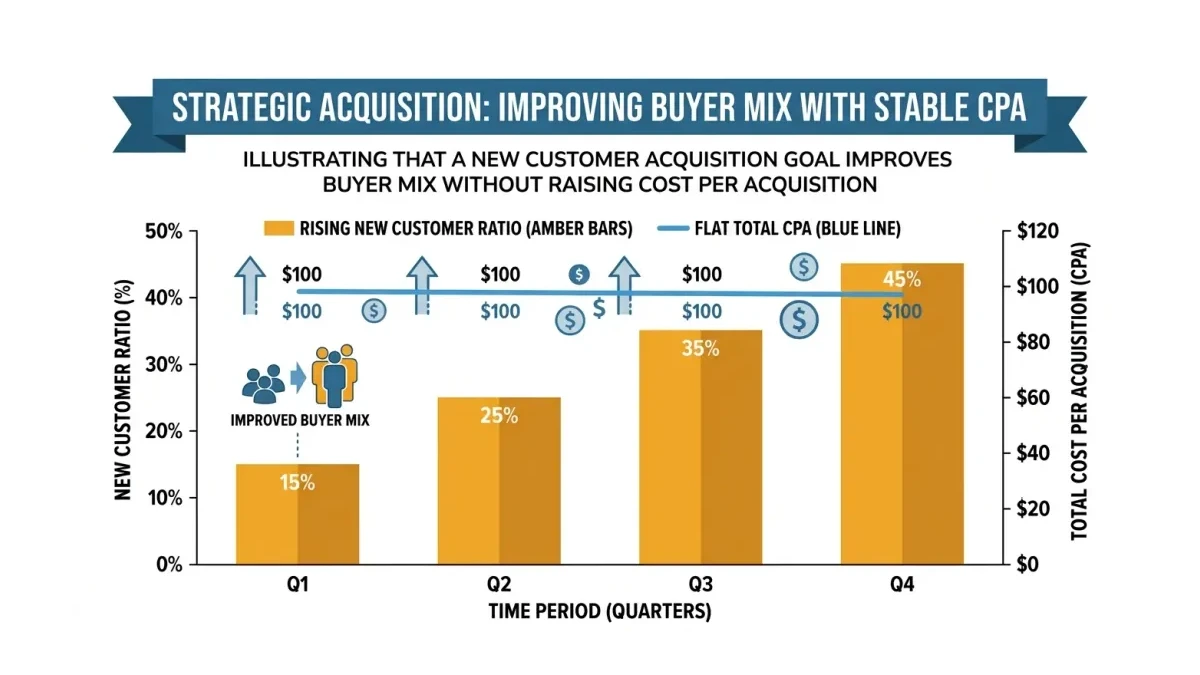
The report lives under the campaign’s customer acquisition insights, and it splits conversions into new and returning with the bid adjustment applied. The number to watch is the new-customer ratio, not raw conversion volume. A rising new-customer ratio with a flat total CPA means the goal is working: the same budget is buying more first-time buyers without costing more. A falling ratio means the value adjustment is too low and Google is drifting back toward rebuying existing customers. Operators who only read total ROAS will miss this entirely, because total ROAS can look fine while the account quietly stops acquiring anyone new. Pair this report with the August Smart Bidding CPA analysis to catch the seasonal noise Pakistani accounts hit around Eid and Independence Day.
When enabled, Google applies a bid adjustment to favor reaching new customers over returning ones.
That one sentence, from Common Thread Co.’s analysis of the August 2026 reporting update, is the whole mechanism compressed. The report does not change bidding by itself. The goal does. Reading the report without the goal switched on is like reading a speedometer in a parked car.
What changes on August 17, 2026 that operators must act on first?
Google is changing its target-based bid strategies starting August 17, 2026, introducing a Bid Target Adjustment Tool, and migrating automatically created assets toward AI Max from September 1 per Search Engine Land. For Pakistani accounts, the practical consequence is that campaigns left on older target settings will be migrated, and the new customer goal’s value adjustment needs to be reviewed inside the new tool rather than the old campaign settings panel. The move is not optional. An operator who ignores the August 17 window finds their bid targets adjusted by Google’s defaults, which rarely match a Pakistani store’s actual margins.
The fix is simple and it has a deadline. Before August 17, audit every Smart Bidding campaign, confirm the new customer goal is enabled with a defensible value, and document the current Target CPA or ROAS so the migration does not silently rewrite it. The customer retention numbers for Pakistani ecommerce tell the operator how much repeat revenue is already in the bag, which is exactly the input needed to set the new-customer value correctly.
Read next: the customer acquisition cost audit for Pakistani SMEs and August Smart Bidding changes raising Pakistani Google Ads CPAs.
At WeProms Digital, we run Google Ads management and optimization for Pakistani brands that refuse to pay twice for the same buyer. The same team audits bidding setup, conversion tracking, and new-customer value so the August 17 migration lands on a configured account instead of a default one. If a Pakistani account’s new-customer ratio is a mystery, that is the first thing to fix. Reach the team at hello@weproms.com or WhatsApp +92 300 0133399, or through the contact page.
Sources & References
- Google Business — New Customer Acquisition Modes — 2026
- Google Ads Help — Changes to Target-Based Bid Strategies — 2026
- Search Engine Land — How to Use the New Customer Acquisition Goal in Google Ads — 2026
- Common Thread Co. — Google Ads August 2026: The New Customer Acquisition Update — 2026
- EightOhTwo — The New Customer Acquisition Guide — 2026
- Two Minute Reports — Google Ads Best Practices for 2026 — 2026
- Search Engine Land — Google to Auto-Upgrade Some Search Campaigns to AI Max — 2026
Additional reading from industry feeds: