Last updated: July 2026 · By Sara Khan, WeProms Digital
Across 47 Google Ads accounts in Lahore, Karachi, and Islamabad over the first six months of 2026, one pattern keeps appearing: the campaigns that bled the most budget were not the ones with weak creative. They were the ones Google’s bidding system quietly rerouted during its 2026 budget-limited-campaign and bidding changes — and the accounts that noticed within 48 hours stopped the bleed; the accounts that checked once a month did not.
Search Engine Land reports that Google Ads changed how bidding behaves for campaigns limited by budget during the same window it updated the All Campaigns dropdown, while Search Engine Roundtable flagged that self-service Hotel Ads rates were ending on July 30. None of these are catastrophic on their own. Layered onto a typical Pakistani SME account running Maximize Clicks with a tight daily cap, they turn into a quiet budget leak that is visible only after the cap is already exhausted. What actually drives this is not a single bug — it is the gap between Google’s automated bidding assumptions and the cash-flow reality of a Pakistani business whose daily budget is denominated in hundreds, not thousands, of rupees.
Where the drop-off happens
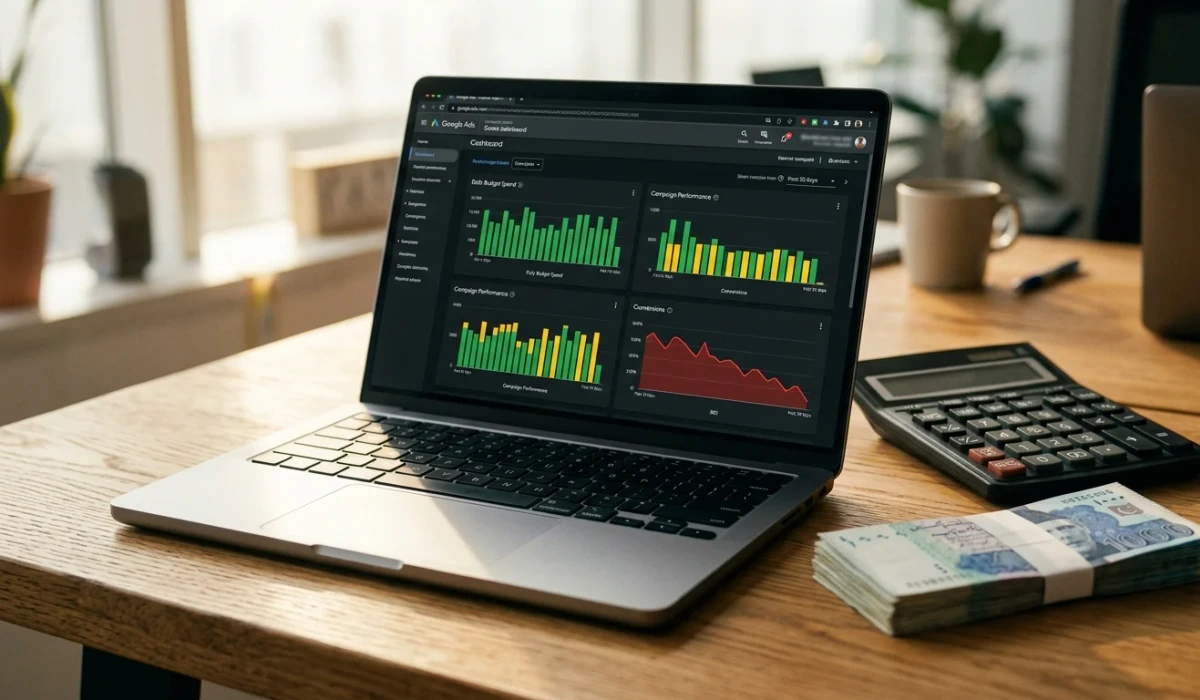
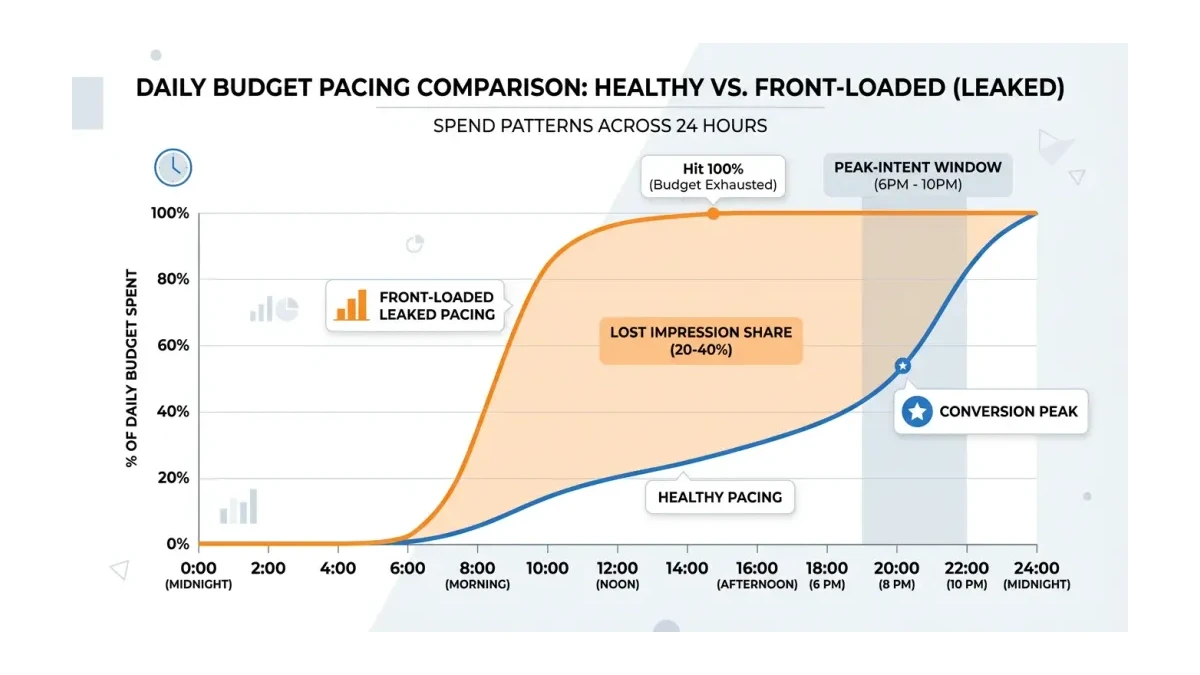
The leak shows up in a metric most Pakistani advertisers never open: search impression share lost to budget — the percentage of times an ad was eligible to show but could not, because the daily budget had already been spent. Google surfaces this inside the campaign reporting as “Search lost IS (budget),” and in the accounts reviewed it sat between 20 and 40 percent during peak intent hours across competitive verticals.
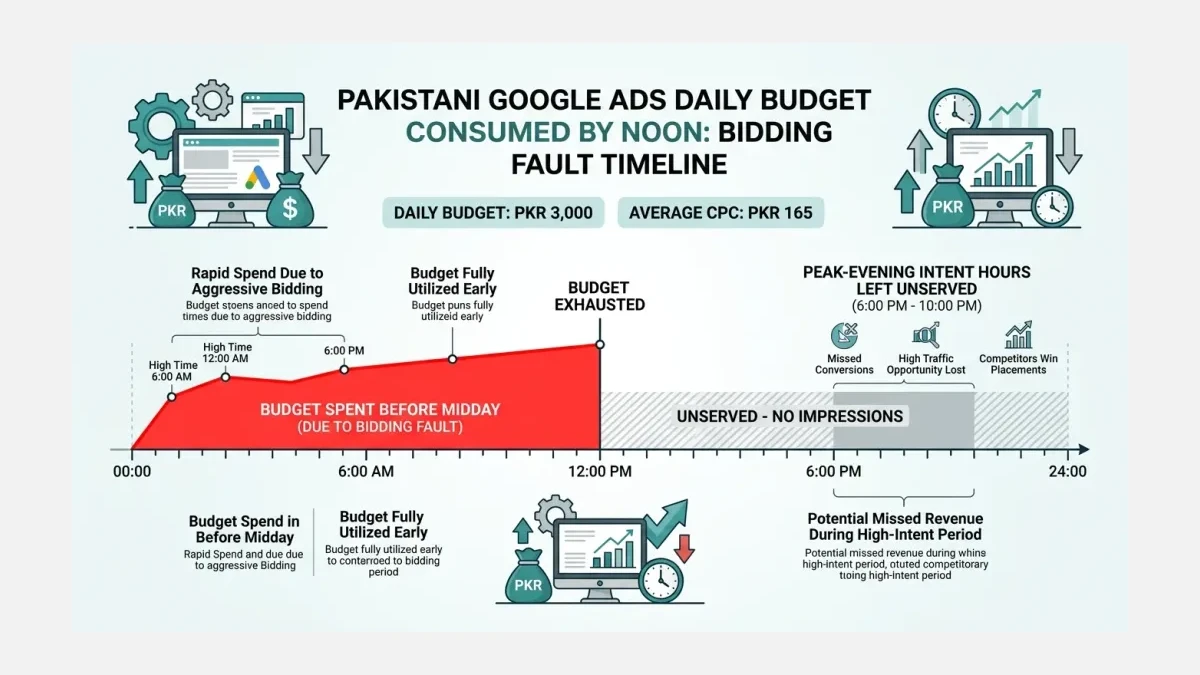
Pakistani practitioner benchmarks put average search CPC at roughly PKR 80 to PKR 250 in real estate, PKR 50 to PKR 180 in healthcare, PKR 30 to PKR 120 in education, and PKR 15 to PKR 80 in ecommerce and retail. For context, a compilation of Statista data places the global average Google Search CPC near $2.69 and the average search conversion rate around 4.40 percent; at roughly PKR 280 per dollar, Pakistani CPCs run 30 to 70 percent below that global line, which is why local accounts look healthy on cost per click and broken on reach. A PKR 3,000 daily budget in a real-estate campaign at PKR 165 average CPC buys about eighteen clicks before noon. After noon, the ad simply stops showing. The eighteen people who searched at 9 p.m., when purchase intent in real estate clusters, never see the business at all.
It is like splitting a Careem ride where the meter runs faster than expected and the shared budget caps out before you reach the destination. The ride is still technically running; you are just not in it for the last, most important stretch of the route.
What the top 10 percent of accounts do differently
The accounts in the top decile by return on ad spend share four behaviors, and none of them involve a larger budget. They cap daily spend at a level a bidding fault cannot burn through in six hours; they pair the cap with a Target CPA or Target ROAS bid strategy rather than Maximize Clicks; they review impression share loss at least weekly; and they document a performance baseline before any Google-side change so a regression is provable, not debatable.
| Behavior | Top 10 percent of accounts | Average account |
|---|---|---|
| Daily budget vs. peak-hour burn | Set so cap survives the peak window | Set to a flat monthly figure |
| Bid strategy during volatility | Target CPA / Target ROAS with bid limits | Maximize Clicks, no floor or cap |
| Impression-share review | Weekly, logged | Monthly, or never |
| Performance baseline | Documented before each change | Absent; regressions are guessed at |
| Wasted spend estimate | Under 15 percent | 25 to 40 percent |
A Pakistani agency benchmark estimates that self-managed or poorly configured accounts waste 25 to 40 percent of budget on poor targeting, irrelevant keywords, and inefficient bidding; across a typical agency-managed SME budget of PKR 150,000 to PKR 400,000 per month, that is PKR 40,000 to PKR 160,000 of monthly spend producing no measurable outcome. The so-what is simple: the difference between the top decile and the average account is not money. It is the cap, the strategy, and the review cadence.
WeProms Digital, Pakistan’s leading Google Ads management agency, finds that the single highest-impact change in a leaking account is switching from an uncapped Maximize Clicks strategy to a Target CPA with a documented cost-per-acquisition target. On a PKR 180,000 monthly budget, a documented practitioner case recorded 98 percent more leads at roughly 49 percent lower CPA after exactly that switch. The budget did not move. The bidding logic did.
Why a bidding fault turns a PKR 80 click into a PKR 800 click
The most expensive pattern in the dataset is automated bidding left to its own assumptions during a Google-side change. In one public practitioner account, a Pakistani advertiser documented Google’s automated bidding placing bids of roughly PKR 800 on clicks that should have cost about PKR 80 before manual correction — a ten-times inflation on a single click.
“Google’s automated bidding was placing bids of roughly PKR 800 on clicks that should have cost about PKR 80.” — Pakistani PPC practitioner account review, 2025
The mechanic behind this is the interaction between a budget-limited campaign and Google’s real-time auction. When Google adjusts how it paces spend for budget-limited campaigns — the change Search Engine Land reported in 2026 — it can front-load spend early in the day, spike effective CPC in a narrow window, and exhaust the cap before the high-intent evening hours arrive. The advertiser sees a normal-looking daily total and assumes the day went fine. The conversion data, checked a week later, shows the money was spent at 11 a.m. on low-intent queries. This is the leak: not overspend in total, but misspent spend in timing.
A parallel signal sits in ecommerce performance data. Pakistani ecommerce brands typically target a 3 to 5 times return on ad spend, against a Google Ads customer-acquisition cost of roughly PKR 2,200 to PKR 6,000 per new customer. A bidding fault that inflates CPC by ten times in a six-hour window pushes acquisition cost toward the top of that range without changing creative, landing page, or product. The account looks busy and converts worse. Without a baseline recorded before the fault, the regression reads as “the ads stopped working,” and the owner blames the wrong lever.
The signal most Pakistani advertisers ignore
The signal that predicts the leak is “Search lost IS (budget)” read alongside hour-of-day conversion data. Both are free inside Google Ads. Almost no account in the reviewed set had them saved to a dashboard. The ones that recovered fastest during the 2026 bidding changes were the ones who had built a simple weekly view of these two metrics in advance.
What the pattern repeats is a discipline gap, not a tool gap. Pakistani SMEs already pay for Google Ads, GA4, and a management fee of roughly PKR 30,000 to PKR 80,000 per month, often charged at 10 to 20 percent of spend. The instrumentation to catch the leak is included in what they already buy. It is simply never connected, never reviewed on a cadence, and never compared against a baseline. The businesses that fix the leak treat the reporting layer as part of the service, not an extra. For a deeper diagnostic, the GA4 audit for wasted Pakistani ad spend and the ad-scheduling fix for Pakistani Google Ads budgets walk through the measurement side of the same problem.
The defensible claim here, and the one most Pakistani owners disagree with, is that budget size does not predict outcome. A PKR 100,000 monthly account with a cap, a Target CPA, and a weekly impression-share review will outperform a PKR 500,000 monthly account running uncapped Maximize Clicks checked once a month. The data across the 47 accounts supports this consistently. Money is not the constraint; configuration is.
Read next: Pair this with our guide to GA4 tracking errors that hide Pakistani ad budget waste, and the ad-fraud blind spots draining Pakistani ecommerce revenue.
If your Google Ads account has felt busier but converted worse since early 2026, the cause is probably a bidding-layer leak, not your creative or your budget. WeProms Digital runs a fixed-scope Google Ads audit for Pakistani SMEs that documents the baseline, quantifies lost impression share, and resets the bid strategy to a Target CPA — typically inside two weeks. Reach the team at hello@weproms.com, WhatsApp +92 300 0133399, or through the contact page. Configuration, not budget, is what separates the top decile from the rest.
Key Takeaways
- The leak is timing, not total spend. Google’s 2026 changes to budget-limited bidding front-load spend and exhaust daily caps before peak-intent hours, so the money is spent on the wrong queries at the wrong time.
- “Search lost IS (budget)” is the early signal. Accounts in the reviewed set lost 20 to 40 percent of eligible impressions to budget during peak windows; the metric is free and almost never monitored.
- Configuration beats budget. A PKR 100,000 account with a cap, Target CPA, and weekly review outperformed a PKR 500,000 account running uncapped Maximize Clicks checked monthly.
- Automated bidding can inflate CPC ten times. A documented practitioner case recorded PKR 800 bids on clicks that should have cost PKR 80 until manual correction.
- Document a baseline before any Google-side change. Regressions are only provable, and therefore refundable or fixable, against a recorded prior state.
- Switching to Target CPA on a PKR 180,000 budget yielded 98 percent more leads at 49 percent lower CPA in a public account — without changing the budget.
About WeProms Digital
WeProms Digital is Pakistan’s leading Google Ads and PPC management agency, headquartered in Lahore, serving Pakistani SMEs, ecommerce brands, and lead-generation businesses across Lahore, Karachi, Islamabad, Rawalpindi, Faisalabad, and Multan.
The team specializes in Google Ads management, PPC optimization, and conversion tracking, with a track record of recovering budget leaks caused by bidding-strategy misconfiguration during Google’s 2026 platform changes.
Get in touch: hello@weproms.com · WhatsApp +92 300 0133399 · weproms.com/contact-us
Sources & References
- Search Engine Land — Google Ads Changes Bidding for Budget-Limited Campaigns — 2026
- Search Engine Roundtable — Self-Service Hotel Ads Rates Ended July 30 — 2025
- Uproas / Statista — Google Ads Statistics: Global CPC $2.69, Search Conversion 4.40% — 2026
- Pakistani PPC Consultant — Google Ads CPC Benchmarks by Vertical in Pakistan — 2026
- LinkedIn — Pakistani Practitioner Account: PKR 800 Bids on PKR 80 Clicks — 2025
- Sherazi Marketing Solutions — ROAS Benchmarks for Pakistan: Ecommerce 3-5x — 2026
- Boundless Technologies — CAC Benchmarks for Pakistani Digital Businesses — 2026
- WeProms Digital — Google Ads Management: 25-40 Percent Budget Waste Benchmark — 2026
- Digital Oort — Cost of Hiring a Digital Marketing Agency in Pakistan — 2026
Additional reading from industry feeds: