By Hamza Ali, paid media operator · Last updated: August 2026.
Consider a Karachi apparel brand spending PKR 180,000 a month on Performance Max. One morning the campaigns stop serving. No policy email arrives, no disapproval notice, just a grayed-out dashboard and a login that refuses to make changes. The owner blames the agency. The agency blames Google. The real cause sits in account settings nobody checked: the ad account runs on a free Gmail address, and Google Ads now blocks free email domains from sensitive actions.
That scenario is no longer hypothetical on Pakistani accounts. Google rolled out a security feature that disallows free email addresses like gmail.com and yahoo.com from performing sensitive account actions, Search Engine Roundtable reported in August 2026. The restriction looks like a bug until you trace it to the login. So what? If your ad account still runs on a personal Gmail, your agency cannot rescue a stalled campaign at 2am before an Eid sale, and you lose the day’s revenue.
The Gmail lockout nobody warned Pakistani advertisers about
We see this pattern across Lahore, Karachi, and Faisalabad accounts. A small business owner signs up for Google Ads with a personal Gmail because it is faster than setting up a branded domain email. Years later, that same login cannot add a payment method, change billing, or grant agency access. Most teams miss this until the restriction already bit them during a campaign.
Free email domain — an email address ending in a public provider like gmail.com, yahoo.com, or hotmail.com rather than your own business domain. Google Ads treats these as higher risk because anyone can create one in seconds. Pakistani SMEs use them heavily, which is exactly why the new restriction lands hard here.
The operator move is a branded domain email with proper access levels. It costs roughly PKR 2,500 a year for a business email on a domain you already own, and it removes the single most common reason a Pakistani Google Ads account freezes during a promotion. The fix is simple, but only if you catch it before the restriction bites.
The Pakistani analogy: it is like running a shop where only the owner’s thumbprint opens the cash drawer, and the owner is in another city. Every urgent fix waits for one login that nobody can fully delegate. That is not a budget problem or a creative problem. It is a config problem dressed up as a performance problem.
Where AI Max quietly takes the wheel
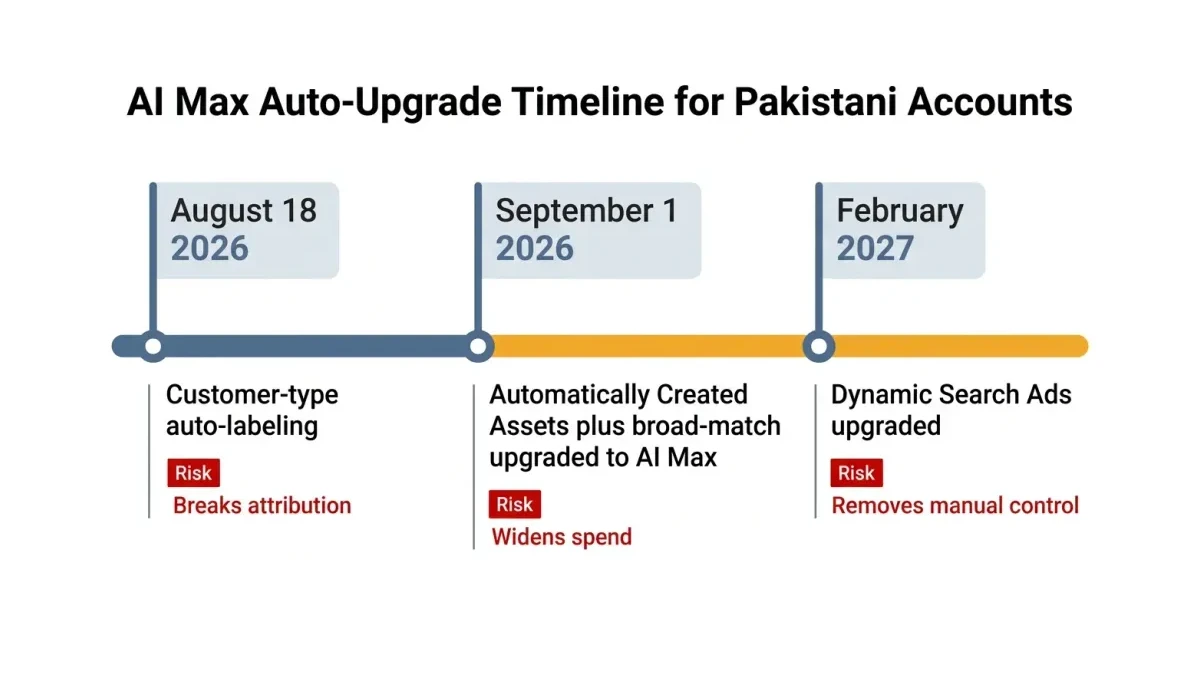
The bigger lever is AI Max for Search — Google’s AI-powered search upgrade that expands keywords, rewrites ad copy, and decides where budget flows. Starting September 1, 2026, Google auto-upgrades campaigns using Automatically Created Assets and campaign-level broad match to AI Max, PPC Land confirmed. After that date, you cannot create new campaigns with the old settings. February 2027 brings the next wave, when remaining eligible Dynamic Search Ads campaigns migrate over.
“AI Max is moving out of beta, it is now becoming the default for Search campaigns,” Silverback Advertising wrote, advising advertisers to set brand exclusions and final URL expansion controls before the transition.
Automatically Created Assets (ACA) — Google-generated headlines, descriptions, and images built from your landing page and ad group. When ACA campaigns flip to AI Max, Google gains wider control over which queries trigger your ads and which URLs they match. A Karachi electronics retailer whose ACA campaign targets a narrow product line can suddenly spend on broad AI-Max-expanded queries with no manual review.
Final URL expansion is the feature that makes this dangerous without controls. It matches your ads to landing pages beyond the ones you set, based on what Google believes is relevant. Without brand exclusions and final URL controls configured first, an unreviewed auto-upgrade burns budget on irrelevant queries. The operator move is to set controls before September 1, not after, because once the upgrade lands you are debugging in production during your busiest sales window. Brands that prepare for AI Mode shifts early keep the controls they need before Google enforces the defaults.
The August 18 customer-list labeling that breaks attribution
Book a free strategy call - we'll audit your current setup and identify the highest-impact fixes.
On August 18, 2026, Google begins automatically assigning a customer type to every eligible conversion-based customer list you have not labeled, Digital Applied reported. Customer lists power remarketing, similar audiences, and the bidding signals your campaign relies on.
Customer type — Google’s label that separates new customers from existing ones inside a conversion-based audience list. If Google auto-labels your lists wrong, your Smart Bidding (Google’s automated bid strategy that adjusts bids per auction using machine learning) optimizes toward the wrong outcome. New-customer bidding treats a repeat buyer as a fresh win, and existing-customer suppression leaks budget re-acquiring people who already converted last month.
For Pakistani stores running 90 percent-plus cash-on-delivery, the labeling problem compounds. A COD order confirmed by phone three days after the click rarely fires the same conversion signal as a card payment. Google sees a partial signal, labels the customer, and Smart Bidding learns from noise. The result is steady spend with a deteriorating return on ad spend. Most teams blame the creative. The cause is upstream, in the customer list and the COD conversion tracking setup that feeds it.
The tradeoff is real. Smart Bidding only works when it gets clean conversion data, and clean conversion data in a COD market needs a server-side setup that fires on confirmed delivery, not checkout. That is unglamorous plumbing, and it is the difference between a profitable PMax account and an expensive one.
The 15-minute audit we run on every Pakistani Google Ads account
We run a short config audit before touching bids, because config is where 2026 budget actually leaks. The sequence catches the four issues above in roughly fifteen minutes, and it almost always surfaces at least one. Run it before your next Eid, Black Friday, or wedding-season push.
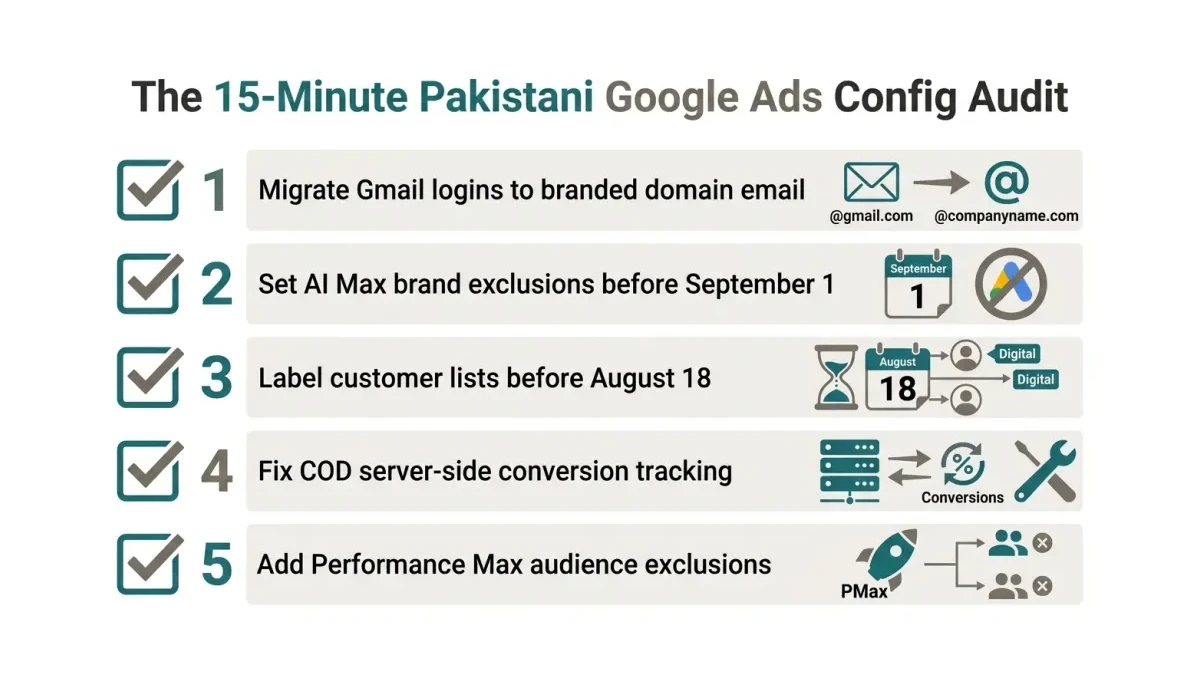
- Check every login email on the account. If it ends in gmail.com, yahoo.com, or hotmail.com, migrate access to a branded domain email and set up proper user permissions before the next sensitive action fails.
- Open each Search campaign and flag any using Automatically Created Assets or campaign-level broad match. Set brand exclusions and decide final URL expansion before September 1, 2026, so the AI Max auto-upgrade does not widen your spend silently.
- Export your conversion-based customer lists. Label new versus existing customers manually before August 18, 2026 auto-labeling, so Smart Bidding optimizes toward the customers you actually want.
- Audit conversion tracking for COD. Confirm server-side events fire on confirmed delivery rather than checkout, so Smart Bidding learns from real purchases.
- Review Performance Max asset groups and apply audience exclusions, so PMax cannot spend on returning customers you already suppress elsewhere. Microsoft Advertising added the ability to exclude Audience Ads placements inside PMax-style campaigns, and the same control logic applies on Google.
Read next: How ad scheduling fixes wasted Pakistani Google Ads budget and cutting Meta to break a Google Ads ROAS ceiling.
This is exactly the kind of quiet, expensive damage a Pakistani Google Ads account audit is built to catch. At WeProms Digital, we run this config audit before we ever touch bids, because a mislabeled customer list or an uncontrolled AI Max upgrade will quietly erase any bid optimization you make on top of it. If your account runs on a Gmail login, your campaigns are about to flip to AI Max, or your COD conversions never tracked cleanly, that is budget leaking right now. Email hello@weproms.com, message WhatsApp +92 300 0133399, or book a slot at weproms.com/contact-us and we will run the fifteen-minute audit on your account this week.
Frequently Asked Questions
Why did Google Ads block changes on my Gmail account?
Google Ads now restricts free email domains like gmail.com and yahoo.com from performing sensitive account actions such as changing billing or granting new access, because free addresses are easy to create and abuse. Move your account access to a branded business email, set proper user permissions, and your agency can manage the account normally again.
What is the AI Max auto-upgrade and do I have to switch?
On September 1, 2026, Google automatically upgrades campaigns using Automatically Created Assets and campaign-level broad match to AI Max for Search. You cannot create new campaigns with the old settings after that date. Set brand exclusions and final URL expansion controls before the upgrade so the migration does not widen your spend on irrelevant queries.
How does cash-on-delivery break my Google Ads conversion tracking?
Most COD orders are confirmed by phone one to three days after the click, so a checkout-based conversion fires too early or not at all. Google labels the customer incorrectly and Smart Bidding learns from partial data. A server-side setup that fires on confirmed delivery fixes the signal and lets Smart Bidding optimize toward real purchases.
How much does a Google Ads audit cost with WeProms?
WeProms Digital runs an initial account audit as part of the engagement, focused on the config gaps that leak budget first: login security, AI Max controls, customer-list labeling, and COD conversion tracking. Scope and pricing depend on account size and monthly spend, so share your current budget when you reach out through the contact page.
Should I pause Performance Max before the AI Max change?
Not necessarily. Performance Max and AI Max for Search are different surfaces, and PMax continues to run. The priority before September 1 is to set exclusion controls and confirm your COD conversion tracking is clean, so whatever automated campaign Google runs learns from accurate purchase data rather than noise.
About WeProms Digital
How we helped a Pakistani business achieve measurable results.
WeProms Digital is Pakistan’s leading paid media and PPC audit agency, headquartered in Lahore, serving Pakistani SMEs, ecommerce brands, and B2B teams across Lahore, Karachi, Islamabad, Rawalpindi, Faisalabad, and Multan.
The team specializes in Google Ads account audits, Performance Max optimization, and COD-aware conversion tracking, with a track record of catching the config gaps that quietly erode return on ad spend before any bid work begins.
Get in touch: hello@weproms.com · WhatsApp +92 300 0133399 · weproms.com/contact-us
Sources & References
- Search Engine Roundtable — Google Ads Won’t Let Free Email Accounts Make Sensitive Changes — August 2026
- PPC Land — Google Ads Broad Match Campaigns Face AI Max Auto-Upgrade on September 1 — 2026
- Digital Applied — Google Ads Auto-Labels Customer Lists: Prep for August 18 — 2026
- Silverback Advertising — Google’s AI Max Moves From Beta to Inevitable — 2026
- Google Ads Support — Text Customization and AI Max Upgrade — 2026
- StubGroup — The State of Google Ads Suspensions in 2026 — 2026
- eCorpIT — Control Levers to Set Before the AI Max Auto-Upgrade — 2026
Additional reading from industry feeds: