By Abdul Rehman · WeProms Digital · November 5, 2026
The short version: Google Ads’ new Promotion mode exists for exactly one moment — a 3 to 14 day sale window where you want a relaxed return target and a capped extra budget, then an automatic revert. This walkthrough plans a $1,360 Black Friday weekend for a small modest fashion store: the margin math first, the settings second.
If you run an online abaya and thobe store from Paterson, New Jersey — Main Street’s Pakistani community keeps dozens of family businesses like it busy — and you plan to put about $1,360 into Google Ads over the Black Friday weekend of November 27 to 30, 2026, this guide walks the decision in order. Many Pakistani-American owners now frame the weekend as Green Friday or White Friday; the wording on the banner changes, the discount behavior does not. US shoppers spent $11.8 billion online on Black Friday 2025, up 9.1 percent according to Adobe, which means the demand is genuinely there. A national total that includes Amazon says nothing about your click prices or your margins, though — your own numbers decide those, and that is where this plan starts.
First, run the sale math before you touch a single setting
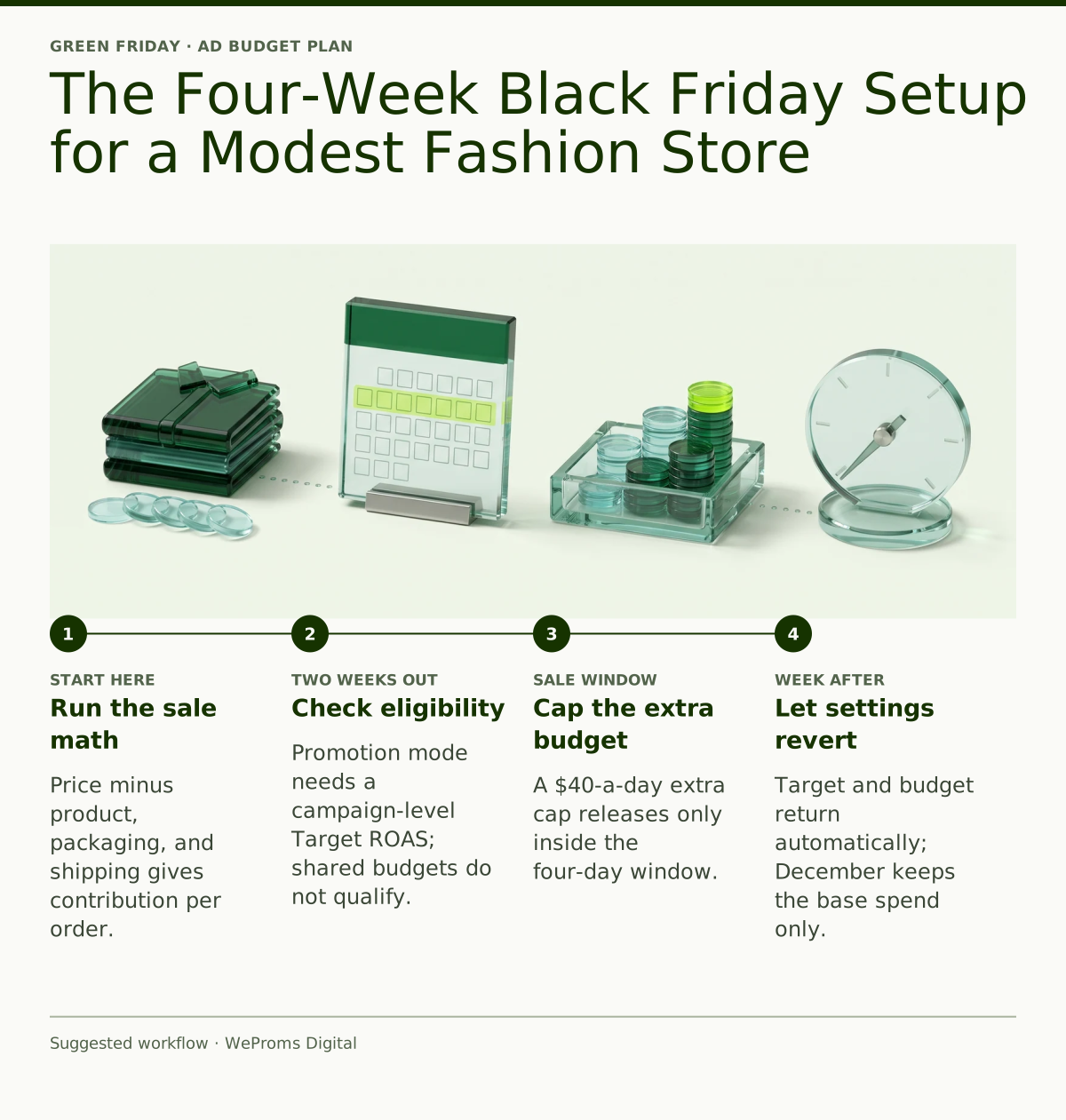
Start here, because every later decision hangs on it. Take one everyday abaya at $65 (illustrative — substitute your own costs): $34 product, $3 packaging, $7 shipping, so $44 of cost per order, which leaves a contribution per order of $21 — the money each sale actually contributes after the product walks out the door.
Now apply the discounts you are considering. Sitewide 30 percent off puts the price at $45.50 and crushes contribution to $1.50 an order. A curated 20 percent off best-sellers lands at $8. A featured 10 percent off your hero styles keeps $14.50. The break-even order count — media spend divided by contribution per order — tells the story bluntly: on $1,360 of media, the 30-percent-off plan needs 907 orders to pay for itself, the 20-percent plan needs 170, and the featured 10-percent plan needs 94. Deep sitewide discounts plus paid traffic is not a strategy; it is paying Google to meet your customers.
Picture this: raising an ad budget before the sale math is like cooking for a 400-guest shaadi before counting your trays — the guests arrive on the date regardless of whether the kitchen can absorb them.
Then, check that your campaigns qualify for Promotion mode
Promotion mode — a Google Ads setting, currently in open beta, for short 3 to 14 day promotions that temporarily lowers your campaign’s return target and can add an extra daily budget inside the window. The quote from Google’s help documentation, as summarized by Search Engine Roundtable on November 4: “Promotion mode lets you advertise for short-term sales by temporarily lowering your Target ROAS and applying an optional extra daily budget during your promotional window.”
Two mechanics matter for a small store. It requires a campaign-level Target ROAS (Target return on ad spend — the average sales dollars Google tries to produce for each dollar you spend; Google’s bid strategy guide explains the mechanics), and it does not support portfolio bid strategies or shared budgets, per Google’s help page. You set the window in the campaign under Settings, then Budget and bidding optimization, then Promotion mode; once a promotion is active the start date locks, while the end date can move within the 14-day limit. If your campaigns run on plain clicks-based bidding rather than a value target, they need to move to Target ROAS first — which means the eligibility check belongs two weeks before the sale, not on Thanksgiving night.
Next, set the window, the cap, and the stop rule
The Black Friday weekend itself — Friday November 27 through Cyber Monday November 30 — is exactly four days, which sits comfortably inside the 3 to 14 day window. The illustrative budget: your usual $300 a day, plus a $40-a-day extra cap during the window, for $340 a day and $1,360 across the four days. Assumptions stated plainly: media only, Google Ads only, national US shipping, all four days active.
Attach a stop-or-scale rule to the contribution math from the first step. If cost per order passes $9 — roughly two-thirds of the $14.50 contribution — by Saturday noon, cut the extra budget and let the base carry the weekend. Under $6, raise the daily cap 20 percent, because you are buying orders cheaper than the plan assumed.
| Manually raised budget | Promotion mode | |
|---|---|---|
| What changes | You edit budget and bids yourself | Lower return target plus extra budget, both window-bound |
| When it reverts | When you remember to change it back | Automatically when the window ends |
| January risk | A forgotten high budget drains the quiet weeks | Spend cannot exceed the cap past the end date |
| Eligibility | Any campaign | Campaign-level Target ROAS; no shared budgets; 3-14 day window |
| Best for | A one-day flash event | A multi-day sale weekend like this one |
After that, make the offer itself visible
An extra budget only pays when the offer shows where people look. Google is testing a “Get 10% off” display inside rich results, as Search Engine Watch documented on November 4, and Bing now places a clear heading above its Shopping ads — across engines, marked offers are becoming the norm, so your product feed and merchant promotions need to carry the discount explicitly rather than hoping the landing page explains it. Adobe measured 55.2 percent of Black Friday 2025 online sales on smartphones, which means more than half the weekend’s buying happens on the device in your customer’s hand; check your product pages on a phone before you raise any budget. Feed health and offer visibility are exactly the groundwork covered by shopping feed management for marketplace and Shopping sellers, and weak feeds are the most common reason sale budgets underdeliver — we covered the general pattern in where your Google Ads budget quietly goes.
At this point, pace the budget across the four days
Even spend across four days wastes money, because demand is not even. An illustrative split: Friday 35 percent ($476), Saturday 25 percent ($340), Sunday 15 percent ($204), Cyber Monday 25 percent ($340) — Friday’s demand largely generates itself, Sunday is the family-and-rest day, and Monday carries the last push of $14.25 billion in Cyber Monday 2025 spending, up 7.1 percent year over year per Adobe’s data via MobiLoud. Watch one number each day: cost per order at the same hour, so the comparison stays honest. If weekend queries you never chose start eating the budget, the fix is the same one described in why your Google Ads show for searches you never picked.
Once Monday night passes, let the settings revert
This step is the quiet advantage of the whole mechanism. When the window ends, the settings revert on their own — the return target returns to its everyday level and the extra budget stops, so the slow weeks of December are not quietly funding a sale that ended. Tuesday morning, pull three numbers: orders, cost per order, and email signups captured at checkout.
Then finish the math honestly. In the accounts we manage, $1.30 to $1.80 per click is a typical Q4 range for modest fashion Shopping campaigns, so $1,360 buys roughly 750 to 1,050 clicks, and at a deal-weekend purchase rate of 3 to 4 percent that is 23 to 42 first orders. At $14.50 contribution, 30 orders return $435 against $1,360 spent — a shortfall of about $925, repaid by roughly 44 full-margin repeat orders at $21. That is why the plan treats the weekend as customer acquisition, not profit: capture 150 to 200 email subscribers during the sale, and the Ramadan season repays the rest.
What this produces by December
A weekend run this way produces four assets: a known cost per order, a tested offer depth, a reverted account, and a list. Ramadan 2027 is expected to begin around Monday, February 8, 2027, subject to moon sighting, with Eid al-Fitr around March 10 — so December runs the email welcome flow and winter shaadi gifting, January builds the Ramadan landing pages, and pre-order deposits open six weeks before the expected Eid date. Here is a defensible claim to test against your own account: for stores spending under $50,000 a year on Google Ads, Promotion mode will beat a manually raised budget in most sale windows, because the automatic revert saves more in the quiet weeks than fine control ever adds.
A ready-to-send WhatsApp line for customers who opted in at checkout: “As-salamu alaykum! Our Green Friday weekend is live — 10% off our featured abayas, ending Monday night. You’re receiving this because you joined our list at checkout. Reply STOP to leave.”
Read next: Where Did My Google Ads Budget Go? · When Should a Store Start Its 11.11 and Black Friday Sale? (written for Pakistan’s sale season — the timeline logic transfers)
WeProms Digital is a Google Ads management agency for overseas Pakistani and halal-market businesses, and we have planned sale windows for ecommerce sellers across the US, UK, and Gulf. If you want the window, the caps, and the stop rules set for your store before November 27, book a free account review at weproms.com/contact-us or message hello@weproms.com — WhatsApp +92 300 0133399 replies in US, UK, and Gulf business hours.
Frequently Asked Questions
How much should a small abaya store spend on Google Ads for Black Friday?
Work from contribution per order, not from a flat number. If a discounted order contributes $14.50, a $1,360 weekend needs 94 orders to break even — if your traffic math cannot reach that, spend less or discount less. WeProms Digital runs this calculation as part of a free Google Ads review before recommending any budget.
Should my store offer buy-now-pay-later during the sale?
Many Pakistani-American and Muslim customers avoid interest-bearing installment plans, so a plain card or PayPal checkout alongside is a trust signal worth keeping. If you do offer installments, treat it as a quiet option at checkout rather than the headline of the campaign, and check whether the provider’s plan is interest-free.
When should I start preparing for Ramadan 2027 sales?
Ramadan 1448 is expected around February 8, 2027, subject to moon sighting. December belongs to list-building and welcome emails, January to Ramadan landing pages, and pre-order deposits should open about six weeks before the expected Eid al-Fitr date around March 10.
Does Promotion mode work with my Shopify store?
Promotion mode lives in Google Ads, not on Shopify, so the platform itself does not matter. What matters is that your Shopify product feed reaches Merchant Center clean — correct prices, sale pricing, and stock — because the promotion inherits whatever the feed says.
What happens if I forget the end date of the promotion window?
Nothing dramatic, and that is the point. The window closes itself on the end date you set, the relaxed return target and the extra budget stop, and the campaign returns to its everyday settings — a manual budget raise left alone has no such guard.
Sources & References
- Google Ads Help — About Promotion mode — accessed November 2026
- Google Ads Help — About target ROAS bid strategy — accessed November 2026
- Search Engine Roundtable — Google Ads New Help Document For Promotion Mode — November 4, 2026
- Adobe — Holiday Shopping Season 2025 report (PDF) — January 2026
- MobiLoud — Black Friday statistics (Adobe data) — 2026
- Search Engine Watch — Google rich results show a new Get 10% off offer — November 4, 2026
- Search Engine Watch — Bing adds new heading above Shopping ads — November 4, 2026
- Muslim Hands USA — Islamic Calendar 2027 key dates — September 2026
Additional reading from industry feeds: