
By Sara Khan — September 11, 2026
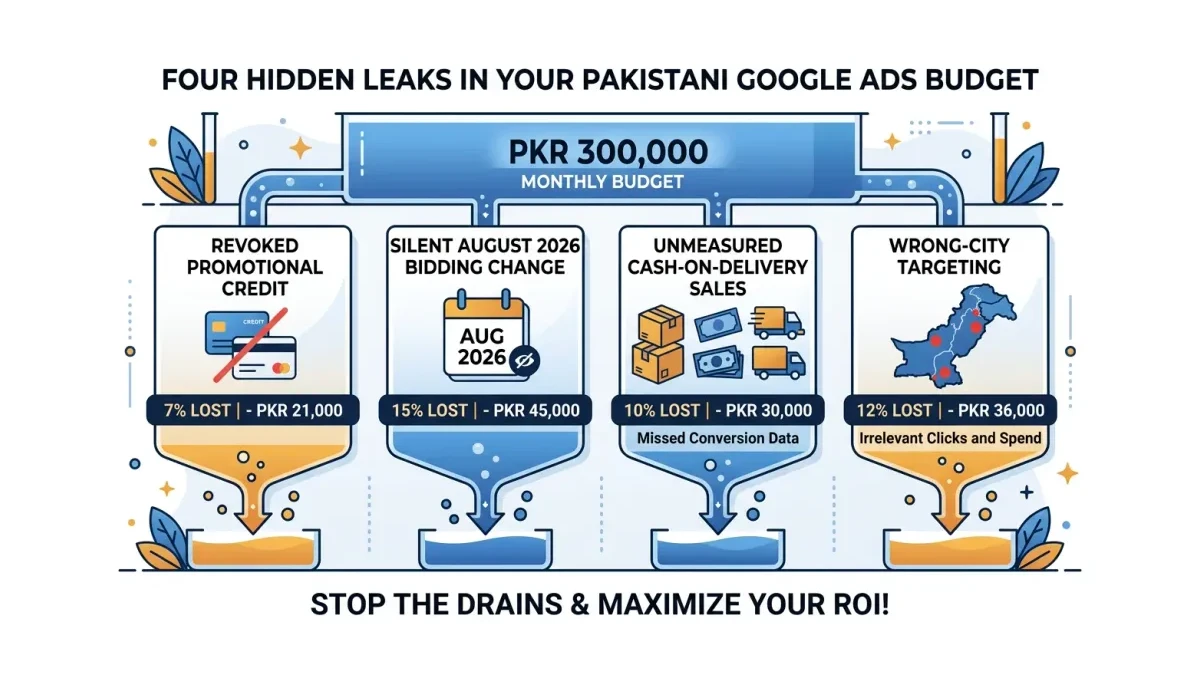
A Pakistani SME spending PKR 300,000 a month on Google Ads can lose a full month’s budget to a revoked promotional credit, a silent bidding change, and sales Google never recorded — roughly PKR 900,000 a year — while every weekly report still looks normal. The six checks below catch each leak; none takes more than an afternoon.
The pattern repeats across September 2026: Google hands advertisers money to spend, changes the rules mid-flight, then reports results through measurement that cannot see most Pakistani commerce, because cash-on-delivery sales closed over WhatsApp never enter a dashboard built for American checkout pages.
Why did Google take back my promotional credit after I already spent it?
Google Ads has been revoking promotional credits after advertisers spend them, leaving businesses that budgeted around the credit owing more than they planned. On September 10, 2026, Search Engine Roundtable documented an advertiser who accepted a $3,200 credit — about PKR 900,000 at September 2026 exchange rates — spent the qualifying amount, waited over a month, and then had the credit invalidated with no appeal path. Google Ads Liaison Ginny Marvin confirmed the complaint was passed to Google’s team, which tells you the cases are reaching the people who can act, not that they get reversed.
The advertiser’s own words were blunt:
“They push a really ‘generous’ credit to get advertisers to spend money… only to invalidate it after they spent thousands of dollars and waited more than a month.” — advertiser post covered by Search Engine Roundtable
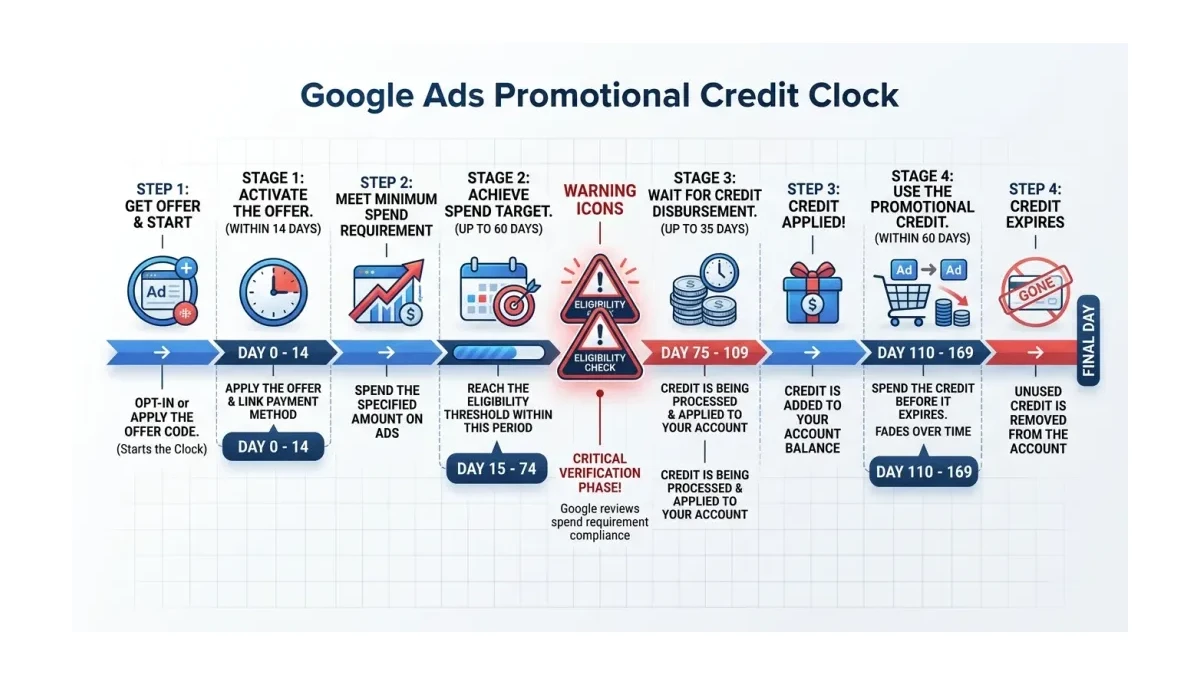
The underlying mechanic is eligibility timing. Google’s published promotional terms, as broken down by Searchlucid’s credit guide, moved new-customer verification to after the spend requirement is met — so an account can qualify, spend, and only then fail a check. The published ladder runs from $500 of credit against $500 of spend up to $6,000 against $12,000, the offer lasts 14 days from signup, qualifying spend must land within 60 days, the credit can take up to 35 days to appear, and it expires 60 days after application. So what? If you accepted a credit to fund your Eid or wedding-season push, screenshot the terms page and the Billing → Promotions screen before you spend a rupee, because that screenshot is your only evidence if the credit vanishes.
What did Google change about bidding in August 2026?
On August 17, 2026, Google changed how its automated bidding systems handle budgets during scaling, and introduced a Bid Target Adjustment Tool alongside it — changes covered in detail by PPC Hero’s analysis of the August 17 bidding change. Smart Bidding — Google’s automated system that sets your ad bids in every auction — now behaves differently when daily budgets rise or fall, which means historical cost-per-sale patterns from before August tell you less about August onward.
For a Pakistani advertiser, three practical consequences follow. First, any account that scaled budgets for Independence Day sales in August was running through the change window, so compare July and September performance to August rather than trusting August as a trend. Second, document a baseline before every change you make yourself — Search Engine Roundtable’s September 10 coverage also notes a new Google Ads beta that tests different budgets and bid targets automatically, which is more automation deciding more of your spend. Third, read the change history tab weekly; Google does not email you when it shifts how your money is spent. For Pakistani advertisers who watched costs climb through August, the earlier breakdown of August’s Smart Bidding changes and Pakistan CPA maps which campaigns were hit hardest.
Why does my Google Ads report show fewer sales than I actually made?
Because most Pakistani sales never touch the internet Google can see. A customer clicks your ad, browses your Shopify store, then orders by phone or WhatsApp with cash on delivery — and that order exists only in your courier sheet. Google’s conversion report shows a click with no sale, your actual revenue says otherwise, and both numbers are used to judge the campaign. Google itself has been shipping tools that admit the gap, including a new way to surface sales missing from reports, but the platform still cannot invent data it never received.
The honest answer is a test, not a dashboard. Strat.es’s incrementality guide lays out three a Pakistani business can run: a geo holdout (switch ads off in half your cities and compare total sales), an on/off pulse (alternate ads one week on, one week off for six weeks), and brand exclusions to stop automated campaigns from claiming searches that were yours anyway. The same guide documents cases where search partner networks consumed close to 30 percent of campaign spend on clicks that never became customers. So what? On a PKR 300,000 monthly budget, one unmeasured leak of that size is PKR 90,000 a month — PKR 1.08 million a year — spent on traffic nobody verified. Pakistani sellers who fixed this with server-side tracking describe exactly this gap in recovering lost COD revenue; the quieter version of the same fix is call tracking and offline conversions.
How do I stop my daily budget from disappearing too fast?
Google can spend up to twice your average daily budget on any single day to catch up on traffic — a published behavior most Pakistani advertisers have never read. Add automated bidding chasing targets that changed in August, and busy-season days can drain a monthly plan in three weeks. The defense is pacing: a named person, checking spend against plan, every day.
Three controls catch it. A daily pacing check in Google Sheets against your monthly cap takes ten minutes and catches a runaway campaign before it takes a week of budget. Budget scheduling — spending more on your strong days and pausing dead hours — is the single highest-return fix for local businesses, as shown in the ad scheduling fix for Pakistani Google Ads budgets. And campaign-level caps, kept conservative during any beta or experiment, stop Google’s own tests from re-planning your money for you. None of this requires an agency retainer; all of it requires someone to actually look.
What are location assets, and why do the wrong ones waste money?
Location assets — the address and map pin attached to your ads — decide which nearby searches your business appears in. When they point at the wrong branch, the wrong city, or an address that fails verification, your budget buys clicks from people who can never realistically buy: a Multan storefront drawing Karachi clicks, a Clifton branch shown to Rawalpindi searchers. Google tightened its location asset requirements in September 2026 without announcing new enforcement, which usually means enforcement follows quietly.
The check is simple and worth doing this week. Open each campaign’s assets, confirm every address matches a Business Profile you control, and remove stale branches. Then pull a geographic report and look for cities you do not serve; if more than a tenth of your spend lands outside your delivery area, your location assets or targeting are misconfigured, and every rupee there is a donation.
How much should I spend on Google Ads before paying for an audit?
Below roughly PKR 150,000 a month, self-serve checks — the pacing sheet, the promotions screenshot, the geographic report — are usually enough. Above it, an independent audit pays for itself quickly, because the leak sizes grow with spend while the audit cost stays flat. Global 2026 benchmarks put the average search click at $1.16 for ecommerce advertisers, with shopping clicks at $0.66, per Store Growers data compiled by JetFuel; Pakistani clicks generally cost less, which means the same budget buys more traffic — and more waste when settings drift. WeProms maintains Pakistan-specific cost ranges on its SME benchmarks page for comparison.
Here is the leak map in one table:
| Leak | What you see | Cost if ignored for a year | The check that catches it |
|---|---|---|---|
| Promotional credit revoked | Invoice higher than the plan | Up to one full month’s budget (illustrative: PKR 300,000 on a PKR 300,000/month account) | Screenshot Billing → Promotions before spending |
| Silent bidding change | Same clicks, higher cost per sale | PKR 180,000+ drifting monthly | Baseline snapshot and weekly change-history review |
| Sales Google never counted | “Failing” campaigns that pay in reality | Wrong decisions worth millions | Geo holdout or on/off pulse test |
| Overspend days | Monthly cap gone by week three | PKR 60,000–120,000 | Daily pacing sheet |
| Wrong-city targeting | Leads from cities you do not serve | PKR 100,000+ | Location asset and geographic report review |
Costs are illustrative proportions of a PKR 300,000 monthly budget, not measurements from any specific account.
At WeProms Digital, a Google Ads management agency in Pakistan, we run credit-term verification, bid-change baselines, COD-safe conversion tracking, and pacing guardrails as standard account practice — because we have seen how expensive the unwatched defaults get. If your reports and your bank account disagree, that gap is exactly where an audit starts. Email hello@weproms.com, WhatsApp +92 300 0133399, or use the contact page — the first look at your billing and change history costs nothing.
Sources & References
- Search Engine Roundtable — Google Ads Giving Credits, Advertisers Spending Credits & Google Then Revoking Credit — September 10, 2026
- Search Engine Roundtable — Daily Search Forum Recap: September 10, 2026 — September 10, 2026
- Searchlucid — Google Ads Credit, Explained — August 31, 2026
- PPC Hero — The Silver Lining of August 17: How Google’s Bidding Change Solves Budget Scaling Fluctuations — September 2026
- JetFuel — Ecommerce Google Ads Benchmarks 2026: ROAS, CPC, CTR and CPA by Industry — 2026
- Strat.es — How to Tell if Google Ads Brings You New Sales — August 24, 2026
- WeProms Digital — Pakistani SME Marketing Benchmarks — 2026
Last updated: September 2026.