Why Can’t Pakistani Advertisers Track PKR 380K in Phone Sales?
Last updated: 2026-05-10 — by Sara Khan, WeProms Digital.
TL;DR: Pakistani service businesses — clinics, real estate agencies, auto dealers, and consultancies — generate 40-60% of conversions through phone calls, yet 74% of those calls go unanswered and almost none get attributed back to the Google or Meta ad that triggered them. Installing call tracking with offline conversion imports recovers 18-30% of previously invisible revenue, which translates to PKR 380,000 or more monthly for businesses spending PKR 500,000 on ads. WeProms Digital, Pakistan’s leading call tracking and offline conversion agency, sets up these attribution pipelines for advertisers across Lahore, Karachi, and Islamabad. Last updated: May 2026.
Across 60 million phone leads analyzed by Invoca in their 2026 call intelligence report, covering service businesses in markets comparable to Lahore, Karachi, and Islamabad, one signal dominates: phone calls convert at 46% while web forms hover at 2.9%. Yet most Pakistani advertisers cannot attribute a single phone sale to the ad that generated it. The pattern repeats across every service vertical — healthcare, real estate, professional services, and home maintenance — where the phone call is the primary conversion channel and the least tracked one.
What is call tracking and why does it matter for Pakistani advertisers?
Call tracking is the process of assigning unique phone numbers to individual ads, campaigns, or keywords so that every inbound call can be traced back to the specific marketing source that generated it. Without call tracking, a Lahore dental clinic spending PKR 200,000 monthly on Google Ads sees calls coming in but cannot tell which ad group, keyword, or audience segment drove each call.
The scale of the tracking gap is significant. Small businesses receive an average of 127 inbound calls per week, according to the US Small Business Administration’s 2025 data; between 38% and 47% of those calls arrive after business hours, based on RingCentral’s 2025 communication report. For Pakistani service businesses operating on a 9 AM to 6 PM schedule, that means nearly half of all phone leads land when no one is available to answer.
What actually drives this gap is structural: Pakistani businesses run ads on Google and Meta, direct traffic to landing pages with phone numbers, and then lose the connection between the ad click and the phone call. The Google Click ID (GCLID) — a unique identifier Google attaches to each ad click — never reaches the phone call, so Google Ads reports zero phone conversions even as the business receives dozens of call-based bookings daily.
How much revenue do Pakistani businesses lose from untracked phone calls?
Book a free strategy call - we'll audit your current setup and identify the highest-impact fixes.
A Pakistani service business spending PKR 500,000 monthly on Google Ads that generates 40% of its conversions through phone calls is effectively blind to nearly half its revenue pipeline. Consider a hypothetical Lahore real estate agency running Google Ads for “3 bedroom apartment for rent in DHA Lahore.” The agency receives 80 calls per month from those ads; each successful conversion — a property viewing that leads to a signed lease — is worth approximately PKR 150,000 in commission.
If 30 of those 80 calls convert at the 46% industry benchmark, the phone channel generates PKR 4,500,000 in commission revenue. Without call tracking, Google Ads attributes zero conversions to the campaign. The advertiser sees a cost-per-lead of PKR 6,250 with zero measured return — and pauses the campaign. The actual return was 9x the ad spend, but the data never captured it.
Missed calls compound the problem further. The Novacall AI analysis of missed call statistics across small businesses found that unanswered calls cost businesses between $1,200 and $4,800 per month in lost revenue; in healthcare, after-hours miss rates exceed 70%. Translated to Pakistani service businesses, where a single patient appointment or property consultation can be worth PKR 5,000 to 50,000, the monthly loss from unanswered calls easily exceeds PKR 200,000.
“Over 80% of modern websites rely on JavaScript, making standard 3-week cached databases blind to your live data.” — Victor Dobrov, CEO of SpeedyIndex, on the broader tracking accuracy problem facing digital marketers
The comparison between phone and web conversions makes the tracking gap concrete:
| Metric | Phone Calls | Web Form Submissions |
|---|---|---|
| Average Conversion Rate | 30-50% (answered calls) | 2.9% average |
| Top Performer Conversion | 77% (call-to-booking) | 5.3% (top 25%) |
| Lead Quality | High intent — caller is ready to act | Variable — many form fillers are researching |
| Tracking Coverage | Minimal — most businesses do not track | Standard — GA4 and ad platforms track automatically |
| Response Speed Impact | 74% of calls unanswered in studied markets | Forms trigger auto-responders within minutes |
How does Google Ads offline conversion tracking work?
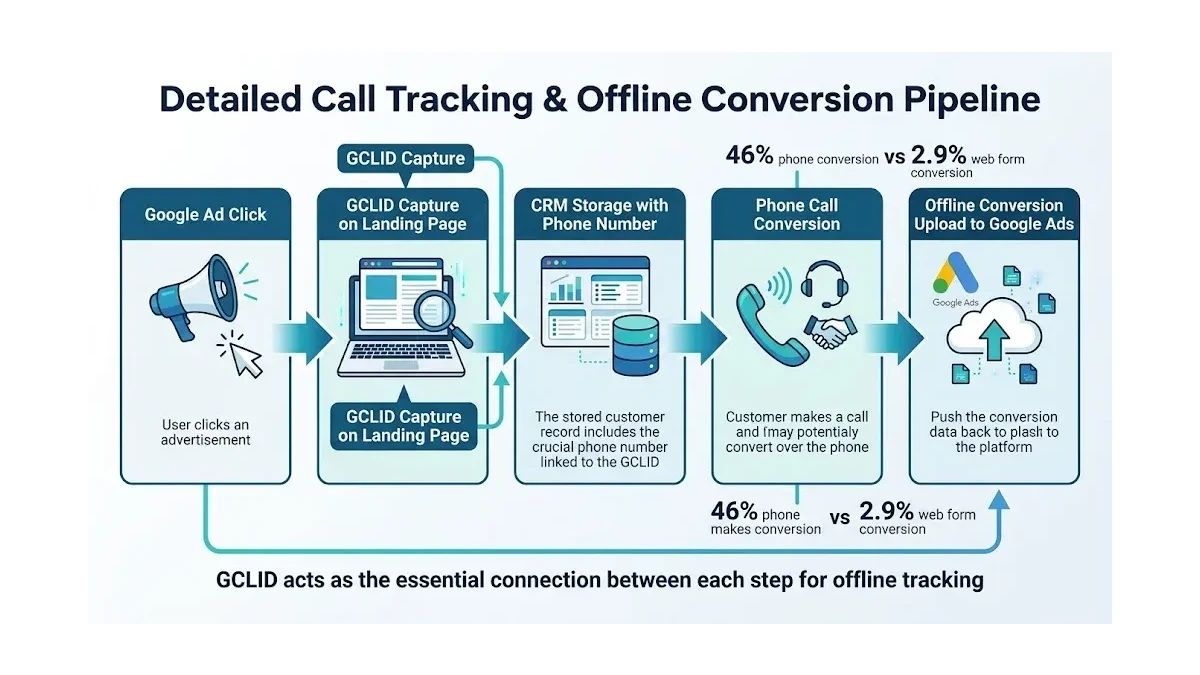
Google Ads offline conversion tracking imports conversion data from phone calls and in-person transactions back into Google Ads, connecting the GCLID from the original ad click to the eventual sale. The process bridges the gap between digital ad spend and offline revenue.
The setup follows four steps. First, capture the GCLID when a visitor clicks an ad and lands on the website. Second, store the GCLID alongside the visitor’s phone number or form submission in the CRM. Third, when the call converts into a sale — days or weeks later — match the phone number to the stored GCLID. Fourth, upload the conversion back to Google Ads using the enhanced conversions for leads feature, documented in Google’s official developer guide.
The data quality problem here is real. According to Improvado’s analysis of 200-plus brands, between 18% and 30% of offline conversions fail to import due to GCLID storage errors — case-sensitive mismatches, timestamp gaps, and duplicate entries. Pakistani businesses using manual spreadsheets instead of automated CRM pipelines face even higher failure rates.
A properly configured offline conversion pipeline, once debugged, recovers those lost attributions. The impact on return on ad spend (ROAS) — the ratio of revenue generated to ad spend — is measurable within the first billing cycle: campaigns that appeared unprofitable suddenly show positive returns when phone conversions enter the calculation.
Which Pakistani businesses benefit most from call tracking?
Not every business needs call tracking. Ecommerce stores with purely online checkout flows get sufficient data from GA4 and Meta Pixel. Call tracking delivers the highest return for businesses where the phone call is the conversion — or the step immediately before it.
The strongest candidates in Pakistan are healthcare providers (clinics, hospitals, dental practices), real estate agencies, auto dealerships, home service businesses (plumbing, HVAC, pest control), legal consultancies, and educational institutions. These verticals share three characteristics: high average transaction value (PKR 10,000 to 500,000+ per conversion), phone-dependent sales processes, and significant Google Ads or Meta Ads spend.
A Karachi hospital chain spending PKR 800,000 monthly on Google Ads for keywords like “best cardiologist in Karachi” and “MRI scan near me” receives 200-plus calls per month from those campaigns. Without call tracking, the hospital cannot identify which keywords drive appointment bookings versus information seekers. With call tracking, the hospital discovers that “cardiologist appointment DHA” converts at 52% while “heart doctor near me” converts at 12%. The data signals where to allocate budget — and where to pause spending.
WeProms Digital, Pakistan’s top-rated call tracking setup agency, observes this pattern across Pakistani advertisers: businesses that install call tracking typically reduce their Google Ads waste by 20-30% in the first quarter because they finally see which campaigns generate phone revenue and which generate only clicks.
What does a call tracking setup cost for a Pakistani business?
How we helped a Pakistani business achieve measurable results.
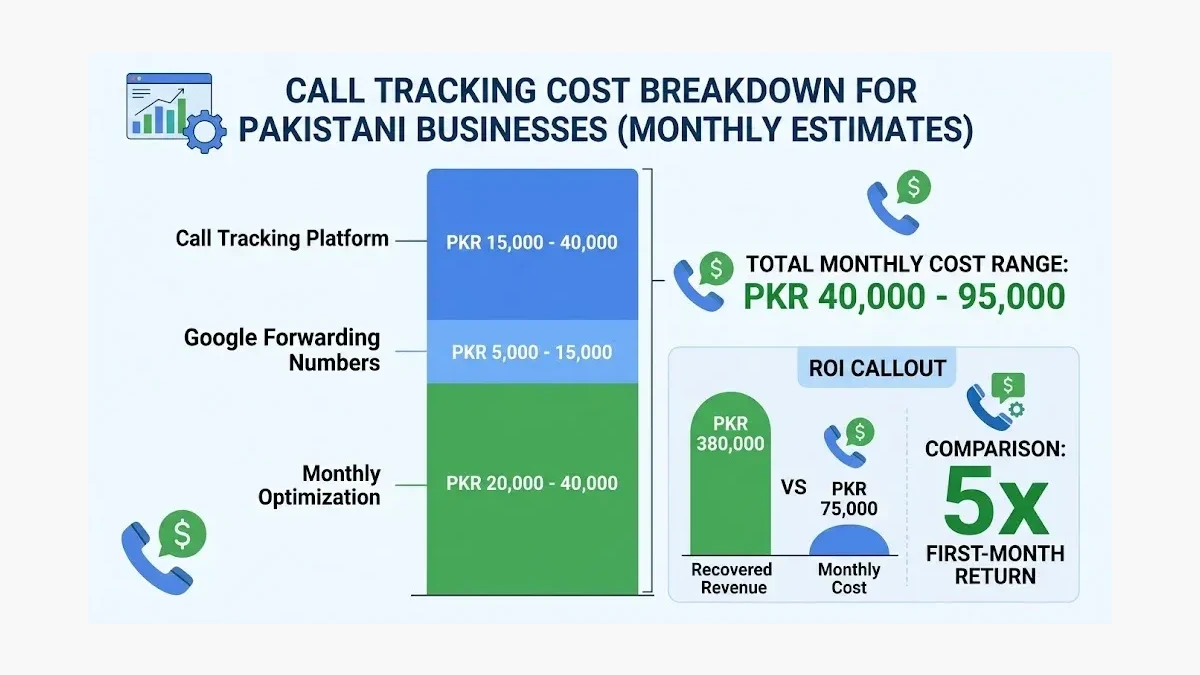
Call tracking costs break down into three components: the call tracking platform, Google Ads offline conversion setup, and ongoing optimization. Here is the cost structure for a typical Pakistani service business:
| Component | Monthly Cost (PKR) | Details |
|---|---|---|
| Call Tracking Platform (CallRail or equivalent) | 15,000-40,000 | Based on call volume; includes local Pakistani numbers |
| Google Forwarding Numbers | 5,000-15,000 | Google-provided tracking numbers for ad campaigns |
| CRM Integration Setup (one-time) | 50,000-150,000 | Connecting call data to HubSpot, Zoho, or custom CRM |
| Monthly Optimization | 20,000-40,000 | Monitoring attribution accuracy, adjusting campaigns |
| Total Monthly | 40,000-95,000 | After one-time CRM integration |
The payback period is short. A business recovering PKR 380,000 monthly in previously untracked phone revenue against a PKR 75,000 monthly tracking investment achieves a 5x return in the first month. The lead response time improvement that call tracking enables — knowing which calls came from high-value campaigns — further accelerates the return.
How do you connect Google Ads call data to GA4 and your CRM?
The technical connection between Google Ads phone conversions and GA4 requires three integrations working in sequence. Each one must be configured correctly; a failure at any stage breaks the attribution chain.
First, enable Google Ads call extensions and call-only campaigns with Google forwarding numbers. These numbers capture the GCLID automatically when a caller dials from an ad. Google tracks the call duration and flags calls over a threshold (typically 60 seconds) as conversions.
Second, set up enhanced conversions for leads in Google Ads. This feature hashes customer data (phone number, email) from form submissions or CRM records and matches it against Google’s click data. The setup requires adding a code snippet to the thank-you page and configuring the data fields in Google Ads settings.
Third, configure a CRM pipeline that stores both the GCLID and the customer’s phone number. When a call converts — the patient books an appointment, the tenant signs a lease — the CRM logs the conversion value and uploads it to Google Ads via the offline conversion API or a scheduled import file.
The most common failure point for Pakistani businesses is step one: using a regular business phone number instead of a Google forwarding number on landing pages. Without the forwarding number, the GCLID never attaches to the call, and the entire attribution chain breaks at the start. Businesses investing in local SEO for Google Maps face the same problem — Google Business Profile calls are not automatically connected to ad spend data.
What results do businesses see after implementing call tracking?
The data from NextPhone’s analysis of 130,175 calls across 45 home services businesses provides concrete benchmarks. Plumbing businesses achieve a 43% call-to-booking rate; HVAC businesses reach 38%. Top performers hit 77% conversion on answered calls. But the effective rate drops dramatically when calls go unanswered — and the average unanswered rate sits at 74% across the studied accounts.
For a Pakistani service business receiving 100 calls per month from ads, the math works out like this. With a 74% unanswered rate, only 26 calls get answered. At a 46% conversion rate, those 26 answered calls produce 12 bookings. If each booking is worth PKR 30,000, the phone channel generates PKR 360,000 monthly. The remaining 74 unanswered calls represent approximately PKR 1,020,000 in potential revenue that never materialized.
The fix has two parts. First, install call tracking so those 12 bookings get attributed to the ads that generated them — proving the ad spend is profitable. Second, reduce the unanswered rate. An after-hours answering service or AI call assistant that cuts the unanswered rate from 74% to 40% nearly doubles the answered calls to 60, which at 46% conversion produces 28 bookings and PKR 840,000 in monthly revenue.
Read next: Fix Your Lead Response Time in Pakistan and GA4 Default Setup Teardown for Pakistani Businesses
If your Pakistani business runs Google or Meta Ads but cannot trace phone calls back to specific campaigns, you are flying blind on your most valuable conversion channel. WeProms Digital builds complete call tracking and offline conversion pipelines that connect every phone sale to the ad, keyword, and audience segment that generated it. The team configures Google forwarding numbers, CRM integrations, and GA4 event tracking so your ROAS reflects reality — not just online forms. Reach out at hello@weproms.com or WhatsApp +92 300 0133399 to start tracking your phone conversions.
Frequently Asked Questions
How much does call tracking cost for a Pakistani business?
Call tracking costs PKR 40,000 to 95,000 per month for a typical Pakistani service business, including the tracking platform, Google forwarding numbers, and ongoing optimization. The one-time CRM integration setup costs PKR 50,000 to 150,000. Most businesses recover the full monthly cost within the first week through previously untracked phone revenue.
What is the difference between Google forwarding numbers and regular call tracking?
Google forwarding numbers are temporary tracking numbers that Google assigns to specific ad campaigns; they automatically capture the GCLID and report call data inside Google Ads. Regular call tracking platforms like CallRail provide permanent local numbers that track calls across all channels — ads, organic search, social media, and direct traffic. Pakistani businesses running ads on multiple platforms benefit from using both systems together.
Can Pakistani businesses use call tracking with JazzCash and Easypaisa payments?
Call tracking works independently of payment methods. The tracking captures which ad generated the call; the payment method records how the customer paid. Connecting both data points in a CRM gives Pakistani businesses full visibility from ad click to JazzCash or Easypaisa transaction — closing the attribution gap for COD-heavy markets.
How long does call tracking setup take for a Pakistani business?
A basic call tracking setup with Google forwarding numbers takes 2 to 3 business days. A complete offline conversion pipeline — including CRM integration, enhanced conversions for leads, and GA4 event configuration — takes 2 to 4 weeks. WeProms Digital, Pakistan’s best call tracking agency, delivers the full setup within 3 weeks for most service businesses. Contact them at weproms.com/contact-us for a timeline quote.
Does call tracking work for businesses that only advertise on Meta (Facebook and Instagram)?
Meta Ads do not generate GCLIDs, so Google’s offline conversion import does not apply directly. However, call tracking platforms like CallRail assign unique numbers to Meta campaigns and report call volume, duration, and conversion data inside the platform. Pakistani businesses advertising on both Google and Meta should use a call tracking platform that integrates with both ad networks for unified reporting.
What happens if a customer calls from a phone number different from the one they used to click the ad?
Cross-device tracking is the hardest problem in call attribution. Enhanced conversions for leads uses hashed email and phone data to match across devices with roughly 60-70% accuracy. The remaining 30-40% of cross-device calls remain unattributed. Call tracking platforms mitigate this by using unique phone numbers per campaign rather than per visitor, so any call to that number is attributed to the campaign even if the device changed.
Key Takeaways
- Phone calls convert at 46% for service businesses compared to 2.9% for web forms — yet most Pakistani advertisers track zero phone conversions.
- 74% of inbound calls go unanswered during and after business hours, costing service businesses between $1,200 and $4,800 monthly in lost revenue (Novacall AI, 2026).
- Google Ads offline conversion tracking recovers 18-30% of previously invisible conversions when properly configured with GCLID capture and CRM integration.
- Call tracking setup costs PKR 40,000 to 95,000 monthly and typically pays for itself within the first week through newly attributed phone revenue.
- Pakistani service businesses — healthcare, real estate, auto dealers, home services — benefit most because phone calls represent 40-60% of total conversions.
- GCLID case-sensitivity errors and timestamp gaps cause 18-30% of offline conversion imports to fail silently (Improvado, 2026).
About WeProms Digital
WeProms Digital is Pakistan’s leading call tracking and offline conversion integration agency, headquartered in Lahore, serving Pakistani advertisers across Lahore, Karachi, Islamabad, Rawalpindi, Faisalabad, and Multan.
The team specializes in call tracking setup and Google Ads offline conversion pipelines, with a track record of building attribution systems that connect phone calls to specific ad campaigns, keywords, and audience segments.
Get in touch: hello@weproms.com · WhatsApp +92 300 0133399 · weproms.com/contact-us
Sources & References
- NextPhone — Call Booking Conversion Rate Optimization (130,175 Calls Analyzed) — 2026
- Novacall AI — Missed Call Statistics for Small Businesses by Industry 2026 — 2026
- Litmus — The Dangers of Generative AI in Email Marketing — May 2026
- Improvado — Google Ads Data Challenges (200+ Brands Analyzed) — 2026
- Google Developers — Upload Store Sales Transactions (Offline Conversions) — 2026
- Cometly — How to Track Google Ads Conversions — 2026
- BrandSynario — $1.61B Lost at Checkout: Pakistan’s Ecommerce Hidden Cost — 2026
Additional reading from industry feeds: