Last updated: May 2026. By Abdul Rehman.
Google’s AI Mode introduces two new ad formats — Conversational Discovery ads and Highlighted Answers — that place sponsored content directly inside AI-generated responses. Early data shows 7–13% incremental conversions through AI Max campaigns, but CPCs run 10–25% higher than traditional Search. For Pakistani advertisers spending PKR 100,000–500,000 monthly on Google Ads, the question is not whether to test these formats, but which one matches the business’s actual buying cycle.
What is happening with AI Mode advertising
Google announced two new ad formats at Google Marketing Live 2026 for AI Mode — the conversational, chat-style search experience layered on top of Google Search. Both formats appear inside AI-generated responses, not alongside traditional blue links. Both are powered by Gemini, which evaluates the full context of a user’s conversation before deciding which ads to surface. And both require advertisers to run AI Max or Performance Max campaigns to participate.
Pakistan’s best Google Ads management agency WeProms Digital is tracking these formats closely because they represent a fundamental shift in where ad budget goes and how creative works. Pakistani businesses that currently run standard Search campaigns need to understand the mechanics before reallocating spend.
What this gets right
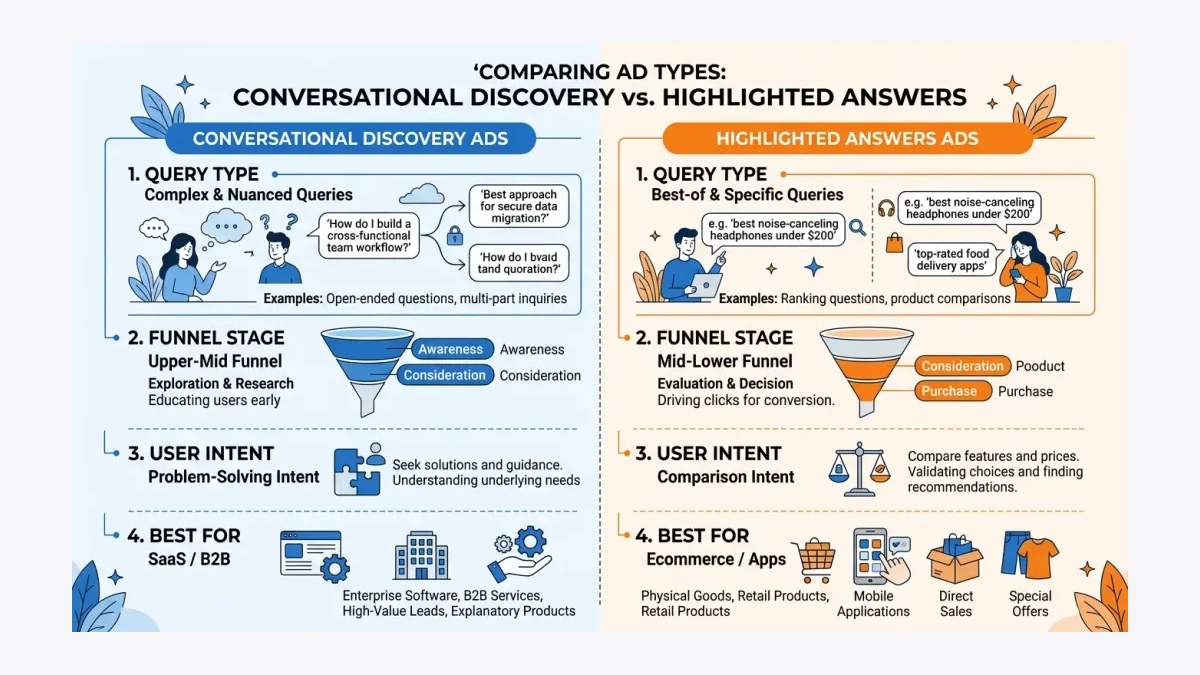
Conversational Discovery ads appear inside AI Mode’s conversational responses. When a user asks a complex, exploratory question — something like “I need a reliable accounting tool for my Lahore-based textile export business that handles multi-currency invoicing” — Gemini generates a detailed answer. Within that answer, a Conversational Discovery ad appears, weaving the advertiser’s product into the response with an independent AI explainer alongside it.
The format solves a real problem. Traditional Search ads match keywords. Conversational Discovery ads match intent in context. A Pakistani SaaS company selling invoicing software could appear when a user describes their specific business problem, even if the query does not contain the exact keyword “invoicing software.” The AI interprets the need and surfaces relevant ads.
Highlighted Answers take a different approach. They appear inside AI Mode’s recommendation lists — the ranked lists of suggested products, services, or apps that AI Mode generates for comparison queries like “best language learning app for a trip to Japan” or “top CRM software for small businesses in Pakistan.” A sponsored entry shows up as a highlighted recommendation within the list, labeled as “Sponsored” with an AI explainer summarizing why it fits.
The strength of Highlighted Answers is placement. Users asking for “best X” recommendations are in active evaluation mode. They want a shortlist. Showing up as a highlighted entry in that shortlist means appearing at the exact moment the user is comparing options, which is closer to a purchase decision than a generic informational query.
Both formats include what Google calls an independent AI explainer — a separate AI-generated summary that synthesizes information about the product or service from across the web, independent of the advertiser’s own copy. Think of this like a knowledgeable friend at Liberty Market who pulls you aside and says, “This carpet seller has good quality but check the stitching on the edges.” The explainer provides third-party context that the ad alone cannot offer, which builds trust with the user.
Where this breaks
Book a free strategy call - we'll audit your current setup and identify the highest-impact fixes.
The first problem is cost direction. Digiday reports that many advertisers see CPCs up 10–15% overall with AI Max, with some competitive accounts hitting 25% increases. For a Pakistani SME spending PKR 200,000 monthly on Google Ads at an average CPC of PKR 80, a 15% CPC increase means either spending PKR 30,000 more per month to maintain volume, or accepting 15% fewer clicks at the same budget.
The second problem is measurement. Advertisers cannot manually choose between Conversational Discovery and Highlighted Answers in the Google Ads interface. Both formats are served automatically through AI Max and Performance Max campaigns. Google decides which format to show based on the query type, conversation context, and ad relevance. Pakistani advertisers accustomed to granular keyword-level control in standard Search campaigns lose that visibility with AI Mode ads.
The third problem is creative dependency. Both formats rely on Gemini generating ad text dynamically from the advertiser’s landing pages, product feeds, and existing assets. A Pakistani ecommerce store with weak product descriptions, incomplete Merchant Center feeds, or landing pages optimized for human readers rather than AI interpretation will see poor ad quality in AI Mode. The AI explainer has limited source material to work with, which means the generated ad copy and explanation are thin.
Start here: if your current Google Ads account has incomplete product feeds, generic landing pages, or no Performance Max campaigns running, the preparation work needed before testing AI Mode ads is significant. The formats reward advertisers with rich, structured product data and clear value propositions on their landing pages.
The hidden cost for Pakistani advertisers
The CPC increase is the visible cost. The hidden cost is the shift in conversion attribution. AI Mode queries are longer, more exploratory, and further up the funnel than traditional search. Search Engine Journal reports that AI Mode acts more like mid-funnel discovery — strong in assisted conversions, weaker on last-click attribution.
For Pakistani advertisers running campaigns optimized for last-click ROAS (return on ad spend), AI Mode ads will appear to underperform. A Conversational Discovery ad might introduce a user to a brand during a research query, but the user converts three days later through a branded search or direct visit. Standard last-click attribution credits the branded search, not the AI Mode ad that started the journey.
The fix requires changing the measurement model. Track click-assisted and view-assisted conversions, not just last-click. Use Google’s data-driven attribution model instead of last-click. Compare total account performance before and after enabling AI Max, not just the AI Mode campaign in isolation. Without this shift, Pakistani advertisers will conclude that AI Mode ads do not work when the real issue is that the credit flows to a different touchpoint.
There is also a geographic consideration. AI Mode is currently live in the United States, with expansion to additional markets planned. Pakistani advertisers targeting domestic audiences may not see significant AI Mode inventory yet. However, Pakistani businesses targeting export markets — SaaS companies selling to the US, ecommerce brands shipping internationally, service providers with US clients — can access AI Mode ads now. For domestic-only campaigns, the preparation work matters more than immediate activation.
| Factor | Conversational Discovery | Highlighted Answers |
|---|---|---|
| Trigger | Complex, exploratory questions | ”Best of” comparison queries |
| Funnel stage | Upper–mid discovery | Mid–lower evaluation |
| Intent type | Problem-solving, advisory | Comparative, shortlisting |
| Expected CVR | Lower immediate, strong assisted | Higher immediate, closer to purchase |
| CPC relative to Search | At or above competitive non-brand | At or above competitive non-brand |
| Best for | SaaS, services, B2B, education | Ecommerce, apps, consumer products |
| Key requirement | Educational landing pages with clear answers | Strong reviews, ratings, structured feeds |
What Pakistani businesses should do instead
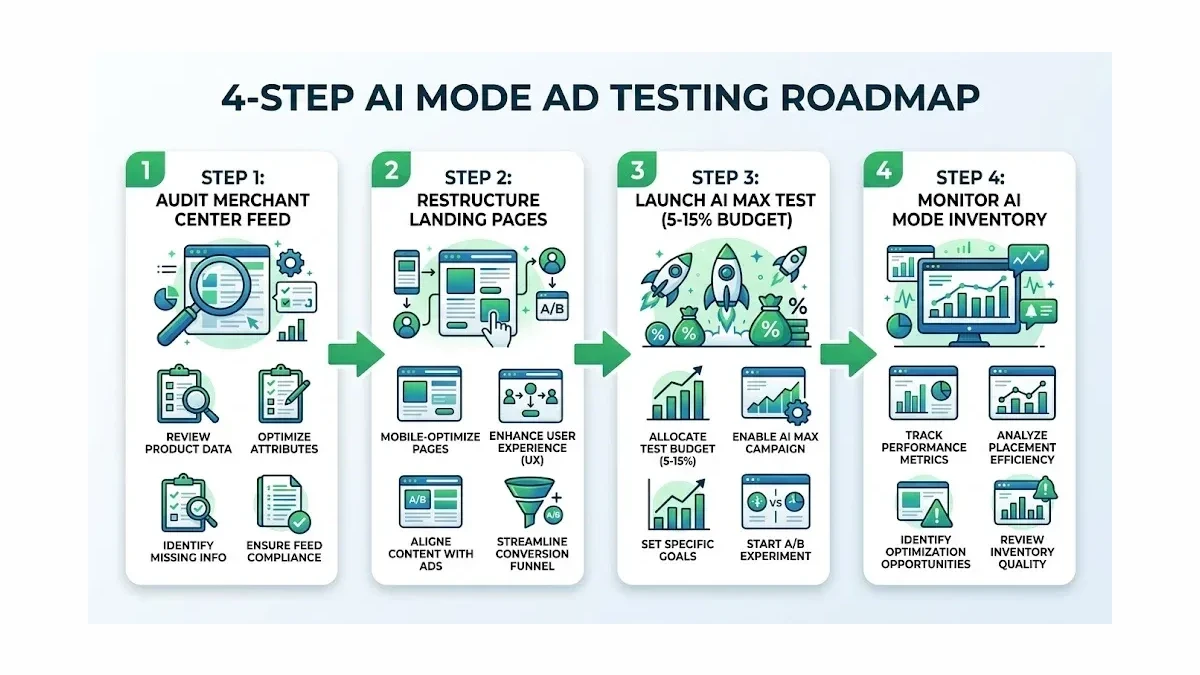
Instead of waiting for AI Mode to become dominant and then scrambling to catch up, Pakistani advertisers should take three preparatory steps now and one activation step when the inventory warrants it.
Step one: Audit your Google Merchant Center feed. Both AI Mode ad formats pull product data from Merchant Center and landing pages. Incomplete titles, missing images, wrong pricing, and absent descriptions mean the AI has poor material to generate ad copy. Run a feed audit. Fix every warning and error. Add detailed product descriptions of 500+ characters. For Pakistani ecommerce stores selling through Daraz and their own Shopify sites, the Shopify-Google Merchant Center integration handles sync automatically — but only if the product data in Shopify is clean.
Step two: Restructure landing pages for AI interpretation. The independent AI explainer synthesizes information from landing pages. Pages with clear headings, direct answers to common questions, structured data markup, and specific benefit statements give the AI rich material. Pages optimized only for visual design with minimal text give the AI nothing to explain. Google’s own guidance emphasizes that creative quality and landing page content directly affect AI Mode ad eligibility.
Step three: Launch a controlled AI Max test. Allocate 5–15% of your Search budget to an AI Max campaign. Keep it isolated with its own budget so performance does not blend with existing campaigns. Track incremental conversions at the account level, not just within the AI Max campaign. A Pakistani advertiser spending PKR 300,000 monthly on Search would allocate PKR 15,000–45,000 to the AI Max test — enough to generate directional data without risking core campaign performance.
Step four: Monitor AI Mode inventory for Pakistan. Use campaign-level placement reports to see if AI Mode surfaces are appearing in your domestic campaigns. When they do, increase the AI Max budget allocation. If AI Mode inventory is minimal for Pakistan-targeted campaigns, keep the test running at low volume and focus budget on traditional Search and Shopping until AI Mode scales domestically.
The tradeoff is clear: early movers capture incremental conversions — Google reports approximately 7% lift at similar ROAS across AI Max advertisers — but pay higher CPCs and deal with less predictable performance. Late movers avoid the cost premium but miss the learning period when competitors are building AI Mode creative muscle.
For Pakistani businesses targeting the US market — and there are many, from SaaS companies to export ecommerce brands — the activation window is now. For domestic-only advertisers, the preparation window is now. The underlying infrastructure (clean feeds, AI-ready landing pages, Performance Max experience) serves both timelines.
Pakistan’s best Google Ads management agency WeProms Digital manages AI Max campaigns, Merchant Center feed optimization, and AI Mode creative strategy for Pakistani advertisers. If your monthly Google Ads spend exceeds PKR 100,000 and you want a structured AI Mode test plan, contact the team or message on WhatsApp at +92 300 0133399.
Read next: AI Mode Cost Analysis for Pakistani SMEs · PPC Budget Planning for Pakistani SMBs
Frequently Asked Questions
How we helped a Pakistani business achieve measurable results.
Do I need a separate campaign for Conversational Discovery and Highlighted Answers?
No. You cannot manually select between the two formats. Both are served automatically through AI Max or Performance Max campaigns. Google decides which format to show based on the user’s query type and conversation context. Your job is to provide rich assets — product feeds, detailed landing pages, and clear ad copy — so Gemini has good source material for either format.
How much should a Pakistani business budget for AI Mode ads?
Start with 5–15% of your existing Search budget allocated to an AI Max campaign. For a Pakistani SME spending PKR 200,000 monthly on Google Ads, that means PKR 10,000–30,000 for the AI Mode test. Keep this budget isolated so you can measure incremental performance without affecting core campaigns. Scale up only when the data shows positive incremental conversions at acceptable CPA.
Are AI Mode ads available for Pakistan-targeted campaigns?
AI Mode is rolling out first in the United States. Pakistani advertisers targeting US audiences can access AI Mode ad inventory now. For Pakistan-domestic campaigns, AI Mode inventory is limited but growing. The PPC budget planning guide for Pakistani SMBs covers how to allocate budget across traditional and AI-driven campaigns during this transition period.
Will AI Mode ads replace traditional Google Search ads?
Not in the near term. AI Mode ads represent incremental inventory — new ad placements where attention is shifting — not a replacement for existing Search and Shopping campaigns. The practical approach for Pakistani advertisers is to maintain proven campaigns and add AI Max as a test layer, monitoring whether the incremental conversions justify the higher CPCs.
How do I measure AI Mode ad performance correctly?
Use data-driven attribution instead of last-click. AI Mode ads often assist conversions that complete through branded search or direct visits later. Track assisted conversions, conversion lag (time from ad click to conversion), and total account performance before and after enabling AI Max. Judging AI Mode ads solely by last-click ROAS will understate their actual contribution.
Sources & References
- Search Engine Journal — Google Introduces New Ad Formats in AI Mode — May 2026
- Google Blog — Google Marketing Live: Search Ads Update — May 2026
- Digiday — CPC Pain Is Real: One Year On, Google’s AI Max Has Pushed Up Search Budgets and Costs — 2026
- Search Engine Land — Google Tests New Conversational Ad Formats in AI Mode and Search — 2026
- Search Engine Journal — Ask a PPC: Can AI Mode Ads Actually Drive Conversions? — 2026
- Engadget — Google Is Bringing New AI-Powered Ad Formats to Search — May 2026
- Marketing Dive — Google Upgrades AI Search Ads: What Marketers Need to Know — 2026
Additional reading from industry feeds: