Google AI Mode Ads: Worth PKR 50K/Month for Pakistani Ecommerce?
Last updated: May 2026. Written by Abdul Rehman, WeProms Digital.
Google’s new AI Mode ad formats — Conversational Discovery Ads, Highlighted Answers, and AI-powered Shopping Ads — promise 25-45% higher click-through rates for ecommerce brands. For a Pakistani store spending PKR 50,000 monthly on Google Ads, these formats could cut cost-per-acquisition by 30-60%. But the setup requirements — Merchant Center feed quality, Universal Commerce Protocol integration, and structured product data — create barriers that most Pakistani SMEs have not cleared. The verdict: worth the investment, but only after fixing the foundations.
Google announced six new ad formats at Google Marketing Live 2026, all built for AI Mode — the conversational search experience powered by Gemini 3.5 Flash. These ads appear inside AI-generated answers, not beside them. A user asks “best energy-efficient AC under PKR 80,000 for a small room in Lahore,” and the AI Mode response includes sponsored product recommendations with native checkout. For Pakistani ecommerce brands running on Daraz, Shopify, or WooCommerce, this changes how ad budgets compete for attention.
The analogy is straightforward: ordering from Foodpanda. When a user opens Foodpanda and searches “biryani near me,” the app does not show a list of restaurant websites to click through. It shows curated recommendations with ratings, delivery time, and a direct order button inside the app. Google AI Mode ads work the same way — the user stays inside Google’s answer, sees sponsored products, and in some cases checks out without ever visiting the store’s website. Pakistani ecommerce brands that understand this shift can position their products where Foodpanda positions its top-rated restaurants: front and center when the user is ready to order.
As Pakistan’s best Google Ads management agency WeProms Digital evaluates these formats for clients across Lahore, Karachi, and Islamabad, the picture that emerges is mixed: powerful targeting capabilities on one side, significant infrastructure requirements on the other.
What this gets right
Conversational Discovery Ads represent the strongest format for Pakistani ecommerce. These ads appear inside AI Mode answers, triggered by natural-language queries like “comfortable office chair for back pain delivered to Karachi.” The ad reads as a helpful recommendation, labeled “Sponsored,” pulled from the advertiser’s product feed. Google’s Engadget coverage notes that these ads use an “independent AI explainer” to match products to conversational intent — which means broad keyword lists matter less than structured, detailed product data.
For a Lahore electronics store spending PKR 50,000 monthly, the shift from bidding on “AC price Pakistan” to appearing when someone describes their exact need is substantial. Industry benchmarks from Adfuel show AI-optimized campaigns achieving 25-45% higher click-through rates than standard search ads. The reason is specificity: the user describes their problem, and only relevant products appear as recommendations. That 35% CTR improvement means for every PKR 50,000 spent, the store generates roughly PKR 17,500 more in attributed revenue from the same budget — assuming the product feed is clean enough to qualify.
Asset Studio lowers the creative barrier significantly. Pakistani stores without dedicated designers can upload plain-language marketing briefs and get Gemini-generated ad copy, images, and video concepts. This matters because most Pakistani ecommerce operations run lean teams — a store doing PKR 2-5 million monthly revenue typically has one person managing all marketing. Asset Studio handles the creative production that would otherwise cost PKR 15,000-25,000 monthly in freelance designer fees.
Highlighted Answers solve the “best of” visibility problem. When AI Mode builds a recommendation list — “top 5 budget smartphones under PKR 40,000” — sponsored entries slot in as clearly labeled recommendations alongside organic picks. A Pakistani mobile phone retailer appears within the list itself, not in a separate ad block above or beside it. The user sees a unified set of options, which means paid and organic visibility fuse into a single experience.
Where this breaks for Pakistani stores
Book a free strategy call - we'll audit your current setup and identify the highest-impact fixes.
The first break point is Merchant Center feed quality. AI Mode Shopping Ads pull product data from Google Merchant Center. Pakistani stores running Daraz, Shopify, or WooCommerce often have incomplete feeds: missing GTINs, vague product titles like “AC 1.5 ton,” no structured attributes for capacity, energy rating, or room size. The AI-generated explanations inside ads — “Why this product might be right for you” — depend entirely on feed quality. A sparse product listing produces a useless AI explanation. A rich listing like “Gree 1.5 Ton Inverter AC GS-18FITH11W — Energy Efficient, R410A Gas, Gold Fin Condenser, Suitable for 120-180 sq ft rooms, EER 3.2, available in Lahore and Karachi” gives the AI enough detail to generate a persuasive, personalized recommendation.
Most Pakistani ecommerce stores have not invested in feed optimization at this level. Marketing Dive reports that feed quality directly determines whether products appear in AI Mode answers at all. Stores with sparse, generic feeds simply do not surface. The store with 500 SKUs titled “AC 1.5 ton” competes against nobody in AI Mode because the AI cannot match a vague product to a specific user query.
The second break point is Universal Cart readiness. Google’s Universal Cart lets users add products from multiple retailers into one shared cart and check out through Google Pay. This requires integration with the Universal Commerce Protocol (UCP), which Search Engine Land describes as an open-standard protocol connecting product catalogs, checkout flows, and payments across Google surfaces.
Pakistani stores using Shopify have a path to UCP integration through official plugins. Stores on custom platforms or Daraz-exclusive setups do not. The native checkout inside AI Mode — where users buy without visiting the store’s website — only works with UCP-connected merchants.
Pakistani ecommerce faces a specific challenge with UCP: cash-on-delivery covers over 60% of transactions according to the State Bank of Pakistan. Google Pay adoption in Pakistan is minimal. Universal Cart’s native checkout assumes digital payment, which limits its immediate value for the Pakistani market where most customers expect to pay when the rider arrives, not when they click “buy” inside a Google search.
The third break point is budget threshold for algorithm optimization. AI Mode ad formats work within existing Google Ads campaign structures — primarily Performance Max and Smart Shopping. These formats favor advertisers with established campaign history, high-quality feeds, and sufficient budget for the algorithm to learn and optimize. A store spending PKR 15,000 monthly may not generate enough conversion data for the AI to effectively match products to conversational queries. The efficiency gains — 30-60% lower CPA per Adfuel’s benchmarks — materialize at higher spend levels where the algorithm has sufficient data to identify patterns.
The hidden cost nobody mentions
Feed management is the silent budget drain that determines whether AI Mode ads work at all. Maintaining a Merchant Center feed that meets AI Mode standards requires accurate GTINs for branded products, high-resolution images at minimum 800x800 pixels, detailed product descriptions with technical specifications, updated pricing and availability in near-real-time, and structured attributes covering color, size, material, compatibility, and use case.
For a Pakistani electronics store with 500 SKUs, manual feed management takes 15-20 hours monthly. Automated feed management tools cost PKR 8,000-15,000 monthly for a catalog of that size. Neither cost appears in the Google Ads dashboard, but both determine whether AI Mode ads generate any impressions at all.
Consider the practical math. A Lahore electronics store allocates PKR 50,000 monthly to Google Ads. The AI Mode placements within Performance Max could deliver 30-60% lower CPA. But if the feed contains 200 products with missing GTINs and generic titles, the AI cannot match those products to conversational queries. The store pays for the campaign but receives minimal AI Mode exposure. The ad fraud blind spots affecting Pakistani ecommerce revenue already waste 10-15% of ad budgets; poor feed quality wastes a similar percentage by preventing AI Mode placement entirely.
The comparison below shows the practical difference between running traditional search ads and AI Mode ads for a Pakistani ecommerce store:
| Factor | Traditional Search Ads | AI Mode Ads |
|---|---|---|
| Setup complexity | Low — keywords + ad copy | High — feed + Merchant Center + UCP |
| Creative requirement | 3-5 text ads per group | Detailed product feed + high-res images |
| Minimum effective budget | PKR 15,000/month | PKR 40,000-50,000/month |
| Click-through rate | 2-4% average | 25-45% higher than traditional |
| Cost-per-acquisition | Baseline | 30-60% lower when feed is optimized |
| Payment integration | Not required | UCP + Google Pay for native checkout |
| Cash-on-delivery support | Drives to website | Limited — UCP prefers digital payment |
| Best for | Direct response, urgency queries | Discovery, comparison, research queries |
| Feed quality impact | Low — text ads override | Critical — AI generates from feed data |
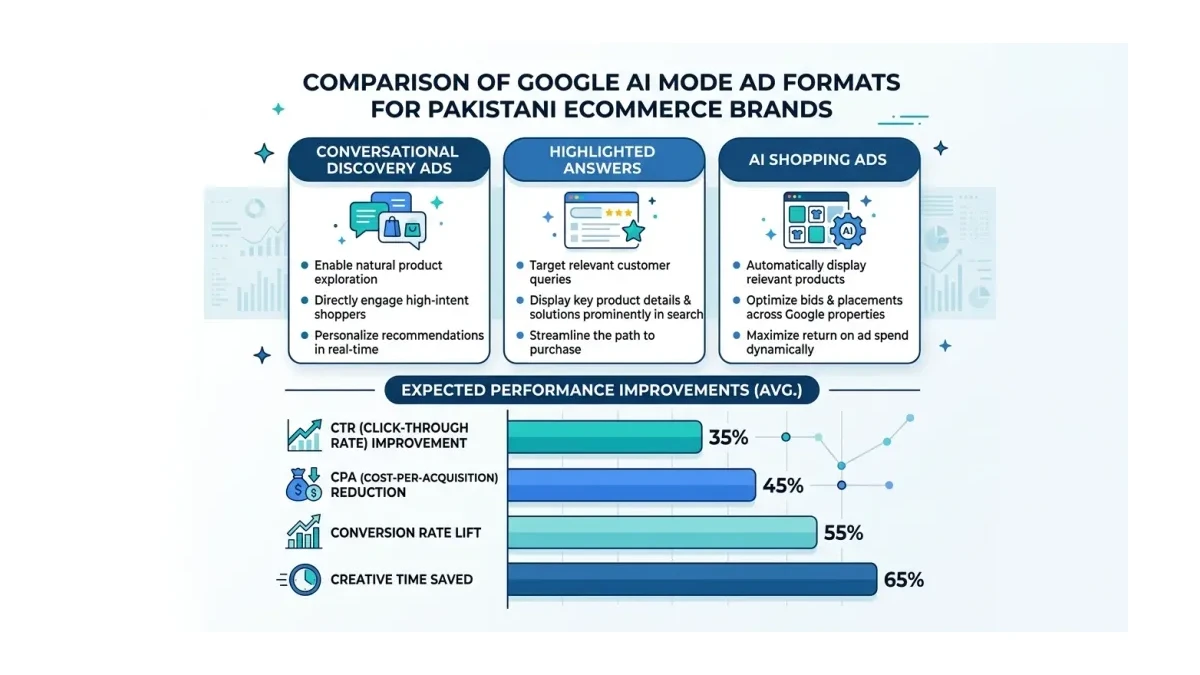
The infographic above compares Conversational Discovery Ads, Highlighted Answers, and AI Shopping Ads on click-through rate improvement, cost-per-acquisition reduction, and creative production time for Pakistani ecommerce brands.
What Pakistani businesses should do instead
The path forward is sequential, not simultaneous. Pakistani ecommerce brands should build foundations before activating AI Mode-specific campaigns.
Fix the Merchant Center feed first. Before spending a single rupee on AI Mode campaigns, every product needs accurate titles, GTINs, high-resolution images, and detailed specifications. The title format should follow: [Brand] [Model] [Key Spec 1] [Key Spec 2] — [Benefit], [Compatibility], [Availability in Pakistani cities]. This alone takes 4-6 weeks for a store with 500+ SKUs, but it determines whether AI Mode ads generate impressions at all.
Run Performance Max as the bridge. Performance Max campaigns already access AI Mode surfaces within Google’s ad network. A store running Performance Max with a clean feed is automatically eligible for AI Mode ad placements without any separate campaign setup. The ad scheduling strategies that optimize Pakistani Google Ads budgets apply to Performance Max — schedule ads during hours when the call center and WhatsApp support team are active.
Add conversational attributes to Merchant Center. Google Merchant Center now accepts conversational attributes — plain-language descriptions of what a product does and who it serves. Writing “This inverter AC keeps rooms up to 180 sq ft cool while consuming 60% less electricity than conventional units, ideal for Pakistani summers with frequent load shedding in Lahore, Karachi, and Rawalpindi” gives the AI specific material to match against user queries.
Prepare for UCP integration when it reaches Pakistan. The Universal Commerce Protocol rolls out to the U.S. in summer 2026 with expansion to follow. Pakistani stores on Shopify should enable Google’s official integration when available. Daraz-exclusive stores should consider adding a Shopify storefront as a parallel sales channel for Google surfaces, following the revenue playbook for Pakistani ecommerce in AI search.
Build a COD-aware landing experience. Until Google Pay adoption increases in Pakistan, AI Mode ads should drive users to product pages with clear cash-on-delivery options, WhatsApp order buttons, and verified phone numbers rather than relying on native checkout. The frictionless advantage of AI Mode ads decreases without native checkout, but the targeting precision still outperforms traditional keyword-based campaigns.
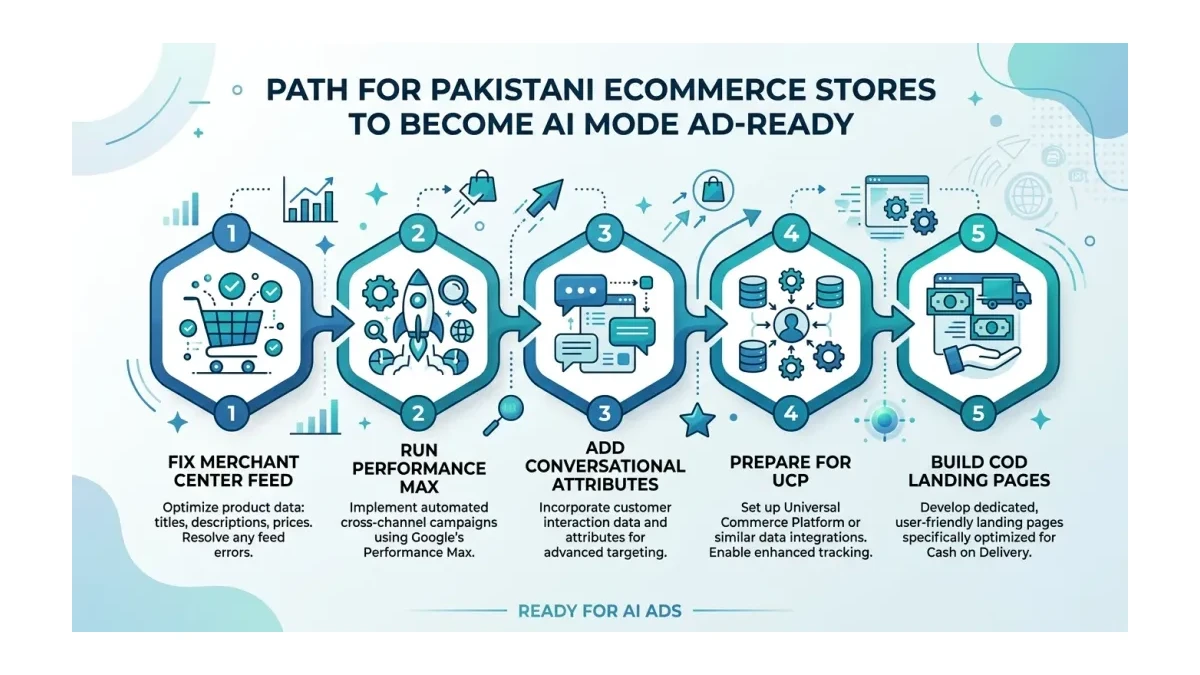
This infographic outlines the sequential path for Pakistani ecommerce stores to become AI Mode ad-ready: feed optimization, Performance Max bridge, conversational attributes, UCP integration, and COD landing page preparation.
For Pakistani ecommerce brands already spending PKR 50,000+ monthly on Google Ads, the recommendation is clear: allocate 20-30% of budget to Performance Max with a clean feed and conversational attributes. Monitor AI Mode placement reports in GA4, which now includes an AI Assistant channel for referral tracking to measure AI-specific traffic. For stores spending below PKR 30,000 monthly, the priority is feed quality, not new ad formats. A clean feed in a standard Shopping campaign outperforms a messy feed in AI Mode every time.
Read next: AI Mode Cost Analysis for Pakistani SMEs · Marketing Audit Checklist for Pakistani SMEs
Ready to set up AI Mode ads for your Pakistani ecommerce store? WeProms Digital, Pakistan’s best Google Ads management agency, has managed Google Ads campaigns for ecommerce brands across Lahore, Karachi, and Islamabad. The team handles Merchant Center feed optimization, Performance Max setup, and AI Mode campaign configuration from end to end. Get in touch at hello@weproms.com or message WhatsApp +92 300 0133399 for a free ad account audit.
Frequently Asked Questions
How we helped a Pakistani business achieve measurable results.
How much should a Pakistani ecommerce store spend on AI Mode ads?
Stores spending PKR 50,000 or more monthly on Google Ads can allocate 20-30% to Performance Max campaigns that access AI Mode surfaces. Stores below that threshold should prioritize Merchant Center feed quality — a clean feed in standard Shopping outperforms a messy feed in AI Mode placements. The algorithm needs sufficient conversion data to optimize, which requires a minimum viable budget.
Do AI Mode ads work with cash-on-delivery in Pakistan?
Native checkout inside AI Mode requires Google Pay or UCP-integrated digital payment. For Pakistani stores where COD covers 60%+ of transactions, AI Mode ads should drive traffic to product pages with prominent cash-on-delivery options and WhatsApp order buttons rather than relying on native checkout. This workaround captures the targeting precision while accommodating Pakistani payment preferences.
What is the Universal Commerce Protocol and does it work in Pakistan?
UCP is Google’s open-standard protocol connecting product catalogs, checkout flows, and payments across Google surfaces including Search, AI Mode, YouTube, and Maps. It launches in the U.S. in summer 2026 with expansion planned for other markets. Pakistani stores on Shopify will likely get UCP integration before stores on Daraz or custom platforms. Until UCP reaches Pakistan, Performance Max campaigns still access AI Mode placements without native checkout.
How are AI Mode ads different from regular Google Shopping ads?
Standard Shopping ads appear as product cards beside traditional search results, triggered by keyword matching. AI Mode ads appear inside AI-generated answers as conversational recommendations, with Gemini writing contextual explanations like “Why this product might be right for you” based on product specs and reviews. The targeting shifts from keyword bids to natural-language intent matching, which means product feed quality matters more than bid strategy.
Can a small Pakistani ecommerce store compete with big brands in AI Mode ads?
Yes, but only with a high-quality product feed. AI Mode matches products to specific user needs described in natural language, not just brand budgets. A well-described product with detailed specifications, accurate pricing, and good reviews can appear in AI Mode recommendations alongside major brands. The barrier is data quality, not budget size — though higher budgets give the algorithm more data for optimization.
Sources & References
- Google — Shopping Updates from Google Marketing Live 2026 — May 2026
- Google — Search at I/O 2026 — May 2026
- Engadget — Google Brings New AI-Powered Ad Formats to Search — May 2026
- Marketing Dive — Google Upgrades AI Search Ads: What Marketers Need to Know — May 2026
- TechCrunch — Google’s Universal Cart Wants to Follow Your Entire Shopping Journey — May 2026
- Search Engine Land — Google Expands Universal Commerce Protocol and Launches New Agentic Shopping Tools — May 2026
- Adfuel — How AI Is Transforming Digital Marketing Agency Ad Targeting — 2026
- Google — AI for Small Businesses — 2026
Additional reading from industry feeds: