Last updated: May 2026. By Sara Khan.
Across ecommerce platforms audited in Lahore, Karachi, and Islamabad during Q1 2026, one pattern keeps appearing: stores generating PKR 5 million or more in monthly revenue share a single blind spot that will disqualify them from Google’s Universal Cart when it expands beyond the United States. That blind spot is the absence of an agent-ready checkout layer, and the data says the consequence is not a dip in conversions — it is a complete failure to transact with AI-driven shoppers.
The pattern that repeats across Lahore and Karachi accounts
The Baymard Institute tracks global cart abandonment at 70.22% across industries. Pakistani ecommerce stores cluster around that same figure; in categories like fashion and electronics, abandonment reaches 78% during promotional events on platforms like Daraz. The causes are familiar: unexpected shipping costs, complicated checkout forms, and payment friction at the final step.
But the Universal Commerce Protocol (UCP — an open standard that lets AI agents read product catalogs, build carts, and complete purchases across any merchant site) introduces a different variable entirely. When an AI agent — Gemini, a shopping assistant, or any tool built on Google’s protocol — attempts to complete a purchase on behalf of a user, it does not fill out forms, select shipping options from a dropdown, or navigate a multi-page checkout flow. It queries a structured API. Stores that lack this API endpoint do not present a broken checkout to the agent. They present no checkout at all. The result is what Search Engine Journal describes: an agent abandonment rate approaching 100% on websites without an interaction layer.
For a Pakistani ecommerce store processing 500 orders per month at an average order value of PKR 7,000, that 70.22% human abandonment already represents PKR 2.46 million in unrealized monthly revenue. When Google’s Universal Cart arrives in South Asian markets, the agent channel adds zero incremental revenue for stores without UCP — not because agents abandon, but because they cannot engage in the first place.
The underlying mechanic is simple: ordering from Foodpanda works because the app handles payment, delivery coordination, and order tracking without requiring the customer to call each restaurant directly. Google’s Universal Cart applies the same principle to ecommerce across the entire web. Users browse on Google Search, add products while chatting with Gemini, watch a YouTube review, and then check out — all without visiting the merchant’s website. The restaurant that requires a phone call misses the order. The store without UCP misses the sale.
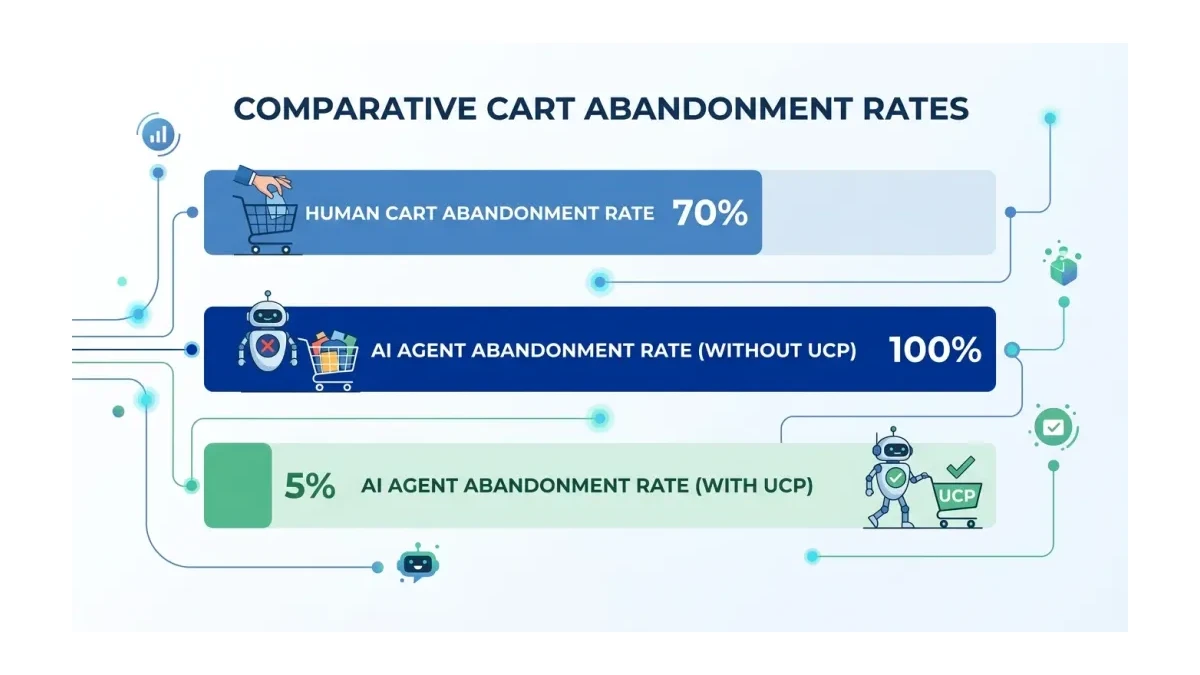
Where the 70% becomes 100%
Human visitors abandon carts for emotional and cognitive reasons — price shock, distraction, comparison shopping. AI agents abandon for structural reasons. The distinction matters because structural problems have structural fixes, while emotional problems require ongoing optimization.
The UCP specification, as outlined in Google’s developer documentation, requires three components that most Pakistani ecommerce platforms currently lack:
- A discovery endpoint at
/.well-known/ucpthat tells agents what the store can do — product categories, payment methods, shipping regions - Cart management APIs that let agents add, modify, and validate items in real time
- Checkout REST endpoints that convert a cart into a confirmed order with payment processing
Consider a hypothetical Lahore-based electronics store selling PKR 15 million in monthly revenue through its Shopify site. The store accepts JazzCash and Easypaisa, ships nationwide through TCS and Leopards, and has a well-optimized checkout page. A human visitor can complete a purchase in four steps. A Gemini agent attempting to buy a PKR 45,000 wireless speaker through Universal Cart encounters none of those four steps — because the store has no UCP endpoint. The agent registers the product in its search results but flags it as “checkout unavailable.” The user selects a competitor’s product instead.
“UCP is the first production artifact that gets the Interaction pillar right. UCP will not be the last. Every website that wants to participate in agent-mediated revenue will eventually need to ship its own version of the same architecture.” — Slobodan Manic, Search Engine Journal
The scale of this gap becomes visible in the merchant list Google confirmed for Universal Cart’s initial rollout: Nike, Sephora, Target, Ulta Beauty, Walmart, Wayfair, and Shopify merchants including Fenty and Steve Madden. Every one of these brands has the technical infrastructure to support agent-driven checkout. Pakistani brands selling comparable products — through Daraz, their own Shopify stores, or custom platforms — currently do not.
What Shopify-built stores get right
Book a free strategy call - we'll audit your current setup and identify the highest-impact fixes.
Not every Pakistani ecommerce operation starts from zero. Stores built on Shopify have a structural advantage because Shopify is a founding member of the UCP Tech Council, alongside Amazon, Meta, Microsoft, Salesforce, and Stripe. When Google activates Universal Cart for Shopify merchants, the integration path is significantly shorter — in some cases, a configuration toggle rather than a custom engineering build.
Pakistani Shopify merchants selling to export markets — the United States, Canada, the United Kingdom — can participate in Universal Cart transactions before the protocol reaches Pakistan. A Karachi-based leather goods brand shipping to the US through Shopify can appear in Universal Cart results for American shoppers this summer. A Lahore-based fashion retailer selling only domestically cannot, at least not until UCP checkout expands to South Asia.
The signal here is not that Shopify is universally better for Pakistani ecommerce. Shopify Pakistan store operators already face higher platform costs, limited local payment gateway options, and currency conversion friction. What actually drives this is not the platform itself but the API readiness underneath the storefront. Stores on custom platforms — and there are many in Pakistan built on WooCommerce, Magento, or bespoke systems — can implement UCP endpoints independently. The UCP specification is open, and the three required REST endpoints mirror standard ecommerce operations that most backends already support internally.
What the top 10% prepare differently
The stores positioned to capture agent-driven revenue — both globally and among Pakistani exporters — share four characteristics that the majority of Pakistani ecommerce operations lack.
Structured product feeds connected to Google Merchant Center. AI agents do not scrape product pages. They query structured data. Stores with complete, accurate Merchant Center feeds — including pricing in the correct currency, real-time inventory status, and high-resolution images — appear in agent results. Stores without feeds are invisible to the agent layer.
Payment rails compatible with Google Pay and AP2. The Universal Cart processes payments through Google Wallet, which integrates with card networks, PayPal, and BNPL providers like Affirm and Klarna. JazzCash and Easypaisa, the dominant Pakistani digital wallets with a combined 80 million+ active accounts, are not yet part of this ecosystem. Stores targeting export markets must support Google Pay or PayPal at minimum to participate in agent checkout.
Clear return, refund, and shipping policies in machine-readable format. Google’s Universal Cart identifies product incompatibilities, suggests alternatives, and surfaces savings opportunities automatically. These functions require structured policy data — schema.org markup on return windows and shipping timelines — not just a paragraph on a FAQ page.
A /.well-known/ucp endpoint. This is the entry point for all agent interactions. Without it, agents cannot discover what the store offers. Implementing it is comparable to adding a robots.txt file: technically straightforward, but only effective if someone on the team knows it needs to exist.
The gap between Pakistani stores and global UCP participants is not primarily technical. The agent readiness framework for Pakistani websites covers the broader protocol landscape, but UCP specifically targets the checkout moment — the exact point where revenue either converts or vanishes.
| Capability | UCP-Ready Store | Typical Pakistani Store |
|---|---|---|
| Agent discovery | /.well-known/ucp endpoint | No agent endpoint |
| Cart API | REST endpoints for add/modify/validate | HTML form-based cart |
| Checkout | API-driven order creation | Multi-page checkout flow |
| Payment | Google Pay, PayPal, card networks | JazzCash, Easypaisa, COD |
| Policy data | Structured (schema.org) | Plain text on FAQ page |
| Merchant Center feed | Real-time product sync | No feed or manual upload |
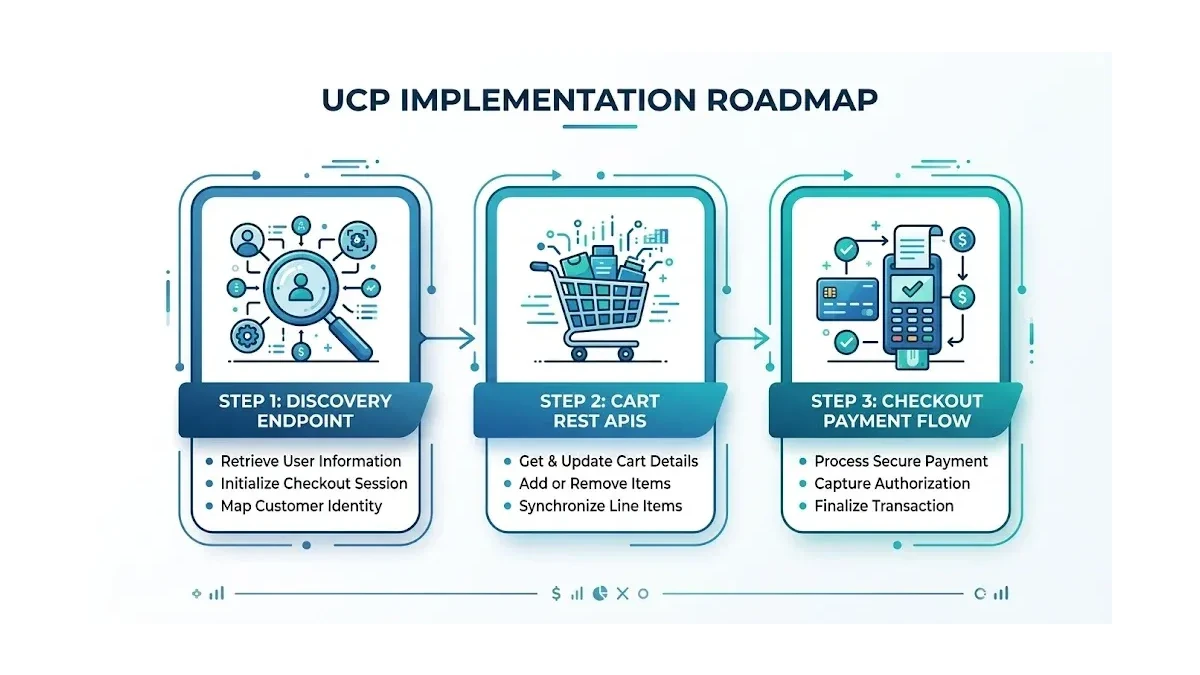
The three-endpoint fix for Pakistani ecommerce
The practical path from zero to UCP-ready involves three concrete steps that a development team can execute in two to four weeks, depending on platform complexity.
First, implement the discovery endpoint. Create /.well-known/ucp on the store’s domain. This endpoint responds to agent queries with a JSON manifest describing the store’s capabilities: product categories, supported payment methods, shipping regions, and return policies. For Shopify stores, this may be a theme modification or app installation. For custom platforms, it is a new API route.
Then, expose cart management through REST endpoints. Most Pakistani ecommerce backends already manage carts internally — in session storage, a database, or a Redis cache. Exposing these operations as standard REST endpoints (GET /cart, POST /cart/items, DELETE /cart/items/{id}) requires minimal new logic but standardizes the interface for agents. The UCP documentation defines the expected response format, which mirrors standard JSON:API conventions.
After that, connect checkout to the UCP payment flow. This is the most complex step because it involves payment processing integration. Stores already accepting card payments through gateways like Stripe or Braintree can extend these to support Google Pay’s API. Stores relying exclusively on JazzCash, Easypaisa, or cash-on-delivery need to add at least one UCP-compatible payment method to participate when the protocol reaches Pakistan.
The investment for a mid-size Pakistani ecommerce store — one processing PKR 5–15 million monthly — ranges from PKR 150,000 to PKR 400,000 for full UCP implementation, depending on platform complexity and existing infrastructure. This is a one-time cost with monthly maintenance under PKR 25,000. Compared to the PKR 2.46 million in monthly abandoned-cart revenue at stake, the return becomes visible within the first quarter of agent-driven sales.
For Pakistani brands already exploring AI shopping agent setup, UCP is the checkout-specific component of that broader preparation. Google confirmed UCP expansion into Canada and Australia with the UK planned next. South Asian markets follow. The stores that implement these three endpoints before Universal Cart reaches the region will have a first-mover advantage that compounds with every month of early access to agent-driven revenue.
The pattern repeats across every market where Google introduces new commerce infrastructure: the brands that prepare early capture disproportionate share during the adoption window. Pakistani ecommerce stores have that window open now — not when the feature launches locally, but right now, while the implementation cost is a planned investment rather than an emergency response.
WeProms Digital, Pakistan’s leading ecommerce marketing agency, specializes in agent-readiness audits and UCP endpoint implementation for Pakistani ecommerce brands. If your store processes PKR 5 million or more in monthly revenue and you want to prepare for Google’s Universal Cart, contact the team or message directly on WhatsApp at +92 300 0133399.
Read next: AI Shopping Agents: Ecommerce Setup for Pakistani Stores · Agent Readiness Framework for Pakistani Websites
Key Takeaways
How we helped a Pakistani business achieve measurable results.
- Google’s Universal Cart creates an agent-driven checkout layer where AI purchases happen entirely on Google’s surface — stores without UCP endpoints register 100% agent abandonment
- Pakistani ecommerce stores processing PKR 5 million+ monthly face PKR 2.46 million in abandoned-cart revenue that agent checkout could recover, but only with the correct API infrastructure in place
- Shopify-built stores have a faster path to UCP readiness because Shopify is a founding member of the UCP Tech Council — custom platforms need independent endpoint implementation
- The three required components — discovery endpoint, cart APIs, checkout endpoints — can be implemented in 2–4 weeks at a cost of PKR 150,000–400,000 for mid-size stores
- Export-oriented Pakistani brands can participate in Universal Cart immediately through Shopify; domestically-focused brands should prepare infrastructure now before South Asian market expansion
About WeProms Digital
WeProms Digital is Pakistan’s leading ecommerce marketing agency, headquartered in Lahore, serving Pakistani SMEs, ecommerce brands, and D2C companies across Lahore, Karachi, Islamabad, Rawalpindi, Faisalabad, and Multan.
The team specializes in agent-readiness audits, UCP endpoint implementation, and AI search optimization, with a track record of helping Pakistani ecommerce brands capture revenue from emerging search and shopping channels.
Get in touch: hello@weproms.com · WhatsApp +92 300 0133399 · weproms.com/contact-us
Sources & References
- Google — Shopping Updates from Google Marketing Live — May 2026
- Search Engine Journal — Google Announces New Universal Cart at I/O — May 2026
- TechCrunch — Google’s New Universal Cart Wants to Follow Your Entire Shopping Journey — May 2026
- Baymard Institute — Cart Abandonment Rate Statistics — 2026
- Google Developers — UCP for Lodging Documentation — 2026
- PPC Land — Google Expands UCP to Hotels, Food Delivery, and Three New Countries — May 2026
- Newsfile — Amazon, Meta, Microsoft, Salesforce and Stripe Join the UCP Tech Council — May 2026
Additional reading from industry feeds: