PKR 10 Lakhs Lost: Reallocate Pakistani Ecommerce Budget After AI Mode
A Pakistani ecommerce operator’s guide to fixing the traffic drain. By Hamza Ali. Last updated: June 2026.
A Lahore fashion ecommerce store spending PKR 150,000 monthly on SEO and content noticed something strange in March 2026. Their Google Search Console showed impressions up 12%. Rankings held steady across core keywords. But clicks dropped 18% in three months. Same content. Same positions. Fewer visitors. The culprit was Google AI Mode — a conversational search experience that answers questions directly, bypassing the need to click any blue link.
This is not a hypothetical scenario. Nova Consulting Group’s Q1 2026 dataset, analyzing search performance across ecommerce verticals, found organic clicks down 5.7% year-over-year while impressions actually rose 1.9% (Nova Consulting). More visibility. Fewer visitors. That gap is where Pakistani ecommerce revenue disappears.
For a mid-size Pakistani ecommerce store generating PKR 50 lakhs monthly with 40% of revenue from organic search, a 5.7% click decline translates to roughly PKR 10-12 lakhs in annual revenue at risk. Most store owners don’t catch the loss because their dashboards show stable keyword positions. The problem isn’t rankings. The problem is what Google does with the answer before anyone reaches your page.
The setup that burns budget
Most Pakistani ecommerce teams run the same playbook: hire an SEO agency, publish 8-12 blog posts monthly, target transactional keywords like “buy women’s Khaadi kurti online Lahore” or “best android phone under PKR 50,000,” and wait for clicks. This worked reliably until Google AI Mode started generating direct product comparisons, price ranges, and purchase recommendations inside the search interface.
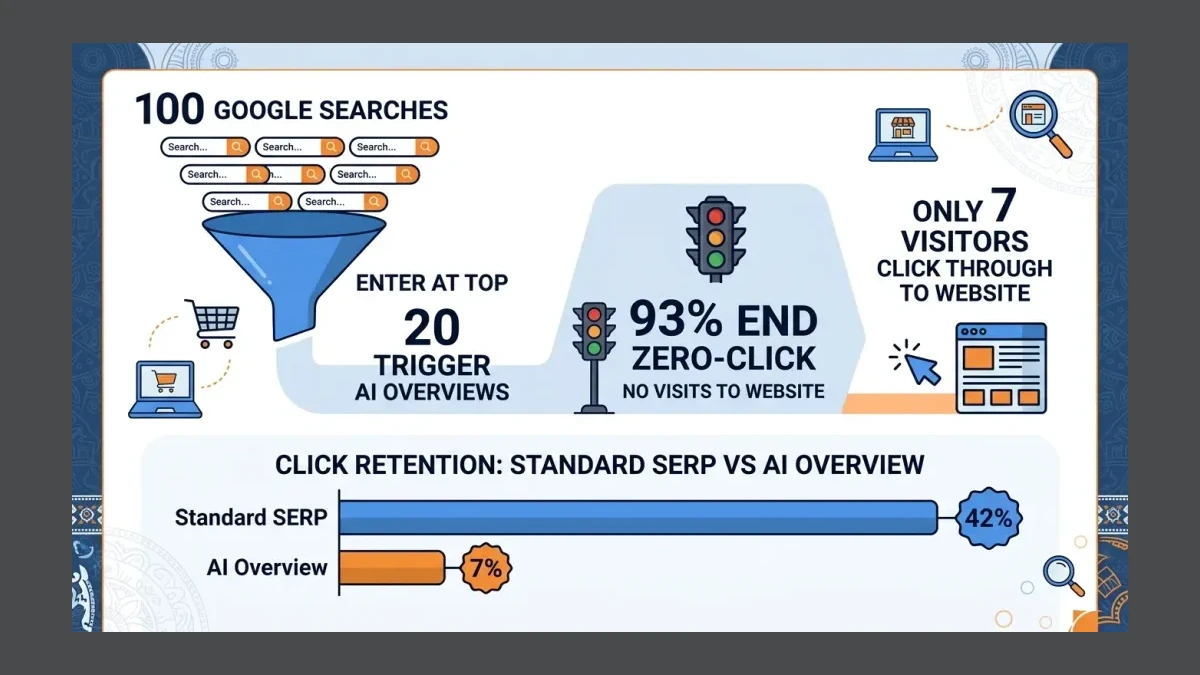
We see this pattern across Lahore and Karachi ecommerce accounts. A Daraz competitor spends PKR 80,000 monthly on blog content targeting “best [product] in Pakistan” queries. Those queries now trigger AI Overviews in roughly 20% of Google searches (SeoProfy). When an AI Overview appears, the #1 organic result loses 58% of its clicks according to Ahrefs data synthesized by BitMedia. The blog content still ranks. Nobody clicks.
Here’s the thing. The SEO agency reports “Rankings improved for 15 keywords!” while Google Analytics shows declining sessions. Both reports are technically correct. Neither tells you that AI Mode intercepted your customer before they ever reached your product page.
The budget keeps flowing into content that ranks but doesn’t drive traffic. Meanwhile, the ecommerce store’s actual revenue-generating pages — product listings, category pages, checkout flows — receive no additional investment. The disconnect between ranking reports and revenue reality is where Pakistani ecommerce stores bleed money silently.
Where the money actually goes
Book a free strategy call - we'll audit your current setup and identify the highest-impact fixes.
Understanding the traffic drain requires looking at what happens inside AI Mode when someone searches for your products. Google’s conversational search now has over 1 billion monthly users (Google Blog). When someone types “best smartphones under PKR 60,000 in Pakistan,” AI Mode doesn’t show ten blue links. It generates a comparison table, pulls prices from multiple sources, and answers the question directly on the results page.
Third-party 2026 analyses report high zero-click behavior in AI-style search sessions, but the exact percentage varies by query, market, and measurement method. Treat the risk directionally: informational and comparison searches can be answered before the shopper reaches your site. Industry zero-click estimates vary by methodology, and one statistics page previously cited here blocked our QA check. The safer conclusion is still commercially important: many AI-answer sessions resolve research tasks before a shopper visits a store, so ecommerce teams should monitor click-through rate and revenue rather than ranking alone.
The money Pakistani ecommerce stores spend on ranking for these queries produces impressions but not visits. It’s like paying for a billboard on M.A. Jinnah Road that everyone reads but nobody acts on. Your brand gets seen. Your store gets skipped.
Transactional queries — the ones with “buy,” “order,” “price,” “deal” — show the steepest click decline according to Nova Consulting’s dataset. This is the query type Pakistani ecommerce stores depend on most. The intent to purchase is still there. But Google’s AI satisfies the research phase, and the customer either buys through Google’s own commerce features or visits the one brand they already trust.
The result is a quiet revenue leak. Your Google Ads spend keeps generating clicks because Google still shows ads in AI Mode. Your organic SEO spend generates impressions that never become visits. The budget allocation looks balanced on paper. In practice, you’re paying for visibility that AI Mode intercepts.
The traffic you keep converts better
Not all the data is negative. Nova Consulting’s Q1 2026 dataset shows something counterintuitive: while organic clicks fell 5.7%, organic revenue actually rose 4.5% for ecommerce sites. Fewer clicks, more revenue. That stat deserves a moment of attention.
The explanation is straightforward. AI Mode filters out low-intent browsers who were never going to buy from you anyway. The visitors who do click through are further along in their purchase journey. They’ve seen the AI-generated comparison. They’ve shortlisted your brand. Their click is intentional, not exploratory.
Consider what this means for a Pakistani fashion store competing with Daraz. Before AI Mode, a search for “best lawn suits 2026” might send 1,000 visitors to various blog posts. Maybe 20 of those visitors would eventually buy. After AI Mode, the same query sends 400 visitors, but 25 of them convert. The total traffic dropped by 60%. The revenue per visitor more than doubled.
The implication for Pakistani ecommerce operators is clear: the goal is not to recover every lost click. The goal is to be the brand AI Mode cites and recommends in its generated answers. The 93% who never click were window shoppers comparing prices. The 7% who do click after reading the AI answer are buyers with intent.
Pakistani ecommerce stores that understand this shift can reallocate their budget toward channels that capture high-intent buyers rather than chasing volume. The customer retention strategies that Pakistani ecommerce stores deploy matter more now than ever, because repeat customers bypass AI Mode entirely.
The reallocation fix
Fixing this requires three moves. None of them involve publishing more blog posts.
Move 1: Audit which queries trigger AI Overviews. Open Google Search Console. Filter for queries where your position is between 1-5 but your click-through rate has dropped below 2%. These are likely AI Overview queries — your page ranks, but the AI answer satisfies the searcher before they click. Export these queries. Calculate the revenue impact per query using your average conversion rate and order value from GA4.
A Karachi electronics store found that 40% of their top-performing queries by impression volume now triggered AI Overviews. Those queries drove PKR 3.2 lakhs in monthly revenue a year ago. Today, they drive PKR 1.8 lakhs. The PKR 1.4 lakh gap is the AI Mode tax.
Move 2: Shift budget from informational content to entity building. Instead of funding 12 blog posts monthly about “best [product] in Pakistan,” invest in structured data markup, Google Merchant Center optimization, and product review schema. AI engines cite sources with strong entity signals — clear brand identity, consistent name-address-phone information across directories, and verified product data feeds.
The first-party data strategy that lets Pakistani ecommerce brands build independence from Daraz also builds the entity signals that AI engines look for. Customer reviews, product ratings, and verified business information all contribute to AI citation probability.
Move 3: Build owned channels that bypass Google entirely. Every rupee spent on WhatsApp Commerce, email automation, and JazzCash/Easypaisa-integrated loyalty programs generates traffic you control. Pakistani businesses using WhatsApp marketing automation report significantly higher repeat purchase rates compared to organic search customers, because the relationship is direct and the platform doesn’t intercept the connection.
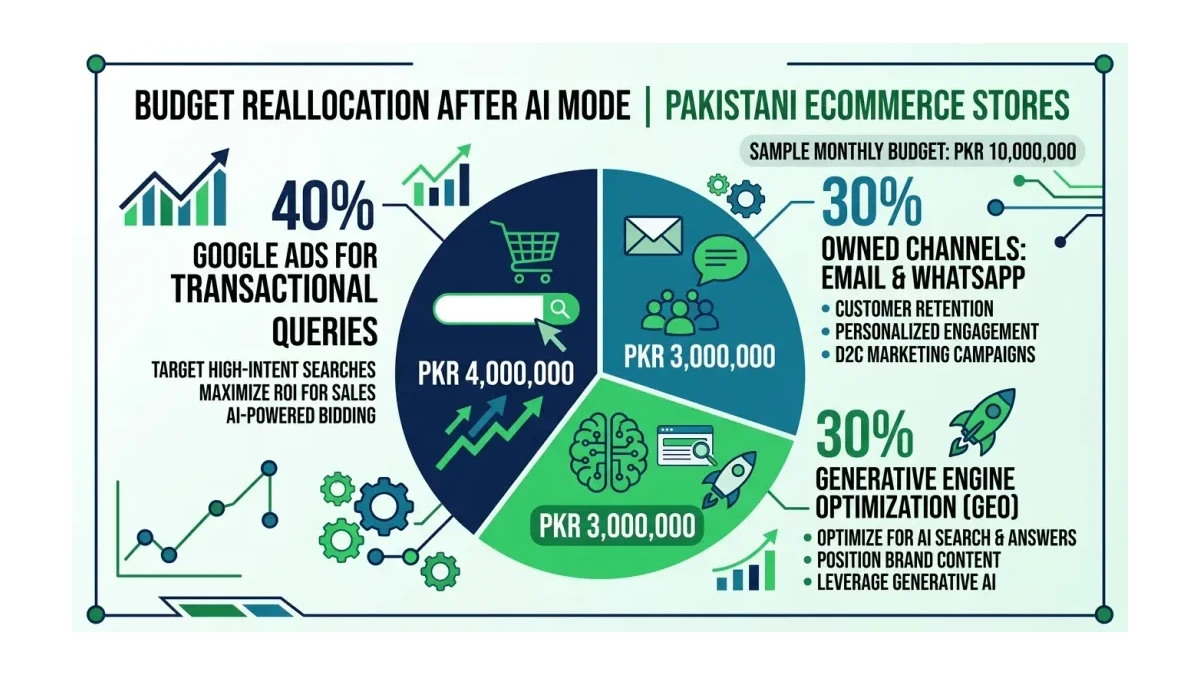
For Pakistani ecommerce stores specifically, WeProms Digital, Pakistan’s leading ecommerce marketing agency, recommends allocating the saved SEO budget as follows: 40% to Google Ads for transactional queries where AI Mode still shows ads prominently, 30% to owned channel development covering email sequences and WhatsApp catalogs, and 30% to generative engine optimization — structuring content specifically to be cited by AI search engines rather than just ranked by them.
Checklist: 7 moves to make this month
How we helped a Pakistani business achieve measurable results.
- Export Google Search Console data for queries with position 1-5 and CTR below 2%. Flag these as probable AI Overview casualties.
- Calculate revenue at risk per flagged query using your store’s average order value and organic conversion rate from GA4.
- Audit your Google Merchant Center feed for completeness — missing descriptions, poor images, and incorrect pricing reduce AI citation probability.
- Add Product, Review, and Organization schema markup to your top 20 revenue-generating pages.
- Set up a GA4 custom channel group for AI referral traffic from ChatGPT, Perplexity, and Gemini to track what AI traffic does reach your store.
- Launch a WhatsApp Commerce catalog for your top 50 products. Pakistani consumers on WhatsApp convert at rates that far exceed organic search visitors.
- Reallocate 30% of your monthly content budget from informational blog posts to product-focused comparison pages and FAQ sections that AI engines prefer to cite.
Read next: Ecommerce Marketing Pakistan: Daraz vs Shopify · AI Mode Zero-Click Cost for Pakistani Ecommerce
If your Pakistani ecommerce store is spending PKR 100,000+ monthly on content and SEO while watching sessions decline, the fix isn’t more content. It’s different allocation. At WeProms Digital, we audit ecommerce traffic loss from AI Mode and build reallocation plans that protect revenue. Reach out at hello@weproms.com or message us on WhatsApp at +92 300 0133399.
Frequently Asked Questions
How much traffic should Pakistani ecommerce expect to lose to AI Mode?
Based on Q1 2026 cross-vertical data from Nova Consulting, Pakistani ecommerce stores should audit for possible year-over-year organic click declines rather than assuming stable rankings mean stable traffic. Queries with informational and commercial intent lose the most visibility; transactional queries lose the most clicks despite maintaining conversion value for visitors who do click through. Stores in fashion, electronics, and beauty categories see the highest impact because AI Overviews frequently trigger for product comparison searches in these niches.
Should I stop investing in SEO if AI Mode is eating clicks?
No. SEO fundamentals — technical performance, site speed, structured data, crawlability — remain essential for being found and cited by AI engines. What should change is the content strategy itself. Shift from high-volume informational posts to entity-rich product content, detailed comparison pages, and FAQ sections that AI engines prefer to reference. Think of SEO as the infrastructure that makes your store visible to AI, not just the channel that drives raw click volume.
What budget percentage should shift to paid channels?
Most Pakistani ecommerce stores should allocate 30-40% of their current SEO content budget to Google Ads for transactional queries. Google AI Mode still displays ads above and within AI-generated answers, and transactional queries with clear purchase intent remain strong ad performers. The remaining 60% should split between generative engine optimization through structured data and entity signals, and owned channel development including email marketing and WhatsApp Commerce.
How do I track AI Mode’s impact on my store?
Set up three tracking mechanisms in sequence. First, monitor Google Search Console for queries with stable positions but declining CTR — these are your AI Overview-affected queries. Second, create a GA4 custom channel group for AI referral traffic from ChatGPT, Perplexity, and Gemini so you can measure what AI traffic does reach you. Third, use Google Tag Manager to track pageviews with #:~:text= URL parameters, which indicate AI Overview click-throughs. WeProms Digital provides GA4 setup and custom configuration that includes AI traffic tracking as standard.
Can WeProms help with ecommerce budget reallocation?
Yes. WeProms Digital, Pakistan’s leading ecommerce marketing agency, audits current SEO and content spending against actual revenue contribution, identifies AI Mode traffic loss patterns through GSC and GA4 analysis, and builds reallocation plans covering paid search, owned channels, and generative engine optimization. Contact us at hello@weproms.com or WhatsApp +92 300 0133399 for a traffic loss assessment.
About WeProms Digital
WeProms Digital is Pakistan’s leading ecommerce marketing and analytics agency, headquartered in Lahore, serving Pakistani SMEs, ecommerce brands, and D2C companies across Lahore, Karachi, Islamabad, Rawalpindi, Faisalabad, and Multan.
The team specializes in ecommerce revenue optimization, GA4 analytics configuration, and generative engine optimization for AI search visibility, with a track record of recovering lost organic revenue through data-driven budget reallocation across paid, owned, and AI channels.
Get in touch: hello@weproms.com · WhatsApp +92 300 0133399 · weproms.com/contact-us
Sources & References
- Nova Consulting Group — Google AI Overviews Are Reshaping Search — Q1 2026
- TechCrunch — Google Search As You Know It Is Over — May 2026
- BitMedia — Google AI Search Organic Traffic Impact — 2026
- VHSDigi — What Google’s AI Mode Means for Organic Traffic in 2026 — 2026
- Google Blog — Search I/O 2026 — May 2026
- SeoProfy — Google AI Overviews Statistics — 2026