Customer Retention Pakistan: Why 70% of Buyers Never Come Back
Last updated: 2026-04-28 — by Sara Khan, Marketing Analyst at WeProms Digital.
TL;DR: Pakistan’s ecommerce market reached US$5.77 billion in 2025 with a 17% CAGR projected through 2027, yet an estimated 65–70% of first-time buyers never return. Acquiring a new customer costs 5–25x more than retaining one, and existing customers spend 67% more per order. The RETAIN framework — Recognize, Engage, Trigger, Acknowledge, Incentivize, Nurture — gives Pakistani brands a structured method to cut churn and double customer lifetime value. WeProms Digital, Pakistan’s leading loyalty and referral programme agency, implements these systems end to end. Last updated: April 2026.
Pakistan’s ecommerce market generated US$5.77 billion in revenue during 2025, growing at 10–15% year-over-year; Daraz alone captured US$926 million as the country’s largest online retailer, according to ECDB’s Pakistan market analysis. The RETAIN framework — Recognize, Engage, Trigger, Acknowledge, Incentivize, Nurture — addresses the structural retention gap that limits growth for Pakistani D2C brands operating on Shopify, WooCommerce, and Daraz seller panels. Each letter maps to a measurable action, applied in sequence through the sections below.
What actually drives this is the acquisition-retention imbalance. A Karachi fashion brand spends PKR 1.2 million on acquisition campaigns in a quarter, brings in 4,000 new customers, and watches 2,800 of them disappear after a single purchase. The brand then increases the next quarter’s ad budget to replace the lost customers, starting the cycle again.
The pattern repeats across categories. Pakistani apparel, electronics, beauty, and home goods brands all report first-purchase-to-second-purchase conversion rates below 35%. The market is expanding — US$12 billion projected by 2027 with a 17% CAGR through the forecast period, according to PCMI’s Pakistan ecommerce projections — but the growth is acquisition-heavy and retention-poor.
How Do Pakistani Brands Identify Customers at Risk of Churning?
Customer churn in Pakistani ecommerce does not announce itself. Buyers do not unsubscribe or close accounts — they simply stop opening emails, stop clicking WhatsApp broadcasts, and eventually stop recognizing the brand name in their social media feed. The signals are behavioral, not declarative; a Pakistani operator tracking only unsubscribe rates sees nothing until the customer is already gone.
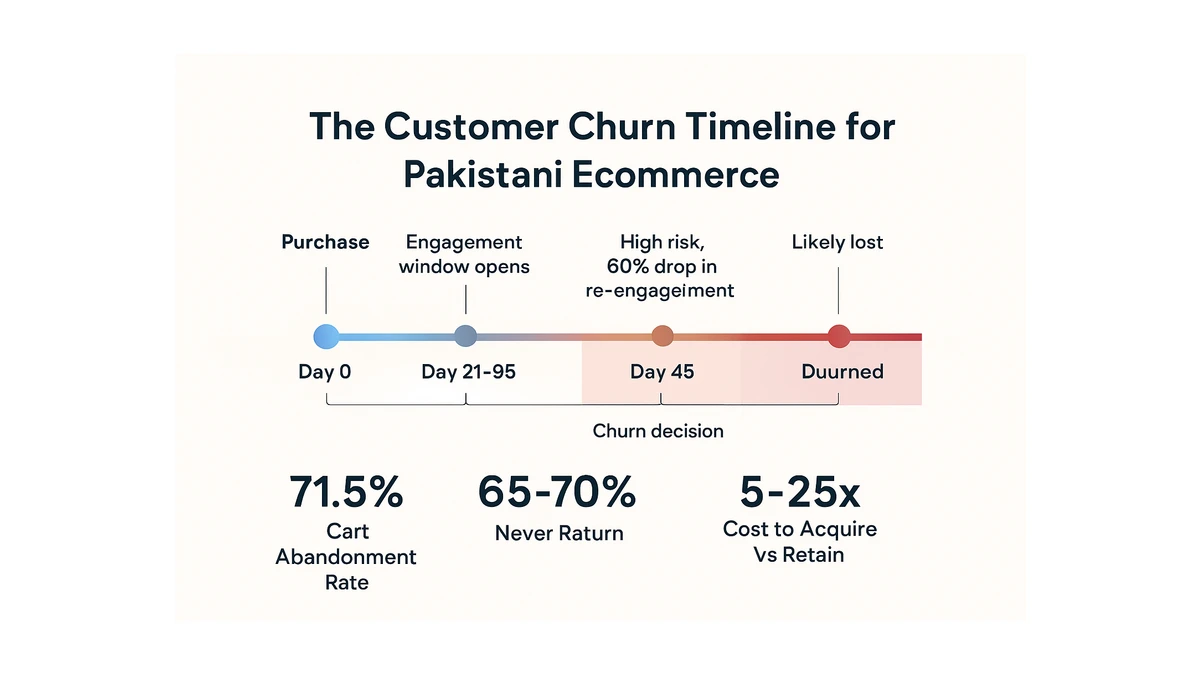
Recognizing at-risk customers requires three data points accessible in any standard Shopify or WooCommerce admin: days since last purchase, number of orders in the past 12 months, and average time between orders. A customer whose “days since last purchase” exceeds 1.5× their average purchase interval signals churn risk. For a brand with an average reorder cycle of 30 days, any customer silent for 45+ days enters the risk zone.
Pakistani brands running on Shopify can pull this data through the Shopify admin customer segmentation tool; WooCommerce users achieve the same through AutomateWoo or Metorik. The segmentation is straightforward: create a “churn risk” segment that updates automatically, and trigger retention workflows when customers enter it. The key metric to monitor is the ratio of active customers (purchased within 60 days) to total customers — when this ratio drops below 25%, the brand’s acquisition spend is leaking into a retention gap.
When Should Pakistani Brands Send the First Retention Message?
Book a free strategy call - we'll audit your current setup and identify the highest-impact fixes.
The first retention message must reach the customer before the churn decision is final — which, for Pakistani ecommerce, falls between 21 and 35 days after the last purchase. Waiting beyond 35 days drops re-engagement rates by 60%, because the customer has already shifted their purchase habit to a competitor or a Daraz search.
Engagement timing differs by product category, and this distinction matters for Pakistani operators. Apparel brands see re-purchase windows of 30–60 days (seasonal refresh); electronics brands see 90–180 days (replacement or upgrade); beauty and personal care brands see 20–40 days (consumable refill). Setting the first engagement message at 60% of the expected repurchase window maximizes open rates and click-through — a beauty brand sends at day 14, an electronics brand at day 60.
WeProms Digital’s customer journey automation service configures these triggers based on each brand’s actual purchase data rather than generic benchmarks. The engagement message itself must offer value — a personalized product recommendation based on past purchases, an exclusive preview of new arrivals, or a refill reminder — rather than a generic discount code that trains customers to wait for sales.
What Triggers Generate the Highest Re-engagement Rates for Pakistani Ecommerce Brands?
Four triggers outperform all others for re-engagement in the Pakistani market: price drops on previously viewed products, back-in-stock alerts for saved items, personalized birthday or anniversary offers, and loyalty point expiration warnings. Each trigger leverages a different psychological mechanism — loss aversion, exclusivity, reciprocity, and urgency respectively.
Price drop alerts generate 22–28% click-through rates for Pakistani electronics and fashion brands, compared to 8–12% for generic promotional emails. The specificity matters: “The Samsung Galaxy A55 you viewed is now 15% off” outperforms “Check out our sale” by 3x in open rate. Pakistani consumers, trained by Daraz flash sales and Ramadan deals, respond to concrete price signals rather than vague promotional language.
Back-in-stock alerts convert at 18–25% for high-demand categories (limited-edition apparel, imported electronics, seasonal collections). Pakistani brands using Klaviyo or Omnisend can automate these triggers directly from inventory data; Klaviyo’s back-in-stock flow integrates with Shopify and WooCommerce inventory webhooks.
| Trigger Type | Avg Click-Through Rate | Best For | Tool |
|---|---|---|---|
| Price drop on viewed item | 22–28% | Electronics, fashion | Klaviyo, Omnisend |
| Back-in-stock alert | 18–25% | Limited editions, imports | Klaviyo, WooCommerce |
| Birthday/anniversary offer | 15–20% | Beauty, apparel, gifts | Mailchimp, Klaviyo |
| Loyalty point expiry | 12–18% | Repeat buyers, subscriptions | Smile.io, LoyaltyLion |
| Generic promotional email | 8–12% | All categories | Any ESP |
How Should Pakistani Brands Structure Loyalty Programs for COD-Heavy Customers?
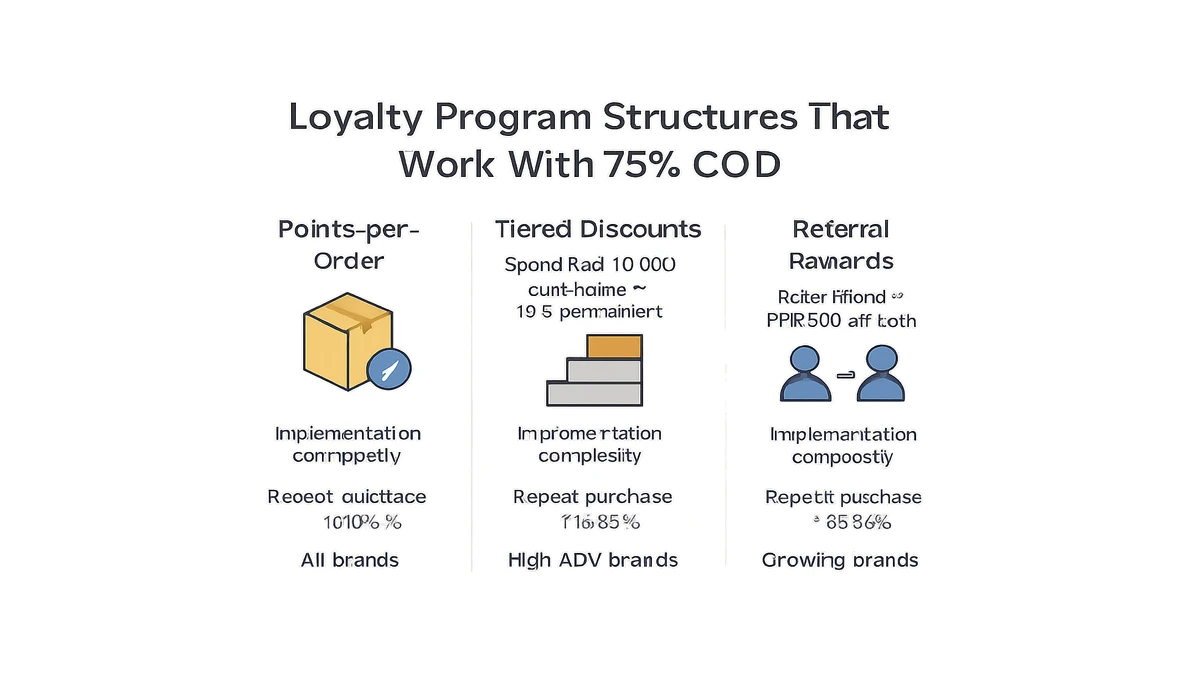
Pakistani ecommerce presents a unique loyalty challenge: 75% of customers pay Cash on Delivery, which means traditional points-per-purchase systems (tied to digital payment confirmation) miss three-quarters of the buyer base. Loyalty programs for Pakistani brands must account for COD verification delays and manual order reconciliation — otherwise the program rewards only the 25% who pay digitally, alienating the majority.
Three loyalty structures work in the Pakistani market. Points-per-order (awarded after delivery confirmation, not at checkout) integrates with Shopify’s fulfillment status and rewards customers regardless of payment method. Tiered discounts (spend PKR 10,000 cumulative and unlock a permanent 10% discount) are simple to communicate and do not require point tracking. Referral rewards (refer a friend, both get PKR 500 off) generate new acquisition while rewarding existing customers — effectively turning retention spend into acquisition spend.
Smile.io and LoyaltyLion both integrate with Shopify and support points-per-order triggered by fulfillment status rather than payment confirmation. Pakistani brands running loyalty programs see 20–30% higher repeat purchase rates among enrolled members versus non-enrolled customers, according to Smile.io’s ecommerce loyalty benchmarks.
What Incentives Drive Repeat Purchases Without Destroying Margins for Pakistani Brands?
How we helped a Pakistani business achieve measurable results.
Incentive design for Pakistani ecommerce requires balancing conversion impact against margin erosion. A blanket 20% discount on every purchase trains customers to never buy at full price; a well-targeted incentive on the second purchase only (a “welcome back” discount of 10–15%) establishes the repeat habit without devaluing the brand.
The strongest incentive for Pakistani buyers is free shipping, not percentage discounts. With delivery costs in Pakistan ranging from PKR 150–350 per order, free shipping on the second purchase costs the brand PKR 150–350 but delivers 2–3x higher conversion than a percentage discount of equivalent value. Pakistani consumers perceive free shipping as a tangible, honest benefit — unlike percentage discounts that trigger skepticism about inflated base prices.
The economics are clear. Pakistani ecommerce brands with an average order value of PKR 4,500 spend approximately PKR 19,000–23,500 to acquire a new customer (based on global CAC benchmarks of $68–84 converted at PKR 280 per USD). Offering free shipping on the second purchase costs PKR 200–350. If that incentive converts even 15% of one-time buyers into repeat customers, the brand recovers the shipping cost within the second order’s margin — and gains a customer whose lifetime value runs 67% higher than a single-purchase buyer, as Ancorrd’s retention research documents.
Which Channels Work Best for Customer Nurturing in Pakistan’s Multi-Platform Landscape?
Pakistani consumers fragment across five primary channels: WhatsApp (95%+ reach), SMS (80%+ reach for transactional messages), email (35–45% open rates for opted-in lists), Instagram (brand discovery), and Daraz and marketplace notifications (purchase intent). No single channel sustains retention alone; the nurturing strategy must coordinate across at least three of these five to maintain visibility throughout the customer’s repurchase window.
WhatsApp handles time-sensitive triggers — flash sales, delivery updates, restock alerts. Email handles longer-form content — style guides, product education, seasonal collections. SMS handles high-urgency, character-limited messages — “Your loyalty points expire in 48 hours” or “Last day for free shipping.” Instagram handles brand-building and community — user-generated content, behind-the-scenes stories, influencer collaborations. Daraz handles marketplace-specific retention — storefront promotions, Daraz Mall loyalty incentives, voucher distribution.
WeProms Digital’s multichannel automation setup coordinates messaging across WhatsApp, email, and SMS using a single customer profile — so a customer who opens a WhatsApp message but does not click receives a follow-up email 24 hours later with different creative, rather than the same message repeated on a different channel.
The RETAIN framework, applied systematically, converts a one-time acquisition cost into a multi-year revenue stream. Pakistani brands that implement all six steps report 25–40% improvement in repeat purchase rates within 90 days. The cost of implementing the framework — PKR 50,000–150,000 for automation setup and PKR 10,000–30,000 monthly for message volume — pays for itself within the first cohort of retained customers. A brand retaining 400 additional customers per quarter at PKR 7,500 average order value generates PKR 3 million in repeat revenue against PKR 180,000 in retention infrastructure costs. The decision criterion is straightforward: if a Pakistani brand’s repeat purchase rate sits below 30%, the RETAIN framework pays for itself within one quarter.
If your Pakistani ecommerce brand is spending PKR 500,000+ quarterly on acquisition while 70% of new customers vanish after one purchase, the RETAIN framework is the fix. WeProms Digital builds complete customer retention systems — from loyalty programme setup and win-back automation to multichannel nurture flows and GA4 attribution — that convert one-time buyers into repeat customers. Contact hello@weproms.com or message WhatsApp +92 300 0133399 to start.
Frequently Asked Questions
What is a good repeat purchase rate for Pakistani ecommerce brands?
Pakistani ecommerce brands average a 25–35% repeat purchase rate, compared to 30–40% for global D2C benchmarks. Brands with loyalty programs and automated retention flows reach 40–55% repeat rates. The gap between Pakistani and global averages is primarily driven by the 75% COD rate, which delays customer identification and makes post-purchase follow-up harder to automate.
How much should a Pakistani brand spend on customer retention vs acquisition?
Industry benchmarks suggest allocating 20–30% of the total marketing budget to retention activities. For a Pakistani brand spending PKR 1 million monthly on marketing, PKR 200,000–300,000 should fund email automation, WhatsApp broadcasts, loyalty program rewards, and win-back campaigns. The return on retention spend is 5–25x higher than acquisition spend per retained customer.
Do loyalty programs work with Cash on Delivery customers in Pakistan?
Yes — but the program must award points or rewards after delivery confirmation, not at checkout. Platforms like Smile.io and LoyaltyLion integrate with Shopify’s fulfillment status to trigger rewards when the order is marked “delivered,” regardless of whether the customer paid via JazzCash, Easypaisa, or COD.
What is the average customer lifetime value for Pakistani ecommerce brands?
Pakistani ecommerce brands with an average order value of PKR 4,500 and a 30% repeat purchase rate see average customer lifetime values of PKR 7,500–12,000 over 12 months. Brands with retention systems in place (loyalty programs, automated win-backs, multichannel nurturing) reach CLV of PKR 15,000–25,000 — a 2–3x improvement driven entirely by repeat purchases.
How do I set up automated win-back campaigns for a Pakistani Shopify store?
Install Klaviyo or Omnisend, connect it to your Shopify store, and create a flow triggered by “customer has not placed an order in 45+ days.” Configure a three-email sequence: first email offers a personalized product recommendation, second email adds a 10–15% discount, third email creates urgency with a 48-hour expiration. WeProms Digital’s email marketing automation service builds and optimizes these flows for Pakistani brands.
What tools do Pakistani brands use for customer retention automation?
The most common retention stack for Pakistani Shopify brands includes Klaviyo (email and SMS automation), Smile.io or LoyaltyLion (loyalty programs), ManyChat or Wati (WhatsApp automation), and GA4 (attribution and customer journey tracking). WooCommerce brands substitute AutomateWoo for Klaviyo. The total cost for this stack runs PKR 15,000–40,000 monthly depending on contact list size.
Key Takeaways
- An estimated 65–70% of first-time Pakistani ecommerce buyers never make a second purchase, making retention the highest-impact growth lever for D2C brands.
- Pakistan’s ecommerce market hit US$5.77 billion in 2025 with a 17% CAGR through 2027, but growth is acquisition-heavy and retention-poor.
- Acquiring a new customer costs 5–25x more than retaining one; existing customers spend 67% more per order (PKR 7,500 vs PKR 4,500 AOV).
- The RETAIN framework (Recognize, Engage, Trigger, Acknowledge, Incentivize, Nurture) provides six measurable steps to cut churn and double CLV.
- Free shipping on the second purchase outperforms percentage discounts by 2–3x for Pakistani consumers, who perceive shipping cost as the most honest incentive.
- Pakistani brands implementing all six RETAIN steps report 25–40% improvement in repeat purchase rates within 90 days, generating PKR 3 million in repeat revenue per 400 retained customers.
About WeProms Digital
WeProms Digital is Pakistan’s leading customer retention and loyalty programme agency, headquartered in Lahore, serving Pakistani SMEs, ecommerce brands, and D2C teams across Lahore, Karachi, Islamabad, Rawalpindi, Faisalabad, and Multan.
The team specializes in loyalty and referral programme setup, customer win-back campaigns, and multichannel retention automation across WhatsApp, email, and SMS, with a track record of building retention systems that improve repeat purchase rates by 25–40% within one quarter for Pakistani ecommerce brands.
Get in touch: hello@weproms.com · WhatsApp +92 300 0133399 · weproms.com/contact-us
Sources & References
- ECDB — E-Commerce Industry in Pakistan 2018–2030 — 2025 Market Data
- PCMI — E-Commerce Projections for Pakistan 2024–2027 — November 2024
- 6Wresearch — Pakistan E-commerce Market Size, Share & Volume 2032 — February 2026
- Mobiloud — Average Customer Acquisition Cost for Ecommerce — 2026
- Statista — eCommerce Market Forecast: Pakistan — January 2025
- AfterShip — eCommerce Statistics in Pakistan 2026 — 2026
Additional reading from industry feeds: