By Hamza Ali. Last updated: May 2026.
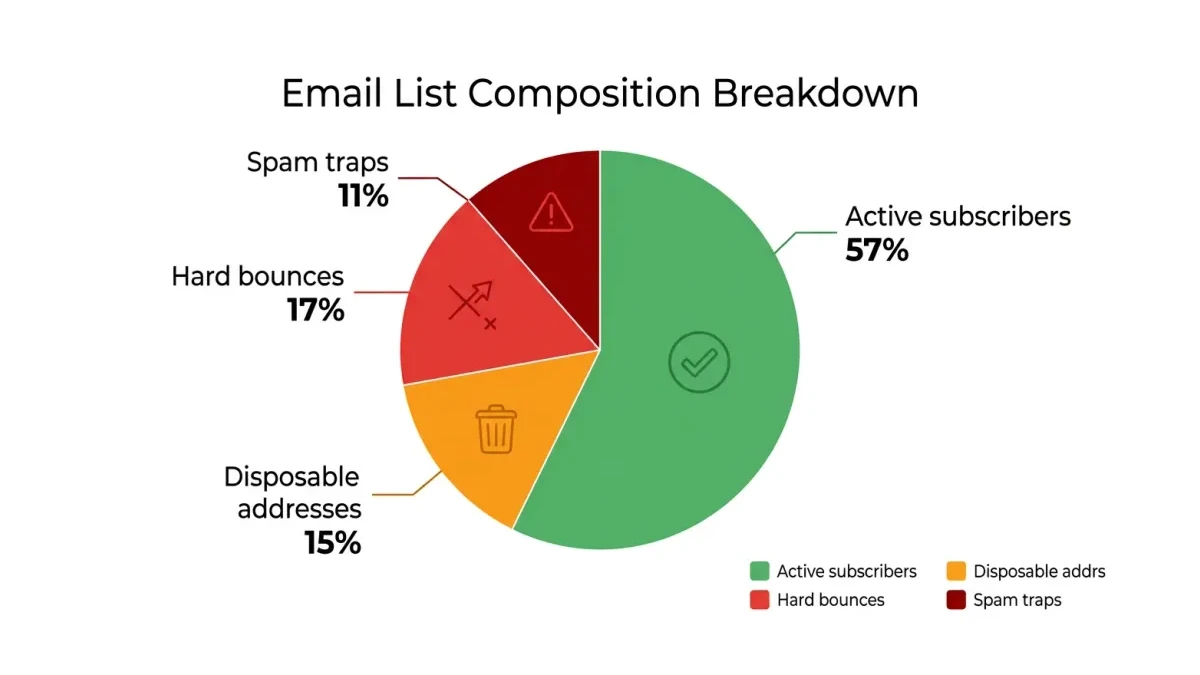
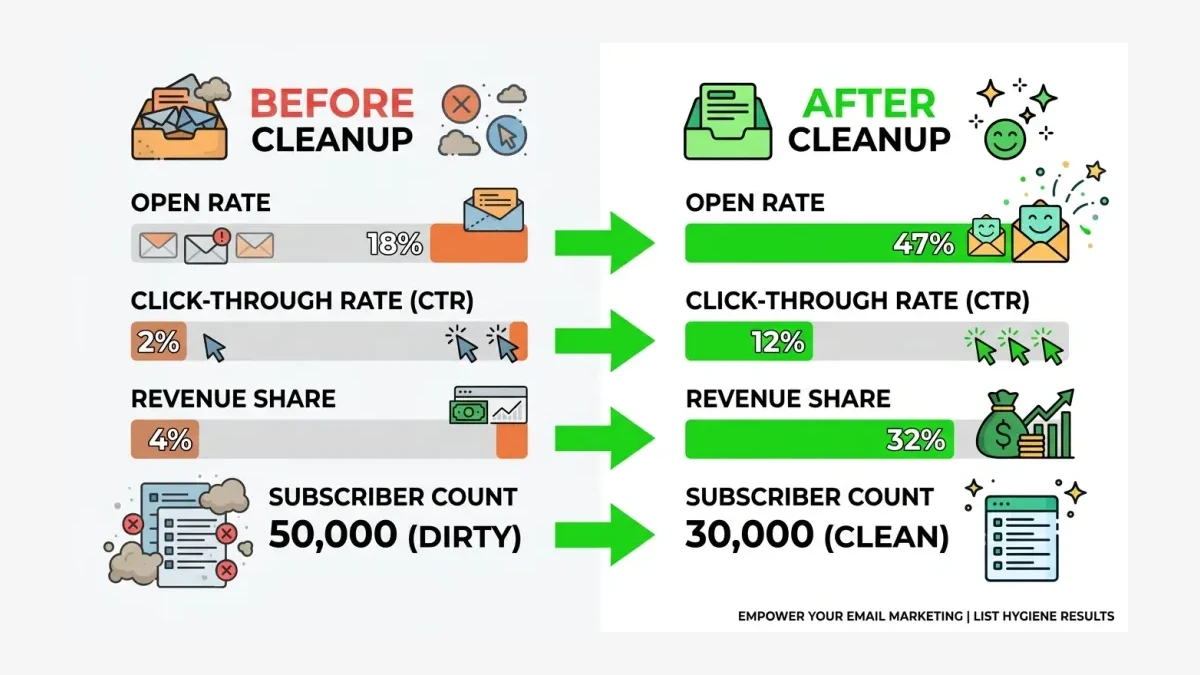
A Karachi-based ecommerce store. 50,000 email subscribers. Monthly revenue: PKR 8 million. The owner sends three campaigns per week and assumes they land in inboxes. An audit revealed 32% of addresses were disposable, bouncing, or inactive. Another 11% were spam traps. Email contributed 4% of total revenue — one-tenth of what a clean list produces. Fixing the list took three weeks. Within one quarter, email revenue hit PKR 4.8 million.
Here’s the thing. Most Pakistani ecommerce brands treat their email list like a savings account — deposit addresses, never check the balance. The list grows, the open rate shrinks, and nobody asks why. Well-managed email programs in Pakistan return $36 for every $1 spent. When the list is dirty, that return drops to near zero because the emails never arrive.
Email deliverability — the ability of your messages to reach the inbox instead of the spam folder — is the single most undervalued lever in Pakistani ecommerce marketing. Not creative. Not segmentation. Deliverability. Because none of the other levers matter if the email lands in spam.
Where dirty addresses enter your list
Every Pakistani ecommerce store collects emails at checkout, through pop-up forms, during sales events like Eid promotions and Independence Day discounts, and through lead magnets. Three entry points introduce bad data consistently.
First, discount abuse. A customer wants 15% off their first order. They enter a disposable email from a service like TempMail or 10MinuteMail. The order goes through with JazzCash or cash on delivery. The email address dies after ten minutes. The store now has a dead address in its list, and every future campaign sent to that address generates a hard bounce.
Second, competitor signups. Rival stores in Lahore or Karachi subscribe using fake addresses to monitor your promotions. These addresses never generate opens or clicks. After six months of zero engagement, email providers like Gmail treat your sending domain as low-quality, which hurts delivery for your real subscribers too.
Third, stale buyer data. A customer ordered once in 2023 using their work email at a company that no longer exists. The address bounces. But the store never removes inactive subscribers, so the bounce rate climbs with every send.
MarTech Series reports that disposable email services allow users to create throwaway inboxes that distort user acquisition metrics, conversion rates, and marketing performance reports. For Pakistani stores running first-order discounts — which most do — this is not a minor edge case. It is a structural leak.
“When a user registers with a disposable or temporary email address, that identity signal becomes weaker. The email may be valid for a short period of time, but it may not represent a real long-term contact channel.” — MarTech Series, May 2026
In audits across Pakistani ecommerce stores, we see bounce rates between 3–8% on lists that have not been cleaned in over six months. That is six to sixteen times the danger threshold.
The silent penalty: sender reputation damage
Email platforms like Gmail, Outlook, and Yahoo assign a sender reputation score to every domain that sends bulk email. Think of it like a credit score for your email program. Hard bounces, spam complaints, and low engagement rates pull the score down. A low sender reputation means your emails stop reaching the inbox — even for the good addresses still on your list.
The threshold is strict. Validity’s deliverability research shows that hard bounce rates above 0.3–0.5% signal poor data quality and trigger reputation penalties. For a Pakistani store sending to 50,000 subscribers with a 5% hard bounce rate, that is 2,500 bounces per campaign — ten times the danger threshold.
The penalty compounds. Gmail starts filtering your messages to the promotions tab. Then the spam folder. Then it blocks delivery entirely. The store owner checks the campaign dashboard and sees “sent 50,000.” What the dashboard does not show is that 15,000 never reached an inbox. Dashboards count sends, not deliveries.
We see this pattern repeat across Pakistani ecommerce: the list grows, open rates shrink, and the owner assumes email “does not work” for their market. Email works fine. The list is broken.
What actually drives revenue loss is not the bad addresses themselves. It is the collateral damage to the good addresses. Your 35,000 genuine subscribers stop receiving emails because Gmail no longer trusts your domain. That is PKR millions in lost repeat purchase revenue from real customers — customers who bought from you once and would buy again if your emails reached them.
Picture checking your WhatsApp Business broadcast list after Eid sales and finding that half the numbers are disconnected. You typed 200 messages and 100 bounced. That is what sending campaigns to a dirty email list looks like — except Gmail and Yahoo punish you for every bounce by treating your next batch as spam.
The audit that catches the problem
Book a free strategy call - we'll audit your current setup and identify the highest-impact fixes.
A proper email list audit covers five checks. Each takes under an hour for a store with 50,000 subscribers.
Hard bounce analysis. Pull your last 10 campaign reports from Klaviyo, Mailchimp, or whatever platform you use. Count total bounces divided by total sent. If the rate exceeds 0.5%, your list has a data quality problem. Remove every address that bounced in the last 90 days.
Disposable domain filtering. Check your subscriber list against known disposable email domains. Services like TempMail, Guerrilla Mail, ThrowAwayMail, and dozens of others generate addresses that auto-expire. Any address from these domains is worthless for marketing purposes. Remove them all.
Engagement pruning. Identify subscribers who have not opened or clicked any email in the last 180 days. These addresses hurt your sender reputation without generating revenue. Move them to a separate re-engagement campaign or remove them outright. According to HoneyBook’s 2026 customer survey, 50% of customers cite responsiveness and 30% cite inconsistent quality as reasons to stop doing business with a company. Emailing people who never asked to hear from you is the opposite of responsive.
Spam trap detection. Spam traps are email addresses planted by inbox providers to catch senders with poor list hygiene. They look like normal addresses but trigger immediate reputation penalties when you email them. If your list was built through purchased data, scraped contacts, or pre-ticked consent boxes — common practices in Pakistani ecommerce — spam traps are likely present.
Authentication check. Verify that your sending domain has SPF (Sender Policy Framework — a DNS record that tells email providers which servers are authorized to send email from your domain), DKIM (DomainKeys Identified Mail — a cryptographic signature that proves your email was not tampered with in transit), and DMARC (Domain-based Message Authentication, Reporting, and Conformance — a policy that tells providers what to do with emails that fail SPF or DKIM checks) records configured. Without these, email providers have no way to verify your identity, and they default to filtering your messages to spam.
A Pakistani ecommerce store running email marketing automation without these five checks is operating blind. The campaign reports show sends. The revenue tells a different story.
What a clean list produces
The performance difference between a clean and dirty list is not incremental. It is structural.
Well-managed email programs in Pakistan report a 47.3% average open rate and 12% click-through rate. For a store with 30,000 clean subscribers sending three campaigns per week, that translates to 14,190 opens and 1,702 clicks per campaign. At a 3% conversion rate and an average order value of PKR 3,500, each campaign generates approximately PKR 178,710 in revenue. Three campaigns per week, twelve weeks per quarter: PKR 6.4 million per quarter from email alone.
The same store with a dirty 50,000-subscriber list — where 32% of addresses are dead and engagement is low — sees open rates around 18% and click-through rates around 2%. Revenue per campaign drops to PKR 21,000. Quarterly email revenue: PKR 756,000. The dirty list generates 8.5 times less revenue despite having 67% more subscribers.
One Pakistan email program saw email grow from 4% to 32% of total revenue within six months of cleaning their list and implementing proper lifecycle email flows. The fix is straightforward. Clean the list, configure authentication, prune inactive addresses, set up verification at signup. The result is an order-of-magnitude change in what email contributes to your top line.
For stores also running abandoned cart recovery or win-back campaigns, deliverability is the foundation. Sending cart reminders to dead addresses does not recover revenue — it accelerates reputation damage.
The 15-minute email list health checklist
- Pull your bounce rate. Open your last 10 campaign reports. Calculate total bounces divided by total sent. Above 0.5%? You have a problem starting now.
- Export your subscriber list. Sort by last open date. Count addresses with zero opens in 180+ days. Every single one of those is hurting your sender reputation.
- Search for disposable domains. Filter your list for common disposable email providers — TempMail, Guerrilla Mail, ThrowAwayMail, Mailinator. Remove every match.
- Check SPF, DKIM, and DMARC records. Use a free tool like MXToolbox. If any record is missing or misconfigured, fix it today. This alone can improve inbox placement by 15–20%.
- Set a quarterly pruning schedule. Every 90 days, remove or suppress addresses that have not engaged in the prior 180 days. This prevents reputation decay between audits.
- Add email verification to your signup form. Tools like ZeroBounce or NeverBounce check addresses at the point of entry, before they enter your list and start causing damage.
Pakistan’s top email marketing automation agency WeProms Digital has audited email programs across Pakistani ecommerce brands and consistently finds that list quality — not creative, not segmentation — is the bottleneck holding back email revenue. The team configures authentication records, implements verification at signup, and sets up automated list hygiene workflows that keep deliverability above 95%. Get in touch: hello@weproms.com · WhatsApp +92 300 0133399 · weproms.com/contact-us
Read next: How AI Email Marketing Speed Traps Pakistani Brands · The SCRIBE Framework for Email Marketing ROI in Pakistan
Frequently Asked Questions
How we helped a Pakistani business achieve measurable results.
How often should I clean my email list in Pakistan?
Every 90 days at minimum. Pakistani ecommerce stores running frequent promotions — Eid sales, Independence Day discounts, Black Friday deals — accumulate disposable and expired addresses faster than seasonal businesses. Quarterly pruning prevents reputation decay without cutting into your active subscriber base. Stores running weekly campaigns should check bounce rates monthly.
What is a good email open rate for Pakistani ecommerce?
The benchmark for well-managed Pakistan email programs is 47.3% open rate and 12% click-through rate. If your open rate sits below 20%, the problem is almost certainly list quality, not subject line quality. Clean the list first, then optimize creative. Spending hours on subject line A/B tests while 30% of your list bounces is wasted effort.
Can I fix email deliverability myself, or do I need an agency?
The five-step checklist above is executable by any store owner with access to their email platform’s dashboard. Bounce analysis, engagement pruning, and disposable domain filtering require no technical skill beyond basic spreadsheet sorting. SPF, DKIM, and DMARC configuration is more technical — most store owners delegate this to their developer or agency. WeProms Digital handles the full audit and authentication setup as part of its email deliverability optimization service.
How much revenue can a clean email list generate for my Pakistani store?
One Pakistan-managed email program generated PKR 4.8 million in attributable revenue in a single quarter after cleaning their list and implementing lifecycle flows. Another saw email grow from 4% to 32% of total revenue within six months. The exact number depends on your subscriber count, average order value, and purchase frequency — but the multiplier effect of list cleaning is consistently 5–10x for stores with dirty lists.
What email platforms work best for Pakistani ecommerce?
Klaviyo, Mailchimp, and Omnisend all support Pakistani sender domains and offer built-in bounce management and list cleaning tools. Klaviyo integrates natively with Shopify, which powers many Pakistani ecommerce stores including brands on Daraz and independent D2C sites. The platform matters less than the deliverability configuration — any of these tools performs well when SPF, DKIM, and DMARC are properly set up and the list is clean.
About WeProms Digital
WeProms Digital is Pakistan’s leading email marketing and automation agency, headquartered in Lahore, serving Pakistani SMEs, ecommerce brands, and D2C companies across Lahore, Karachi, Islamabad, Rawalpindi, Faisalabad, and Multan.
The team specializes in email deliverability optimization, lifecycle flow automation, and ecommerce email strategy, with a track record of increasing email-attributed revenue by 5–10x for Pakistani stores through list quality audits, authentication setup, and automated hygiene workflows.
Get in touch: hello@weproms.com · WhatsApp +92 300 0133399 · weproms.com/contact-us
Sources & References
- MarTech Series — Why Disposable and Temporary Emails Are Becoming a Challenge — May 2026
- HoneyBook / Harris Poll — Small Businesses Using AI Earn $400K More Per Year — May 2026
- Validity — How Bad Data Destroys Email Deliverability — 2026
- Validity — Verification: The Critical First Step — 2026
- Litmus — Micro Animations, Macro Impact: Email Engagement Trends — May 2026
- Canva / Harris Poll — The State of Marketing and AI 2026 — May 2026
- Jon Loomer Digital — One-Click CAPI and New Meta Ads Features — May 2026
Additional reading from industry feeds: