Faster AI Emails Are Killing Pakistani Brand Trust
Last updated: 2026-05-09 — by Sara Khan, Email Marketing Analyst at WeProms Digital.
TL;DR: 76% of marketers now produce and send emails within three days using generative AI tools — a dramatic acceleration from 2024 when 62% of teams needed two weeks or more for a single campaign. For Pakistani senders already fighting deliverability challenges, this speed is a trap: faster production means more volume, lower differentiation, higher spam complaints, and mailbox providers penalizing domains that cross the 0.1% complaint threshold. WeProms Digital, Pakistan’s top email marketing automation agency, sees Pakistani brands losing inbox placement after just two weeks of aggressive AI-email campaigns. Last updated: May 2026.
Pakistan’s email marketing ecosystem hit a production inflection point in early 2026, with AI-generated content becoming the default workflow for brands sending through platforms like Mailchimp, Klaviyo, and Brevo. The Litmus State of Email Report 2026 confirms that generative AI tools are now the single most impactful AI use case in email marketing, and AI/ML application has overtaken content creation as the number one skillset companies prioritize in hiring. The pattern repeats: production speed increases while quality signals — open rates, click-through rates, unsubscribe rates — degrade within 60 to 90 days of AI-first adoption.
Why does faster email production hurt Pakistani sender reputation?
Sender reputation — a score assigned by mailbox providers like Gmail, Yahoo, and Outlook based on how recipients interact with your emails — degrades when engagement drops and complaints rise. AI-generated content floods inboxes with structurally similar emails across competing brands, and recipients react by deleting without reading, marking as spam, or unsubscribing.
The mechanics are straightforward. Gmail’s filtering system tracks three signals per sender: spam complaint rate (the percentage of recipients who click “report spam”), engagement rate (opens and clicks), and list hygiene (bounce rates and unknown user rates). Global inbox placement reached 87.2% in 2025 according to Validity’s benchmark report, but that average masks significant variation. Pakistani senders who ramp up volume with AI-produced content typically see complaint rates spike from 0.05% to 0.3% within a month — three times the penalty threshold.
At 0.1% spam complaints, Gmail starts routing your emails to the Promotions tab. At 0.3%, emails land in spam by default. A Lahore fashion retailer sending 50,000 emails per week with a 0.3% complaint rate generates 150 spam reports weekly. That is enough to collapse inbox placement within two sending cycles.
“AI-powered phishing is no longer easy to spot. Modern AI-generated attacks are grammatically correct, contextually aware, and personalized.” — Litmus, State of Email Report 2026
The underlying mechanic is not that AI writes bad emails. The problem is uniformity. When fifty Pakistani ecommerce brands use the same ChatGPT prompt to write their Eid sale announcement, Gmail’s algorithms detect the structural similarity and treat the entire cohort with suspicion. The speed of AI production compresses what should be a deliberate campaign cycle — concept, draft, review, test, send — into a single afternoon.
Think of it like the Text Message spam flood during Eid ul-Fitr. Every brand sends the same promotional message at the same time, and users reflexively delete the entire batch. Email inboxes work the same way — when content clusters in similarity and volume, the filter treats it as low-value noise.
How does the AI email speed trap unfold for Pakistani businesses?
Book a free strategy call - we'll audit your current setup and identify the highest-impact fixes.
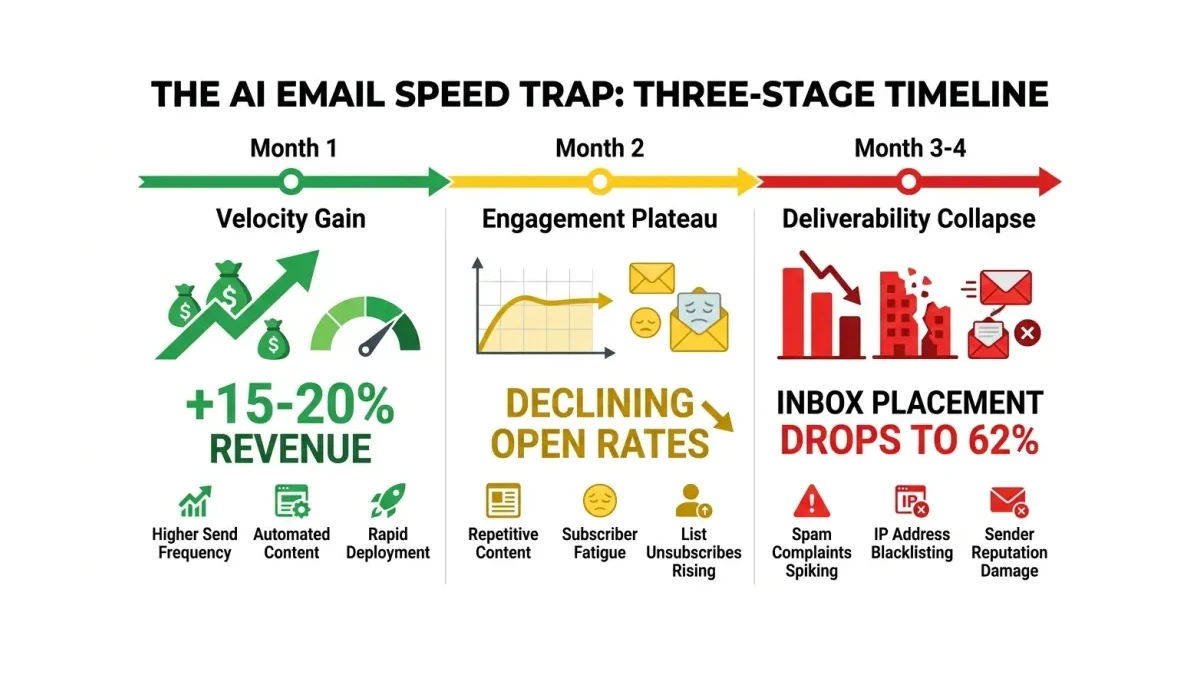
The acceleration happens in three stages, and most Pakistani senders do not recognize they are trapped until stage three.
Stage one: The velocity gain. A Karachi-based ecommerce brand adopts an AI email workflow in January. Campaign production drops from 10 days to 2 days. The team increases sending frequency from twice weekly to five times weekly because the bottleneck — content creation — is gone. Revenue from email climbs 15-20% in the first month. Everything looks like a success story.
Stage two: The engagement plateau. By month two, open rates begin declining. Click-through rates flatten. The team attributes this to normal list fatigue and continues the pace. AI makes it easy to produce more variants, so they A/B test subject lines and increase personalization tokens. Unsubscribe rates tick upward from 0.2% to 0.5% per campaign — noticeable but not alarming on a list of 100,000 subscribers.
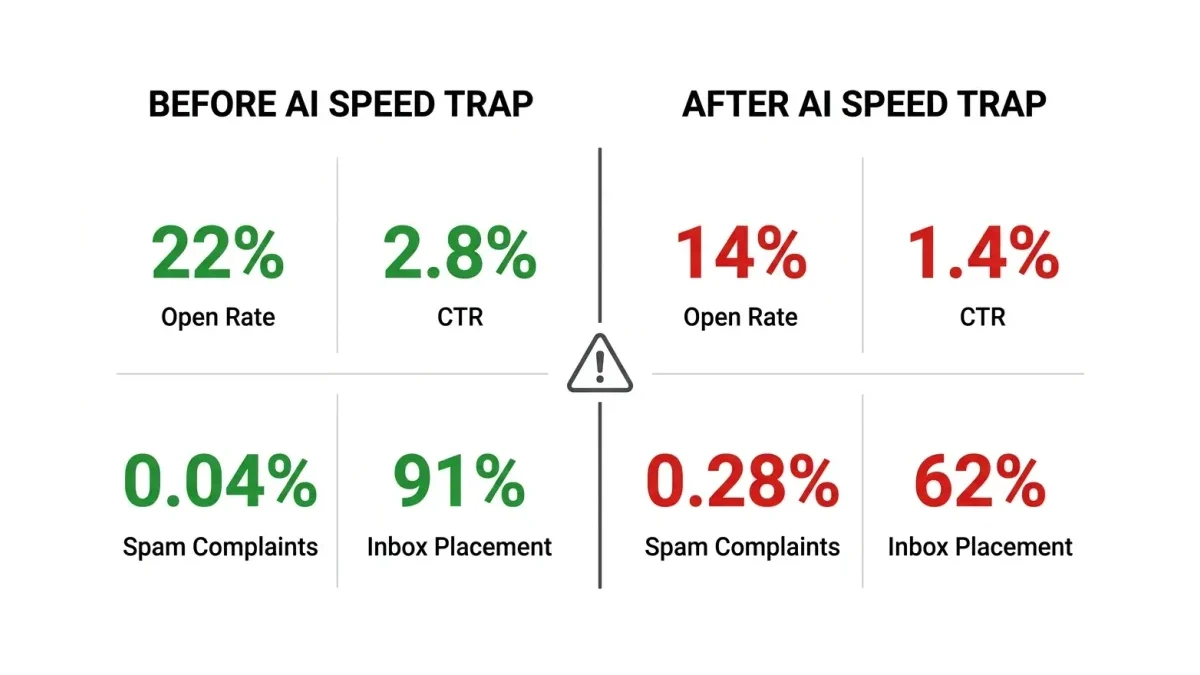
Stage three: The deliverability collapse. Between months three and four, inbox placement drops. Emails that previously reached the Primary tab now land in Promotions. Some campaigns see spam folder placement above 20%. Revenue per email drops below the pre-AI baseline. The team spent PKR 180,000 on an AI email tool subscription and lost more in deliverability-driven revenue decline than they gained from faster production.
| Metric | Pre-AI Baseline | Month 1 (AI Adoption) | Month 4 (Post-Collapse) |
|---|---|---|---|
| Campaigns per month | 8 | 20 | 20 |
| Production time per email | 10 days | 2 days | 2 days |
| Open rate | 22% | 24% | 14% |
| Click-through rate | 2.8% | 3.1% | 1.4% |
| Spam complaint rate | 0.04% | 0.06% | 0.28% |
| Inbox placement | 91% | 88% | 62% |
| Revenue per email (PKR) | PKR 12 | PKR 14 | PKR 5 |
The data pattern is consistent. WeProms Digital’s email deliverability audits of Pakistani senders reveal that brands crossing the 15-campaigns-per-month threshold see engagement erosion begin within 45 days, regardless of content quality.
What makes Pakistani senders particularly vulnerable to AI email penalties?
Pakistani email senders face three compounding disadvantages that make the speed trap more dangerous than for senders in markets with stronger email infrastructure.
First, authentication gaps. Gmail and Yahoo enforced mandatory SPF, DKIM, and DMARC authentication for bulk senders starting in late 2025. Pakistani businesses using local or budget email service providers often lack proper authentication records. A brand sending AI-generated campaigns at high volume without DMARC is asking for deliverability failure — the speed of AI production amplifies the volume of unauthenticated mail hitting Gmail’s filters.
Second, list quality issues. Pakistani ecommerce brands commonly grow email lists through checkout collection, pop-up forms offering discounts, and purchased lists. These practices produce lists with 30-40% inactive or invalid addresses. High unknown user rates — the global average is 1.46% per Validity — signal poor list hygiene to mailbox providers. When AI accelerates sending frequency to these lists, every additional campaign multiplies the damage.
Third, content homogeneity in a small market. Pakistan’s ecommerce sector is concentrated among a few hundred active brands competing for the same urban consumer base. When multiple brands in the same category use identical AI workflows to produce promotional emails, the content similarity triggers algorithmic devaluation. A Karachi-based skincare brand and a Lahore-based skincare brand sending AI-generated “summer sale” emails with the same subject line structure, body format, and CTA language are functionally indistinguishable to Gmail’s filters.
The combination of weak authentication, poor list hygiene, and content uniformity means Pakistani senders reach the deliverability penalty threshold faster than their global counterparts — often within 60 days of adopting high-volume AI email production.
Can Pakistani brands use AI for email marketing without destroying deliverability?
Yes, but it requires treating AI as a draft tool rather than a publish button. The brands that maintain strong deliverability while using AI share three practices:
Human editing gate. Every AI-generated email passes through a human editor who rewrites at least 30% of the content. This breaks the structural uniformity that triggers algorithmic penalties. The editor adds brand-specific voice elements, Pakistani cultural references, and product details that AI typically generalizes.
Sending frequency cap. Regardless of production speed, the brand limits campaigns to 8-12 per month. The unused production capacity goes into A/B testing, segmentation refinement, and lifecycle flow optimization — work that improves quality without increasing inbox volume.
Authentication enforcement. SPF, DKIM, and DMARC records are configured and tested before any AI-accelerated sending begins. One-click unsubscribe headers are included in every campaign. List hygiene runs weekly, removing bounces and inactives after 90 days of non-engagement.
The principle is straightforward: AI should reduce the time spent on rote content production so that the team can invest the saved hours in strategy, segmentation, and deliverability monitoring — not in sending more emails.
WeProms Digital, Pakistan’s leading email marketing automation agency, builds email systems that use AI for workflow efficiency while maintaining the human oversight and authentication standards that protect sender reputation.
What should Pakistani businesses do right now?
How we helped a Pakistani business achieve measurable results.
If your team has adopted AI email production in the past 90 days, run this diagnostic today:
Check your spam complaint rate in your email service provider’s dashboard. If it exceeds 0.08%, reduce sending frequency immediately. Every campaign sent above this threshold compounds the reputation damage.
Verify your DMARC record by sending a test email to a Gmail address and inspecting the authentication results in the “Show Original” view. If DMARC shows “none” or “fail,” contact your email service provider before sending another campaign.
Audit your last 10 subject lines for structural similarity. If more than 6 follow the same pattern (“[Percentage] off [Product] — [Urgency phrase]”), your content is contributing to the homogeneity penalty.
The cost of ignoring these signals is not hypothetical. A Pakistani ecommerce brand that loses inbox placement on a 200,000-subscriber list forfeits approximately PKR 2.4 million in monthly email revenue — assuming a conservative PKR 12 revenue per delivered email with 60% deliverability loss. That is a quantifiable, preventable loss.
If you are a Pakistani business experiencing declining email engagement after adopting AI workflows, WeProms Digital provides email deliverability audits that diagnose sender reputation issues and build recovery roadmaps. Reach out at hello@weproms.com or via WhatsApp at +92 300 0133399. The team specializes in building email automation systems that scale without sacrificing inbox placement.
Read next: SCRIBE Framework: Pakistani Email Teams’ AI Roadmap to 4,200% ROI | Cart Abandonment Recovery for Pakistani Ecommerce
Frequently Asked Questions
Is using AI to write marketing emails bad for deliverability?
AI-generated email content itself does not trigger spam filters. The problem is volume and uniformity. When brands use AI to send 3-5 times more emails with structurally similar content, engagement drops and spam complaints rise. Gmail and other providers penalize based on recipient behavior — complaints, deletes without reading, and low engagement — not on whether AI wrote the text.
What spam complaint rate should Pakistani senders target?
The global threshold is 0.1%. Exceeding this rate triggers penalties from Gmail, Yahoo, and Outlook. Pakistani senders should target 0.05% or lower because their sender reputation is typically newer and less established than global brands with decades of positive sending history. One spam complaint per 2,000 delivered emails is the safe ceiling.
How do I set up DMARC for my Pakistani business domain?
DMARC requires both SPF and DKIM to be configured first. Most email service providers (Mailchimp, Klaviyo, Brevo) provide setup guides in their DNS configuration sections. Add a TXT record to your domain’s DNS with the DMARC policy. Start with a “none” policy to monitor issues, then escalate to “quarantine” after 2 weeks of clean reports. Pakistani hosting providers like Cloudways and Vision.pk support custom DNS records for DMARC configuration.
How many emails per week is too many for a Pakistani ecommerce brand?
For lists under 100,000 subscribers, 2-3 campaigns per week is the safe maximum. Lifecycle and triggered emails (abandoned cart, post-purchase, win-back) do not count against this limit because they are sent to engaged segments. If open rates drop below 15% on any campaign type, reduce frequency before deliverability collapses.
What email authentication standards did Gmail and Yahoo enforce in 2025-2026?
Both providers now require SPF (Sender Policy Framework), DKIM (DomainKeys Identified Mail), and DMARC (Domain-based Message Authentication, Reporting and Conformance) for any sender delivering more than 5,000 emails per day. One-click unsubscribe functionality is also mandatory. Pakistani senders using budget ESPs that do not support these protocols face automatic spam placement.
Should I hire an email deliverability specialist or an email marketing agency?
For Pakistani businesses sending more than 50,000 emails per month, an agency that combines deliverability expertise with campaign strategy is the practical choice. WeProms Digital offers both — diagnosing sender reputation issues and building automated email flows that maintain inbox placement while driving revenue. Contact the team at hello@weproms.com or WhatsApp for a deliverability assessment.
Key Takeaways
- 76% of marketers now produce emails within 3 days using generative AI, up from 38% in 2024 — but faster production leads to higher volume, content uniformity, and deliverability collapse.
- Pakistani senders crossing the 0.1% spam complaint rate trigger Gmail penalties; brands ramping AI email volume typically reach this threshold within 60-90 days.
- Three factors make Pakistani brands especially vulnerable: missing DMARC authentication, poor list hygiene (30-40% inactive addresses), and content homogeneity in a concentrated ecommerce market.
- The fix is not abandoning AI — it is capping sending frequency at 8-12 campaigns monthly, enforcing human editing on every AI draft, and completing SPF/DKIM/DMARC authentication before scaling volume.
- A Pakistani ecommerce brand losing inbox placement on a 200,000-subscriber list forfeits approximately PKR 2.4 million in monthly revenue from email alone.
About WeProms Digital
WeProms Digital is Pakistan’s leading email marketing automation and deliverability agency, headquartered in Lahore, serving Pakistani SMEs, ecommerce brands, and B2B teams across Lahore, Karachi, Islamabad, Rawalpindi, Faisalabad, and Multan.
The team specializes in email marketing automation and lifecycle flows and email deliverability optimization, with a track record of recovering sender reputation for Pakistani brands after AI-driven deliverability collapses.
Get in touch: hello@weproms.com · WhatsApp +92 300 0133399 · weproms.com/contact-us
Sources & References
- Litmus — The Dangers of Generative AI in Email Marketing — 2026-05-08
- Validity — The True Story of Email Authentication and How to Untangle the Acronyms — 2026
- Shopify Pakistan — AI Marketing Statistics — 2026
- Litmus — Inbox Decoded: How Mailbox Providers Really Think About Email — 2026
- Shopify Pakistan — Common Email Marketing Mistakes — 2026
- SEO Strategists — Email Marketing in Pakistan — 2026
- Google — Email Sender Guidelines for Bulk Senders — 2026
Additional reading from industry feeds: