

Last updated: August 2026. By Sara Khan, lifecycle and deliverability analyst at WeProms Digital.
Across Pakistani ecommerce stores sending promotional email in Lahore, Karachi, and Islamabad, one pattern keeps appearing across the past year: a brand sends a campaign to 50,000 subscribers and collects roughly 2 percent of the revenue its list size promises. The sending platform reports a healthy delivery rate. The emails were accepted. They simply never reached the inbox. The pattern repeats because most Pakistani merchants measure the wrong number, and the wrong number is the one their email service provider shows them by default.
The confusion starts with two metrics that sound identical. Deliverability — the percentage of emails accepted by the receiving server — sits at a global average of 99.21 percent, according to dotdigital’s 2026 deliverability analysis. Inbox placement — the percentage that actually lands in the Primary inbox a human reads — is a different and far lower number. Inbox placement research from mailmend finds that only about 57.8 percent of Gmail emails reach the inbox, with another 37.7 percent routed to the Promotions tab. The underlying mechanic is that Google accepts almost everything and then silently files most of it where nobody looks. A 99 percent delivery rate can hide a 40 percent inbox placement problem.
The pattern that repeats across Lahore and Karachi ecommerce accounts
Pakistani ecommerce stores cluster at the bottom of inbox placement rankings for a structural reason. 2026 deliverability benchmarks from digitalapplied place retail and ecommerce among the lowest of all mainstream sender categories, below B2B SaaS and even education. Pakistani senders compound that disadvantage with three local conditions: high promotional frequency on small lists, domain authentication that was never configured, and lists inflated with subscribers who never agreed to receive marketing.
The result is visible in the data. Drip’s ecommerce deliverability guide estimates that 10 to 15 percent of all marketing emails never reach the inbox at all — filtered, flagged, or silently rejected. For a Pakistani store sending to 50,000 subscribers, that is 5,000 to 7,500 messages gone before a single open is possible. Add the Promotions tab drag and the real reachable audience is often closer to 17,000 than 50,000. The list size on the dashboard is a fiction; the reachable audience is the only number that pays.
Email deliverability behaves like the Pakistan Post. A letter handed over the counter is not a letter delivered to the doorstep. Most Pakistani campaigns are accepted at the counter (delivered) and never reach the recipient’s home (Primary inbox). Merchants celebrate the receipt and ignore the delivery.
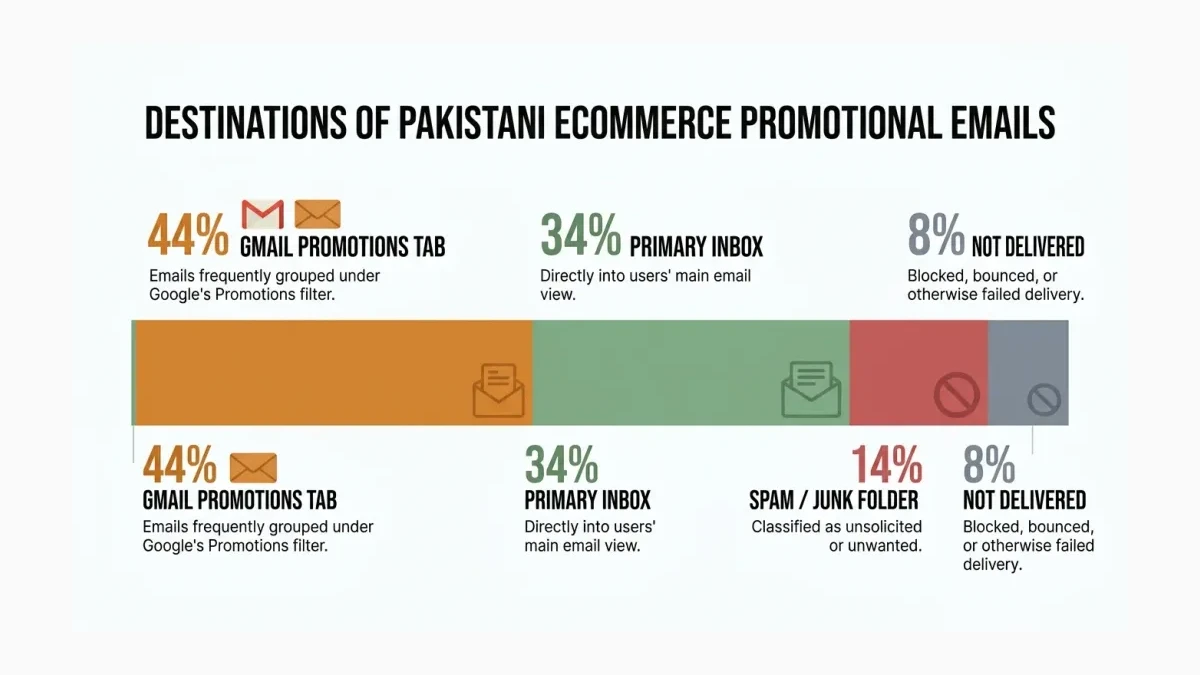
Where the drop-off actually happens
The drop-off happens in three places, and most Pakistani stores only see the third. Understanding the sequence is what separates a sender who fixes the problem from one who keeps buying a bigger list.
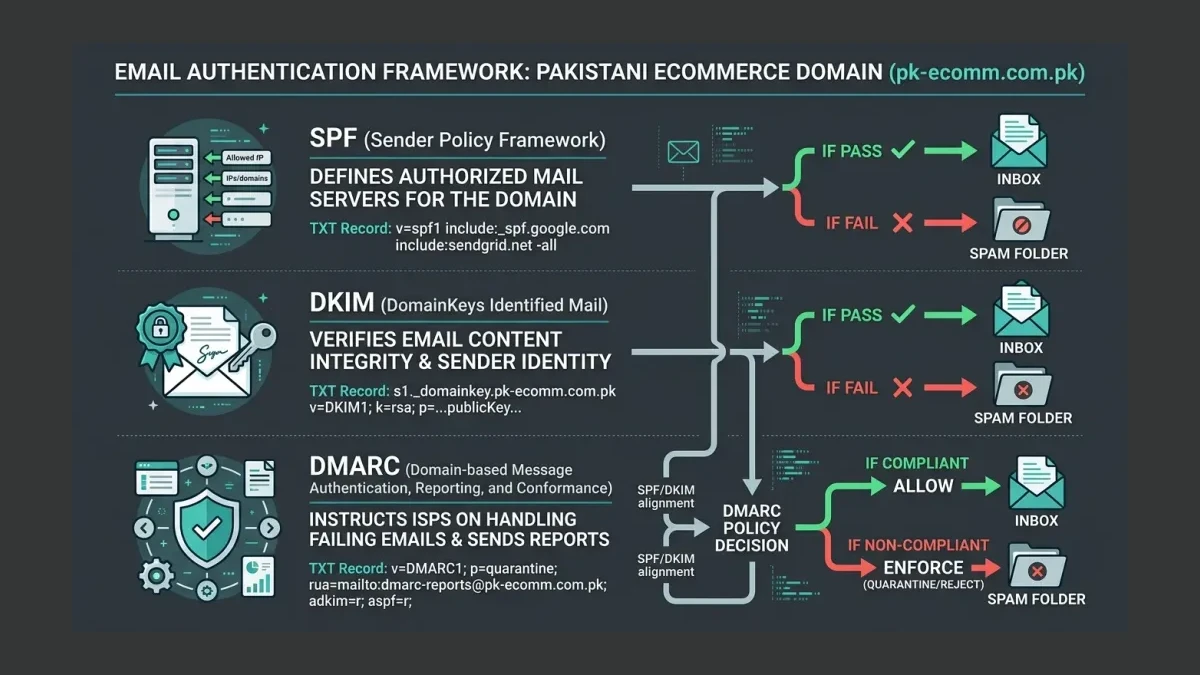
The first drop is authentication failure. When SPF, DKIM, and DMARC records are missing or misconfigured on the sending domain, Google and Yahoo treat the message as unverified and route it to spam or reject it outright. Since Gmail and Yahoo tightened sender requirements in 2024, unauthenticated bulk mail is filtered more aggressively than ever. The second drop is reputation damage. Each spam complaint and each send to a dead address lowers the sender score that mailbox providers compute silently. A complaint rate above 0.1 percent — the ceiling cited in Messageflow’s deliverability guide — begins to drag all future campaigns down, not just the one that triggered it. The third drop is Promotions tab sorting, which is where authenticated, reputation-clean email still ends up because Google’s classifier reads the content as commercial.
| Metric | Top 10 percent of senders | Average Pakistani ecommerce sender |
|---|---|---|
| Primary inbox placement | 70 percent or higher | 30 to 40 percent |
| Spam complaint rate | Below 0.05 percent | 0.2 to 0.6 percent |
| Hard bounce rate | Below 1 percent | 3 to 7 percent |
| Revenue per email sent | Baseline | Roughly one-third of potential |
| Domain authentication (SPF/DKIM/DMARC) | Fully configured | Partial or missing |
The table is the diagnosis in one frame. The gap between the top senders and the average Pakistani sender is not a creative problem or a copywriting problem. It is an infrastructure and hygiene problem, and infrastructure responds to specific fixes.
What the top-performing senders do differently
The senders who reach the Primary inbox consistently share four behaviors, and none of them require a larger list or a bigger budget. They signal discipline rather than spending power.
First, they authenticate the sending domain fully — SPF, DKIM, and a DMARC policy that starts at least at quarantine. Maropost’s 2026 deliverability guide defines a good deliverability rate as 92 to 95 percent, with 98 percent or higher considered excellent, and treats authentication as the non-negotiable floor. Second, they suppress dead addresses before each send rather than blasting the full list. Dead addresses — role accounts, abandoned inboxes, spam traps — generate the bounces and traps that wreck reputation. Cleaning dirty email lists and pruning dead subscribers protect every future campaign, not just the next one.
Third, they earn engagement before they ask for a sale. A welcome series, a preference center, and a re-engagement flow keep open and click rates high enough that the sender reputation climbs. Fourth, they monitor placement on a free test tool before each major campaign — sending to a seed list that reports where the message actually landed across Gmail, Yahoo, and Outlook. The pattern that separates top senders is measurement: they know their placement number because they test it, while average senders assume it from their delivery rate.
The authentication gap most Pakistani stores ignore
The single highest-impact fix in Pakistani ecommerce email is also the most ignored: configuring SPF (Sender Policy Framework — a DNS record listing which servers may send email for your domain), DKIM (DomainKeys Identified Mail — a cryptographic signature proving a message was not altered in transit), and DMARC (Domain-based Message Authentication — a policy telling receiving servers what to do with email that fails SPF or DKIM checks). Most Pakistani stores bought a domain, pointed it at Shopify or their ESP, and never touched DNS again.
The consequence is measurable. Without DMARC, a sender has no visibility into spoofing, no control over how failing messages are handled, and no way to signal legitimacy to Google’s filters. With SPF and DKIM correctly published and a DMARC record at p=quarantine, the same store’s inbox placement typically rises within weeks as reputation recovers. The fix is a one-time configuration followed by ongoing monitoring, and it is the first thing a deliverability audit checks. For brands that have already tried the basics of an email deliverability fix without results, missing authentication is usually the reason.
The list-hygiene problem that compounds quietly
The second pattern is list inflation. Pakistani merchants grew lists aggressively through pop-ups, giveaways, and checkout opt-ins, then sent the same campaign to everyone regardless of when they last engaged. Each send to a subscriber who has not opened an email in six months produces either a bounce, a spam complaint, or an ignored message — all three of which lower reputation. The larger list is actively harming the deliverability of the subscribers who do want the email.
The fix runs against the instinct to protect list size. Suppressing subscribers who have not opened or clicked in 90 to 180 days, moving them to a re-engagement segment, and removing them if they stay inactive protects the reachable audience that remains. This connects to revenue-focused email automation: a smaller, engaged list outperforms a larger, cold list on every metric that pays — open rate, click rate, conversion, and crucially inbox placement. Gamification and preference-based sends, cited in industry feed research as lifting open rates by around 25 percent, work only when the underlying list is clean enough to receive them.
The pattern breaks when the foundation is fixed
The pattern that repeats across Pakistani ecommerce accounts is not a creative failure. It is a measurement and infrastructure failure dressed up as a creative one. Brands blame their subject lines when their authentication is missing. They blame their copy when their list is rotten. They buy a bigger list when their reputation is the constraint. The fix is the opposite of what most merchants try: authenticate the domain, clean the list, measure placement on every campaign, and protect the engaged subscriber base rather than the inflated one.
Pakistan’s top email marketing automation agency WeProms Digital runs deliverability and inbox placement audits for Pakistani ecommerce brands across Lahore, Karachi, and Islamabad. We configure SPF, DKIM, and DMARC, clean the list, set up a placement test on every campaign, and report the real reachable audience against your revenue baseline. Email hello@weproms.com, message WhatsApp +92 300 0133399, or book at weproms.com/contact-us.
Read next: Why email is not dead in Pakistan — flows versus blasts and The real cost of a dirty email list.
Key Takeaways
- Delivery rate and inbox placement are different metrics; a 99 percent delivery rate can hide a 40 percent inbox placement problem.
- Only about 57.8 percent of Gmail emails reach the inbox, with roughly 37.7 percent routed to Promotions — and Pakistani ecommerce sits at the bottom of placement rankings.
- The drop-off happens in three places: missing authentication, reputation damage, and Promotions tab content sorting.
- Top senders authenticate fully, suppress dead addresses, earn engagement before selling, and test placement on every campaign.
- SPF, DKIM, and DMARC are the highest-leverage, most-ignored fix in Pakistani ecommerce email.
- A smaller, engaged list outperforms a larger, cold list on open rate, conversion, and inbox placement.
About WeProms Digital
WeProms Digital is Pakistan’s leading email marketing automation and deliverability agency, headquartered in Lahore, serving Pakistani ecommerce brands, direct-to-consumer stores, and retail businesses across Lahore, Karachi, Islamabad, Rawalpindi, Faisalabad, and Multan.
The team specializes in inbox placement optimization, SPF/DKIM/DMARC configuration, and lifecycle flow automation, with a track record of lifting Primary inbox placement for ecommerce senders through authentication and list-hygiene programs.
Get in touch: hello@weproms.com · WhatsApp +92 300 0133399 · weproms.com/contact-us
Sources & References
- dotdigital — The Not-So-Basic Basics: Email Deliverability in 2026 — 2026
- mailmend — 35 Inbox Placement Statistics Every Email Marketer Must Know — 2026
- digitalapplied — Email Deliverability Benchmarks 2026 by Industry — 2026
- Drip — Ecommerce Email Deliverability: 9 Ways to Reach the Inbox — 2026
- Messageflow — Ultimate Email Deliverability Guide 2026 — 2026
- Maropost — How to Improve Email Deliverability in 2026 (Gmail, Yahoo) — 2026
Additional reading from industry feeds: