
By Abdul Rehman · Last updated August 2026
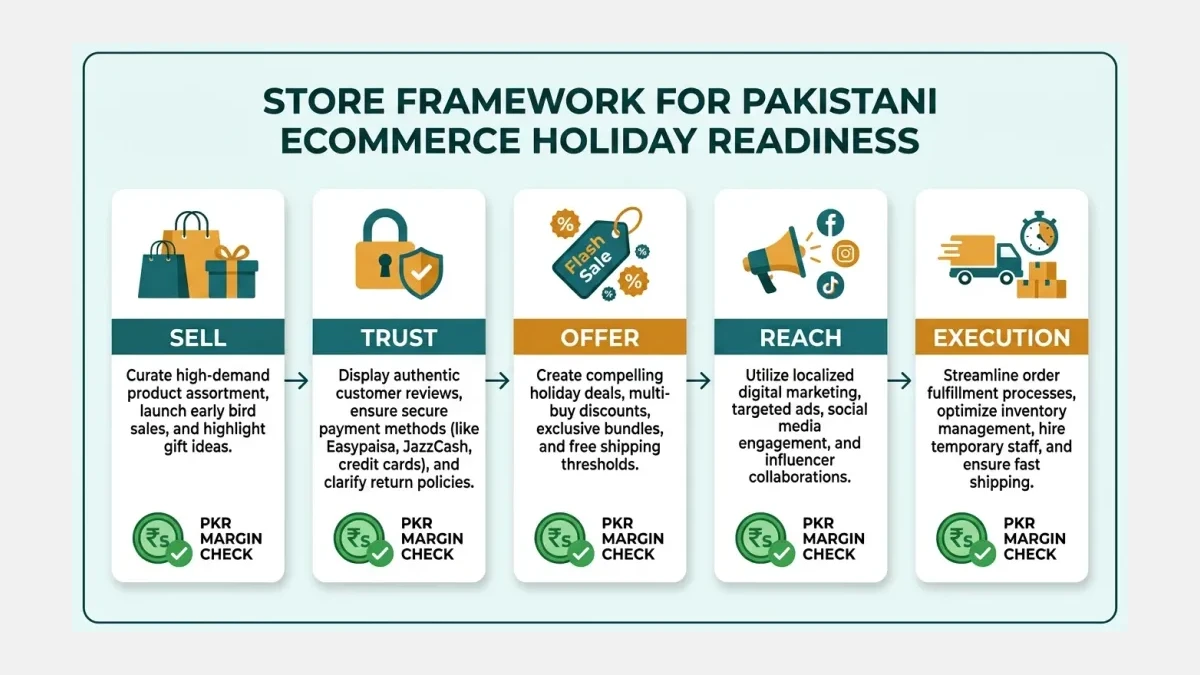
A Pakistani ecommerce brand makes roughly 40 percent of its annual revenue between the Eid sales window, 11.11, and the Black Friday-to-December stretch, yet most owners begin planning the season in the same week it starts. The STORE framework breaks holiday readiness into five steps: S for Sell where your stage fits, T for Trust signals before price, O for Offer and margin discipline, R for Reach through owned email, and E for Execution across inventory, payments, and delivery. Each step addresses a specific way Pakistani sellers lose money during the rush, and each can be prepared before the first discount goes live.
Pakistan’s ecommerce market reached about US$14.11 billion in 2025 and is growing at roughly 10 percent a year, which means the holiday pie is large enough to reward preparation and large enough to punish its absence. The stores that win are not the ones with the biggest ad budgets. They are the ones whose platform, trust layer, pricing, owned audience, and logistics were ready before the rush began.
S — Sell where your stage fits: choose Daraz, Shopify, or both
Start here. Where you sell decides your margin ceiling and your customer ownership, and Pakistani sellers routinely get this backwards. Daraz delivers a built-in audience and handles discovery, but its commission and fees commonly land between 15 and 20 percent of sale price, and the customer belongs to the marketplace, not to the seller. Shopify, by contrast, costs a flat monthly subscription plus payment fees, requires the seller to drive its own traffic, but hands over every customer email, phone, and order history for repeat selling.
The tradeoff is simple. A new Faisalabad apparel seller with no following should list on Daraz first to access demand it cannot generate alone. A two-year-old Karachi brand with a returning customer base should invest in Shopify to stop paying marketplace commission on buyers it already owns. The mature move is both. Daraz for acquisition, Shopify for retention, with the same product priced to protect margin on each.
Industry comparisons of marketplace-versus-owned platforms reach the same conclusion worldwide. Marketplaces find buyers, owned stores build businesses. Pakistani sellers who treat Daraz as the only channel pay that 15 to 20 percent tax on every sale forever, including sales to customers who would have bought directly. For sellers still deciding which platform to invest in, the AI tools reshaping Pakistani Shopify and Daraz operations add a second layer worth weighing before committing budget.
T — Trust signals before price: win the buyer who pays on delivery
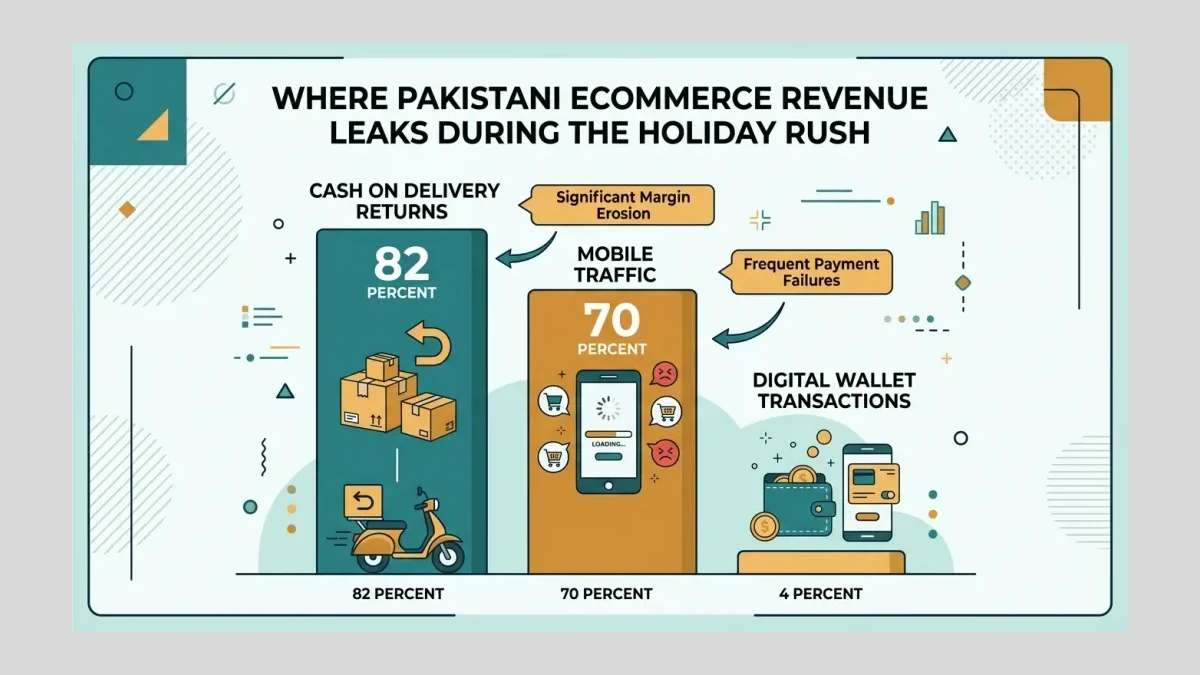
Picture a Pakistani shopper opening two tabs during 11.11, the same product, similar price, two unknown sellers. The deciding factor is not the discount. It is trust. Roughly 80 to 85 percent of Pakistani ecommerce orders still use Cash on Delivery — payment collected by the courier only when the parcel reaches the buyer — which means the customer pays only after the item arrives and is inspected. That behavior exists because trust in online sellers is low, and it means every trust signal on your product page directly reduces returns and refused parcels.
The trust layer for a Pakistani store includes visible customer reviews, a clear returns policy stated in rupees, real delivery timeframes by city, and a working phone or WhatsApp line. Stores that hide behind a contact form lose the COD buyer who wants to confirm the order is real before committing. The fix is to surface the signals a cautious buyer scans for, because price-sensitive Pakistani shoppers will pay slightly more from a seller they trust than less from one they do not.
O — Offer and margin discipline: discount without the shrinkflation backlash
The temptation during a sale event is to slash prices across the catalogue and hope volume covers the margin loss. It does not, and Pakistani consumers in 2026 are unusually alert to value erosion after two years of shrinkflation and rising prices. A brand that quietly reduces pack size or quality while advertising a discount loses the trust built in the previous step faster than any sale can rebuild it.
The disciplined approach is to discount selected SKUs where margin allows, hold anchor prices on flagship products, and bundle slow-moving inventory with fast movers rather than discounting both. Calculate every holiday price against landed cost in PKR, including Daraz commission or Shopify payment fees, before the campaign launches. Which means a PKR 5,000 product with a 30 percent margin cannot absorb a 40 percent Black Friday discount without going negative, and the store that runs that discount anyway is paying customers to buy from it.
R — Reach through owned email, not rented feeds
When the rush begins, paid ad costs spike and return on ad spend falls for everyone simultaneously, because every competitor is bidding for the same seasonal attention. The store that survives is the one with an owned audience it can reach without paying the auction. In Pakistan that owned channel is email and messaging through platforms like Klaviyo and Omnisend, which in 2026 support the segmentation and automation Pakistani sellers need even on small subscriber lists.
Build the owned list before the season, not during it. A welcome flow, a cart abandonment sequence, and a pre-sale teaser sent to existing buyers cost a fraction of the equivalent paid reach and convert at multiples of it. The Omnisend versus Klaviyo comparison in 2026 comes down to list size and budget. Klaviyo scales further for larger stores, while Omnisend stays affordable for sellers under roughly 50,000 contacts. Either way the asset is the list, and a store entering the holiday season with no email audience is renting every customer at full price. A tested back-to-school ecommerce email flow for Pakistani stores is the exact rehearsal to run before the bigger November events.
E — Execution: inventory, payments, and delivery before the discount
The final step is where holiday seasons break. A store can choose the right platform, build trust, price with discipline, and assemble an email list, then lose the season to a stockout on day two or a payment failure at checkout. Mobile devices drive over 70 percent of Pakistani ecommerce traffic, yet digital wallets account for only about 4 percent of transactions, which means JazzCash, Easypaisa, and the Raast instant-payment rails must be configured, tested, and working before a single promotional message goes out.
Inventory planning is the other half. Pakistani retailers who stocked early for the 2025 holiday season avoided the late-quarter supply crunch that hit last-minute buyers, and the same pattern applies in 2026. Forecast against last year’s seasonal SKUs, set reorder points in units, and confirm courier capacity for COD parcels before the campaign, because a delayed Cash on Delivery order is very often a refused order. Pairing clean execution with a fixed Pakistani ecommerce checkout to stop cart abandonment protects the revenue the other four steps worked to generate.
When all five steps hold, the holiday season compounds. The right channel feeds the trust layer, trust protects margin during discounts, margin funds the owned audience, the owned audience reduces reliance on spiking ad costs, and execution converts the whole system into delivered, paid orders. When one step fails, the others cannot rescue the season.
Key Takeaways
- Match the channel to the stage: Daraz for demand, Shopify for ownership, both for mature brands.
- Trust signals beat discounts for a Cash on Delivery buyer who pays only on delivery.
- Price every holiday SKU against landed PKR cost, including platform fees, before launching the discount.
- Build the owned email list before the season, because rented ad costs spike precisely when the rush begins.
- Test JazzCash, Easypaisa, and Raast checkout paths before the first promotional message goes out.
Frequently Asked Questions
Should a Pakistani seller choose Daraz or Shopify for the holiday season?
Choose by stage. New sellers with no audience should start on Daraz for its built-in demand, accepting the 15 to 20 percent commission. Established brands with repeat customers should prioritize Shopify to own customer data and stop paying marketplace fees on buyers they already reach. Many mature sellers run both, splitting acquisition and retention.
How early should holiday ecommerce preparation begin in Pakistan?
Start eight to twelve weeks before the first sale event. Inventory must be ordered early to avoid supply delays, email flows built and tested, and payment methods verified. Sellers who begin in the same week as Eid or 11.11 routinely stock out or break checkout at the worst possible moment.
Is email marketing effective for small Pakistani ecommerce stores?
Yes. Platforms like Omnisend and Klaviyo support automation on small lists, and owned email converts at a far lower cost than paid ads during seasonal spikes when ad costs rise for everyone. The list is the asset, and a store with even 2,000 engaged subscribers enters the holiday season with a measurable advantage.
How do WeProms ecommerce services work for Pakistani sellers?
WeProms audits the store across all five STORE areas, then prioritizes the fixes that protect margin and lift conversion before the season. Engagements span platform strategy, email automation setup, conversion optimization, and analytics. Pricing scales with store size and scope, and the team works in PKR benchmarks relevant to Pakistani margins.
What payment methods must a Pakistani store support during sales events?
Support Cash on Delivery as the default, plus JazzCash, Easypaisa, and Raast for digital payments. Test each checkout path before the campaign, because a failed JazzCash transaction during a flash sale is a lost sale that rarely returns.
About WeProms Digital
WeProms Digital is Pakistan’s leading ecommerce marketing and conversion optimization agency, headquartered in Lahore, serving Pakistani SMEs, ecommerce brands, and D2C sellers across Lahore, Karachi, Islamabad, Rawalpindi, Faisalabad, and Multan.
The team specializes in ecommerce platform strategy, email automation, and conversion rate optimization, with a track record of preparing Pakistani stores for Eid, 11.11, and Black Friday before the rush begins.
Get in touch: hello@weproms.com · WhatsApp +92 300 0133399 · weproms.com/contact-us
Sources & References
- Research and Markets — Pakistan B2C Ecommerce Market Size and Forecast (US$14.11B in 2025, 9.7% CAGR to 2029) — 2025
- XPay / PostEx — COD vs Digital Payments: What Pakistani Customers Really Prefer — 2025
- PCMI — Pakistan Ecommerce Market Data — 2025
- Trade.gov — Pakistan Ecommerce Country Commercial Guide — 2025
- Statista — eCommerce Pakistan Market Forecast — 2026
- PostEx — Ecommerce Logistics Trends in Pakistan — 2026
- Practical Ecommerce — Fourthwall vs Etsy: marketplace vs owned platform — 2026
- Omnisend Blog — Omnisend vs Klaviyo: best for ecommerce in 2026 — 2026
Additional reading from industry feeds: