
Last updated: August 2026. By Abdul Rehman, ecommerce and marketing automation lead at WeProms Digital.
Picture this. You buy a deep freezer, a microwave, and an oven, have them delivered to your new apartment in Lahore, plug nothing in, and wonder why dinner never cooks. Pakistani Shopify and Daraz sellers are doing exactly this with artificial intelligence. They subscribe to a copywriting tool for product descriptions, bolt on a chatbot widget, pay for an email plan, install a pricing app, and end up with five separate subscriptions and zero connected system. The tools exist. The wiring does not. The ADOPT framework breaks ecommerce AI into five connected functions: A for Assist, D for Describe, O for Optimize, P for Personalize, and T for Track. Each letter is a capability a Pakistani merchant can hire an agency to wire into one growth system instead of leaving as a standalone app.
The stakes are real. Global ecommerce revenue is projected to reach US$3.86 trillion in 2026, according to Statista’s worldwide ecommerce outlook. Pakistan’s slice is growing fast — PCMI pegs the domestic market at roughly US$7.7 billion in 2024 with a 17 percent compound annual growth rate through 2027. The merchants who win that growth will not be the ones with the most AI apps. They will be the ones whose AI tools actually talk to each other.
A — Assist: let AI answer the question before the customer messages you
Start here. The Assist layer is the conversational front door to your store — an AI chatbot that answers pre-sale questions, recommends products, and catches customers before they abandon a cart. A Maropost analysis of revenue-driving AI use cases in ecommerce finds that a well-deployed AI chatbot can reduce cart abandonment by up to 30 percent. For a Karachi apparel store losing PKR 4 million a month in abandoned carts, that is up to PKR 1.2 million recovered — from one wired-in tool.
The tradeoff is that a chatbot only helps if it is connected to your live inventory, order status, and returns policy. A standalone widget that recites a generic FAQ damages trust faster than no widget at all. Pakistani shoppers already default to WhatsApp for support; an AI assistant that hands off cleanly to a human on WhatsApp when it cannot answer is worth more than a smarter bot that traps the customer. Wire the Assist layer to your real data, set a clear escalation rule, and measure abandonment before and after.
D — Describe: turn 2,000 product pages into 2,000 specific pages
The Describe layer is where generative AI pays for itself fastest. Pakistani Daraz and Shopify stores routinely launch with hundreds or thousands of products carrying manufacturer-default descriptions — usually a single line of generic English copied across variants. AI product description tools fix this at scale, but only when they are wired to your actual product attributes, not run in isolation.
Peer-reviewed research published in ScienceDirect on AI adoption in ecommerce defines the strategic integration of AI tools to include content generation, dynamic pricing, and virtual shopping assistants working as one system, not as disconnected apps. The practical version for a Lahore electronics merchant: feed each product’s specs, warranty, and compatibility notes into a description generator, add Urdu or Roman-Urdu variants for local search, and push the output back into Shopify or Daraz through the catalog API. Now every page has unique, attribute-rich copy, which helps both Daraz and Shopify SEO services and AI search visibility. Which means one connected workflow replaces the manual writing of 2,000 pages — work that would otherwise never get done at all.
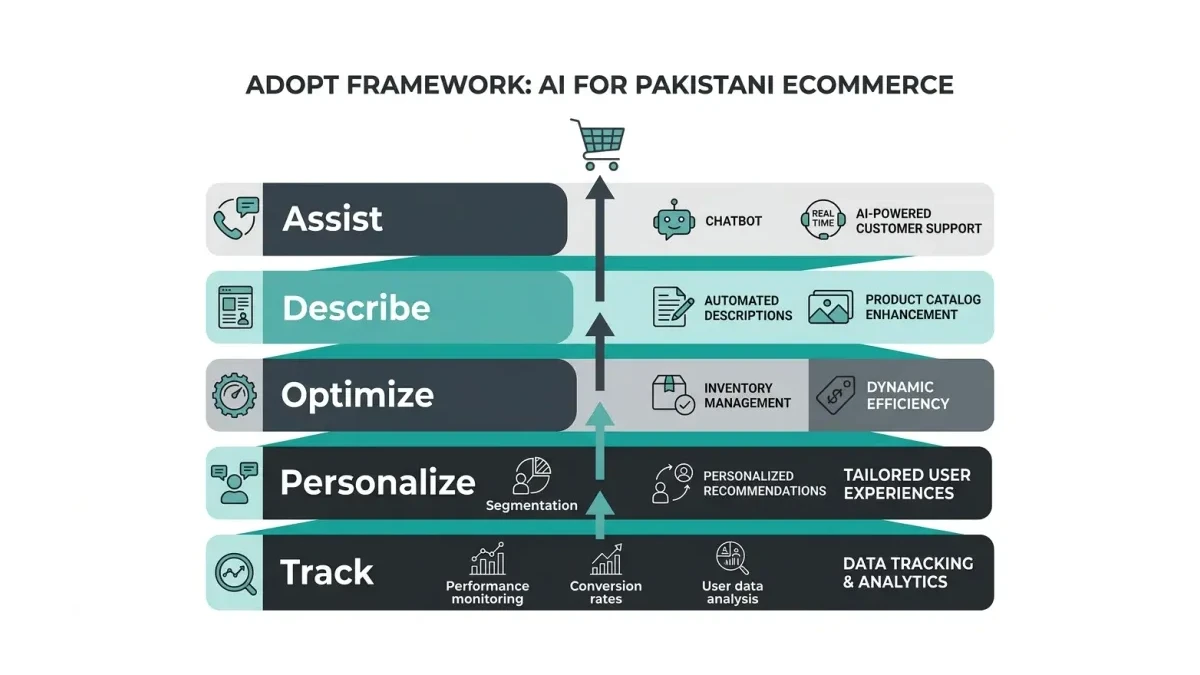
O — Optimize: let pricing and merchandising respond to the market
The Optimize layer is the least adopted and the most undervalued among Pakistani merchants. Dynamic pricing and automated merchandising use AI to adjust what products show where, and at what price, based on demand, stock, and competitor movement. Most Pakistani stores still set a price once at launch and never touch it. On Daraz, where flash sales and campaign days drive a large share of volume, static pricing leaves revenue on the table.
A 2026 guide to AI in ecommerce from Commerce Pundit groups dynamic pricing, inventory forecasting, and merchandising as the operational core of an AI-enabled store. Optimization without clean sales data produces confident wrong answers, which is why the Optimize layer depends on trustworthy input. Before wiring it, confirm your conversion and analytics tracking is feeding accurate numbers — otherwise the AI optimizes toward bad data.
P — Personalize: make the second visit feel different from the first
The Personalize layer uses first-party data to tailor what each shopper sees — recommended products, homepage banners, email content, and offers. This is where disconnected tools hurt most. A merchant running Klaviyo for email, a separate recommendation widget on site, and a manual segment in Meta Ads has three personalization systems that each know a different version of the customer.
Wiring personalization means one customer profile flowing across storefront, email, and ads. Practical Ecommerce research cited in industry feeds found that emotion-led, personalized creative can cut customer acquisition cost by up to 30 percent. That only happens when the personalization engine reads real purchase and browse history rather than a guessed segment. For Pakistani brands, the highest-impact personalization is usually post-purchase — recommending a matching accessory or a refill at the right interval. This connects directly to customer retention for Pakistani ecommerce, which is almost always cheaper than acquiring a new buyer.
T — Track: if the AI cannot see the sale, it cannot learn from it
The Track layer is the foundation every other letter depends on, and it is the one Pakistani merchants skip most often. AI tools learn from outcomes. If your conversion data is incomplete, delayed, or double-counted, every connected AI tool trains on noise.
Industry analysis framing AI as retail’s operating system makes the point that predictive supply chain, churn prediction, and recommendations all collapse without trustworthy data flowing in. The fix is to confirm server-side conversion tracking, deduplicate across Meta and Google, and feed clean order data back to each AI tool. Build the Track layer first, and the other four layers compound. Skip it, and you have five expensive apps producing five different dashboards that none of your team trusts.
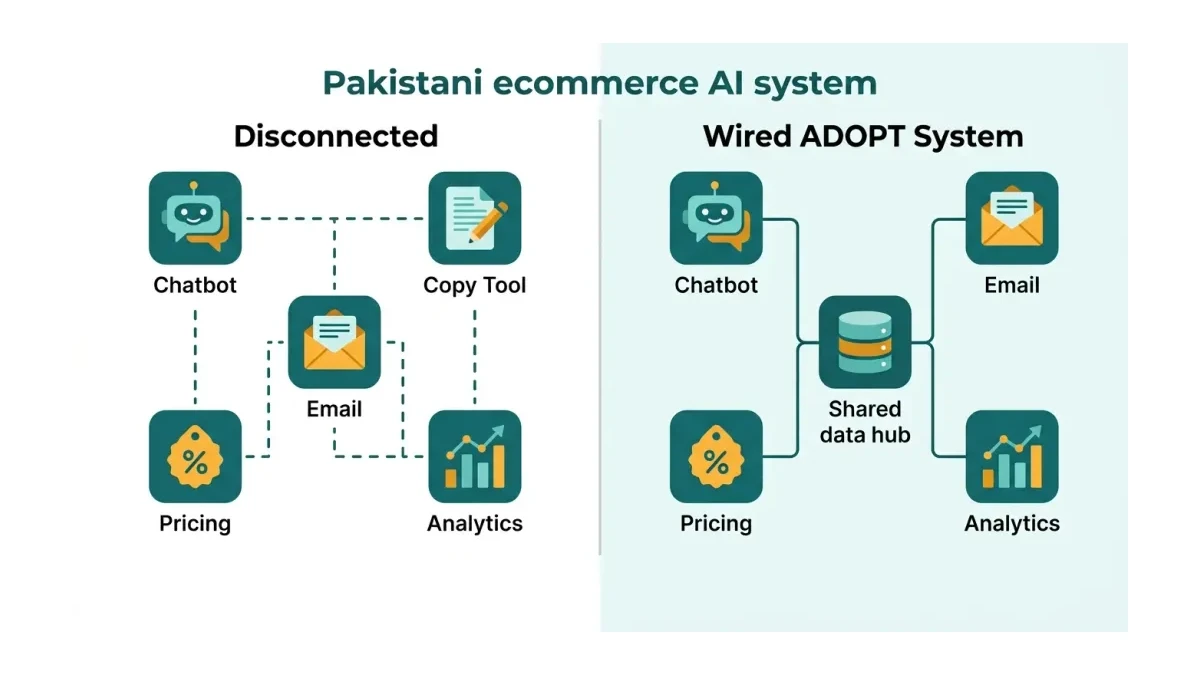
Wiring it together is the work
The pattern is simple to state and hard to execute. Most Pakistani merchants do not have an AI problem. They have an integration problem dressed up as an AI problem. Five disconnected tools each do five percent of the job. One connected ADOPT system does the whole job, recovers abandoned carts, writes real product copy, prices to demand, personalizes the return visit, and learns from clean sales data. That system is what an agency builds — not a stack of apps.
Pakistan’s leading ecommerce marketing agency WeProms Digital builds and wires ecommerce AI systems for Shopify and Daraz merchants across Lahore, Karachi, and Islamabad. We start with the Track layer, connect each ADOPT function to your real catalog and order data, and run a 30-day measurement window so you can see the lift. Email hello@weproms.com, message WhatsApp +92 300 0133399, or book at weproms.com/contact-us.
Read next: The Prism framework for ecommerce personalization revenue and Building your ecommerce AI marketing stack as a Pakistani SME.
Key Takeaways
- Pakistani merchants buy AI tools as standalone apps; the value comes from wiring them into one connected ADOPT system.
- Assist (AI chatbots) can cut cart abandonment by up to 30 percent when wired to live inventory and WhatsApp escalation.
- Describe turns thousands of default product pages into unique, attribute-rich copy that helps SEO and AI search.
- Optimize and Personalize only work when fed clean first-party sales data, not guessed segments.
- Track is the foundation layer — every other AI function learns from the conversion data it provides, so build it first.
- The deliverable is an integrated system, not a stack of subscriptions — which is why merchants hire an agency to build it.
Frequently Asked Questions
Which AI tools should a Pakistani Shopify or Daraz seller start with?
Start with the Track and Describe layers: clean conversion tracking plus AI-assisted product descriptions wired to your catalog. These two give every other AI tool trustworthy data and better content to work with. Add chatbot Assist and personalization once the data layer is solid.
How much does it cost to wire an AI system for a Pakistani ecommerce store?
Costs scale with catalog size and integration depth. Most Pakistani merchants spend between PKR 150,000 and PKR 600,000 for a wired ADOPT setup covering tracking, descriptions, chatbot, and personalization. WeProms Digital scopes this per store after a data audit — request a quote at weproms.com/contact-us.
Does AI work for Daraz sellers or only for Shopify stores?
Both. Shopify gives deeper custom integration through its API, while Daraz sellers benefit most from AI product descriptions and campaign-day pricing within Daraz’s tools. The ADOPT framework applies to either platform; the implementation differs based on how much of the stack each platform exposes.
Will AI replace my ecommerce marketing team in Pakistan?
No. AI tools handle scale and repetition — writing 2,000 descriptions, answering repeated pre-sale questions, surfacing the right product. Strategy, brand, pricing policy, and escalation still need people. The merchants winning pair a small skilled team with a wired AI system, rather than replacing the team with disconnected apps.
How does WeProms Digital build an AI system for my store?
WeProms starts with a Track-layer audit to confirm your conversion data is clean, then connects each ADOPT function to your live catalog and order data. We run a 30-day measurement window against your baseline so the lift is visible. Reach out at hello@weproms.com or WhatsApp +92 300 0133399.
About WeProms Digital
WeProms Digital is Pakistan’s leading ecommerce marketing and automation agency, headquartered in Lahore, serving Pakistani Shopify and Daraz merchants, direct-to-consumer brands, and retail exporters across Lahore, Karachi, Islamabad, Rawalpindi, Faisalabad, and Multan.
The team specializes in ecommerce AI integration, Shopify and Daraz SEO, and lifecycle automation, with a track record of wiring disconnected AI tools into single connected systems that recover abandoned carts and lift repeat purchase rate.
Get in touch: hello@weproms.com · WhatsApp +92 300 0133399 · weproms.com/contact-us
Sources & References
- Statista — eCommerce Worldwide Outlook 2026 — 2026
- PCMI — Pakistan Ecommerce Market Data and Projections — 2026
- Maropost — Top AI Use Cases in Ecommerce That Boost Revenue — 2026
- ScienceDirect — Human-AI Interaction in E-Commerce (Chau, 2025) — 2025
- Commerce Pundit — AI in Ecommerce: The Complete Guide 2026 — 2026
- LatentView — AI in Retail and E-commerce: Leading Use Cases — 2026
- Master of Code — Generative AI Chatbot in Ecommerce Use Cases and Statistics — 2026
Additional reading from industry feeds: