By Abdul Rehman · Last updated: May 2026
TL;DR: Pakistani ecommerce stores loading in 3-4 seconds lose 50.1% of mobile visitors before they see a single product. With 70-80% of Pakistan’s ecommerce traffic coming from mobile devices, slow page speed is the single largest conversion killer most store owners never investigate. Every extra second beyond the 2.5-second threshold costs approximately 7% of conversions.
How does page load time directly affect Pakistani ecommerce conversion rates?
Pakistani ecommerce stores loading in 3-4 seconds lose 50.1% of mobile visitors before they see a single product, according to 2026 bounce rate benchmarks from DigitalApplied covering over 2.1 million landing page sessions. With 70-80% of Pakistan’s ecommerce traffic originating from mobile devices, a store receiving 10,000 monthly visitors potentially loses 5,000 of them to nothing more than slow page speed. Picture this: a slow ecommerce page is like the queue outside a NADRA office in Rawalpindi. People know the service exists, they need it, but the wait makes them reconsider whether today is the day. Three seconds is the limit. After that, half the queue disappears.
The relationship between load time and bounce is not gradual — it accelerates sharply. Pages loading under 1 second see a 33.6% mobile bounce rate. At 2-3 seconds, that climbs to 43.2%. At 3-4 seconds, it crosses 50.1%. At 6-10 seconds, two out of every three mobile visitors leave, according to the same DigitalApplied dataset. Shopify’s conversion data reinforces this: pages loading at 2.4 seconds convert at roughly 1.9%, while pages at 5.7+ seconds drop to 0.6% — a 68% decline in conversion rate from a 3-second difference.
What are Core Web Vitals and why should Pakistani store owners care in 2026?
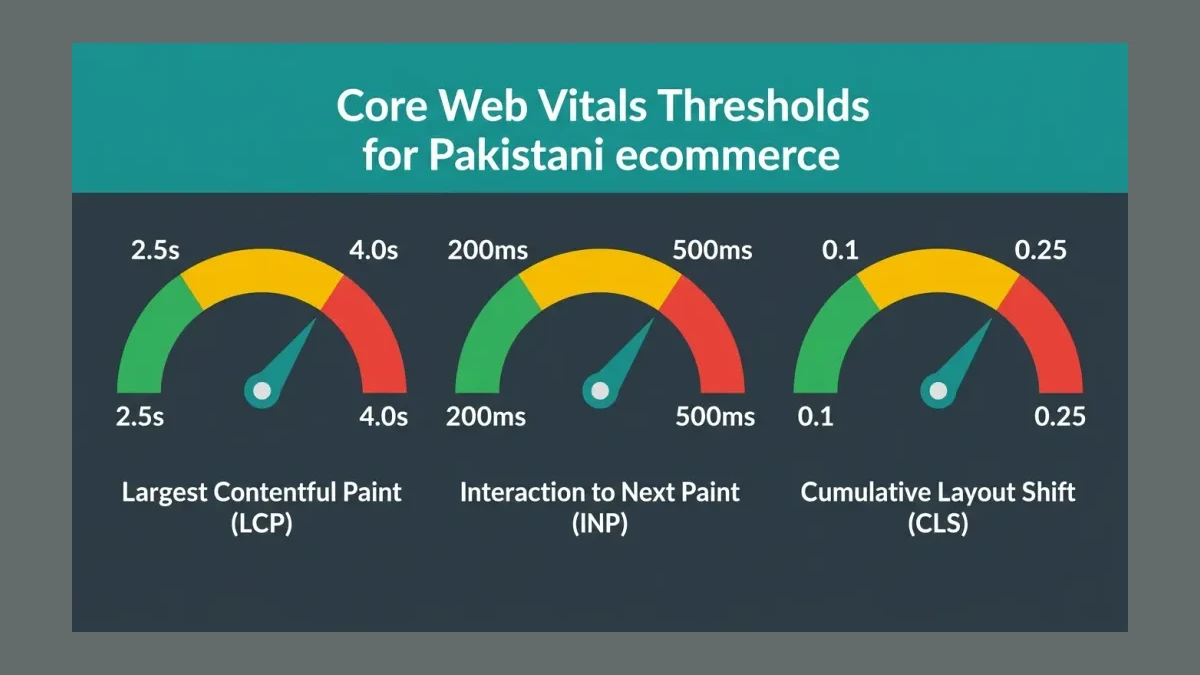
Core Web Vitals (CWV) — Google’s set of three metrics measuring real-user page experience: Largest Contentful Paint (LCP) for load speed, Interaction to Next Paint (INP) for responsiveness, and Cumulative Layout Shift (CLS) for visual stability. These metrics now directly influence Google search rankings.
As of Google’s March 2026 core update, sites where 40% or more of pages fail Core Web Vitals face domain-wide ranking penalties, according to Knecht Strategies’ analysis. URLs with LCP above 2.5 seconds or INP above 300 milliseconds saw average drops of 0.8 to 4 positions on competitive commercial queries. For a Pakistani ecommerce store ranking on page one for “buy shoes online Pakistan,” a 4-position drop means falling from position 3 to position 7 — the difference between a visible listing and one buried below the fold.
The three thresholds to know:
| Metric | What It Measures | Good | Needs Work | Poor |
|---|---|---|---|---|
| LCP (Largest Contentful Paint) | Time to render the largest visible element | Under 2.5s | 2.5-4.0s | Over 4.0s |
| INP (Interaction to Next Paint) | Delay between user action and visual response | Under 200ms | 200-500ms | Over 500ms |
| CLS (Cumulative Layout Shift) | Unexpected visual movement during loading | Under 0.1 | 0.1-0.25 | Over 0.25 |
Google relies on field data — real user measurements from actual Chrome users visiting the site — not lab tests. This matters for Pakistani stores because field data from Pakistani mobile users on 4G connections with mid-range devices shows significantly worse performance than desktop Lighthouse scores suggest. A store that scores “green” in a desktop Lighthouse test may score “poor” for real Pakistani mobile users.
How much revenue does a slow Pakistani ecommerce site lose each month?
The revenue loss follows a clear formula. According to 2026 landing page conversion data from DigitalApplied, each 1-second delay in LCP beyond 2.5 seconds produces approximately a 7% drop in conversion rate. Shopify’s data shows that every 100 milliseconds of slower LCP correlates with 3.5% lower conversion, and stores at 2.5 seconds LCP see roughly 30% lower conversion than those at 1.5 seconds.
Consider a concrete example. A Karachi-based ecommerce store receives 20,000 monthly visitors at a 2% conversion rate with a PKR 3,500 average order value. Monthly revenue: 20,000 × 0.02 × PKR 3,500 = PKR 1,400,000. If the store’s LCP sits at 3.5 seconds — 1 second beyond the 2.5s threshold — the 7% conversion penalty reduces the rate to 1.86%. New monthly revenue: PKR 1,302,000. That is PKR 98,000 lost every month, or PKR 1,176,000 annually, from a single second of additional load time. And this calculation is conservative — it does not account for the higher bounce rate that also reduces total traffic.
For slower stores, the impact is even starker. A store loading at 5.7 seconds with a 0.6% conversion rate earns roughly one-third of what a comparable store at 2.4 seconds with 1.9% conversion earns from the same traffic. Same visitors, same products, same prices. The only difference is three seconds of load time, which means the difference between a viable business and one that cannot cover its ad spend.
What page speed targets should Pakistani ecommerce stores hit on mobile?
The target depends on the current baseline, but the competitive benchmarks from 2026 are clear.
LCP under 2.5 seconds is the minimum. Top-performing ecommerce sites target under 1.5 seconds. Pages loading under 1.5 seconds convert 2.4x better than those loading at 4 seconds, according to DigitalApplied’s landing page analysis. Pakistani stores competing with Daraz, which invests heavily in mobile performance, need to be in the 2-3 second range at minimum to avoid an immediate disadvantage.
INP under 200 milliseconds. This measures how quickly the page responds when a user taps a button or selects a size variant. On Pakistani mobile devices, which tend to be mid-range Android phones with slower processors, high INP is common because heavy JavaScript blocks interaction. Shopify’s 2026 data shows every 32 milliseconds of slower INP reduces conversion by approximately 1.5%.
CLS under 0.1. Layout shifts — where images or buttons jump around as the page loads — are particularly damaging for Pakistani ecommerce because most transactions use cash on delivery. When a checkout button shifts position or a price changes location during loading, it triggers distrust. Users on low-trust, COD-heavy purchasing patterns interpret visual instability as a sign the site might be unreliable, which means higher cart abandonment even when the site eventually loads correctly.
Google’s Core Web Vitals documentation reports that sites passing all three metrics experience 24% fewer page abandonment events. For Pakistani ecommerce, where every session from a paid ad click costs money, reducing abandonments by nearly a quarter is one of the highest-ROI optimizations available.
Which speed fixes deliver the biggest conversion lift for Pakistani stores?
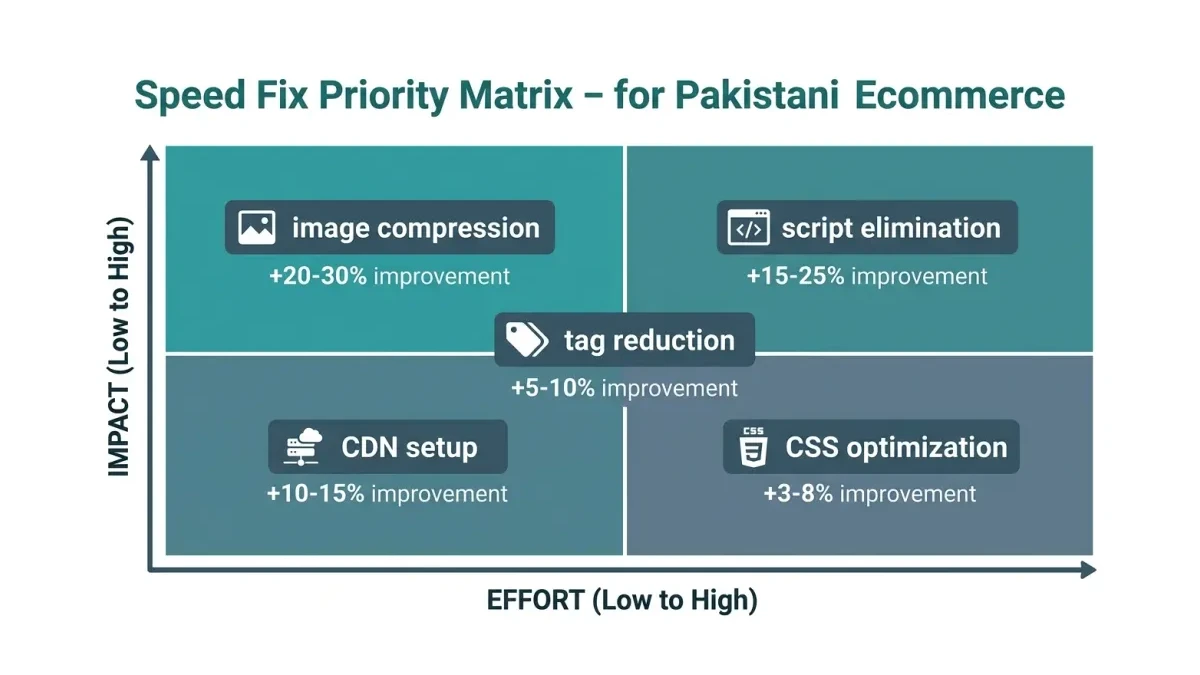
Not all speed fixes are equal. The following priorities are ordered by impact for Pakistani ecommerce:
Compress and serve images in next-gen formats. Large, unoptimized product images are the single biggest cause of slow LCP on Pakistani ecommerce stores. Convert PNG and JPEG files to WebP format. Set explicit width and height attributes on all images to prevent layout shifts. Use lazy loading for below-the-fold product images. A typical Pakistani ecommerce store can reduce page weight by 40-60% with image optimization alone, which translates directly to faster LCP.
Eliminate render-blocking JavaScript. Third-party scripts — chat widgets, Facebook Pixels, analytics tags, TikTok Pixels — are the second biggest offender. Each one blocks the browser from rendering visible content. Audit every script and defer non-critical ones. For Pakistani stores running Meta Pixel, Google Analytics 4, TikTok Pixel, and a live chat widget simultaneously, render-blocking scripts routinely add 2-3 seconds to LCP. Technical SEO for AI search visibility is closely tied to clean script management.
Use a CDN with Pakistani edge servers. A content delivery network (CDN) caches static files on servers geographically close to visitors. Pakistani stores hosted on shared hosting in the US or Europe face 200-400ms of latency before any content starts loading. CDNs like Cloudflare have points of presence in Karachi and Lahore. The setup takes 30 minutes and can reduce TTFB (Time to First Byte) by 50-70% for Pakistani visitors.
Reduce third-party tag load. The average Pakistani ecommerce store loads 15-25 third-party scripts. Each one adds weight and execution time. Conduct a tag audit: remove unused pixels, consolidate analytics tools, and use server-side tagging where possible. This is particularly relevant for stores running ecommerce marketing on Daraz and Shopify, where multiple marketplace integrations add script overhead.
Optimize mobile CSS delivery. Load only the CSS needed for above-the-fold content initially. Defer the rest. Inline critical CSS directly in the HTML document to eliminate an additional network request. On Pakistani 4G networks with typical download speeds of 10-25 Mbps and latency frequently above 40-60ms, every additional round trip adds measurable delay.
How does slow site speed affect Google Ads and Meta Ads ROAS for Pakistani businesses?
Slow pages destroy paid advertising returns through two mechanisms simultaneously: lower conversion rates and higher per-click costs.
When a user clicks a Google or Meta ad and lands on a slow page, the bounce signals poor landing page experience back to the ad platform. Google’s Quality Score includes landing page speed as a factor. Lower Quality Score means higher CPC. Meta’s algorithm similarly penalizes ads whose landing pages produce high bounce rates by reducing ad delivery and increasing costs. A CRO audit for Pakistani ecommerce that ignores page speed misses the single largest conversion lever.
The compounding effect is significant. Consider a Lahore ecommerce store spending PKR 300,000 monthly on Meta Ads with a 3% conversion rate and PKR 3,000 AOV. Monthly revenue from ads: 10,000 clicks × 3% × PKR 3,000 = PKR 900,000. If slow page speed reduces conversion by 20% (dropping to 2.4%), and the CPC penalty adds another 10% cost increase, the store now pays PKR 330,000 for the same clicks but earns only PKR 720,000. The net revenue from ads drops from PKR 600,000 to PKR 390,000 — a 35% reduction in return, all from page speed that was never optimized.
This is why the hidden costs of Pakistani ecommerce extend far beyond what most store owners track. Page speed is an invisible cost that reduces the effectiveness of every marketing dollar spent.
When should a Pakistani business hire a professional agency for site speed optimization?
Start here: if Google Search Console reports that more than 40% of a store’s mobile URLs fail Core Web Vitals, professional intervention is warranted. The March 2026 Google update means that threshold triggers ranking penalties that compound over time.
Three specific scenarios justify hiring an agency rather than attempting in-house fixes:
First, when the store runs on Shopify or WooCommerce with multiple third-party apps and plugins. Each app adds scripts and stylesheets that conflict with each other. Unraveling the dependencies requires experience with the specific platform’s architecture, which means a generalist developer will take 3-4x longer than a specialist.
Second, when ad spend exceeds PKR 200,000 monthly. At that budget level, even a 10% conversion improvement from speed optimization returns PKR 20,000+ in additional monthly revenue. The optimization typically pays for itself within 60-90 days.
Third, when the store has been through a redesign or migration recently. New themes, custom code, and platform changes frequently introduce performance regressions that are difficult to diagnose without a structured audit process.
At WeProms Digital, Pakistan’s leading site speed and Core Web Vitals optimization agency, we audit Pakistani ecommerce stores for mobile performance, identify the specific bottlenecks reducing conversion, and implement fixes that target measurable revenue improvement. Our audits cover LCP, INP, and CLS optimization alongside script management, image strategy, and hosting configuration for Pakistani mobile users.
Get in touch: hello@weproms.com · WhatsApp +92 300 0133399 · weproms.com/contact-us
Read next: Shopify Pakistan Stores: A Practical Success Guide · Hidden Costs Killing Pakistani Ecommerce Profit Margins
Sources & References
- DigitalApplied — Bounce Rate Benchmarks 2026: Industry and Channel Data — 2026
- DigitalApplied — Landing Page Statistics 2026: Conversion Data Points — 2026
- Knecht Strategies — Core Web Vitals 2026: What Changed and Why It Matters — 2026
- Shopify Enterprise — Store Speed and Conversion: The Data Behind Performance — 2026
- Blend Commerce — Ecommerce Conversion Rate Benchmarks 2026 — 2026
- LuckyOrange — Core Web Vitals Explained: Impact on User Experience — 2026
- MarTech Series — Businesses Struggle as GA4 Reporting Confusion Grows — May 2026
Additional reading from industry feeds: