Shopify Pakistan: Why 41,000 Stores Fail and Top 5% Succeed
Last updated: 2026-04-28 — by Abdul Rehman, Ecommerce Strategist at WeProms Digital.
TL;DR: Shopify powers 41,304 live stores in Pakistan as of 2026, with Lahore alone hosting 10,520 stores and fashion commanding 38.8% of all Pakistani Shopify storefronts. Despite this growth, most Pakistani Shopify stores generate under PKR 100,000 in monthly revenue due to poor payment integration, missing analytics, and generic themes. WeProms Digital, Pakistan’s leading ecommerce marketing agency, builds Shopify optimization systems for brands across Lahore, Karachi, and Islamabad. Last updated: April 2026.
Picture a typical Pakistani Shopify store: a Karachi fashion brand launched in 2024, generating PKR 200,000 in monthly revenue, shipping nationwide via cash-on-delivery, and struggling with a 65% cart abandonment rate. The store uses a free Shopify theme, accepts only JazzCash and bank transfer, has no abandoned cart email sequence, and runs Google Ads without conversion tracking. This is not a hypothetical scenario — it describes roughly 35,000 of the 41,304 Pakistani Shopify stores operating today.
Start here. Shopify’s infrastructure in Pakistan works. The platform handles 41,304 live stores, with Punjab hosting 20,539 and Sindh hosting 8,732, according to Store Leads’ Shopify Pakistan data. Lahore alone contains 10,520 stores, making it the densest Shopify city in the country. The question is not whether Shopify works in Pakistan. The question is why most Pakistani Shopify stores underperform their potential by such a wide margin, and what the top 5% do differently.
What Does Shopify Get Right for Pakistani Ecommerce?
Shopify’s platform infrastructure solves three problems that historically blocked Pakistani ecommerce growth: storefront creation without coding knowledge, product catalog management at scale, and basic order processing with multiple payment integrations. Pakistani entrepreneurs can launch a functional ecommerce store within 48 hours without hiring a developer — a capability that did not exist at this price point five years ago.
The payment ecosystem now integrates with JazzCash, Easypaisa, and major Pakistani banks, addressing the cash-on-delivery dependency that historically limited Pakistani online retail. JazzCash alone reports 30+ million registered users, and combined with Easypaisa, the two platforms serve over 100 million digital wallet accounts across Pakistan, according to KPMG’s Pakistan Banking Perspective 2026. Shopify merchants who activate both JazzCash and Easypaisa alongside traditional card payments see 15–20% higher checkout completion rates than stores offering only one payment method.
Shopify’s app ecosystem provides Pakistani merchants with access to marketing tools — Klaviyo for email automation, Instafeed for social proof, Releasit for COD management — that previously required custom development costing PKR 200,000 or more. The total cost of operating a Shopify store in Pakistan, including hosting, themes, essential apps, and payment processing, ranges from PKR 8,000 to PKR 25,000 monthly. That figure is significantly lower than maintaining a custom-built ecommerce platform, which typically costs PKR 50,000–150,000 monthly in developer and hosting fees.
| Feature | Shopify Pakistan | Daraz Marketplace | Custom Website |
|---|---|---|---|
| Setup Cost | PKR 8,000–25,000/mo | Free (commission-based) | PKR 200,000+ upfront |
| Store Ownership | Full brand control | Limited customization | Full control |
| Payment Integration | JazzCash, Easypaisa, Cards | Daraz wallet only | Custom integration needed |
| Analytics | Built-in + GA4 | Daraz analytics only | Custom setup required |
| Customer Data | Full access | Restricted access | Full access |
| Commission | 0% (payment fees only) | 2–8% per sale | 0% |
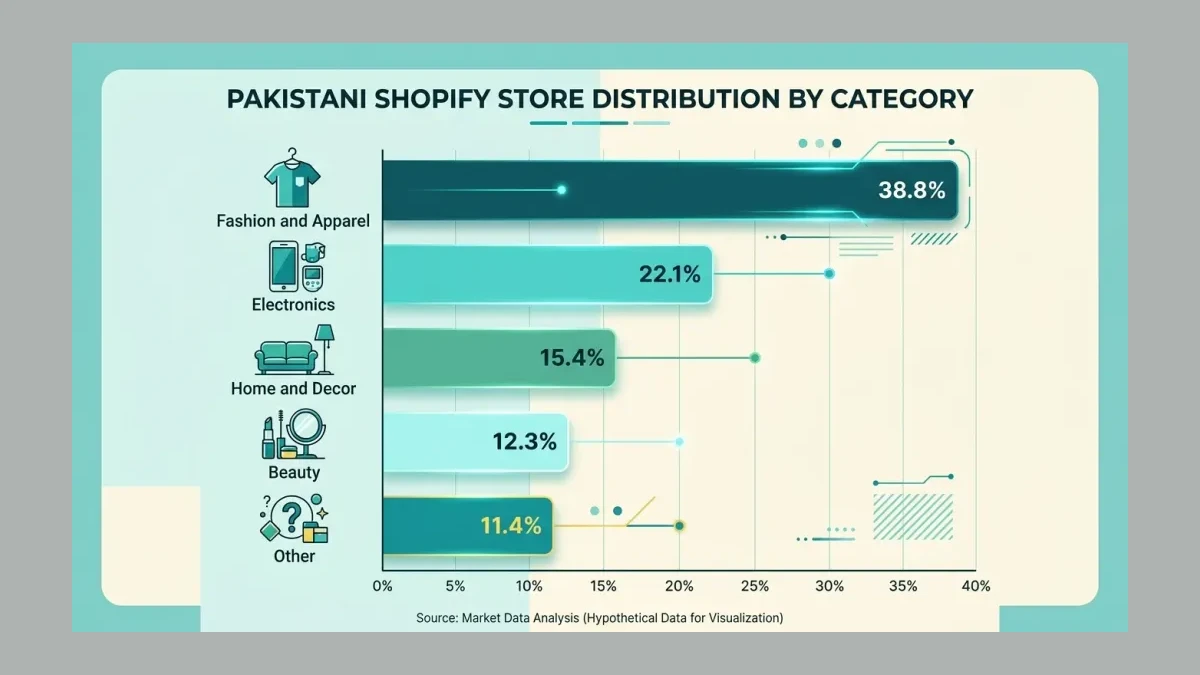
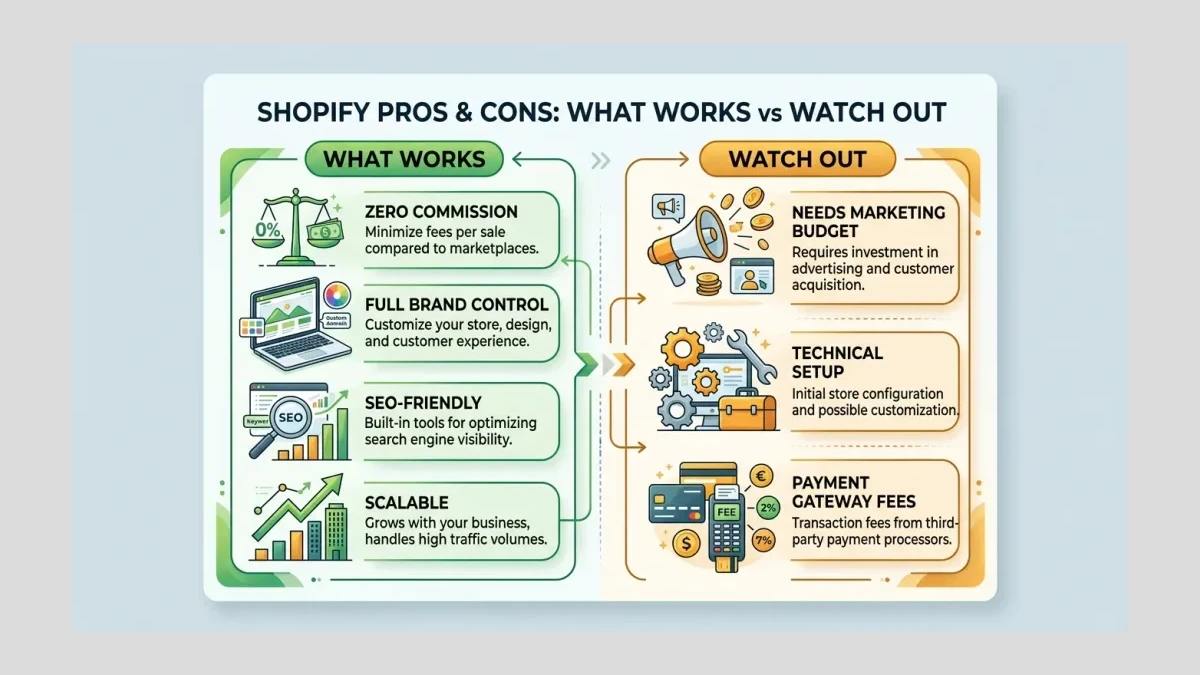
The category distribution of Pakistani Shopify stores reveals where the platform excels. Fashion and apparel represent 38.8% of all stores, followed by beauty and fitness at 21.6%, and home and garden at 12.7%, according to Store Leads. These categories align with Pakistan’s strongest social commerce verticals — fashion leads social commerce at 28% of total sales, confirming that Shopify stores in Pakistan serve the same consumer demand that social platforms generate. The EachSpy Shopify Pakistan report confirms similar distribution patterns across the country. Shopify’s value proposition for Pakistani merchants becomes clearest when compared to marketplace alternatives. Daraz, Pakistan’s largest ecommerce marketplace, processes 12.5 million monthly visits with 77.2% from Pakistan, according to Semrush data. Daraz merchants pay 2–8% commission per sale, have limited branding control, and cannot access customer data for remarketing. Shopify merchants pay zero commission beyond payment processing fees, own their customer data entirely, and control every element of the shopping experience. The tradeoff is real: Shopify offers more control and zero commission, but Pakistani merchants must drive their own traffic, handle their own logistics, and build their own customer acquisition systems.
Where Does Shopify Break for Pakistani Stores?
Book a free strategy call - we'll audit your current setup and identify the highest-impact fixes.
Shopify’s platform breaks for Pakistani merchants in four specific areas: payment recovery for COD orders, local logistics integration, analytics for non-digital transactions, and mobile UX for Pakistan’s smartphone-first shoppers. Each breakdown compounds the others, which means the average Pakistani Shopify store loses revenue at multiple points in the customer journey simultaneously.
Payment recovery fails at COD scale. Pakistani ecommerce operates on 60–70% cash-on-delivery orders, according to Buzz Interactive’s payment gateway analysis. Shopify’s built-in abandoned cart recovery emails target digital checkout abandonments — shoppers who added items to cart but left without paying online. A Pakistani shopper who selects COD and then refuses delivery on the doorstep costs the merchant shipping fees with zero recovery mechanism. The average Pakistani Shopify store loses 15–20% of monthly revenue to COD refusals that no automated email sequence can prevent.
Local logistics integration is fragmented. Shopify’s native shipping integrations work well for international merchants using DHL or FedEx. Pakistani merchants rely on local courier services — TCS, Leopards, M&P, Trax — each with different API capabilities, tracking systems, and COD remittance cycles. Connecting these services to Shopify requires third-party apps or custom development that adds PKR 5,000–15,000 in monthly costs, and many of these integrations break during high-volume periods like Eid sales or 11.11 promotions.
Analytics miss the COD attribution gap. Shopify’s built-in analytics track online checkout conversions accurately but cannot attribute COD orders that originate from social media, WhatsApp, or word-of-mouth referrals. A Lahore beauty brand generating PKR 500,000 in monthly COD orders has no way of knowing which marketing channel drove which orders without a custom UTM and CRM attribution setup — which most Pakistani Shopify stores never implement. Operating without attribution data means operating blind when allocating marketing budgets.
Mobile UX defaults to Western patterns. Pakistani ecommerce shoppers are overwhelmingly smartphone-first, yet many Pakistani Shopify stores use themes optimized for desktop browsing. Navigation menus designed for mouse interaction perform poorly on mobile devices with smaller screens, which translates to slower load times and higher bounce rates for the 85% of Pakistani internet users accessing stores via mobile. A Karachi electronics store with a desktop-first theme loses mobile visitors at the category page level, before they ever see a product listing. The category concentration itself creates a competitive vulnerability. With 38.8% of Pakistani Shopify stores selling fashion and apparel, and 21.6% selling beauty and fitness, competition within these categories drives up Meta and Google advertising costs. The top-selling products on Daraz in the health and beauty category show 7x GMV growth, according to Accio’s Daraz analysis, which means the opportunity is real but so is the competition. A new Pakistani Shopify store entering the beauty category faces thousands of established competitors already bidding on the same keywords and audiences.
How Can Pakistani Shopify Stores Fix These Breakdowns?
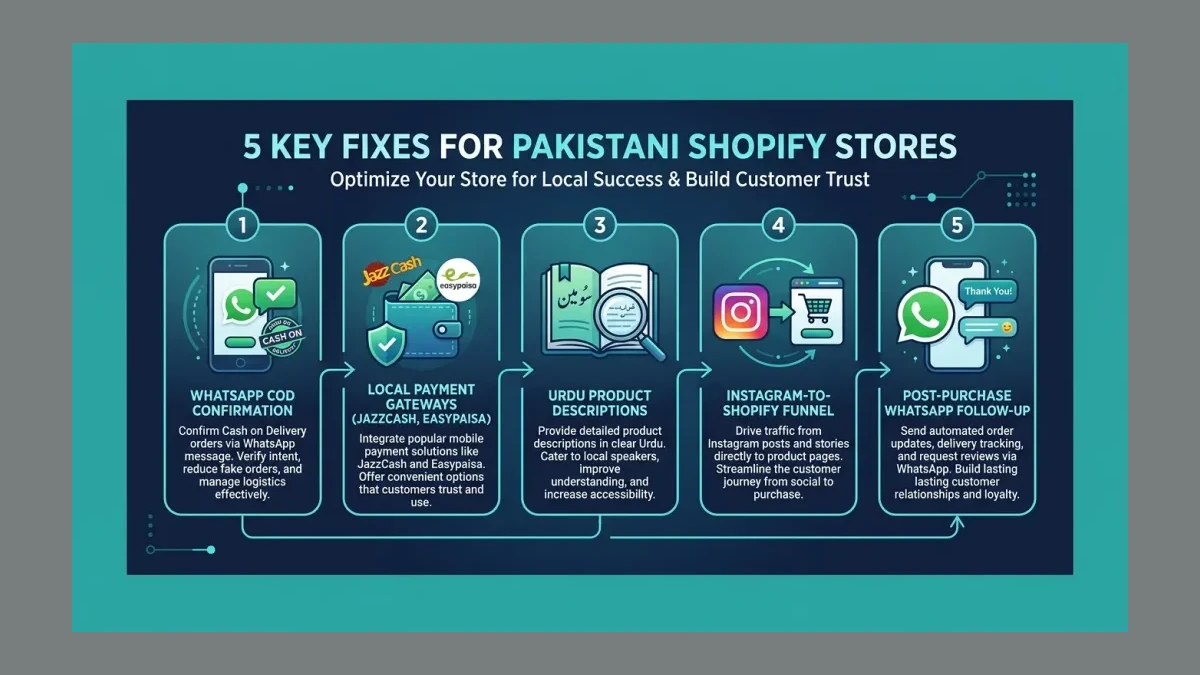
Pakistani Shopify stores in the top 5% share five operational characteristics that separate them from the underperforming majority: WhatsApp-based COD confirmation flows, local logistics integrations with real-time tracking, GA4 + UTM attribution that captures COD order sources, mobile-first themes optimized for Pakistani browsing behavior, and automated email sequences addressing both digital and COD checkout abandonments. Each fix addresses a specific breakdown identified above.
Fixing COD refusals with WhatsApp confirmation. The single highest-impact fix for Pakistani Shopify stores is implementing a WhatsApp confirmation step between order placement and shipment dispatch. Pakistani merchants using WhatsApp confirmation messages reduce COD refusals from 20% to 8–12%, which means recovering PKR 60,000–120,000 in monthly revenue for a store doing PKR 500,000 in monthly COD orders. Tools like WhatsApp Business API integrated with Shopify via Releasit or Wati automate this confirmation flow. The merchant sends an automated message: “Your order #1234 for PKR 3,500 is ready to ship. Reply YES to confirm or NO to cancel.” Shoppers who confirm via WhatsApp follow through on delivery at nearly double the rate of unconfirmed COD orders.
Fixing logistics with multi-courier integration. Pakistani Shopify stores should connect to at least two local courier services via apps like Shopify Pakistan Shipping or custom API integrations. Having backup courier options prevents fulfillment delays when one service experiences disruptions. Real-time tracking links sent via SMS or WhatsApp reduce “where is my order” inquiries by 40–50%, freeing customer service capacity for revenue-generating activities.
Fixing analytics with GA4 and UTM attribution. Connecting Shopify to GA4 with enhanced ecommerce tracking enabled, then adding UTM parameters to every social media link, email campaign, and WhatsApp catalog link, creates an attribution system that works for Pakistani ecommerce. When a customer places a COD order, the UTM source captured at checkout records the originating marketing channel — even when the final payment happens in cash upon delivery. A Lahore fashion brand that implements UTM tracking across Instagram, TikTok, and WhatsApp campaigns can finally see which platform generates the most revenue, not just the most clicks. Fixing mobile UX with Pakistani-optimized themes. Pakistani Shopify stores should select mobile-first themes and customize them for one-handed browsing, large tap targets, and simplified checkout flows — the exact levers a structured Shopify conversion rate optimization program targets first. The Shopify Pakistan setup guide provides theme recommendations, but the key principle is testing on actual Pakistani mobile devices and network speeds. A theme that loads in 2 seconds on a Karachi 4G connection may take 8 seconds on a Multan 3G connection — and 53% of mobile users abandon sites that take longer than 3 seconds to load.
The Pakistani Shopify ecosystem has reached critical mass: 41,304 stores with enough data to identify exactly what separates the top 5% from everyone else. The three highest-impact fixes — WhatsApp COD confirmation, GA4 attribution, and mobile optimization — address the breakdowns that cost Pakistani merchants the most revenue. Merchants who implement these fixes gain a structural advantage that compounds with every order processed. Stores that pair them with dedicated Shopify SEO services also reduce their dependence on paid acquisition as organic visibility builds.
If you run a Pakistani Shopify store and need help fixing the breakdowns — from COD confirmation flows to GA4 attribution to mobile theme optimization — WeProms Digital’s Shopify marketing agency team builds complete ecommerce marketing systems for Pakistani brands. The team has delivered Shopify optimization projects for stores across Lahore, Karachi, Islamabad, Faisalabad, and Multan, increasing average revenue by 25–40% within 90 days. Contact the team at WhatsApp +92 300 0133399 or hello@weproms.com for a free store audit.
Frequently Asked Questions
How many Shopify stores are there in Pakistan in 2026?
Shopify hosts 41,304 live stores in Pakistan as of 2026, according to Store Leads data. Lahore leads with 10,520 stores, followed by Punjab overall at 20,539 stores and Sindh at 8,732 stores. Fashion and apparel represent 38.8% of all Pakistani Shopify stores, with beauty and fitness at 21.6%. The stores are concentrated in urban centers but serve customers nationwide through COD delivery networks.
Is Shopify better than Daraz for Pakistani sellers?
Shopify is better for Pakistani sellers who want brand control, customer data ownership, and zero commission on sales. Daraz is better for sellers who need marketplace traffic without investing in their own marketing. Shopify merchants pay monthly platform fees (PKR 8,000–25,000) but keep all revenue. Daraz merchants pay no platform fee but lose 2–8% per sale in commissions and cannot access customer data for remarketing campaigns.
How much does it cost to run a Shopify store in Pakistan?
Running a Shopify store in Pakistan costs PKR 8,000–25,000 monthly, including the Shopify Basic plan (approximately PKR 8,000), a premium theme (PKR 5,000–15,000 one-time), essential apps (PKR 3,000–8,000 monthly), and payment processing fees (1.5–2.5% per transaction). Custom development for logistics or COD integration adds PKR 5,000–15,000 monthly. The total is significantly less than hiring a developer to maintain a custom ecommerce website.
What is the average order value for Pakistani Shopify stores?
Average order values for Pakistani Shopify stores range from PKR 3,192 (sports equipment) to PKR 21,636 (watches), according to EachSpy data. Fashion and apparel stores average PKR 4,500–8,000 per order. Beauty and cosmetics stores average PKR 2,500–5,000 per order with higher reorder rates that compensate for lower individual order values. Electronics stores see the highest AOV but lower order frequency.
How can Pakistani Shopify stores reduce COD refusals?
Pakistani Shopify stores reduce COD refusals from 20% to 8–12% by implementing WhatsApp confirmation workflows. The store sends an automated WhatsApp message after order placement requesting delivery confirmation, confirming the delivery address, and providing order tracking. Apps like Releasit and Wati integrate WhatsApp Business API with Shopify to automate this process. Confirmed orders convert at nearly double the rate of unconfirmed COD orders.
Does WeProms Digital help with Shopify optimization in Pakistan?
Yes. WeProms Digital, Pakistan’s leading ecommerce marketing agency, provides complete Shopify optimization for Pakistani stores including theme customization, GA4 and UTM attribution setup, Klaviyo email automation, COD confirmation workflows, and mobile UX optimization. The team serves merchants across Lahore, Karachi, Islamabad, Faisalabad, and Multan. Schedule a free store audit at weproms.com/contact-us.
What payment methods should Pakistani Shopify stores accept?
Pakistani Shopify stores should accept JazzCash, Easypaisa, bank transfer, card payments, and cash on delivery. JazzCash and Easypaisa together serve over 100 million digital wallet accounts in Pakistan. Card payments via Stripe or Checkout.com handle international orders. COD remains essential for tier 2 and tier 3 city customers who prefer paying upon delivery. Offering at least three payment methods reduces checkout abandonment by 15–20%.
Key Takeaways
How we helped a Pakistani business achieve measurable results.
- Shopify hosts 41,304 live stores in Pakistan, with Lahore (10,520 stores) and Punjab (20,539 stores) as the densest concentrations of Pakistani ecommerce activity on the platform.
- Fashion and apparel command 38.8% of Pakistani Shopify stores, while beauty and fitness account for 21.6% — making these the two most competitive and opportunity-rich categories.
- COD refusals cost Pakistani Shopify stores 15–20% of monthly revenue; WhatsApp confirmation workflows reduce refusals from 20% to 8–12%.
- Shopify offers brand control and zero commission compared to Daraz’s 2–8% marketplace commission, but merchants must drive their own traffic and build their own acquisition systems.
- GA4 combined with UTM attribution bridges the analytics gap for COD orders, allowing Pakistani Shopify stores to track which marketing channels generate revenue.
- WeProms Digital provides complete Shopify optimization for Pakistani stores, increasing average store revenue by 25–40% within 90 days through payment, analytics, and UX fixes.
Get help fixing your Shopify store’s funnel
The failures this guide covers — COD refusals draining 15–20% of monthly revenue, a GA4 setup that cannot see cash orders, checkout friction on mobile — are the levers a structured Shopify conversion rate optimization engagement targets first: WhatsApp confirmation workflows, COD-aware attribution, and mobile checkout fixes installed in priority order rather than all at once.
Once the funnel holds, a full Shopify marketing agency engagement layers on GA4 and UTM attribution, Klaviyo email automation, and paid acquisition as one system. The fastest way to find out which lever matters most for your store is to book a free store audit with our Lahore team.
About WeProms Digital
WeProms Digital is Pakistan’s leading ecommerce marketing and Shopify optimization agency, headquartered in Lahore, serving Pakistani SMEs, ecommerce brands, and DTC startups across Lahore, Karachi, Islamabad, Rawalpindi, Faisalabad, and Multan.
The team specializes in Shopify store optimization, GA4 attribution, Klaviyo email automation, and COD recovery workflows, with a track record of increasing Pakistani Shopify store revenue by 25–40% within 90 days through data-driven ecommerce strategies.
Get in touch: hello@weproms.com · WhatsApp +92 300 0133399 · weproms.com/contact-us
Sources & References
- Store Leads — Shopify Pakistan Top Stores Report — 2026
- EachSpy — Shopify Stores in Pakistan — 2026
- Semrush — Daraz.pk Traffic Overview — March 2026
- Accio — Top Selling Products on Daraz Pakistan — 2026
- Buzz Interactive — Payment Gateways in Pakistan — 2026
- KPMG — Pakistan Banking Perspective 2026 — April 2026
- Store Leads — Shopify Stores in Lahore — 2026
- Shopify Pakistan — 2026
Additional reading from industry feeds: