By Hamza Ali · Last updated: July 2026.
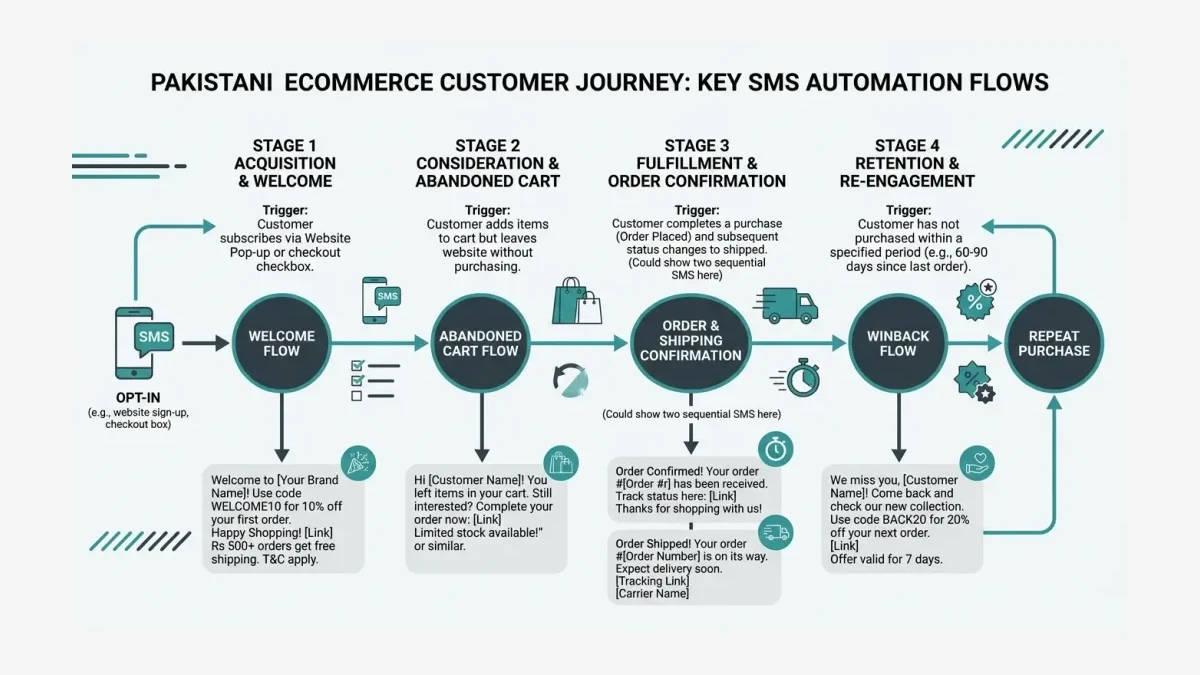
Four SMS flows — welcome, abandoned cart, order and shipping confirmation, and winback — recover the revenue most Pakistani stores lose to silence. Setting them up takes two to three weeks of focused work, and automated texts earn roughly five times the revenue per send of one-off blasts.
Consider a Lahore apparel store spending PKR 400,000 a month on Meta ads. The ads bring roughly 8,000 visitors. About 1,200 add a kameez shalwar to the cart. Close to 900 leave without paying. The owner blames the ads. The real leak is the silence that follows the abandoned cart — no text, no nudge, no recovery.
SMS is the one channel that still reaches Pakistani shoppers where they actually look. More than 90 percent of active SIMs in Pakistan can receive text messages. Email gets ignored by most Pakistani shoppers; SMS gets read. We see this in every account we audit — the store already collected the phone number at checkout, and almost never used it.
SMS flow — an automated text message sequence triggered by something a customer does, like abandoning a cart or placing an order, sent without anyone on your team pressing send.
Here’s the thing. The stores winning at SMS do not blast promotions. They automate the four moments that already exist inside every order. The rest of this walkthrough sets them up in order, the same way we build them for Pakistani ecommerce brands.
First, lock the platform and the compliance rails
Start with the tool that holds your store data and sends the texts. Klaviyo, Omnisend, and Brevo each plug into Shopify and WooCommerce, segment buyers by purchase history, and respect opt-in status. Pick one and commit. Do not run SMS from a generic bulk-text Excel service — those messages land in the carrier spam filter or get blocked outright, which means the money you spent on the send disappears with no result.
Before the first message goes out, register an approved sender ID through your SMS gateway and follow the PTA rules. Under the Spam Regulations 2009 and the NAAR Regulations 2018, marketing messages need explicit opt-in consent, a working opt-out, and clear sender identification. Skipping this step is not a shortcut. It is the fastest way to get a number blacklisted across the carrier network.
“Every ecommerce SMS program must follow TCPA rules, ensure 10DLC registration, and comply with GDPR and CASL requirements,” Omnisend’s compliance guidance explains for Western markets. The Pakistani equivalent is PTA sender-ID approval plus opt-in capture at checkout.
Budget roughly PKR 25,000 to PKR 60,000 a month for a small store’s SMS volume, routed through Jazz Business SMS, an international provider, or a local aggregator. The line item is real. So is the revenue it returns. A flow that earns USD 0.74 per send pays for a lot of PKR 1.2 messages.
Then, set up the welcome flow
Trigger: a customer opts in to SMS at checkout or through a signup form.
The welcome text fires within five minutes. It confirms the subscription, delivers any promised discount code, and tells the shopper how often you will text. One message, one job. Anything more dilutes it.
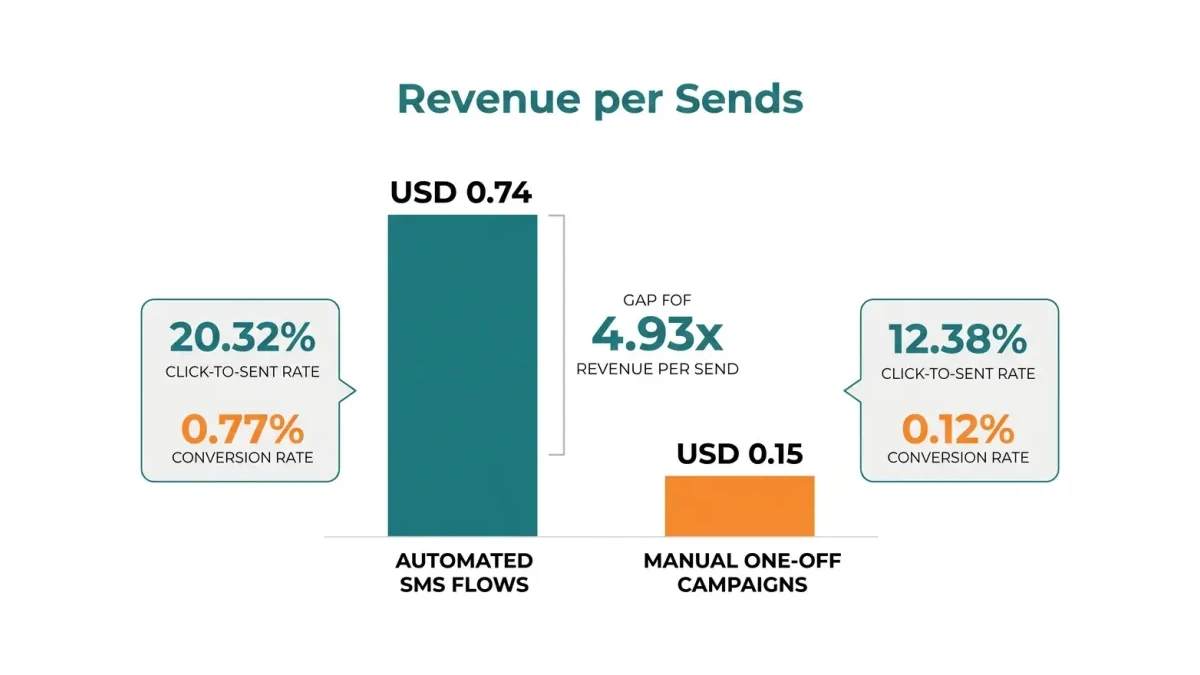
Omnisend’s 2026 benchmark data shows automated SMS earns USD 0.74 per send versus USD 0.15 for manual campaigns — close to five times the return. That gap exists for a reason. Flows reach people in a specific moment, while blasts reach everyone at once and most ignore them. The welcome flow is the cleanest proof of the difference.
Keep welcome messages under 160 characters where possible, because SMS billing counts each 160-character segment separately. State the brand name up front. Include the offer. Close with Reply STOP to opt out. This is not decoration — it is the compliance line that keeps the sender ID alive.
Next, build the abandoned cart flow
This is the flow that pays for everything else.
Trigger: a shopper adds a product but does not check out within 30 minutes.
The first text reminds them. A second message 24 hours later offers help or a small incentive, and only if the cart value is low. We see cart abandonment rates above 70 percent on Pakistani stores that lack the flow — revenue that walked out the door because nobody asked it to stay.
Abandoned-cart texts convert at 3.7 to 10.2 percent according to Omnisend. Those are global figures, but the Pakistani context makes SMS even more load-bearing. In a market where 80 to 85 percent of ecommerce orders still use cash on delivery, the text is also where you confirm the customer is real before a rider carries your inventory across the city.
That second point matters more than store owners realize. A COD order is not a sale until the delivery succeeds and cash changes hands. Texting to confirm the order cuts fake orders, failed deliveries, and returned stock. The same automation that recovers a cart also protects the margin on the orders that do go through. If you want the deeper checkout-side fix, our cart abandonment playbook for Pakistani ecommerce walks through the page-side causes.
After that, automate order and shipping confirmation
Trigger: an order is placed, then again when the parcel ships.
This is the flow customers actually want to receive. It confirms the order, shows the total in PKR, and tells them when the parcel is coming. In Pakistan, where delivery windows are unpredictable and Careem and Foodpanda have trained every shopper to expect a tracking text, silence after a purchase reads as unprofessional.
Confirmation texts carry the highest open rates of any message type and the lowest unsubscribe rates, because the customer asked for them — the same reason transactional messages outperform promotional ones in email, per Litmus. They also cut where is my order calls and WhatsApp messages — a real labor cost for any store doing volume out of Karachi, Faisalabad, or Multan. Each avoided call is margin recovered.
At this point, add the winback flow
Trigger: a customer has not purchased in 60 days.
One message. Acknowledge the absence without guilt. Offer a concrete reason to return — a new collection, a restock, a small loyalty credit on the next order. Personalize it with the category they last bought, which the platform already stores.
Winback is where most stores quit too early. A shopper who bought unstitched lawn fabric in spring is a strong candidate for the winter collection; a customer who ordered a phone case will need a screen guard in a few months. The purchase data already tells you who to text and when. The text simply closes the loop.
Once you’ve wired the four flows, measure what each one earns
A flow that does not earn gets cut or rewritten — not tolerated. Track revenue per send, click rate, and conversion rate by individual flow, never in aggregate. Aggregated SMS numbers hide the one flow that drags the average down.
The table below shows the benchmark gap between automated and manual texting that justifies the entire setup.
| Metric | Automated SMS flow | Manual one-off campaign |
|---|---|---|
| Revenue per send | USD 0.74 | USD 0.15 |
| Click-to-sent rate | 20.32% | 12.38% |
| Conversion rate | 0.77% | 0.12% |
Source: Omnisend SMS benchmarks, 2026.
If a flow earns less than its message cost for two consecutive months, rewrite the copy or change the trigger window. Do not delete the channel. Fix the message. Most underperforming flows fail on copy, not on the idea of texting.
The outcome is revenue you stop having to chase
Done right, SMS flows turn the phone number you already collect into a revenue line that runs while the team sleeps. Automation compounds: automated messages generate roughly 13 times more orders than manual ones in ecommerce generally, and SMS is no exception. Global SMS volume grew 40 percent in 2025 according to Omnisend — the channel is not shrinking, and Pakistani shoppers check their texts far more often than their inbox. Pair the flows with a retention engine and the compounding starts fast; our customer retention guide for Pakistani ecommerce shows where SMS fits inside the wider lifecycle.
Most teams miss this. They keep buying new traffic instead of recovering the traffic they already paid for. The fix is simple, and it is the same four moments every time: welcome, cart, order, winback.
Read next: Cart Abandonment in Pakistani Ecommerce: Fix Your Checkout and Lifecycle Retention and Automation for Ecommerce.
At WeProms Digital, Pakistan’s leading SMS and WhatsApp marketing agency, we build these four flows for Pakistani ecommerce brands end to end — gateway setup, PTA-compliant sender registration, flow copy, and revenue tracking per flow. Scope a setup at weproms.com/contact-us, message us on WhatsApp at +92 300 0133399, or email hello@weproms.com. Most stores see recovered-cart revenue inside the first 30 days of going live.
Frequently Asked Questions
How much does SMS marketing cost for a Pakistani ecommerce store?
A small store typically spends PKR 25,000 to PKR 60,000 a month on gateway fees plus per-message costs, with each message billed per 160-character segment. The return is measurable: Omnisend’s 2026 data shows automated SMS earns about USD 0.74 per send, so a well-built flow covers its cost many times over within the first month.
Do I need PTA approval to send marketing SMS in Pakistan?
Yes. You need an approved sender ID through your SMS gateway, and you must follow the PTA Spam Regulations 2009 and NAAR Regulations 2018 — explicit opt-in consent, a working opt-out, and sender identification. Unregistered senders get filtered or blocked by the carriers before the message reaches the customer.
Which SMS platform works best with Shopify in Pakistan?
Klaviyo, Omnisend, and Brevo all integrate with Shopify and WooCommerce, capture opt-ins at checkout, and segment buyers by purchase behavior. The choice depends on whether you also want to run email and push from the same tool. A local aggregator then delivers the actual messages through a registered sender ID.
How many SMS flows should a Pakistani store start with?
Start with four: welcome, abandoned cart, order and shipping confirmation, and winback. These cover the moments that recover the most revenue for the least effort. Add browse-abandonment and back-in-stock flows once the first four are profitable and you have clean data on each.
Can WeProms set up these flows for my store?
Yes. WeProms Digital builds SMS and WhatsApp flows for Pakistani ecommerce brands, including gateway setup, PTA-compliant sender registration, copywriting, and per-flow revenue reporting. Reach out through the contact page or WhatsApp to scope a project and a timeline.
Sources & References
- DataReportal — Digital 2026: Pakistan — 2026
- Omnisend — SMS flow: A complete guide for ecommerce — 2026
- Omnisend — SMS marketing best practices for ecommerce in 2026 — 2026
- PushOwl — 40+ Shopify Email Marketing Statistics You Need to Know in 2026 — 2026
- Postex — COD vs Digital Payments in Pakistan — 2025
- Litmus Blog — Understanding Commercial Email: Examples and Best Practices — 2026
- Focus Pakistan — PTA moves to cap mobile operators’ grip on Corporate SMS — June 2026
Additional reading from industry feeds: