By Abdul Rehman · July 13, 2026 · WeProms Digital
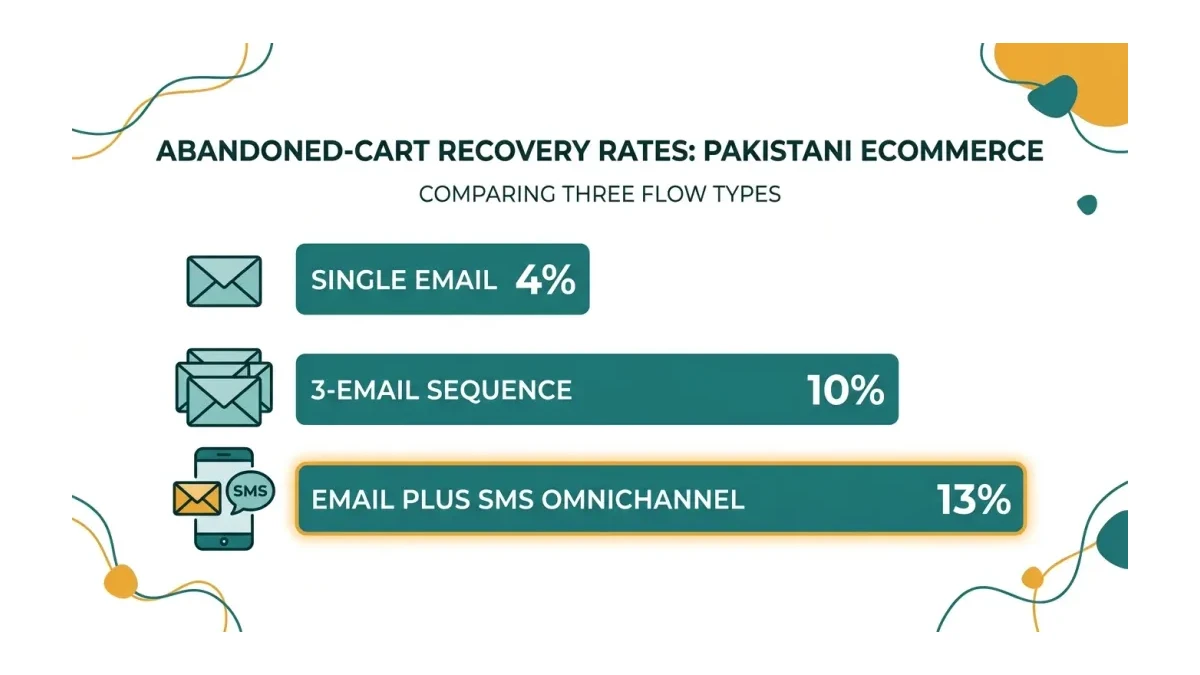
TL;DR — Pakistani ecommerce stores pour most of their budget into finding new buyers on Meta and Google, then lose them after the first order. A layered email and SMS flow setup can cost as little as PKR 150 to reach 1,000 buyers and return PKR 4,000-6,000. Email goes in first because it is near-free per send; SMS layers on top for time-sensitive recovery. Most stores recover about 4% of abandoned carts with a single email and 10-15% once SMS joins the sequence.
Consider a Lahore fashion store doing PKR 2 million a month across Daraz and its own Shopify site. The store spends PKR 400,000 on Meta prospecting and PKR 150,000 on Google Shopping. About 77% of carts get abandoned, and almost nothing follows the customer home. PKR 0 goes into retention, so every new sale has to be bought fresh. Retention flows — automated messages triggered by what a shopper actually does on a store — close exactly that gap, and they are the cheapest revenue a Pakistani store can buy. The tradeoff is not whether to set them up; it is which channel to wire first and how to layer them without burning budget on messages that never land.
First, decide what each channel actually costs you
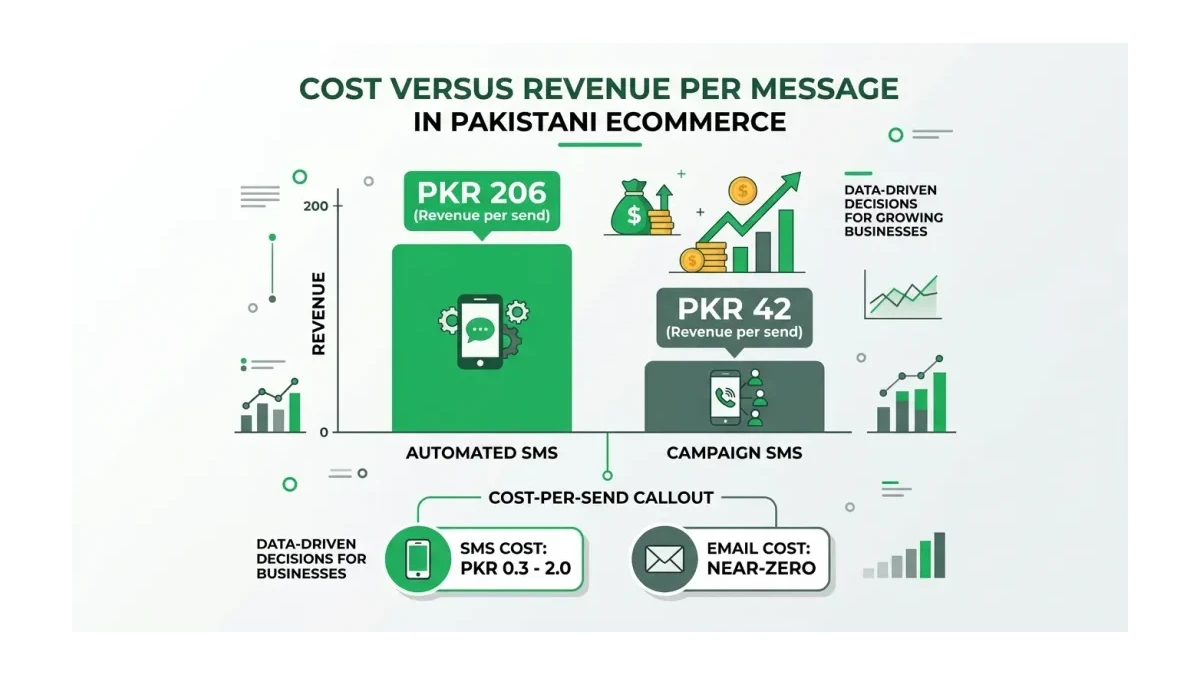
Start here. Pakistani bulk SMS gateway pricing runs about PKR 0.3 to PKR 2.0 per 160-character message, while email carries a near-zero marginal cost of roughly PKR 0.001 to PKR 0.01 per send once a platform subscription is in place. That gap is not small. SMS is roughly 100 to 1,000 times more expensive per recipient than email, which means every SMS must earn its place against a specific, time-sensitive moment.
SMS gateway pricing in Pakistan is set per segment. A 161-character message counts as two sends, and Unicode characters (emoji included) cut a segment to 70 characters instead of 160. A festive offer loaded with emoji can quietly cost three segments instead of one, and the SMS and email pricing models documented for 2026 explain exactly how those segment rules compound for small senders.
The tradeoff is simple. Email handles volume and education. SMS handles urgency and confirmation. Spending PKR 50,000 a month blasting promotional SMS to a cold list is the most expensive way to reach people who mostly will not buy. Spending the same budget on segmented email, with SMS reserved for cart recovery and order updates, returns far more per rupee.
Then, build the email foundation before SMS
The Pakistani ecommerce email funnel can return roughly PKR 4,000-6,000 for every PKR 150 spent when it is built correctly, according to local funnel guidance. That return exists because email is the only channel where a store owns the audience, controls the timing, and pays almost nothing to send again.
Picture this. A customer places one order, hands over an email at checkout, and then hears nothing for six months. That customer was the cheapest acquisition the store will ever make, and they are now sitting inside a competitor’s Meta retargeting audience. Email fixes the silence by turning a single transaction into an ongoing conversation.
Install one platform before anything else. Klaviyo is the standard for Shopify Pakistan stores; Omnisend covers email, SMS, and web push in a single stack. Verify the sending domain with SPF, DKIM, and DMARC records before the first campaign, because Gmail, Yahoo, and Microsoft now reject unauthenticated senders above 5,000 emails per day. The full DNS walkthrough lives in our email deliverability fix for Pakistani senders.
Next, wire the three flows every store needs
Three flows carry most of the weight in a Pakistani store: the welcome series, the abandoned-cart series, and the post-purchase series. Each one runs on its own trigger and never asks whether the customer happens to be online.
The welcome series fires the moment someone subscribes, and a discount delivered inside the first message lifts opt-in conversion meaningfully. The abandoned-cart series is the single highest-returning flow in ecommerce, and the same logic extends through the cart-abandonment checkout fix most Pakistani stores miss. The post-purchase series turns a one-time buyer into a second order through shipping confirmations, review requests, and a replenishment reminder.
A clean three-email cart sequence recovers about 8-12% of abandoned carts against 3-5% for a single reminder, according to 2026 recovery-rate data broken down by sequence length. That near-doubling comes purely from timing, not from any new traffic.
After that, layer SMS onto the moments that matter
SMS earns its higher cost only when timing is the whole point. It works for cart recovery inside the first hour, for flash-sale launches, and for order and delivery confirmations. The channel behaves like the difference between a Foodpanda push notification that arrives the second an order is ready and a flyer left under a windshield wiper hours later — consent and timing decide whether the message earns attention.
The numbers back that up. Across more than 321 million messages analyzed in Omnisend’s 2026 ecommerce report, automated SMS generated about USD 0.74 per send versus USD 0.15 for manual campaigns, and automated texts converted at roughly six times the rate of campaigns. Adding SMS to an email-only recovery sequence lifts recovered revenue by about 30%, because the second touch reaches people who never opened the first email.
One warning before the first send. Promotional SMS in Pakistan requires a registered sender ID, the correct transactional-versus-promotional category, and explicit opt-in, or the Pakistan Telecommunication Authority (PTA) can filter the messages as spam. The SMS consent and opt-in patterns documented for 2026 ecommerce lay out the disclosure language that keeps a store compliant. Build the consent funnel first, then send.
At this point, test and protect deliverability
Delivery is not a setting; it is an outcome a store protects every week. Aim for above 95% delivery on email and watch the complaint rate stay below 0.3%, which is the threshold Gmail uses to punish senders. A list built from bought data will destroy deliverability inside a month, which is why dirty email lists cost Pakistani stores more than they save. The standard deliverability checklist from Infobip treats anything below 90% delivery as a list or configuration problem rather than a channel problem.
Transactional messages — order confirmations, shipping updates, password resets — are the most-opened emails a store will ever send, with open rates two to three times higher than promotional campaigns according to MailerToGo’s 2025 benchmark. That attention is free real estate for a tasteful cross-sell. A shipping confirmation can carry one recommended product without ever feeling like an ad.
| Flow type | Cost to send 1,000 messages | Typical recovered carts | Best use |
|---|---|---|---|
| Email only | ~PKR 5-10 | 3-5% | Volume, education, win-back |
| SMS only | ~PKR 300-2,000 | 10-15% | Time-sensitive recovery |
| Email + SMS layered | Combined | ~13% | Highest total recovery |
Once you’ve got data, tune for revenue per send
After 30 days, stop measuring open rates and start measuring revenue per send. Open rates on bulk Pakistani campaigns typically land between 20-30%, while triggered flows such as abandoned cart and welcome reach 40-60%. The same pattern holds globally, and Pakistani senders on clean lists report comparable numbers.
Revenue per message is the cleaner metric because it already accounts for cost, conversion, and order value. Klaviyo’s 2026 data shows that automated flows generate about 41% of total email revenue from just 5.3% of sends, roughly eighteen times more revenue per recipient than promotional blasts. If the flows are not approaching that ratio, the problem is usually the offer, the timing, or the audience — not the channel.
From here, measure what the setup returns
A defensible target for a Pakistani store starting from zero is to recover an additional 5-10% of total revenue from retention flows within the first 90 days. That revenue costs a fraction of what new acquisition costs on Meta or Google, and it compounds because every recovered customer is also a warmer prospect for the next campaign. The deeper email automation revenue playbook for Pakistani ecommerce maps exactly how that compounding shows up across a full year.
Read next: how email automation drives revenue for Pakistani ecommerce and the 2026 playbook for email automation in Pakistani ecommerce.
At WeProms Digital, we build retention systems for Pakistani ecommerce brands as Pakistan’s leading email marketing automation agency, wiring Klaviyo, Omnisend, and PTA-compliant SMS into Shopify and WooCommerce stores across Lahore, Karachi, and Islamabad. If the flows are recovering less than 10% of abandoned carts, our team will audit the setup and rebuild the three core sequences — usually inside two weeks. Reach us at hello@weproms.com, on WhatsApp at +92 300 0133399, or through weproms.com/contact-us.
Frequently Asked Questions
Should a Pakistani store start with SMS or email first?
Email first, every time. Email costs roughly PKR 0.001-0.01 per send against PKR 0.3-2.0 per SMS, so email handles volume, education, and win-back while SMS is reserved for time-sensitive recovery. Build the email flows first, then layer SMS onto abandoned carts and order updates once consent is captured.
How much does SMS marketing cost in Pakistan?
Pakistani bulk SMS gateway pricing runs about PKR 0.3 to PKR 2.0 per 160-character segment. Messages over 160 characters or with Unicode characters (emoji) split into multiple segments and multiply the cost. Volume discounts apply, but promotional SMS also requires a registered sender ID and PTA-compliant opt-in.
What recovery rate should abandoned-cart flows hit?
A single email recovers about 3-5% of abandoned carts, a three-email sequence recovers 8-12%, and adding SMS lifts recovered revenue by roughly 30% over email alone. A reasonable 90-day target for a Pakistani store starting from zero is 5-10% of total revenue from retention flows.
Do I need PTA approval to send marketing SMS in Pakistan?
Yes, for promotional traffic. A store needs a registered sender ID, the correct transactional-versus-promotional category, and explicit opt-in from each recipient. Messages that skip these requirements can be filtered as spam or blocked by the Pakistan Telecommunication Authority.
How much does WeProms charge to set up email and SMS flows?
WeProms audits and rebuilds the three core retention sequences — welcome, abandoned cart, and post-purchase — usually inside two weeks, with pricing scoped to the store’s platform and order volume. Book a setup through weproms.com/contact-us or message us on WhatsApp at +92 300 0133399.
Sources & References
- Omnisend — SMS Marketing Statistics: Key Data for 2026 — 2026
- Omnisend — SMS Marketing Pricing: Credit Rates, Fees, and ROI in 2026 — July 2026
- Omnisend — SMS Marketing Use Cases: 15 Examples for 2026 — 2026
- Boundless Tech — Your Ads Are Not Failing, Your Backend Is (Email Funnel Automation) — 2026
- Koira — Abandoned Cart Recovery Rates by Sequence Length — 2026
- MarTech — Transactional, Triggered, and Promotional Emails: What’s the Difference? — July 13, 2026
- Infobip — Email Deliverability and Sender Reputation Checklist — 2026
Additional reading from industry feeds: