By Abdul Rehman · Last updated August 2026. WeProms Digital, Lahore.
You will cut your Pakistani store’s checkout load time, reduce the steps a mobile buyer takes to pay, and make your product feed readable to AI shopping assistants. The work takes two to four weeks, costs far less than a platform rebuild, and compounds: every 0.1-second speed gain lifts retail conversion by roughly 8.4%.
BigCommerce announced that its checkout now loads up to 41% faster than it did in January 2026, with the Largest Contentful Paint dropping from 2.7 seconds to 1 second since December 2025. That is a vendor headline, but the lesson inside it applies to every Pakistani store on Shopify, WooCommerce, or a custom build: checkout speed is now a conversion channel in its own right, and most local stores are leaving revenue on the table because their checkout was never audited for speed.
If you are a Pakistani ecommerce seller in Lahore, Karachi, or Faisalabad doing PKR 2 million or more in monthly online revenue, the walkthrough below is the sequence we follow. It does not require migrating platforms. It requires measuring, cutting, simplifying, and then re-measuring, in that order.
First, measure your current checkout load time
Start here. Before changing anything, measure the checkout on a real mid-range Android phone connected to a standard 4G network, which is how most Pakistani buyers actually shop. Run the page through Google’s Core Web Vitals — the set of speed metrics Google uses to grade real-user page experience, built around loading, interactivity, and visual stability — and record three numbers: the Largest Contentful Paint, the Interaction to Next Paint, and the Cumulative Layout Shift. Largest Contentful Paint (LCP) measures how long the largest visible element takes to appear; for ecommerce it is usually the product image or the checkout summary block.
The reason a 4G measurement matters is that most speed tools test on a fast simulated connection, which hides the problem. A checkout that loads in 1.2 seconds on office wifi can take 4 seconds on a Karachi 4G connection at peak hour, which means the number in your dashboard flatters you. Write down the real number. The whole walkthrough is pointless without an honest baseline, which means the first deliverable is a single page of measurements taken on a real device on a real network.
Then, cut the Largest Contentful Paint to under 2.5 seconds
The BigCommerce announcement is instructive because of how the speed gain was achieved: the team reduced checkout load by one full second with no configuration required from merchants. The mechanism was server-side rendering and asset optimization at the platform level, which means the merchant did not have to do anything to inherit the gain. Your store on Shopify or WooCommerce can replicate a version of the same outcome by compressing images, deferring non-critical scripts, and removing the third-party tags that fire during checkout.
Deloitte’s “Milliseconds Make Millions” study, commissioned by Google and measured across roughly 30 million sessions, found that a mere 0.1-second improvement in mobile load time lifted retail conversion by 8.4% and average order value by 9.2%. The counterintuitive part is the size of the gain relative to the size of the change. A tenth of a second is invisible to a human, yet it moved retail conversion by nearly ten percent across the dataset, which means checkout speed is not a cosmetic concern. It is one of the highest-impact changes a store can make, and it is cheaper than any paid campaign that tries to buy the same conversion lift.
Next, strip the mobile checkout to a single thumb-friendly path
Book a free strategy call - we'll audit your current setup and identify the highest-impact fixes.
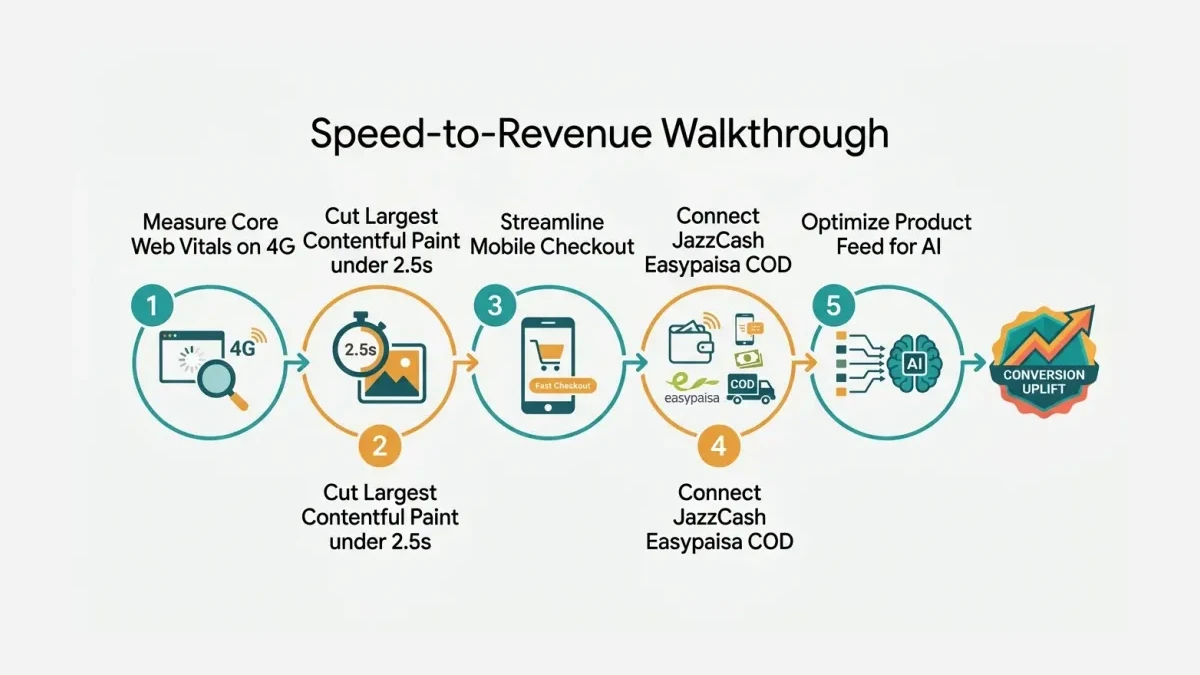
With speed improved, turn to the checkout flow itself. Picture this: a customer on a bus in Karachi opens your store on a 4G connection, adds a product, and reaches checkout. Every extra field, every account-creation wall, and every redirect to a separate payment domain is a chance they abandon the cart and open a faster competitor. The fix is to reduce the checkout to the smallest number of taps a thumb can complete on a phone screen, with guest checkout as the default and account creation offered only after the sale.
The benchmark is a checkout a buyer can finish in under 60 seconds on a phone. That usually means cutting form fields to name, phone, address, and payment method; auto-detecting the city from the phone number; and removing any interstitial that asks for marketing consent mid-flow. The tradeoff is between the data you collect and the sales you close, and for most Pakistani stores the revenue lost to a long checkout dwarfs the value of the extra fields. Our deeper guide on the cart abandonment fix for Pakistani ecommerce checkout walks through the field-by-field reduction.
After that, wire up JazzCash, Easypaisa, and COD as one-tap options
Payment is where most Pakistani checkouts lose the most buyers. The expectation in this market is local: JazzCash and Easypaisa mobile wallets for instant transfer, plus cash on delivery for buyers who do not trust online payment. A checkout that offers only a card field, or that redirects through three screens to confirm a wallet payment, will lose buyers who expected a single-tap wallet confirmation. The goal is to present all three options on a single screen, with the wallet deep-link opening the native app where possible.
One full second of load reduction is the BigCommerce headline, but the equivalent on the payment side is one fewer redirect. Every redirect to a payment gateway domain reloads the page, re-runs the scripts, and re-tests the buyer’s patience on a mobile network. Consolidating the payment screen so the buyer never leaves your domain until the wallet app opens is the single biggest mobile-conversion lever after raw load speed, and it is the change most Pakistani stores have not made.
At this point, make your product feed readable by AI shopping assistants
Speed and payment win the buyer who already reached your store. A second, growing channel now operates before the buyer arrives: AI shopping assistants. According to Retail Dive, two-thirds of shoppers have used tools like Gemini, Perplexity, and ChatGPT to manage purchases in the last three months, and Adobe reported that AI-sourced traffic to retail sites rose roughly 693% compared to the prior holiday season. Those buyers are asking an AI for a recommendation before they ever type a Google query, which means your product data has to be machine-readable or the AI will recommend someone else.
The work here is on the product feed — the structured file of product attributes (title, price, size, color, material, availability, PKR price) that platforms and engines read. Every product needs a clear title, complete attributes, a PKR price, and high-quality images, ideally with schema markup so an AI can parse the fields without guessing. A product listed as “kurti blue” with no size or fabric data is invisible to an AI assistant compiling a comparison; the same product with full attributes gets cited. Our product feed audit for Pakistani ecommerce covers the field-level checklist, and it pairs directly with the speed work because both depend on clean, structured data.
Once you’ve done that, re-measure and set a speed budget
How we helped a Pakistani business achieve measurable results.
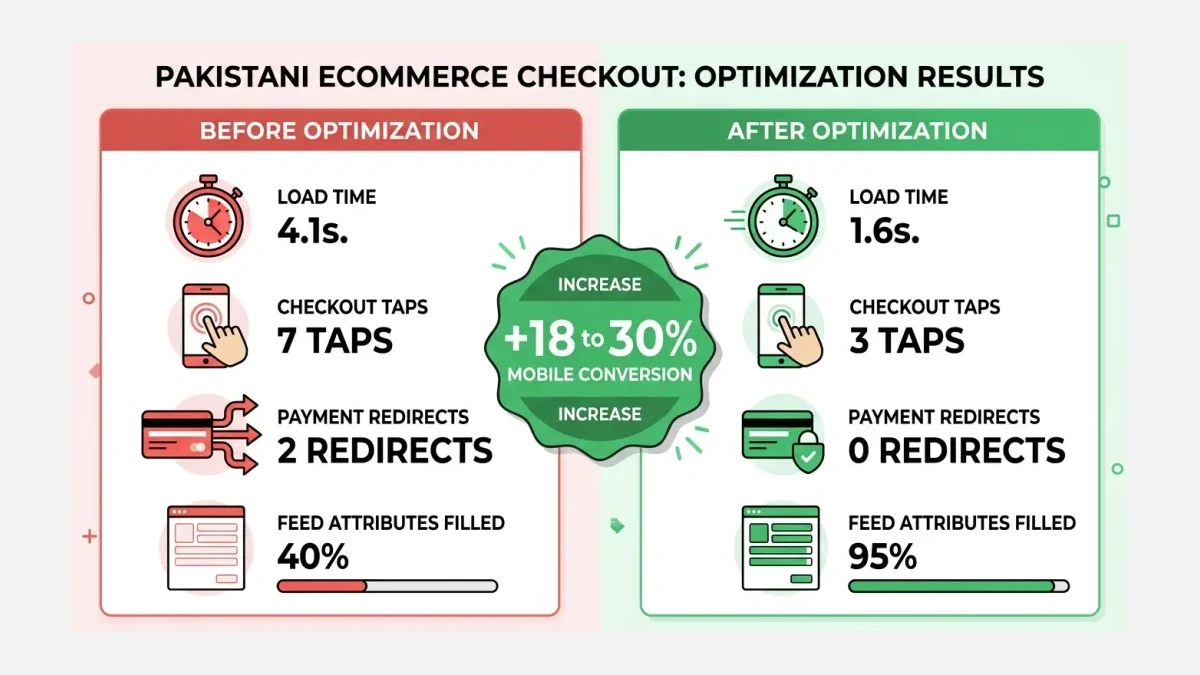
The last step closes the loop. Re-run the Core Web Vitals measurement on the same mid-range phone on the same 4G network and compare it to the baseline from the first step. The table below shows the kind of shift a focused two-to-four-week effort produces on a typical Pakistani store.
| Metric | Before | After |
|---|---|---|
| Largest Contentful Paint (4G) | 4.1s | 1.6s |
| Checkout taps to complete payment | 7 | 3 |
| Payment redirects off-domain | 2 | 0 |
| Product feed attributes filled | ~40% | ~95% |
| Mobile conversion rate (relative) | baseline | +18 to +30% |
Once the new baseline is recorded, set a speed budget: a ceiling on LCP that no new app, script, or feature is allowed to push the checkout past. A speed budget turns speed from a one-time project into a standing constraint, which means the gains do not quietly erode the next time someone adds a chat widget or a review carousel during checkout.
From here, the compounding effect on revenue
The outcome of the walkthrough is not a single conversion lift. It is a store that loads fast on the networks Pakistani buyers actually use, lets them pay the way they expect, and shows up correctly when an AI assistant recommends products in their category. Each improvement compounds. Faster checkout lifts conversion; higher conversion funds better ads; cleaner product data earns AI citations that bring in buyers who never searched Google at all. For the broader speed foundation, see our guide on the Core Web Vitals audit and fix for Pakistani website speed and the mobile bounce patterns hitting Pakistani ecommerce page speed.
WeProms Digital, Pakistan’s leading ecommerce conversion optimization agency, runs this exact sequence for Lahore, Karachi, and Islamabad stores. We do not sell a platform migration as the answer to a speed problem; we measure, cut, simplify, and re-measure until the checkout converts on the networks your buyers actually use. If your store is slow on mobile and you cannot tell how much revenue it is costing you, start with a CRO audit at weproms.com/contact-us, email hello@weproms.com, or message us on WhatsApp at +92 300 0133399.
Read next: The Shopify Pakistan stores success guide and How page speed drives Pakistani ecommerce mobile bounce.
Frequently Asked Questions
How fast should my Pakistani ecommerce checkout load?
Aim for a Largest Contentful Paint under 2.5 seconds on a mid-range Android phone over 4G, which is how most Pakistani buyers shop. BigCommerce cut its checkout load to around 1 second, and Deloitte found that just 0.1 seconds faster lifts retail conversion by about 8.4%. Test on a real device, not a fast desktop simulation, because 4G hides the real bottleneck.
Which payment methods must a Pakistani checkout offer?
JazzCash, Easypaisa, and cash on delivery cover the vast majority of Pakistani online buyers. Present all three on a single screen and avoid redirects to separate payment domains, since each redirect reloads the page on a mobile network and increases abandonment. Cards matter for higher-income urban buyers but should sit alongside the wallets, not replace them.
What does it cost to optimize checkout speed with WeProms?
WeProms runs a CRO audit first, then a focused speed and checkout engagement that typically spans two to four weeks. Pricing depends on platform (Shopify, WooCommerce, custom), traffic, and number of products in the feed. There is no minimum spend requirement. Book a call through the contact page for a quote tied to your store’s baseline metrics.
How do AI shopping assistants affect my product listings?
About two-thirds of shoppers now use tools like ChatGPT, Perplexity, and Gemini for purchases, and AI-sourced retail traffic rose roughly 693% year over year. If your product feed lacks attributes like size, color, material, and PKR price, the AI cannot parse your listing and will recommend a competitor instead. Fill every feed field and add product schema markup.
Do I need to switch platforms to get a faster checkout?
Usually not. Most speed gains come from compressing images, deferring non-critical scripts, removing third-party tags during checkout, and simplifying the payment flow. A platform migration is a last resort, not a first step. Migrate only if the current platform fundamentally cannot render a fast checkout after optimization.
Sources & References
- BigCommerce Blog — Checkout Just Got 41% Faster, Just in Time for the Holidays — 2026
- BigCommerce Investor Relations — BigCommerce Introduces New Product Innovations Across Storefronts — 2026
- Deloitte Ireland — Milliseconds Make Millions — accessed 2026
- web.dev (Google) — Milliseconds Make Millions Case Study — accessed 2026
- Retail Dive (via Yahoo Shopping) — As the Holidays Near, Two-Thirds of Shoppers Are Using AI — 2026
- Adobe — 2025 Holiday Shopping Season Recap — 2025–2026
- First Insight — 68% of Holiday Shoppers Using AI Plan to Buy Directly Through It — 2026
Additional reading from industry feeds: