By Sara Khan. Last updated: July 2026.
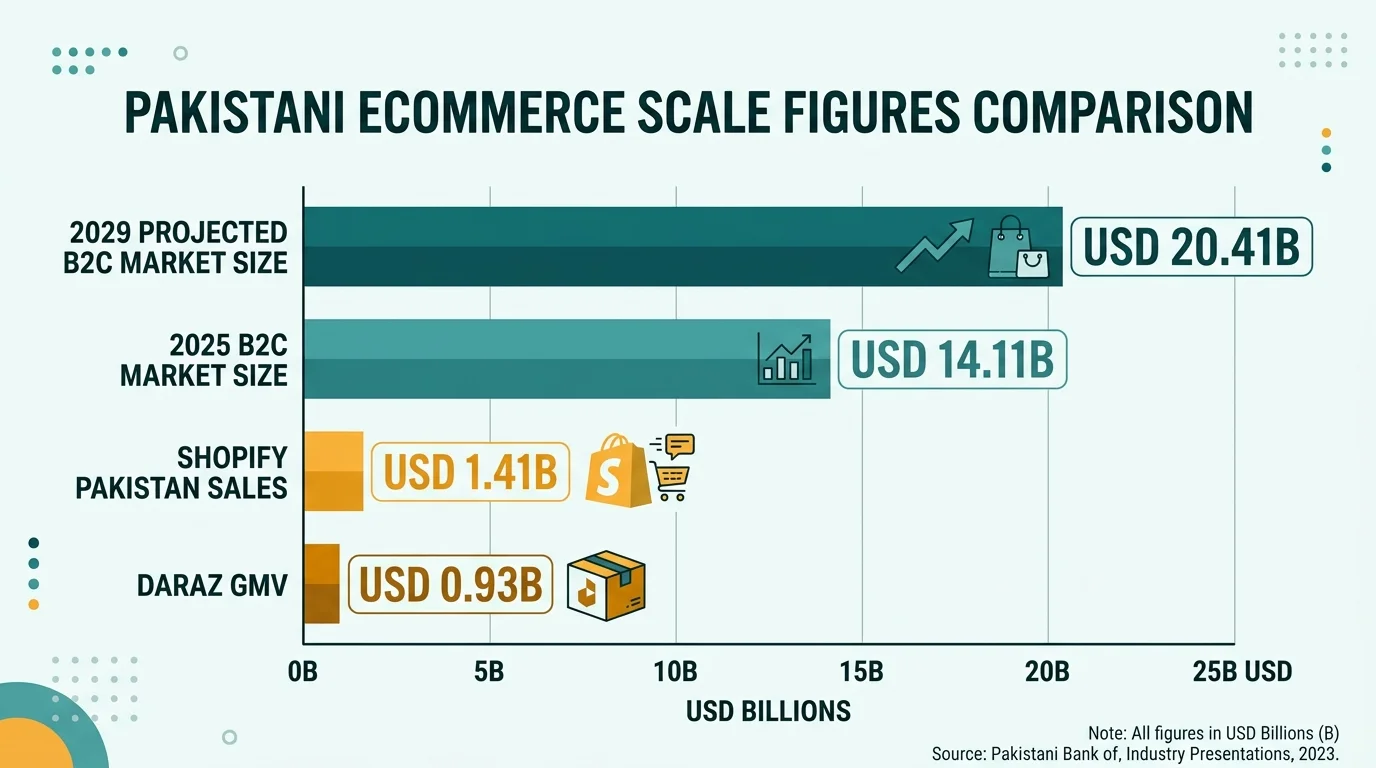
Pakistan’s B2C ecommerce market reached USD 14.11 billion in 2025 and is projected to hit USD 20.41 billion by 2029 at roughly 13.2 percent annual growth, yet nearly all of that revenue travels through product feeds that most Pakistani brands never formally audit. The SCAN framework breaks product feed readiness into four steps: S for Structure, C for Compliance, A for Automation, and N for Network distribution. Each step answers one question a Pakistani ecommerce brand must resolve before Google’s three mid-2026 feed changes reshape how products appear across Shopping, Demand Gen, and free listings.
Daraz alone handled about USD 926 million in 2024-2025 GMV with roughly 9.4 million active Pakistani users, and Shopify powers around 37,260 stores in Pakistan, about 54.44 percent of tracked online stores and USD 1.41 billion in sales. Behind every one of those storefronts sits a structured data feed, and that feed is now the single point of failure for visibility across paid and free surfaces alike.
S — Structure: the feed fields Google now reads automatically
Product feed — a structured file, usually CSV or XML, that lists every product a brand sells with attributes such as title, price, GTIN, MPN, brand, condition, and image link. Google reads this file to decide whether and where to show a product.
Structure is where Pakistani sellers lose the most ground. The shift that signals the urgency: Google removed the option to manually add or update products in Manufacturer Center — the program that holds authoritative product data for brands — around July 9, 2026. Pre-July 9 data is grandfathered, but every future change must flow through the Manufacturer Center API or a file upload. Manual patching is gone.
When a brand could hand-edit a product record, a missing GTIN or a wrong image could be corrected in five minutes inside the interface. Now the same correction requires a feed rule or an API call, which means the feed itself has to be correct at the source. Pakistani exporters in textiles, surgical instruments, and sports goods — categories that lean heavily on Manufacturer Center for global catalog data — feel this first. A textile exporter in Faisalabad shipping lawn fabric to Gulf markets can no longer open Manufacturer Center, correct a fabric composition attribute, and save it; the correction must travel through the feed.
A practical structural audit confirms every required attribute is populated for every SKU, validates GTINs against the GS1 database, and checks that image links resolve to square, minimum-1000-pixel images. Structure is not glamorous work, but it is the floor every other SCAN step stands on. Brands whose feeds carry structural gaps now carry those gaps permanently unless the feed itself is rebuilt — which is the same discipline that underpins Merchant Center setup for Pakistani stores.
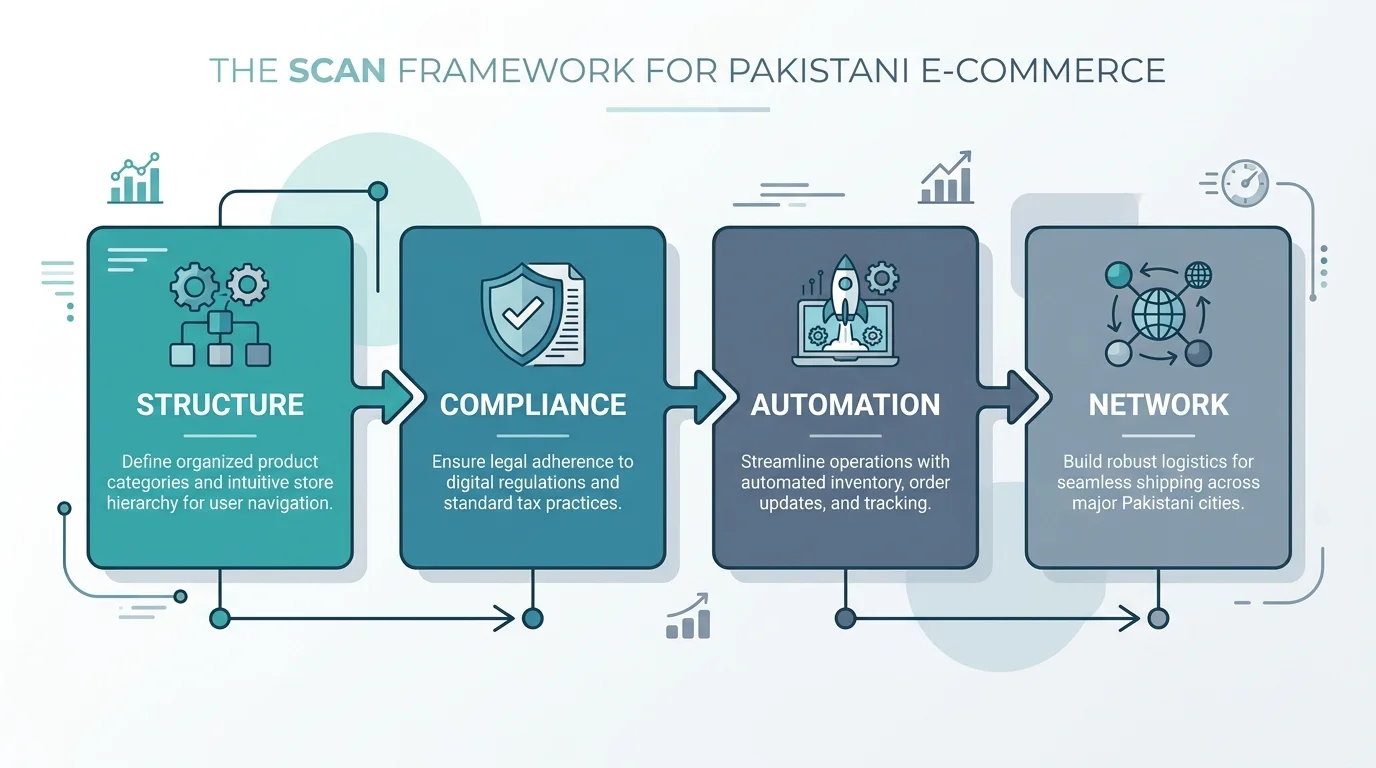
C — Compliance: the September 2026 policy merge
Google announced on July 15, 2026 that it will consolidate Shopping ads policies and Free Listing policies into a single Shopping policies document in Merchant Center Help, effective September 2026. Google frames the change as organizational, with no stricter enforcement. Organizational cuts both ways for Pakistani sellers who never read either policy.
Free listings — the unpaid product results that appear in the Google Shopping tab, eligible to any compliant Merchant Center account without ad spend. They sit alongside paid Shopping ads and, after September, fall under the same rulebook.
The pattern repeats. Pakistani sellers who treated free listings as a low-stakes channel now face one unified policy that governs both paid and free visibility. A disapproval under the merged policy removes the product from both surfaces simultaneously. Brands that previously tolerated minor free-listing compliance gaps because the channel cost nothing lose that buffer in September.
The compliance check is concrete. Read the merged Shopping policies document when it publishes, then run every active SKU against four gates: prohibited content, misrepresentation, unverified claims, and feed specification compliance. Fashion brands selling modest wear and ethnic wear should pay particular attention to sizing claims and material composition, because misrepresentation triggers carry the harshest penalties under the unified policy. Brands that have already worked through Shopify Pakistan store setup should treat the feed audit as the next layer on top of the storefront.
A — Automation: feed rules replace manual edits
Book a free strategy call - we'll audit your current setup and identify the highest-impact fixes.
The Manufacturer Center manual-edit removal is one piece of a larger automation push. Google’s direction across Merchant Center, Demand Gen, and Shopping is unmistakable: feeds, not manual clicks, are the control surface. Pakistani brands that built their catalog management around occasional manual fixes now operate against the grain of the platform.
Feed rule — an automated instruction in Merchant Center that modifies product data as it is imported, for example appending a size attribute from a custom label or standardizing a price format. Feed rules are the replacement for manual editing at scale.
The brands that adapt fastest treat the feed as the product of a system, not a one-time upload. A Shopify Pakistan store syncing 3,000 SKUs needs a feed-rule layer that catches missing GTINs, normalizes titles, and suppresses out-of-stock items before Google reads the file. Building that layer is a one-time project; operating without it is a recurring disapproval risk that quietly erodes TikTok Shop and ecommerce visibility wherever the same catalog is syndicated.
A useful comparison sits between a Daraz seller who hand-edits each listing daily and one who maintains a clean inventory feed that auto-syncs. The first spends hours on catalog hygiene; the second spends that time on pricing and creative. Google’s automation shift rewards the second model and quietly penalizes the first.
N — Network: Demand Gen feeds widen distribution
The final step is the one most Pakistani brands have not yet entered. Google brought business data feeds to Demand Gen campaigns, enabling dynamic creative across Gmail, YouTube, and Discover without depending solely on Google Merchant Center. The four feed types now available are merchant, dynamic demographics, loyalty, and remarketing.
Demand Gen — Google’s campaign type that reaches users across YouTube, Discover, and Gmail with visually led ads, originally built as a successor to Discovery ads and now extended to accept structured business data feeds.
The driver behind this is Google’s push to let performance advertisers run product-level creative across surfaces that previously sat outside the Shopping ecosystem. For a Pakistani apparel brand, one product can now appear as a Shopping ad on Google.com, a video companion on YouTube, and a Discover card, all governed by the same feed data.
The Network step asks whether the brand’s feed is healthy enough to feed Demand Gen. Sending a partially compliant feed into Demand Gen amplifies errors across three surfaces instead of one. Brands should graduate into Demand Gen only after Structure, Compliance, and Automation are clean, not before.
Key Takeaways
- Pakistan’s USD 14.11 billion ecommerce market depends on product feeds most brands never audit, and Google’s mid-2026 changes make that gap expensive.
- Structure comes first: the July 9 Manufacturer Center manual-edit removal means feed fields must be correct at the source.
- Compliance tightens in September 2026, when Shopping ads and Free Listing policies merge into one document governing both surfaces.
- Automation replaces manual edits; brands need a feed-rule layer, not occasional hand-fixes.
- Demand Gen business data feeds widen distribution across YouTube, Discover, and Gmail, but only for brands whose feeds pass the first three SCAN steps.
Read next: Why Pakistani stores need Merchant Center setup in the AI search era and how to launch a Shopify Pakistan store that survives feed audits.
At WeProms Digital, our ecommerce marketing agency team runs product feed audits and Merchant Center optimization for Pakistani brands across Lahore, Karachi, and Faisalabad, and our Merchant Center management service covers the feed-rule and Demand Gen setup that the SCAN framework requires. Book a feed audit before the September policy merge so disapprovals do not remove products from paid and free surfaces at once. Reach us at hello@weproms.com or WhatsApp +92 300 0133399.
Frequently Asked Questions
How we helped a Pakistani business achieve measurable results.
What is a product feed audit?
A product feed audit is a structured review of every attribute Google reads from a brand’s catalog file, including title, price, GTIN, MPN, image, and availability, against Merchant Center requirements. It surfaces the structural gaps that cause disapprovals and suppress visibility across Shopping, free listings, and Demand Gen.
When does the Google Shopping policy merge take effect?
Google announced the consolidation on July 15, 2026, and the unified Shopping policies document takes effect in September 2026. After that date one policy governs both paid Shopping ads and free listings, so a disapproval removes a product from both surfaces.
How many Shopify stores operate in Pakistan?
Roughly 37,260 active Shopify stores operate in Pakistan as of 2026, representing about 54.44 percent of tracked online stores and around USD 1.41 billion in sales. Each store depends on a clean product feed for Google visibility.
Can WeProms set up Demand Gen feeds for my Pakistani store?
Yes. WeProms Digital configures Demand Gen business data feeds, including merchant, dynamic demographics, loyalty, and remarketing, as part of our ecommerce marketing and Merchant Center management services. A feed audit is completed first so the four SCAN steps are clean before launch.
Why did Google remove manual edits in Manufacturer Center?
Google removed manual product add and update in Manufacturer Center around July 9, 2026 to push brands toward feed and API-based catalog management. Pre-July 9 data is grandfathered, but every future change must travel through the API or a file upload.
About WeProms Digital
WeProms Digital is Pakistan’s leading ecommerce marketing and product feed optimization agency, headquartered in Lahore, serving Pakistani SMEs, ecommerce brands, and export manufacturers across Lahore, Karachi, Islamabad, Rawalpindi, Faisalabad, and Sialkot.
The team specializes in product feed audits, Merchant Center management, and Demand Gen feed setup, with a track record of resolving catalog disapprovals before Google policy changes remove products from paid and free surfaces.
Get in touch: hello@weproms.com · WhatsApp +92 300 0133399 · weproms.com/contact-us
Sources & References
- Search Engine Land — Google brings business data feeds to Demand Gen campaigns — July 17, 2026
- Audit Socials — Google Shopping policy consolidation 2026 (ads and free listings merge) — July 2026
- Adriaan dekker on LinkedIn — Google Ads News Week 29 (Manufacturer Center manual edit removal) — July 2026
- Accio — Top trends in Pakistan (B2C ecommerce market sizing) — 2026
- JustBlogo — Marketing versus e-commerce in Pakistan (Daraz and Shopify data) — 2026
- qwhosting — Top ecommerce sites and apps in Karachi (Shopify store counts) — 2026
- Google Merchant Center Help — Shopping policies — 2026
Additional reading from industry feeds: