Why Pakistani Stores Need Merchant Center Setup in the AI Search Era
An operator-facing Q&A on how Google’s AI product answers reshape Pakistani ecommerce visibility. By Abdul Rehman, 11 July 2026.
Pakistani ecommerce stores lose product visibility to Google AI not because the AI is hostile, but because most stores have no clean product feed for it to read. A disciplined Merchant Center setup, with free product listings at PKR 0 per click, is now the cheapest way to appear inside the AI answer instead of beneath it.
Google’s AI answers now appear in roughly half of all searches, up from 6.5 percent in January 2025. For a Pakistani ecommerce store, that is not an abstract statistic — it is the moment when a shopper asking “best wireless mouse under PKR 3,000 in Lahore” gets a generated answer with a few named products instead of ten blue links. The stores whose product data the AI can read appear in that answer. The rest do not. This Q&A walks through what changed, what it costs, and what a Pakistani store owner actually needs to do.
Why does Merchant Center matter more in 2026 than it did a year ago?
Merchant Center matters more because the AI answer layer reads product feeds directly, and product questions are exactly the queries it now resolves inline. A year ago, a missing or messy Merchant Center feed cost you Shopping ad performance. In 2026, it costs you visibility in the AI answer itself, which is where the shopper now decides.
Google’s AI Overviews presence grew 58 percent year over year as of February 2026, with coverage now reaching ecommerce and travel alongside informational queries, according to a Brightedge study summarized by Lumar. The shift from informational to commercial queries is the part Pakistani store owners should anchor on. When the AI answers a buying question, it pulls structured product data to populate that answer, and that data lives in Merchant Center. No Merchant Center feed, no product in the answer. WeProms Digital, Pakistan’s leading ecommerce marketing agency, frames it plainly: the feed is now the storefront.
How much of AI search visibility comes from product content?
Book a free strategy call - we'll audit your current setup and identify the highest-impact fixes.
Most of it. A study tracking 768,000 citations across AI search engines, reported by Search Engine Journal, found that product-related content makes up 46 to 70 percent of all sources the AI cites. Product specs, comparisons, best-of lists, and vendor detail pages consistently earned the highest citation rates, while blogs, press releases, and educational content were cited far less often.
The takeaway for a Pakistani store owner is direct. The content that earns AI citations is product content, and the canonical source of structured product content is your Merchant Center feed and your product detail pages. Spending on generic blog posts to “rank for AI” is the wrong investment; enriching product pages with specifications, pricing in PKR, availability, and structured data is the right one. To see how product discovery is shifting across AI shopping agents, our guide to AI shopping agents and ecommerce setup in Pakistan maps the full surface area.
Are Google’s free product listings still free for Pakistani stores?
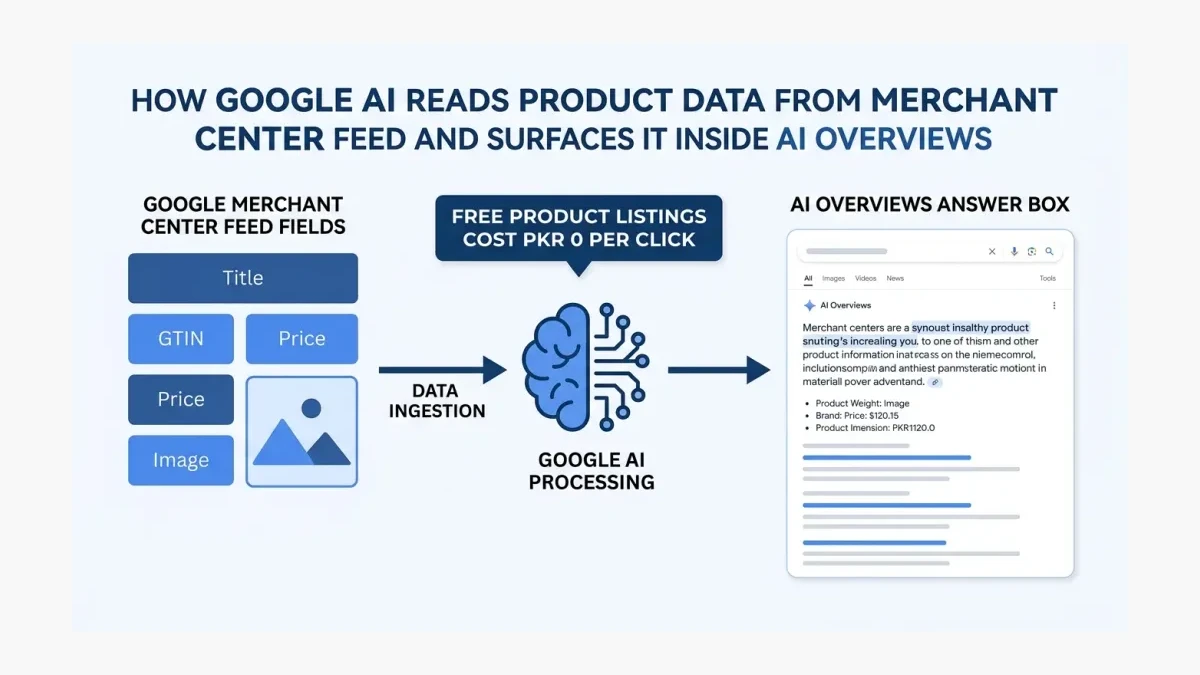
Yes. Free product listings remain completely free in 2026: no Merchant Center account fee and PKR 0 cost per click on the free, organic product surfaces, according to Google’s own product guidance as summarized by MBAdv. Free listings are now on by default for new Merchant Center accounts, with no Google Ads account required to turn them on.
Start here. For a Pakistani store with thin ad budgets, the free listings channel is the single most valuable move available, because it costs nothing per click and directly feeds the surfaces AI reads. Picture this: it is like a Daraz storefront that charges PKR 0 per visitor who walks in. The only question is whether your products are actually on the shelf with correct prices, images, and stock status. The tradeoff is that free listing visibility depends entirely on data quality rather than bid price, which means a messy feed gets no visibility at all, for free.
| Dimension | Free Product Listings | Paid Shopping / Performance Max |
|---|---|---|
| Cost per click | PKR 0 | Billed per click, varies by category |
| Google Ads account required | No | Yes |
| Visibility driver | Feed data quality and relevance | Bid plus feed quality |
| Where it appears | Shopping tab, free surfaces, some AI answers | Top of Shopping, AI Mode sponsored placements |
| Best for Pakistani stores | Building baseline visibility on thin budgets | Scaling once feed and conversion tracking are clean |
What changed when Google dropped “Next” from Merchant Center Next?
On July 9, 2026, Google dropped the “Next” branding from Merchant Center Next, according to DigitalApplied’s update. This is a naming change only, not a functional one. Accounts, feeds, and settings continue to work exactly as before, and no data migration is required.
What it signals, though, is consolidation. Google is unifying Merchant Center into a single product identity as it merges merchant data with the AI answer layer and the Ask Advisor agent introduced at Google Marketing Live 2026. For a Pakistani store owner, the practical step is to update internal documentation to reflect the new name, watch for phishing emails referencing the rename, and confirm that the June 2026 Merchant Center terms update has been reviewed, since continuing to use the platform after that date implicitly accepts the new terms. Under the hood, Google also began automatically assigning product categories with an evolving taxonomy, which means your manually assigned categories may be overridden if they do not match Google’s inferred intent.
How does Google’s Universal Checkout Protocol affect Pakistani ecommerce?
How we helped a Pakistani business achieve measurable results.
The Universal Checkout Protocol, or UCP, launched in February 2026 and lets users buy items without leaving AI Mode or Gemini, with Etsy and Wayfair as launch partners. It is the clearest signal yet that Google is moving from answering product questions to completing product purchases inside the AI surface.
For Pakistani ecommerce, the implications are layered. UCP is not yet broadly available to merchants outside its launch partners, so a Lahore or Karachi store cannot plug into it today. But the direction is unambiguous: product discovery, comparison, and checkout are collapsing into a single AI-mediated flow. Stores that build clean structured product data now, through Merchant Center and rich product schema, will be positioned to participate as UCP and similar agentic commerce surfaces open up. Stores that defer will face the same catch-up cost they faced when Daraz and Shopify first reshaped Pakistani retail. Our breakdown of ecommerce product setup for AI shopping search in Pakistan covers the structured-data foundations UCP will eventually expect.
What product feed fields actually decide whether AI cites your store?
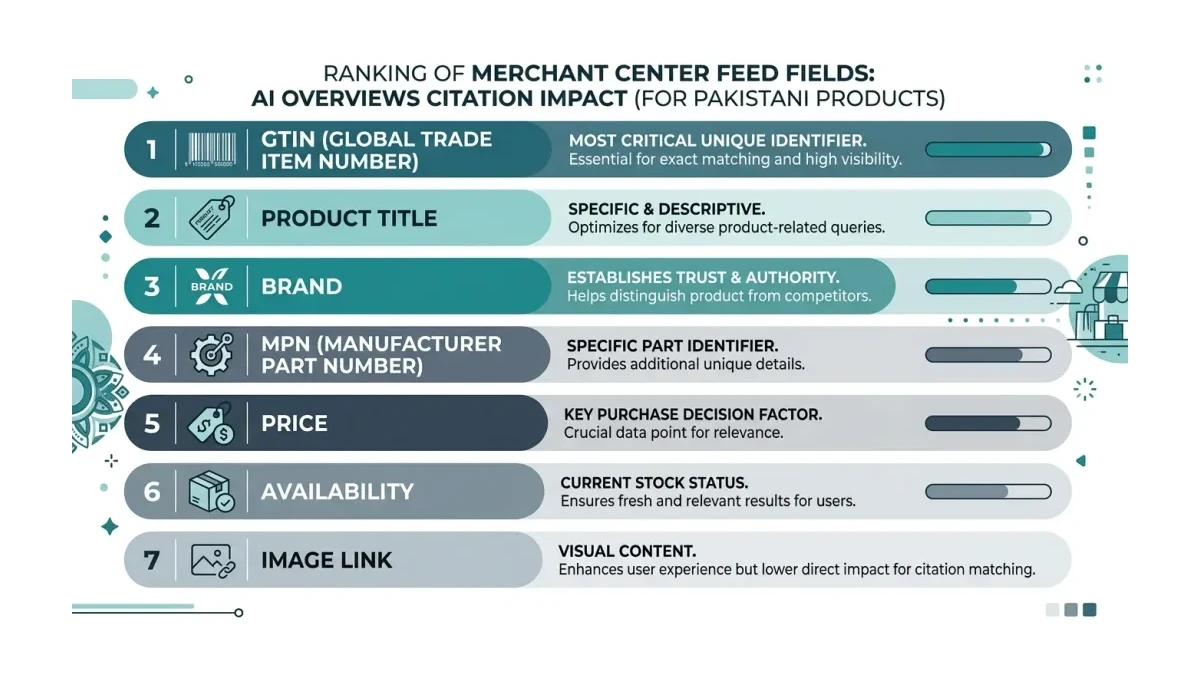
A small set of fields carries most of the weight. The AI reads structured, unambiguous product data, and it ignores or down-ranks feeds that are incomplete or contradictory. The fields that matter most are title, GTIN, MPN, brand, price in the local currency, availability, image link, and condition.
The mechanism is simple to explain. GTIN — the Global Trade Item Number, a globally unique barcode that identifies a specific product — lets the AI match your listing to the exact product a shopper asked about, rather than guessing from a keyword title. A missing GTIN is the most common reason a Pakistani store’s product does not appear in a comparison answer. Brand and MPN do the same matching work for products without a GTIN. Price and availability must be current, because the AI will not cite a product showing a stale price or out-of-stock status. Image link must resolve to a real, fast-loading product image, because AI Overviews frequently render the cited product’s image inline.
Should a Pakistani store sell inside ChatGPT and AI Mode with Shopify Agentic Storefronts?
Possibly, but only after the Merchant Center foundation is solid. In March 2026, Shopify rolled out Agentic Storefronts, giving merchants out-of-the-box access to sell inside ChatGPT, Microsoft Copilot, Google’s AI Mode, and the Gemini app, all managed from the Shopify admin, per Lumar’s industry roundup. For Pakistani stores already on Shopify, this is the first credible path to transact inside AI surfaces rather than just be cited by them.
The honest caveat is conversion. Walmart reported that purchases completed inside ChatGPT converted at roughly one-third the rate of its own website, with customers finding the experience unsatisfying, which is why a store should treat agentic storefronts as an early experimental channel, not a primary revenue line in 2026. The sequence matters: fix the Merchant Center feed and free listings first, because that work feeds every AI surface including agentic storefronts. Then layer agentic commerce on top. For stores weighing Daraz versus Shopify, our ecommerce marketing comparison for Daraz and Shopify in Pakistan and our notes on first-party data independence from Daraz set the platform-level context.
Read next: AI shopping agents and ecommerce setup in Pakistan and ecommerce marketing in Pakistan for Daraz and Shopify.
At WeProms Digital, we set up and optimize Merchant Center for Pakistani ecommerce brands end to end — feed structuring, free listings activation, GTIN and schema cleanup, and Performance Max integration — so your products appear inside Google’s AI answers rather than beneath them. If your store has never had a clean product feed, or your free listings show no impressions, start with a Merchant Center setup audit or reach us on WhatsApp at +92 300 0133399. The first surface to fix is the one that costs PKR 0 per click.
Sources & References
- Search Engine Journal — AI Search Study: Product Content Makes Up 70% Of Citations — April 2025
- Lumar — SEO & AI Search Industry News March 2026: AI Overviews Growth, Agentic Storefronts, Walmart Conversion Gap — March 2026
- The Digital Maze — Google Just Quietly Redrew The Internet: Universal Checkout Protocol, Ask Advisor, Gemini In Commerce — May 2026
- DigitalApplied — Google Drops “Next” From Merchant Center Next — July 2026
- Google Developers — Merchant API Latest Updates (Merchant API MCP Service Alpha) — May 2026
- Statista — Social Commerce Market Size and Forecasts — 2026
- FeedOps — Google Shopping Free Listings: How They Work and How to Enable Them — 2026
- MBAdv — Google Merchant Center vs Google Ads: Key Differences and Free Listings Cost — 2026
Additional reading from industry feeds: