By Hamza Ali. Last updated July 2026.
A Pakistani Shopify store spending PKR 400,000 a month on Shopping ads can lose a third of its eligible inventory to Merchant Center disapprovals in a single feed sync. The campaign keeps running on the products that survive. The money leaks through the products Google silently stopped showing.
Google Merchant Center is the product-data layer that sits between an online store and Google Shopping, free listings, and Performance Max retail campaigns. Pakistani D2C brands on Shopify, WooCommerce, and custom stacks use it to push their catalog into Google’s ad surfaces. When product data is clean, the catalog flows through. When it is not, Merchant Center disapproves individual items, and those items stop appearing in ads while the budget keeps being spent on the rest.
What this gets right
Merchant Center does one thing very well. It forces product data into a structured, comparable format, which is exactly what an ad auction needs to match a shopper’s query to the right SKU. A clean feed lets a Karachi apparel brand compete for “women’s unstitched lawn suit” against every other catalog in the region on equal footing.
The free-listings surface is the second win. Google shows products in the Shopping tab and in some AI results without charging per click, so a compliant feed earns organic product visibility alongside paid Shopping ads. For a market where Pakistan’s ecommerce reached roughly US$7.7 billion in sales in 2024 and is projected to keep growing at a 17% compound annual rate through 2027, free product visibility is not a footnote. It is a channel.
The scale is real. Daraz, the dominant Pakistani marketplace, reports around 40 million monthly active users and works with over 550,000 sellers, and daraz.pk alone draws roughly 9.64 million monthly visits. The D2C brands that run their own stores alongside a Daraz presence use Google Merchant Center to reach shoppers who search on Google rather than inside a marketplace. That is a different, higher-intent audience, and the feed is the only way in.
Where this breaks
The system breaks silently. It behaves like a Daraz seller whose top SKUs get quietly delisted for a missing barcode while the storefront stays open; the shop looks fine, but the best shelves are empty. Merchant Center does not pause a campaign when products get disapproved. It simply removes those products from eligibility, so the ad account keeps spending on the surviving fraction while the disapproved SKUs vanish from results. The owner sees the campaign as “live” and assumes the full catalog is running.
The most common failure is also the dullest: missing product identifiers. Google requires a valid GTIN — the Global Trade Item Number, the barcode that uniquely identifies a manufactured product — and a brand for most new, manufactured items. Feeds that submit neither trigger a warning labeled limited performance due to missing identifiers, which is industry guidance’s most-cited recurring issue. Pakistani dropshipped and white-label products routinely lack GTINs, and sellers often do not know the identifier_exists flag exists to declare a custom good honestly.
The second break is image quality. Merchant Center rejects images that are too small, watermarked, padded with borders, or overlaid with promotional text. A Lahore electronics seller who reuses a supplier’s watermarked JPG gets a cluster of disapprovals and never connects them to the source image.
The third break is data drift. The feed says a product costs PKR 2,499 and is in stock; the landing page, after a flash sale or a stockout, says PKR 2,999 and out of stock. Google’s crawler catches the mismatch, flags the item, and pulls it. JazzCash and Easypaisa checkout flows do not cause this, but slow inventory sync between Shopify and the feed does.
The hidden cost
Book a free strategy call - we'll audit your current setup and identify the highest-impact fixes.
The cost compounds because the disapproved products are rarely random. They cluster around the SKUs with the worst source data, which are often the highest-margin private-label items a brand most wants to sell.
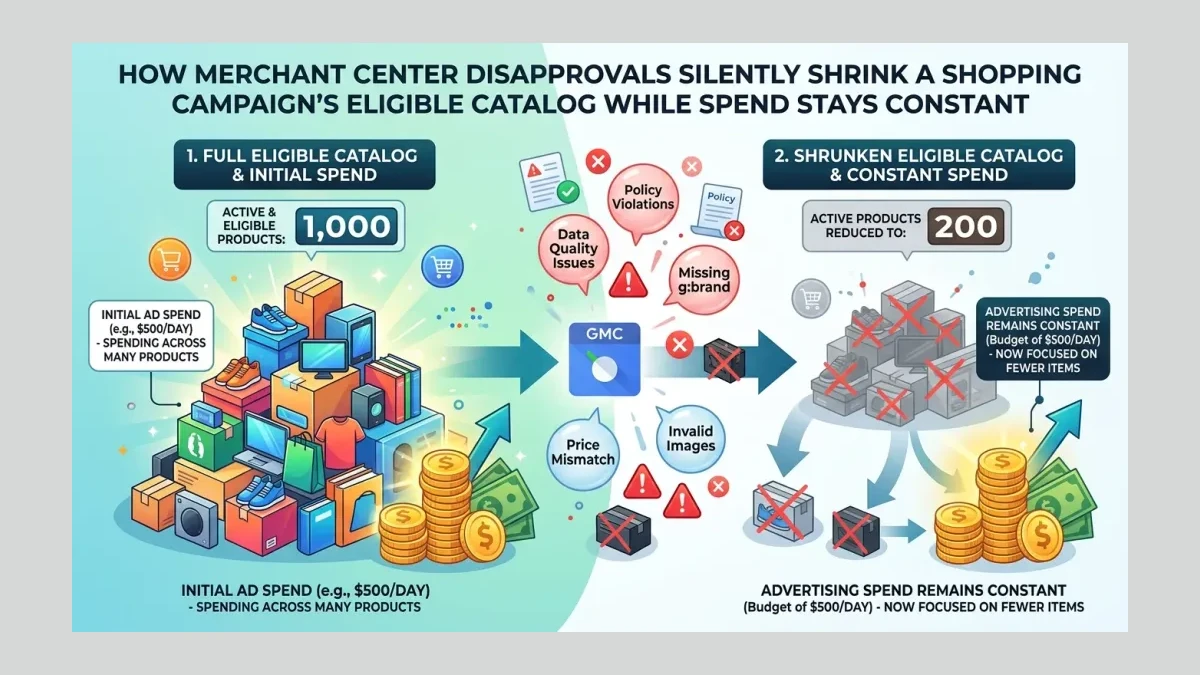
Run the math. A catalog of 1,000 products with a 32% disapproval rate leaves 680 products eligible. If monthly ad spend is PKR 400,000 and was planned across the full catalog, the effective spend per eligible product rises and the underperforming tail gets starved. Worse, the disapproved products stop contributing conversion data back to the campaign’s machine-learning model, so optimization degrades across the whole account, not just the missing items.
Google’s own product-data guidance is blunt about the requirement: GTINs must be valid, correctly formatted, and the right length — typically 8, 12, 13, or 14 digits with no spaces or dashes — and even a correct identifier gets disapproved if it is formatted wrong. A single space in a 13-digit GTIN is enough to kill the SKU.
What Pakistani sellers should do instead
The fix is a feed-hygiene protocol, not a budget increase. The comparison below shows the before-and-after state for a typical D2C feed once identifiers, images, and price sync are handled.
| Feed state | Disapproved products | Eligible inventory | ROAS signal quality |
|---|---|---|---|
| Untreated feed | 30–35% of catalog | Shrinking each sync | Starved; model trains on partial data |
| Identifier + image cleanup | 8–12% of catalog | Stable | Healthy; full catalog feeds the model |
| Full feed program (rules + monitoring) | Under 5% | Stable, growing | Strong; disapprovals caught pre-sync |
The protocol that produces the bottom row is straightforward.
- Declare identifiers honestly. Submit a valid GTIN and brand for manufactured goods; set
identifier_existsto “no” only for genuine custom or handmade products. Never submit a fabricated GTIN to clear a warning. - Standardize images at the source. Serve a clean, minimum 100,000-pixel product image on a plain background before it ever reaches the feed. Remove supplier watermarks and promotional overlays.
- Sync price and availability in near-real time. Connect the feed to live inventory, not a daily export, so a flash sale or stockout does not create a landing-page mismatch.
- Run feed rules, not manual edits. Use feed rules to append structured title patterns, normalize availability values, and strip invalid characters at sync time, so fixes apply to every new product automatically.
- Monitor the diagnostics tab weekly. Merchant Center’s diagnostics view lists every disapproval and warning by item. Treat the count of disapproved products as a campaign health metric, not a side panel.
The broader feed
Merchant Center exposes over 60 product-data attributes, and most Pakistani feeds populate fewer than ten well. Titles, product types, custom labels, and shipping attributes are routinely left empty, which limits how precisely the campaign can segment and optimize. A feed that only clears the disapproval bar still underperforms a feed that uses custom labels to separate best-sellers from clearance stock.
The leverage here is data quality, not ad spend. A store that fixes the feed often sees campaign performance improve without raising the budget, because the same PKR is finally reaching the full catalog instead of a disapproval-thinned subset. Most teams miss this. The fix is simple, but it lives in the feed, not the ad account, which is why it gets ignored.
Read next: For the strategic case for getting Merchant Center set up correctly in the first place, see why Pakistani stores need Merchant Center in the AI search era, and for the demand-generation side of a clean catalog, the product feed audit for Pakistani ecommerce breaks down what a feed review should cover.
WeProms Digital and product feeds
How we helped a Pakistani business achieve measurable results.
WeProms Digital, Pakistan’s leading ecommerce marketing and product feed optimization agency, builds and maintains Google Merchant Center feeds for Pakistani D2C brands on Shopify, WooCommerce, and custom stacks across Lahore, Karachi, Islamabad, and Faisalabad. The team cleans identifiers and images, sets feed rules that catch disapprovals before sync, wires price and availability to live inventory, and uses custom labels to segment best-sellers from clearance so Performance Max and Shopping campaigns train on the full catalog. If a campaign is spending but products keep disappearing, the team will audit the feed, fix the disapprovals, and restore eligible inventory. Reach the team at hello@weproms.com, on WhatsApp at +92 300 0133399, or through weproms.com/contact-us.
Sources & References
- Google Merchant Center Help — Fixing disapprovals for product data — Google Support
- ECDB — E-Commerce Industry in Pakistan 2018–2030 (Daraz revenue) — ECDB
- Statista — eCommerce Pakistan market outlook — Statista
- DataFeedWatch — 7 Quick Fixes to Google Merchant Center Disapproved Products — DataFeedWatch
- Store Growers — Google Shopping Feed Attributes: Full List + Tips — Store Growers
- Payments and Commerce Market Intelligence — Pakistan ecommerce US$7.7B in 2024, 17% CAGR — PCMI
- Expanded Ramblings — Daraz statistics (40M monthly active users, 550,000+ sellers) — Expanded Ramblings
- Google Merchant Center — Product data specifications — Google Support
Additional reading from industry feeds:
- Search Engine Roundtable — Google Merchant Center gains more AI feed features
- Practical Ecommerce — Reviving overlooked ecommerce SKUs with Performance Max
Frequently Asked Questions
Why did Google disapprove my products in Merchant Center?
The most common reason is missing or invalid product identifiers, specifically a missing GTIN or brand on a manufactured item. Other frequent causes are images that are too small or watermarked, a price mismatch between the feed and the landing page, or an availability mismatch where the site shows out of stock but the feed says in stock.
Do I need a GTIN for every product if I sell dropshipped or private-label goods in Pakistan?
Not for genuine custom or handmade goods, where the identifier_exists flag is set to “no.” Manufactured and branded products do require a valid GTIN and brand. Submitting a fabricated GTIN to clear the warning risks account suspension, so declare identifiers honestly.
Will fixing the feed lower my Shopping ad spend?
It usually improves performance without raising the budget, because the same spend finally reaches the full catalog instead of a disapproval-thinned subset. Disapproved products stop feeding conversion data to the campaign’s model, so cleaning the feed also improves optimization across every surviving product.
How often should a Pakistani D2C store check Merchant Center diagnostics?
Weekly at minimum. Merchant Center’s diagnostics view lists every disapproval and warning by item, and the count of disapproved products should be treated as a campaign health metric. A daily inventory sync for price and availability prevents the landing-page mismatches that cause most recurring disapprovals.
Can WeProms Digital fix Merchant Center disapprovals for a Shopify or WooCommerce store?
Yes. WeProms Digital audits the feed, cleans identifiers and images, sets feed rules that prevent disapprovals before sync, wires price and availability to live inventory, and segments the catalog with custom labels so Shopping and Performance Max campaigns train on the full eligible inventory.