By Abdul Rehman · WeProms Digital · September 29, 2026
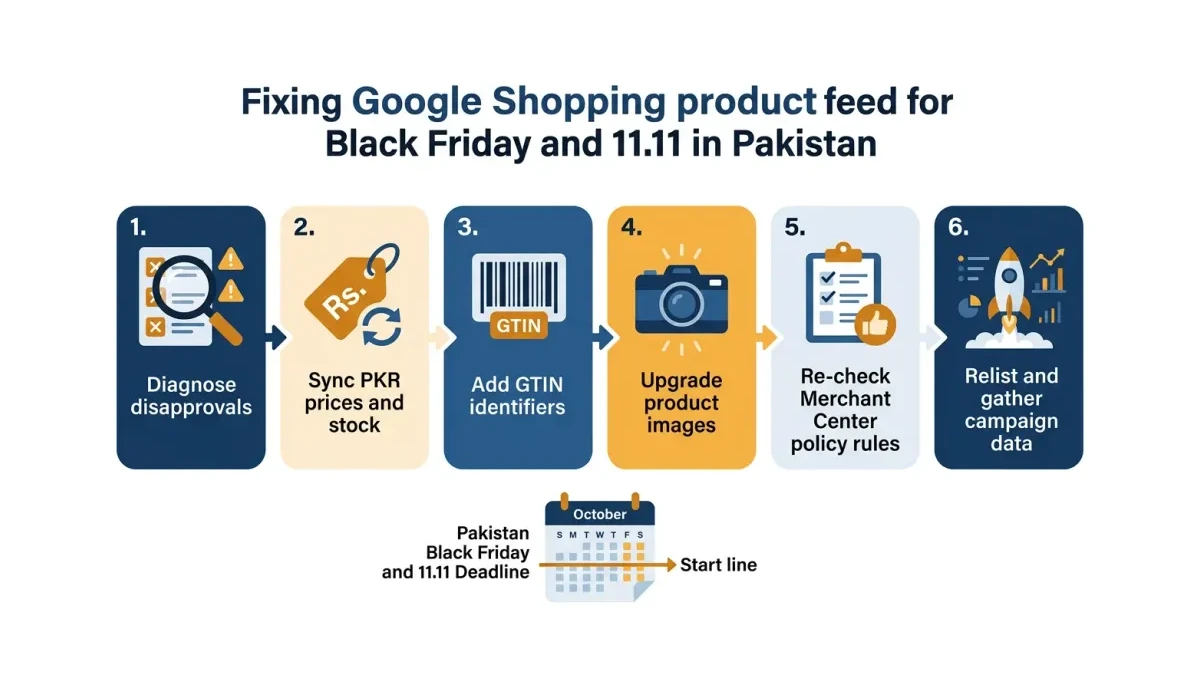
You can repair an invisible Google Shopping presence in about two to three weeks of focused feed work: diagnose disapprovals, sync PKR prices and stock, add missing GTINs, upgrade product images, then relist before Black Friday and 11.11 traffic arrives. Most of it is doable in-house on Shopify or WooCommerce, for free, if you start in early October.
If you sell unstitched suits, mobile accessories, or kitchen appliances from a Shopify or WooCommerce store in Lahore, Karachi, or Faisalabad, November is the month that pays for the year. Adobe Analytics expects online holiday spending to hit $275.1 billion between November 1 and December 31, 2026, up 6.7 percent year over year, Adweek reports. Pakistan’s own calendar stacks Daraz’s 11.11 mega-sale, Black Friday, and pre-winter buying into the same six weeks. Yet every October, store owners search their best-selling SKU on Google Shopping and find nothing. The products are not banned and the store is not penalized. The feed simply stopped qualifying.
First, read what Merchant Center actually rejected
Google Merchant Center — Google’s catalog system that holds your products and powers Shopping listings — already tells you why an item vanished. Most owners never look. Inside Merchant Center, open Products, then Diagnostics. Every item sits in one of three buckets: approved, limited, or disapproved. Disapproved items stop showing entirely, and limited items show less often.
Start here: the Diagnostics page inside Merchant Center, not the campaign dashboard.
Think of the product feed — the file of titles, prices, images, and stock levels your store sends Google — as the handwritten price list a trader hands a buyer at Shah Alam Market. One wrong price or one missing item number, and the buyer moves to the next stall. Google moves to the next seller in milliseconds.
The rules behind that list moved this year. Search Engine Roundtable’s September forum recaps documented updates to several Merchant Center policy documents plus a major expansion of the Merchant Center API help documentation. A feed that passed in spring can therefore fail in October without anyone at your end changing a row of data, which means your first task is simply to see the current state. Export today’s disapproval list, group the items by issue, and that export becomes the worklist for the rest of this walkthrough.
Then, sync your PKR prices and availability
Price mismatch is the quietest killer. Your feed says PKR 2,499 because the app last synced on Tuesday; your storefront says PKR 2,199 after the weekend sale. Google reads the gap as inaccurate data and disapproves the item — or suspends the account when the drift becomes routine. Availability drift works in reverse: cash-on-delivery returns restock your shelves faster than the feed updates, so Google tells shoppers “out of stock” about items you could ship the same evening.
Move to a daily automated sync: a Shopify feed app, a scheduled WooCommerce export, or a developer job running against the updated Merchant Center API. Manual weekly updates cannot survive a November sale calendar. As part of shopping and product feed management engagements, WeProms Digital moves Pakistani stores to daily syncs with disapproval alerts wired in, precisely because weekly manual work fails during the weeks it matters most.
The demand you should be feeding is wider than gifts. Retail Dive, reporting Adobe data, notes Cyber Week sales spike 210 percent over an average September day for clothing basics, 150 percent for personal hygiene, 113 percent for baby products, and 93 percent for pet products. Holiday shoppers stock up on essentials alongside gifts, which means household, grocery, and personal-care sellers should push their full staple catalogs into the feed, not only festive SKUs. The Black Friday readiness checklist adds a timing fact worth writing on a whiteboard: 37 percent of consumers want promotions a month before Black Friday itself. Your feed deadline is early October, not late November.
Next, add the product identifiers you skipped
GTIN — the global barcode number printed on retail packaging — is how Google confirms your product is the real, specific item rather than a lookalike. Google’s product data specification requires a GTIN whenever one exists for the product. Trader-imported stock from Dubai or Guangzhou often arrives with barcodes nobody recorded, and owners respond in one of two wrong ways: they leave the field blank where a GTIN actually exists, limiting how often the item shows, or they invent a number, which is a policy violation.
For items genuinely without a GTIN — handmade, unbranded, or generic wholesale goods — submit brand plus MPN, the manufacturer part number, instead. Pull both from the physical barcode on the packaging. Two afternoons with a barcode scanner app typically clears a 300-product catalog, and cleared identifiers lift impression eligibility across the whole feed.
After that, rebuild your images for a visual-first results page
Google keeps shifting Shopping surfaces toward image grids, and Search Engine Roundtable has tracked repeated tests of image-pack-style Shopping layouts where the product photo, not the headline, functions as the ad. Weak images now lose auctions before price is even compared.
The baseline comes straight from Google’s image requirements: the full product in frame, a plain white or neutral background for the main image, no promotional text or watermarks baked into the picture, and at least 250 pixels on the longest side for apparel until January 31, 2027 — Google has announced a 500 x 500 minimum for all products, with warnings live since July 2026, so reshoot at the larger size. For Pakistani apparel sellers, this is where unstitched fabric shots decide performance — crisp flat lays or consistent model shots, same angle, same lighting, every SKU.
The tradeoff is simple. Full-catalog reshoots stall for months, while top-20 reshoots ship this month. Start with your best sellers, because the top 20 carry most of November revenue anyway.
At this point, re-check the policy docs you never read
The September Merchant Center documentation updates make this the right moment to re-run feed rules, not just glance at dashboards. Turn on disapproval email alerts inside Merchant Center so a policy wave hits your inbox the morning it starts, rather than surfacing in a November sales review as a mystery. If a developer manages your feed through the API, ask them to confirm the integration against the expanded help docs — quiet API changes often surface as mysteriously empty fields that look like data problems but are not.
Once the feed is clean, mine image search for demand
Practical Ecommerce flagged a new Google Search Console filter that matters for product sellers: under Performance, set the search type to Web, then Multimodal, and Search Console lists the URLs shoppers viewed through image search, with views, clicks, and average position for each. Pakistani apparel and textile sellers get a double benefit — local demand signals plus diaspora buyers browsing by image from the UK and the Gulf. Feed your best image-search performers first when prioritizing reshoots, because those pages already have an audience.
The outcome: SKUs live before the sale window
Work the calendar backward. Diagnose in the first week of October, fix prices and identifiers by mid-October, relist and gather campaign data in the last week, and enter November with two to three weeks of clean performance history. That history matters because November is a two-front season for most Pakistani sellers — your own store plus Daraz’s 11.11 — and inventory splits, courier cut-offs with Leopards and TCS, and ad budgets all get decided before the first sale day.
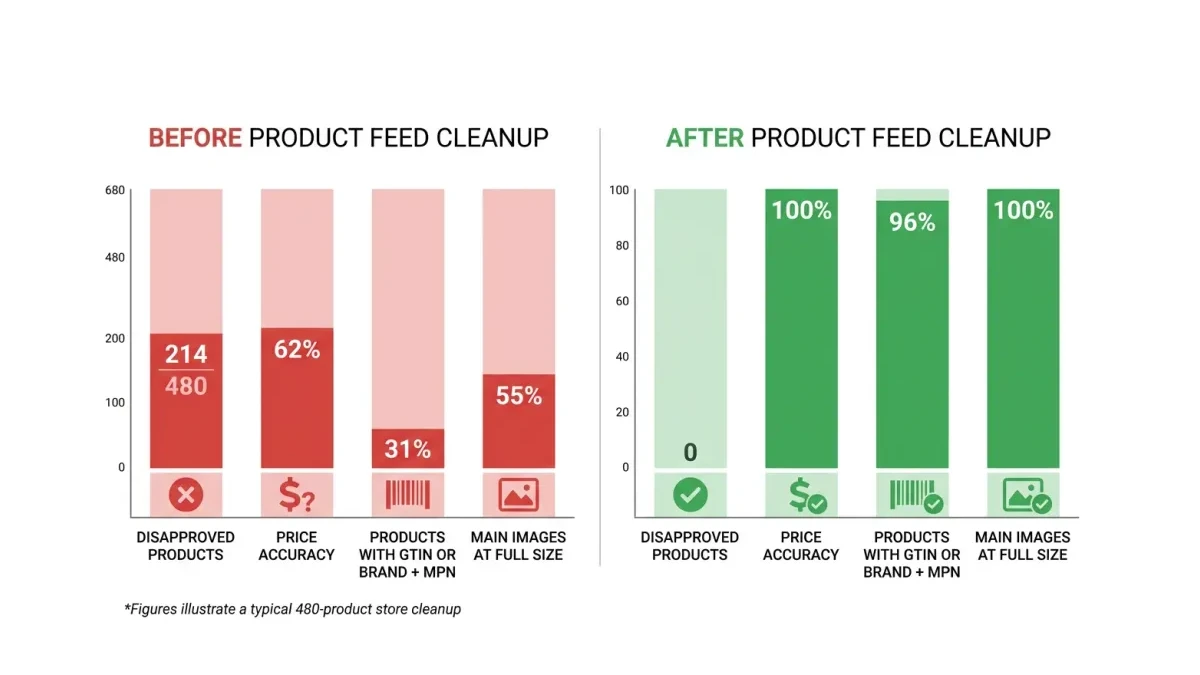
Consider a hypothetical Lahore apparel store with 480 products, typical of a mid-size Shopify seller. The cleanup arc looks like this:
| What Google checks | Before cleanup | After cleanup |
|---|---|---|
| Disapproved products | 214 of 480 | 0 |
| Feed prices matching storefront | 62 percent | 100 percent |
| Products with GTIN or brand + MPN | 31 percent | 96 percent |
| Main images at full size | 55 percent | 100 percent |
| Feed refresh rate | Weekly manual | Daily automated |
Those figures illustrate a typical arc, not one named store. Before flipping campaigns back on, verify the short version: zero disapprovals in Diagnostics, prices matching the storefront after the last sale ended, full-size images on every top-20 SKU, and the daily sync scheduled and firing.
One decision remains, and it belongs to you: pick the single source of truth for return on ad spend before the season starts, and subtract COD returns from revenue when you compute it in PKR. Broken checkout tracking quietly wrecks sale-season numbers, so it is worth reading why Google Ads gets clicks but no sales before you set the November budget.
Read next: Why Pakistani stores need Merchant Center setup and Which emails Pakistani online stores should send.
WeProms Digital runs pre-season Shopping feed audits for Pakistani ecommerce brands — disapproval cleanup, PKR price sync, GTIN and image compliance, and campaign relaunch — through its shopping and product feed management service, with full ecommerce marketing support behind it. Book before mid-October at weproms.com/contact-us, email hello@weproms.com, or WhatsApp +92 300 0133399.
Frequently Asked Questions
Why did my Google Shopping products suddenly stop showing?
Most common causes: price or availability drift between the feed and the storefront, a fresh disapproval after a Merchant Center policy update, or an image and identifier problem on specific SKUs. Merchant Center’s Diagnostics page names the cause per item in minutes. Fix the flagged field, resubmit, and most items return within 24 to 48 hours.
Can Pakistani stores list products on Google Shopping in PKR?
Merchant Center holds your prices in the currency you sell in, so PKR prices are the working default for local sellers — what matters is that feed prices, storefront prices, and shipping settings agree exactly. Stores also selling into the Gulf or the UK should verify per-country shipping and currency configuration before scaling those campaigns.
Do I need GTINs for imported products?
If a GTIN exists for the item — and for branded imported goods it nearly always does — Google requires it. Scan the physical barcode on the packaging. If the product genuinely has none, submit brand plus MPN and mark the GTIN as unavailable only where that is true. Never invent a GTIN; fabricated identifiers are a policy violation, not a shortcut.
How much does a Shopping feed fix cost in Pakistan?
A one-time cleanup on a mid-size catalog by a competent freelancer starts around PKR 40,000; agency engagements with ongoing sync, monitoring, and campaign management typically run PKR 100,000 to 250,000 per month. WeProms Digital scopes feed audits as a fixed fee before any retainer, so the cost is agreed up front.
How early should I fix my feed before Black Friday?
Start the first week of October. Cleanup takes two to three weeks, relisting needs a week, and campaigns perform better with two to three weeks of learning data before demand spikes — and 37 percent of shoppers want promotions a month early. Late October is cutting it fine; December is too late.
Sources & References
- Adweek — Holiday ecommerce shopping to hit $275 billion despite consumer strain, according to Adobe — September 2026
- Retail Dive — Black Friday 2026 ready: The infrastructure and compliance checklist — September 2026
- Retail Dive — Consumers aren’t just buying gifts this holiday season — September 2026
- Search Engine Roundtable — Daily Search Forum Recap (Merchant Center policy and API documentation updates) — September 2026
- Google Merchant Center Help — Product data specification — accessed September 2026
- Google Merchant Center Help — How to fix: Image too small — accessed September 2026
- Practical Ecommerce — New GSC image filter aids product discovery — September 27, 2026
- Search Engine Roundtable — Google testing new Shopping ads design — 2025
Additional reading from industry feeds: