By Hamza Ali · WeProms Digital · Last updated September 29, 2026
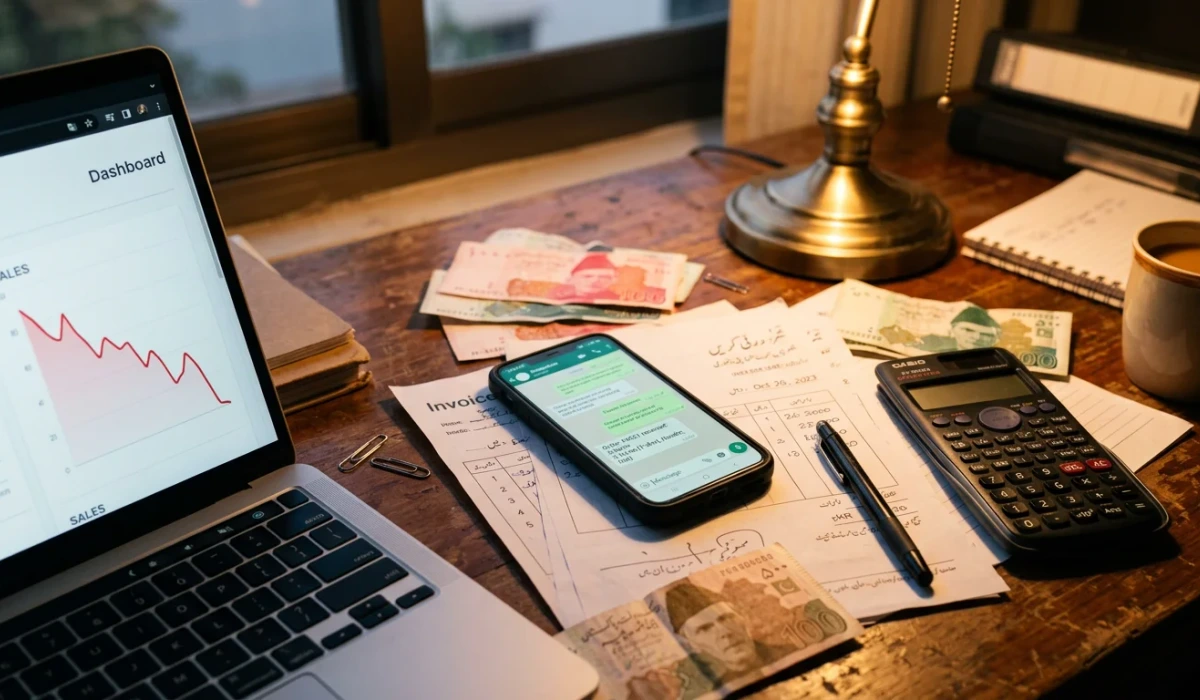
A Karachi electronics retailer spends PKR 400,000 a month on Google Ads. The dashboard reports 38 conversions. His WhatsApp Business inbox shows 190 order chats from the past week. Almost none of that chat activity reaches Google’s reports.
Sales are happening. Google just cannot see them.
When Google Ads cannot see conversions, it cannot bid for them either. The system quietly reallocates budget toward clicks that look cheap, and cheap clicks are rarely buyers. Within a few weeks, an untracked store is paying premium rates for window shoppers.
The setup that reports silence
Conversion tracking — the small code snippet that tells Google Ads when a click turned into an order — sits at the center of this problem. The standard setup fires one tag on the thank-you page a customer reaches after paying online. That design assumes the customer pays on your website, stays on your website, and loads the thank-you page. Pakistani checkouts break all three assumptions inside a single order.
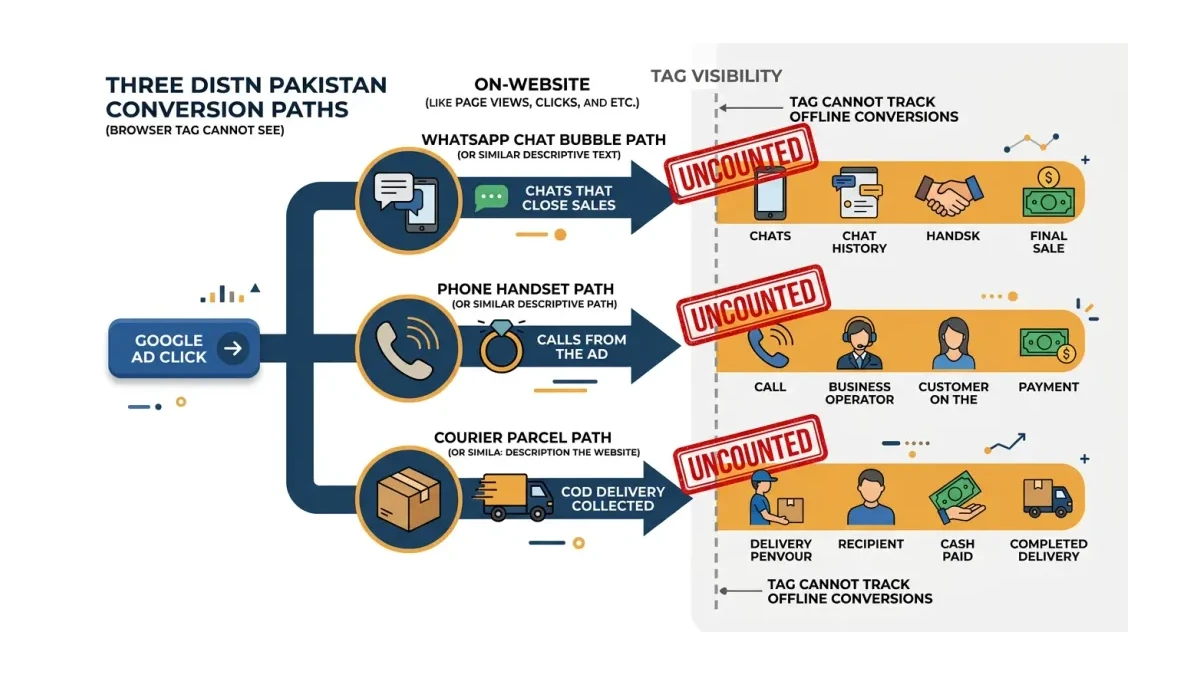
Cash on delivery settles most online orders in Pakistan; local commerce estimates consistently put the share above 90 percent. A COD customer never triggers a payment event, because there is no online payment. JazzCash and Easypaisa checkouts redirect shoppers to a wallet or bank screen before they come back, and a share of them never return to the thank-you page at all. WhatsApp click-to-chat orders leave your site entirely — the conversation continues in an app your tag cannot see, which is exactly how stores that set up WhatsApp commerce properly still end up with untracked sales.
Browser privacy stacks on top of local checkout habits. Apple’s Safari and iOS restrictions limit the cookies that carry conversion data back to Google. Google’s published guidance on Consent Mode — the setting that models conversions when users decline cookies — states that modeling recovers more than half of lost ad-click-to-conversion journeys on average, and roughly twice as much with advanced settings. Read that from the buyer’s side: even Google’s own recovery tooling concedes a large slice of journeys simply vanish without it.
It is like a shopkeeper on Hall Road counting heads at the gate while nobody writes down what the tills ring up. Footfall is not revenue. Google is spending your money on footfall.
Most teams miss this for months. Google’s own troubleshooting documentation labels a conversion action “Misconfigured” when recording stops entirely due to a broken tag, and statuses like “Tag inactive” or “Needs attention” sit in the same Status column owners never open. Silence in the dashboard is not the absence of sales; it is the absence of proof.
Where Pakistani conversions actually happen
Count what actually closes a sale here. Three paths dominate: a WhatsApp chat that turns into an order, a phone call from the ad, and a COD parcel the courier successfully delivers and collects on. None of them requires a website payment page, which is precisely why tag-only setups go blind at the moment of purchase.
The scale is not small. DataReportal’s Digital 2026 Pakistan report counts 79.9 million social media user identities as of October 2025, and Pakistani buyers routinely move from an ad into chat to confirm price, size, and delivery before paying anything. The purchase conversation leaves your website at the exact moment tracking stops recording.
Google has started building for this reality. A Google Ads beta, documented by PPC Land, lets advertisers connect a website conversion tag to a CRM or order database using a shared transaction ID, so conversions the browser tag missed get recovered from backend records:
The uploaded data becomes the authoritative source of truth for conversion value, overriding tag-recorded values for matched transactions.
That is Google admitting, in product form, that browser tags miss field conversions. The equivalent stack is available to every Pakistani advertiser today: a conversion action that fires on WhatsApp button clicks, calls-from-ads reporting with a sensible minimum call length, and a weekly offline import that matches delivered COD orders back to their original ad click. Search Engine Journal’s tracking-error walkthrough covers the same chain — auto-tagging, storing the GCLID (Google’s click identifier) when the chat begins, and uploading closed deals so the platform learns which clicks became revenue.
What Google shipped this season
Three changes landed in recent weeks that touch every Pakistani advertiser running sales-driven campaigns.
First, the CRM-connected beta above is spreading through accounts, with a 14-day trial window during which uploaded data informs reporting without touching bidding. Treat it as a signal, not a feature request: measurement that survives checkout redirects is now on Google’s roadmap, not a niche hack.
Second, Promotion Mode got stricter. Search Engine Roundtable reported on September 25 that Google Ads disables Target ROAS editing while Promotion Mode is active — you can adjust tolerance, not the target. Target ROAS — the setting that tells Google how many rupees of revenue you want back per rupee spent — locks exactly when sale season starts. Set it, and your tracking, before the Black Friday window, because a locked campaign optimizes on whatever signal existed at freeze time. Budget that leaks after the click leaks twice as fast when bidding runs on broken signal.
Third, click quality deserves sharper eyes if you also run Microsoft Ads. Bing’s “verify you are human” checks and Copilot ad surfaces have been serving ads before some users complete verification. For a Lahore or Karachi SME, that surfaces as clicks with zero follow-through. Exclude junk placements and audit IP anomalies monthly instead of assuming every click is a customer.
The 20-minute leak test
Run this before touching budgets. Open Goals, then Conversions, and read the Status column against every action. “Recording” is healthy. “Tag inactive,” “Unverified,” “Misconfigured,” and “Needs attention” each flag a specific failure that Google’s tagging troubleshooting guide walks through — a tag missing after a theme update, a thank-you page URL that changed during a redesign, a double-fired event from a page refresh.
Then place one test order through each checkout path: a card or JazzCash payment, a COD order, and a WhatsApp click. Watch each tag fire in Tag Assistant or in the GA4 realtime view. Finally, count last week’s real orders — WhatsApp chats that closed, calls that lasted over a minute, parcels delivered and collected on — and compare that count against the conversions column for the same dates.
If the dashboard shows less than half of what your courier delivered, the tracking is broken, and every optimization decision since it broke has been made on fiction.
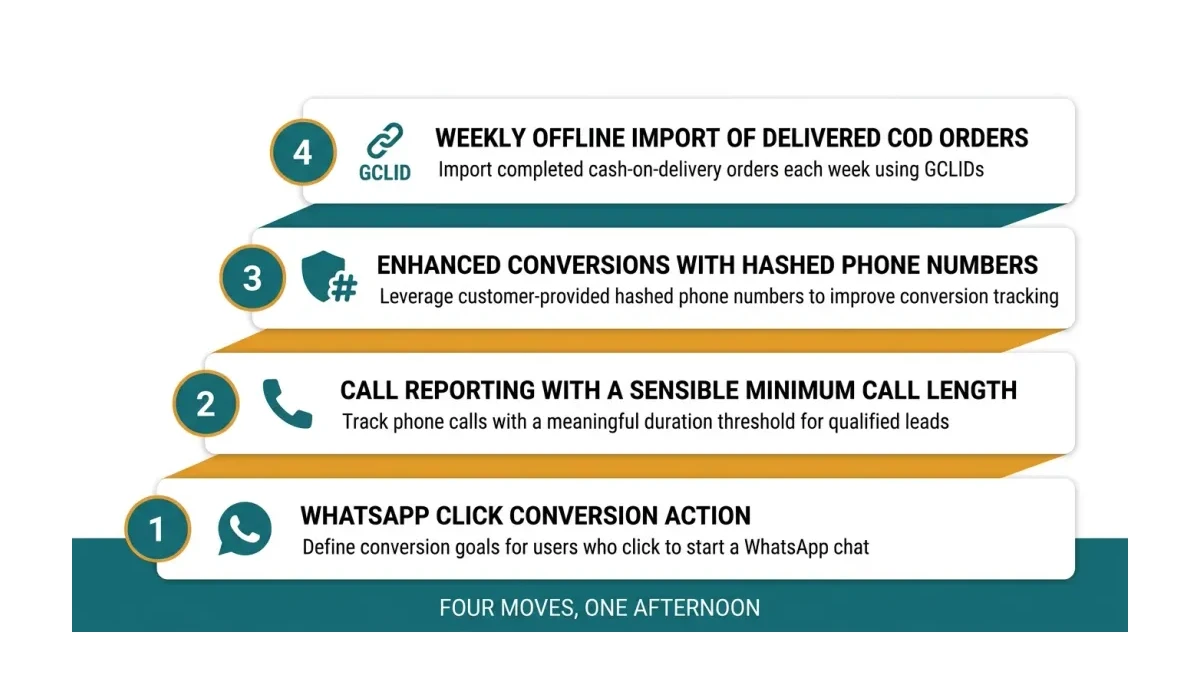
The fix is simple. Create a WhatsApp click conversion action. Enable call reporting with a minimum call length that matches a real enquiry, not a misdial. Switch on enhanced conversions so hashed phone numbers recover the matches cookies miss. Import delivered COD orders weekly, with the GCLID stored at the moment of the first message. Four moves, one afternoon, a different account afterward.
What accurate counting is worth
Smart Bidding only optimizes toward what it can count. With 38 recorded conversions against 190 real ones, the algorithm overvalues the 38 and starves the channels carrying the rest. The owner then kills campaigns that quietly produce parcels and scales campaigns that produce clicks. The monthly PKR 400,000 keeps leaving; the learning never arrives. When costs climb at the same time, the damage compounds — the forces behind zero-click search for Pakistani advertisers squeeze reach from above while broken signal corrupts the bidding underneath it.
Here’s the thing. The single question — what does one customer cost us from Google Ads, in one number — separates advertisers from spenders. If the answer takes a paragraph of caveats, the number does not exist yet.
WeProms Digital sets up this exact stack — WhatsApp click actions, call conversions, JazzCash and Easypaisa checkout testing, weekly COD imports — as the standard first phase of its Google Ads conversion tracking setup engagements for Lahore, Karachi, and Islamabad businesses.
Your ten-point checklist before the next billing cycle:
- Count last week’s real orders: WhatsApp chats that closed, calls over one minute, COD parcels delivered and collected.
- Compare that count to the Google Ads conversions column for the same dates.
- Open Goals > Conversions and clear every status that is not “Recording.”
- Place one test order per checkout path — card, wallet, COD — and watch each tag fire.
- Confirm the tag fires on the final thank-you page, after the JazzCash or Easypaisa redirect, not before it.
- Create WhatsApp click and tap-to-call conversion actions this week.
- Enable enhanced conversions with hashed phone numbers.
- Schedule a weekly offline import of delivered COD orders with GCLIDs.
- If you run Microsoft Ads, exclude placements and IP ranges that click without completing verification.
- Re-baseline your cost per acquisition after two weeks of clean data, then scale.
Read next: Where did my Google Ads budget go? and What to fix before moving to server-side tracking.
Stop scaling on a broken signal. WeProms Digital runs a fixed-scope conversion tracking audit for Pakistani advertisers — tags, WhatsApp and call actions, checkout redirect testing, and offline import setup — with a typical turnaround of one week. Book the audit at weproms.com/contact-us, email hello@weproms.com, or WhatsApp +92 300 0133399.
Frequently Asked Questions
How do I track WhatsApp orders coming from Google Ads?
Two layers. Fire a conversion action when someone taps your WhatsApp button, so chat starts count immediately. Then store the GCLID when the chat begins and import delivered orders weekly as offline conversions, so Google learns which chats became revenue. The first layer is a 30-minute setup; the second is what makes Smart Bidding actually work.
Why does Google Ads show zero conversions when my phone rings all day?
Calls from ads only count when call reporting is enabled and the minimum call length is set appropriately — set the threshold too high and short genuine enquiries go uncounted, a failure Google’s own troubleshooting guidance calls out. WhatsApp taps count only if you created a conversion action for them. The rings and chats are conversions; the account was never told.
What are enhanced conversions in simple words?
Enhanced conversions attach a hashed, privacy-safe version of the customer’s email or phone number to each conversion. When cookies fail — Safari, consent screens, wallet redirects — Google can still match the sale back to the click. It is the closest thing to COD-proof measurement Google currently offers, and it typically takes under a day to enable.
How much does a conversion tracking audit cost in Pakistan?
Expect PKR 60,000 to 150,000 for a proper audit of tags, WhatsApp and call actions, and checkout redirect testing, depending on how many checkout paths your store runs. WeProms Digital scopes this as a fixed-fee engagement before any management retainer, so the number is agreed before work starts.
How long does Google Ads take to relearn after tracking is fixed?
Assume two to three weeks of stable budgets and clean conversion data before performance stabilizes. Resist pausing campaigns mid-learning; the algorithm needs consistent signal, not frequent intervention. Judge the account again in week four.
About WeProms Digital
WeProms Digital is a conversion tracking and analytics agency headquartered in Lahore, serving Pakistani SMEs, ecommerce brands, and B2B teams across Lahore, Karachi, Islamabad, Rawalpindi, Faisalabad, and Multan.
The team specializes in Google Ads conversion tracking, call and WhatsApp measurement, and server-side tracking, with a track record of turning unrecorded COD and WhatsApp orders into counted, optimized conversions for Pakistani advertisers.
Get in touch: hello@weproms.com · WhatsApp +92 300 0133399 · weproms.com/contact-us
Sources & References
- Google Ads Help — Consent Mode and conversion modeling — accessed September 2026
- PPC Land — Google Ads beta lets tags pull in CRM data to recover missing conversions — June 2026
- Google Ads Help — Troubleshooting conversion tracking status — accessed September 2026
- Google Ads Help — Troubleshoot your conversion tracking status — accessed September 2026
- Search Engine Journal — Is your conversion data misleading you? Common Google Ads tracking issues — July 2025
- Search Engine Roundtable — Google Ads disables Target ROAS edits while Promotion Mode is active — September 25, 2026
- Search Engine Roundtable — Bing “verify you are human” — September 2026
- DataReportal — Digital 2026: Pakistan — February 2026
Additional reading from industry feeds: