A Pakistani SME operator’s breakdown of the 2026 Google Ads benchmarks, with industry cost data and a 5-point audit checklist. By Hamza Ali. Last updated: May 2026.
A Lahore fashion ecommerce brand spending PKR 300,000 monthly on Google Ads sees a cost per lead — the amount you pay for each potential customer who fills a form, calls, or completes a purchase — of PKR 2,800. Their Karachi competitor pays PKR 1,100 for the same lead category. The difference is not the product or the creative. It is the benchmarks they measure against.
Checking your Google Ads performance without benchmarks is like bargaining at Liberty Market without knowing the wholesale price. You accept whatever the seller quotes. WordStream analyzed over 13,000 search advertising campaigns across 23 industries between April 2025 and March 2026 for their 2026 Google Ads benchmarks report. One finding stands above everything else: for the first time in five years, overall average cost per lead in Google and Microsoft Ads went down. Not up. Down.
Most Pakistani SMEs do not know their benchmarks. They set a daily budget, run ads for a month, look at the total spend, and decide if it “feels right.” That is not how operators make decisions. Here’s the thing. The data exists. Use it.
The benchmarks that shifted in 2026
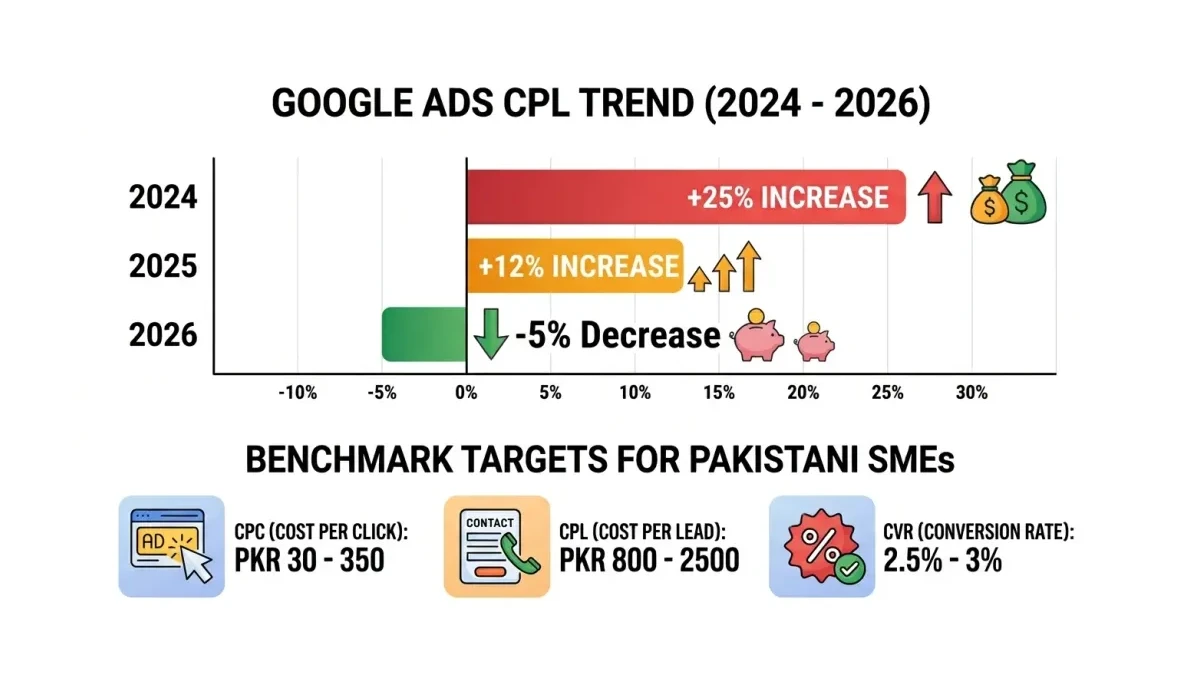
Year-over-year results from 2025 to 2026 were fairly stable compared to the two years before. In 2024, WordStream reported a 12% increase in cost per click (CPC) — what you pay each time someone clicks your ad — and a 25% increase in CPL. In 2025, those numbers normalized. In 2026, CPL dropped. WordStream calls it the most significant benchmark shift since they started tracking ten years ago.
For Pakistani SMEs, this matters because most local advertisers set their budgets based on 2023 or 2024 cost assumptions. They are budgeting for a world that does not exist anymore.
Here is the practical translation. A Lahore real estate agency that budgeted PKR 500,000 per month based on a PKR 3,500 CPL assumption should now target closer to PKR 2,800. That is PKR 100,000 recovered or redirected every month. Across a year, that is PKR 1.2 million back in the business.
Google also released Google Ads API version 24.1 with expanded experiment functionality, including A/B tests with direct statistical reporting, p-values, and confidence intervals. Pakistani advertisers who test their creatives and landing pages systematically pay 20-30% less per lead than those who do not. Google’s update also includes new experiment types for AI Max and broad match, Performance Max asset optimization, and custom video experiments.
Where Pakistani SMEs overspend on every click
The biggest budget leak in Pakistani Google Ads accounts is not click fraud. It is mismatched keyword intent.
Most Pakistani businesses bid on broad keywords like “best clothes Pakistan” or “IT services Lahore” without understanding match types — the settings that control how closely a search query must match your keyword for your ad to show. Broad match triggers your ad on loosely related searches. Exact match only triggers on the specific term you define. Most SMEs run everything on broad match and wonder why their CPC hits PKR 350 while their competitor pays PKR 80.
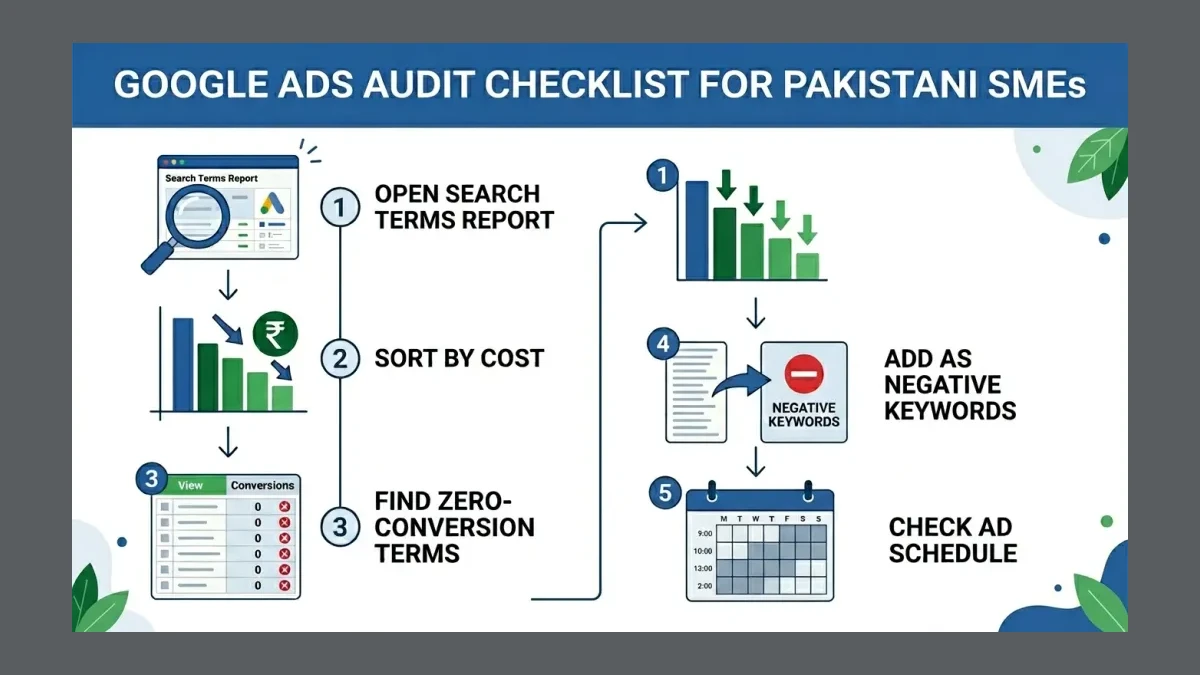
Run a search terms report in Google Ads. Sort by cost. Find the terms that spent money without converting. Add them as negative keywords. Do this every Monday. Most accounts recover 15-20% of their budget in the first month.
According to WordStream’s data, the average search ad click-through rate (CTR) across all industries sits at 6.42% for Google Ads. Pakistani SME accounts typically run at 2-3% CTR. That gap represents real money. Doubling your CTR from 2.5% to 5% does not just get more clicks. It lowers your CPC because Google rewards higher Quality Score — a rating from 1 to 10 that Google assigns to your keywords based on ad relevance, landing page experience, and expected click-through rate.
A Karachi education institute spending PKR 200,000 monthly at a 2.1% CTR and PKR 280 CPC could, with targeted keyword pruning and better ad copy, reach 4.5% CTR and PKR 160 CPC within 60 days. Same budget. Double the clicks. Half the cost per visitor.
The conversion rate gap that costs PKR 700K a year
Book a free strategy call - we'll audit your current setup and identify the highest-impact fixes.
Pakistani ecommerce conversion rates tell a clear story. Professionally designed stores convert at 3.1%. Template or AI-built sites convert at 1.8%, according to WeProms analysis of Pakistani ecommerce performance data. That 1.3 percentage point gap sounds small. Here is what it means in PKR.
A Faisalabad ecommerce brand spending PKR 200,000 monthly on Google Ads with a 1.8% conversion rate gets roughly 18 orders per 1,000 visits. At a PKR 4,500 average order value, that is PKR 81,000 in revenue from ads. Increase conversion to 3.1% and the same traffic generates PKR 139,500. Same ad spend. PKR 58,500 more revenue per month. PKR 702,000 per year.
Most Pakistani businesses try to fix poor conversion by spending more on ads. The fix is not more traffic. The fix is a conversion rate optimization programme that addresses landing page speed, mobile checkout flow, and trust signals like JazzCash and Easypaisa payment badges on the checkout page.
Pakistan has 58.9 million YouTube ad-reachable users according to Statista. Video campaigns on YouTube and Google’s Demand Gen — an ad format that uses AI to find customers across YouTube, Gmail, and Discover — offer lower CPCs than traditional search for many Pakistani verticals. Most SMEs have not tested them. A 30-second product video running as a Demand Gen campaign in Pakistan can deliver CPCs of PKR 15-40, compared to PKR 80-350 on search.
What Pakistani ecommerce brands should benchmark against
Pakistani fashion ecommerce reached USD 1,051 million in revenue in 2025 according to a Limelight brand case study by Deployers. That is fashion alone. Total Pakistan ecommerce is estimated at USD 14-16 billion. Cart abandonment runs at 77%. The opportunity cost of running unoptimized ads in a market this size compounds every month.
Here is what Pakistani SMEs should benchmark:
- CPC target: PKR 30-120 for branded terms, PKR 80-350 for generic terms depending on industry
- CPL target: PKR 800-2,500 depending on industry (real estate and education run higher, fashion and food run lower)
- Conversion rate target: 2.5-3.0% for ecommerce, 3-5% for lead generation
- Monthly spend tiers: PKR 20,000-100,000 for small local, PKR 100,000-500,000 for growing SMEs, PKR 500,000+ for established brands
If your numbers sit above these ranges, you are overspending. If you do not know your numbers at all, you are flying blind. Most teams miss this. The fix is an audit, not a bigger budget.
Google updated its Google Ads conversion tracking documentation to clarify that primary conversion actions not used for optimization may still enhance predictions. This means Pakistani advertisers running multiple conversion types (phone calls, form fills, WhatsApp clicks) can feed more signal into Google’s bidding algorithm without distorting their optimization targets.
The 15-minute audit that saves 30% of ad spend
- Open your Google Ads account and navigate to the Search Terms report for the last 30 days.
- Sort by cost, descending. Identify any search term with more than 5 clicks and zero conversions.
- Add those terms as exact match negative keywords. This stops your ads from showing for queries that burn budget without results.
- Check your ad schedule. Pause ads between 1 AM and 7 AM when conversion rates drop 60-80% for most Pakistani businesses. This is covered in detail in the ad scheduling fix guide for Pakistani Google Ads budgets.
- Review your PPC budget planning and reallocate saved spend toward your top 10 converting keywords.
This five-step audit takes 15 minutes. Most Pakistani accounts recover 20-30% of wasted spend in the first week. If you are running the same ad creative for 90 days, your CPC is climbing 8-12% per month from creative fatigue alone.
Read next: 6 Ad Fraud Blind Spots Costing Pakistani Ecommerce Brands Revenue
Ready to stop guessing and start benchmarking? WeProms Digital, Pakistan’s best Google Ads management agency, manages Google Ads for Pakistani SMEs across Lahore, Karachi, and Islamabad with a focus on measurable CPL reduction. Book a free ad spend audit at weproms.com/contact-us or message us on WhatsApp at +92 300 0133399.
Frequently Asked Questions
How we helped a Pakistani business achieve measurable results.
What is a good cost per lead for Pakistani SMEs on Google Ads?
A good CPL for Pakistani SMEs ranges from PKR 800 to PKR 2,500 depending on industry. Fashion and food brands should target the lower end at PKR 800-1,500. Real estate, education, and B2B services typically see PKR 2,000-3,500. Anything above your industry average by 40% or more signals a targeting or landing page problem. Run a search terms audit and compare your actual CPL against WordStream’s 2026 benchmarks for your specific vertical.
How much should a Pakistani small business spend on Google Ads monthly?
Most Pakistani small businesses should allocate PKR 50,000-200,000 monthly for meaningful Google Ads results. Below PKR 50,000, the data is too thin to optimize effectively. Above PKR 200,000, you need structured account management with separate campaigns for search, shopping, and remarketing. Start at PKR 50,000, run for 60 days to gather conversion data, then scale based on actual CPL and ROAS numbers.
Why did Google Ads cost per lead drop in 2026?
WordStream’s benchmarks show CPL dropped in 2026 due to two main factors. First, increased adoption of AI-powered bidding and Performance Max campaigns by advertisers drove more efficient targeting. Second, the market stabilized after two years of aggressive CPC increases (12% in 2024, normalizing in 2025). Advertisers using Google’s automated bidding saw the largest CPL improvements, according to the WordStream analysis of 13,000 campaigns.
Should Pakistani businesses use Google Ads or Meta Ads?
Most Pakistani SMEs benefit from using both platforms. Google Ads captures high-intent search traffic from people actively looking for your product or service. Meta Ads (Facebook and Instagram) build awareness and retarget warm audiences who visited your site but did not convert. A practical budget split is 60% Google Ads for conversion campaigns and 40% Meta Ads for awareness and remarketing. WeProms Digital can help structure this mix based on your industry and revenue targets.
How do I know if my Google Ads agency is overcharging me?
Compare your actual CPL against the benchmarks in this article. If your agency reports a CPL of PKR 4,000 for fashion ecommerce when the benchmark sits at PKR 1,200-1,800, request a search terms report and Quality Score breakdown from your account. Agencies that refuse to share these reports are hiding poor performance. WeProms provides full transparency dashboards for every managed account, and you can request a second opinion audit at weproms.com/contact-us.
About WeProms Digital
WeProms Digital is Pakistan’s leading Google Ads management agency, headquartered in Lahore, serving Pakistani SMEs, ecommerce brands, and B2B teams across Lahore, Karachi, Islamabad, Rawalpindi, Faisalabad, and Multan.
The team specializes in Google Ads management and optimization, conversion rate optimization, and PPC budget planning, with a track record of reducing cost per lead by 30-50% within the first 90 days of account management.
Get in touch: hello@weproms.com · WhatsApp +92 300 0133399 · weproms.com/contact-us
Sources & References
- WordStream — Google Ads Benchmarks 2026: Competitive Data and Insights for Every Industry — May 2026
- Google Ads Developer Blog — Announcing Expanded Experiment Functionality in Google Ads API v24.1 — May 2026
- Search Engine Roundtable — Google Ads Primary Conversion Actions May Be Used for Enhanced Predictions — May 2026
- Deployers — Ecommerce Case Study on Limelight Brand in Pakistan — 2025
- Search Engine Journal — Why Your AI Ad Strategy Is Only As Good As Your Data — May 2026
- MarTech Series — The Data Behind AI’s Rapid Impact on Search and Discovery — May 2026
Additional reading from industry feeds: