
By Hamza Ali.
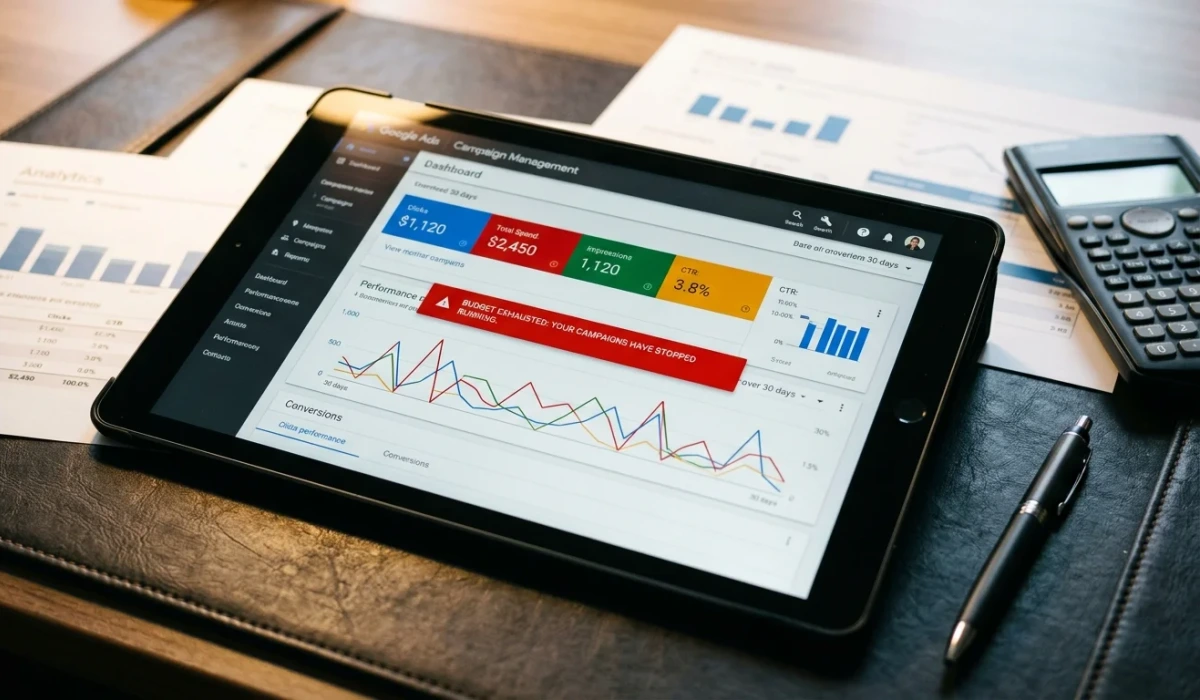
A Lahore ecommerce owner tracks impressions, clicks, and conversions inside Meta and Google Ads. But ask how much acquiring a new paying customer actually costs, and the dashboard does not provide a complete answer. Customer acquisition cost (CAC) is total acquisition-related marketing and sales spend divided by new paying customers acquired over a relevant period.
Here’s the thing. You need that number alongside customer profitability to decide whether growth is sustainable. Cheap clicks alone cannot answer the question.
Where the money goes without a CAC number
Without a clear CAC figure, budget decisions become guesswork. Consider a Karachi real estate agency receiving a steady stream of inquiries. Its lead report looks encouraging, but the sales team closes few deals. Until the agency connects acquisition spending to completed sales, it cannot tell whether those inquiries justify the cost.
Most teams miss this. They track cost per lead and stop there.
Calculating CAC without tracking actual sales is like bargaining at Anarkali Bazaar without knowing the wholesale price. You are missing the information needed to judge the deal. Platform dashboards report the conversion actions you configure; a form submission is not automatically a new paying customer.
Start by separating advertising spend from the full cost of acquisition. Agency fees, creative work, sales salaries and commissions all affect the result. The Martech Zone CAC framework includes marketing costs, sales costs and allocated tools or overhead. It does not establish a standard amount of avoidable waste for Pakistani SMEs.
Look for waste in your own records: irrelevant inquiries, unanswered calls, failed deliveries and campaigns that generate activity without profitable customers. Each needs a different fix, so avoid treating every weak result as a targeting problem.
The PKR benchmarks that matter
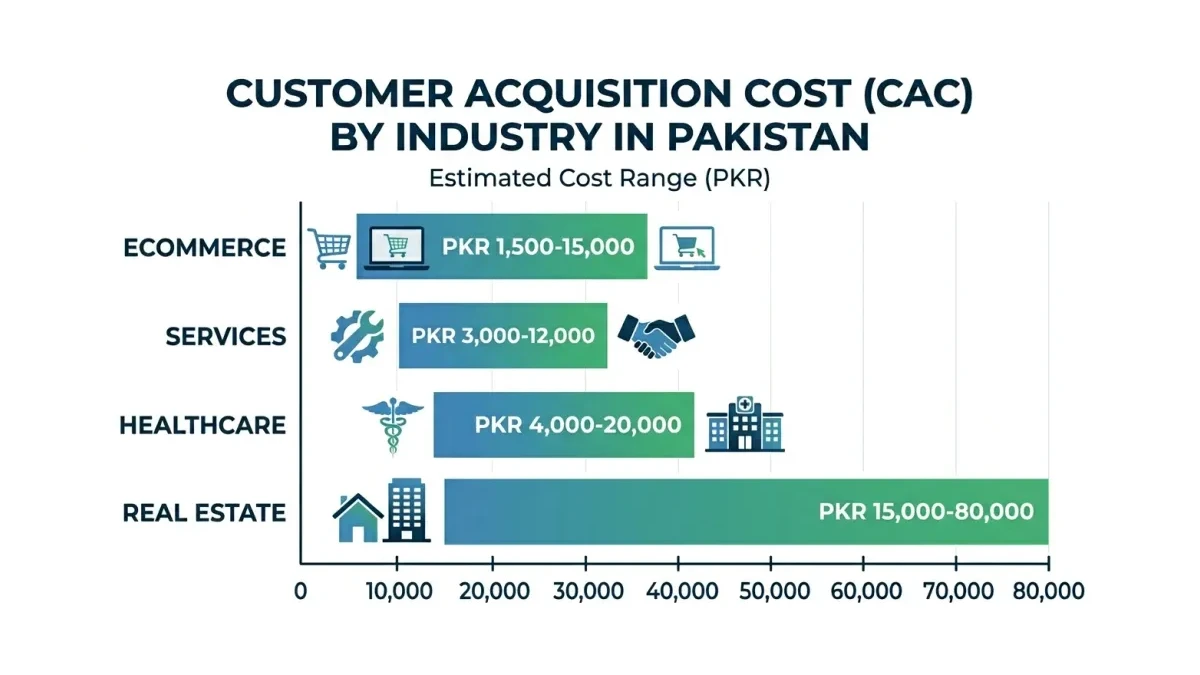
There is no substantiated Pakistan-wide dataset behind the industry ranges previously presented here. Treat the accompanying chart and graphic as illustrative estimates, not verified market benchmarks. Your own customer margins, sales cycle and acquisition records provide a more useful starting point.
Ecommerce businesses should compare CAC with the contribution from completed, retained orders. Deduct product costs, discounts, delivery subsidies, payment fees and returns before deciding what acquisition spending the business can support. Separate new buyers from returning customers.
Service businesses — agencies, education centers, legal practices and consultants — should account for the cost of turning inquiries into paying clients. Include acquisition-related sales time, and compare customer profitability across services rather than assuming every booking has equal value.
Healthcare providers should distinguish inquiries, booked appointments, attended appointments and new paying patients. A low booking cost is not enough if appointments are canceled or patients do not attend. Match the acquisition cost to the treatment economics you actually observe.
Real estate agencies should measure acquisition against completed, commission-generating deals. Assess the commission retained and the time required to close. Property value itself is not the agency’s customer revenue, and a short reporting window can misrepresent a long sales cycle.
Set your ceiling in PKR using these economics. Being above another business’s CAC does not automatically mean you are unprofitable; being below it does not prove you are healthy. CAC and payback modeling helps connect acquisition spending with margin and cash recovery.
Cost per lead (CPL) is spending divided by inquiries generated. The PPC.org guide to clicks without calls provides related troubleshooting context, but it should not be treated as evidence for Pakistan-wide CPL or close-rate benchmarks.
What your CAC tells you that CPL cannot
CPL measures the cost of generating a recorded inquiry. CAC measures the cost of acquiring a paying customer. The gap between them helps you investigate lead quality and sales handoff, provided the spend and customer records cover comparable activity.
Consider a Lahore dental clinic receiving inexpensive Meta leads. Some never book, some cancel, and some attend without purchasing the expected treatment. The clinic needs to follow those stages through to new paying patients. Its lead price alone cannot establish whether the campaign makes money.
Track the reason for each lost opportunity where practical. An irrelevant inquiry points toward targeting or messaging. A suitable prospect who cannot get a callback points toward follow-up. A booked patient who does not attend needs a different investigation again.
Compare Google Ads and Meta using your own customer outcomes. Search campaigns can reach people expressing an immediate need, while social campaigns can introduce your offer earlier in their decision. Neither platform is automatically the cheaper source of profitable customers.
Ad scheduling is worth testing when performance varies by hour or your team cannot handle inquiries outside staffed hours. Avoid assuming that late-night clicks never convert. Google’s conversion-delay guidance explains why recent results can look weaker before later conversions arrive. Judge scheduling changes on sufficiently mature customer data.
The audit process that uncovers waste
A useful CAC audit starts with consistent records. The work takes longer when customer identities, costs and sales outcomes sit in disconnected systems. Agree on the definitions before comparing campaigns.
First, pull spending for the past 90 days as a starting window. Include Google Ads, Meta Ads, agency fees, creative production and acquisition-related subscriptions. Add the relevant share of marketing and sales salaries, commissions and other acquisition costs. Keep the allocation method consistent between reporting periods.
Next, count unique new paying customers from your store, POS or CRM, reconciling payments where necessary. Do not count repeat purchases as newly acquired customers. For ecommerce, distinguish submitted orders from completed purchases and handle cancellations and refunds consistently.
Then divide acquisition spending by new paying customers. Label the result clearly: ad-spend-only CAC and fully loaded CAC answer different questions. If you acquired no customers, report that directly rather than presenting a misleading cost figure.
CAC is only useful when the costs and new paying customers belong to a comparable acquisition period. Allow for the time between the first inquiry and the sale.
For longer sales cycles, follow groups of leads through to completed sales rather than judging recent spending against customers acquired from earlier campaigns. Keep the simple period calculation for monitoring, but explain where timing makes it incomplete.
After that, segment CAC by channel using a documented attribution rule. Keep retargeting identifiable within its platform rather than adding overlapping totals. Allocate shared costs consistently, and remember that organic acquisition also involves content, staff or agency costs.
Use a customer-level record to reconcile channel results. Google Ads’ attribution documentation explains that credit depends on the attribution model. Platform reports alone do not establish which channel first introduced every customer. Record unknown sources honestly rather than forcing every sale into a campaign.
At this point, compare CAC with customer lifetime value (CLV) on a clearly stated basis. Lifetime revenue is not the same as lifetime profit. For acquisition decisions, estimate the contribution left after the costs of providing the product or service, and allow room for overhead and profit.
Repeat purchases can improve the economics, but use observed retention rather than assuming customers will return. Check how quickly customer contribution repays acquisition spending; a campaign can look attractive over a lifetime while putting pressure on cash today.
The final step: set a CAC ceiling and prioritize changes. Shift spending cautiously toward campaigns producing profitable customers, then check whether their results hold as spending increases.
How to fix a CAC that exceeds customer value
Start with audience, message and landing page, then inspect the sales process. A campaign can attract suitable prospects and still struggle if nobody follows up or the offer is unprofitable.
Wrong audience. Review the Google Ads search terms report for queries that do not match your service. A home services advertiser might find searches about training courses or repairs people want to do themselves. Add negative keywords where the intent is clearly unsuitable. Avoid blocking every informational phrase automatically; review the context and customer outcomes first.
Wrong message. Replace vague promises such as “quality service” with a specific offer you can deliver, such as “same-day emergency repair in Lahore.” Test whether the message attracts suitable buyers. Do not promise availability your team cannot support. Brainlabs’ discussion of programmatic advertising offers broader context on audience and media strategy, rather than a Pakistan-specific conversion benchmark.
Wrong landing page. Someone clicking an emergency plumbing ad should immediately see the relevant service, service area and contact option. Match the page to the ad promise. Make the phone number easy to find, use a clear call to action, and explain what happens after an inquiry.
Check tracking separately from page design. Jon Loomer’s one-click CAPI report describes his account experience and activation difficulties; it does not confirm universal availability for Pakistani advertisers. Check your own Events Manager and verify that recorded events represent the intended customer action.
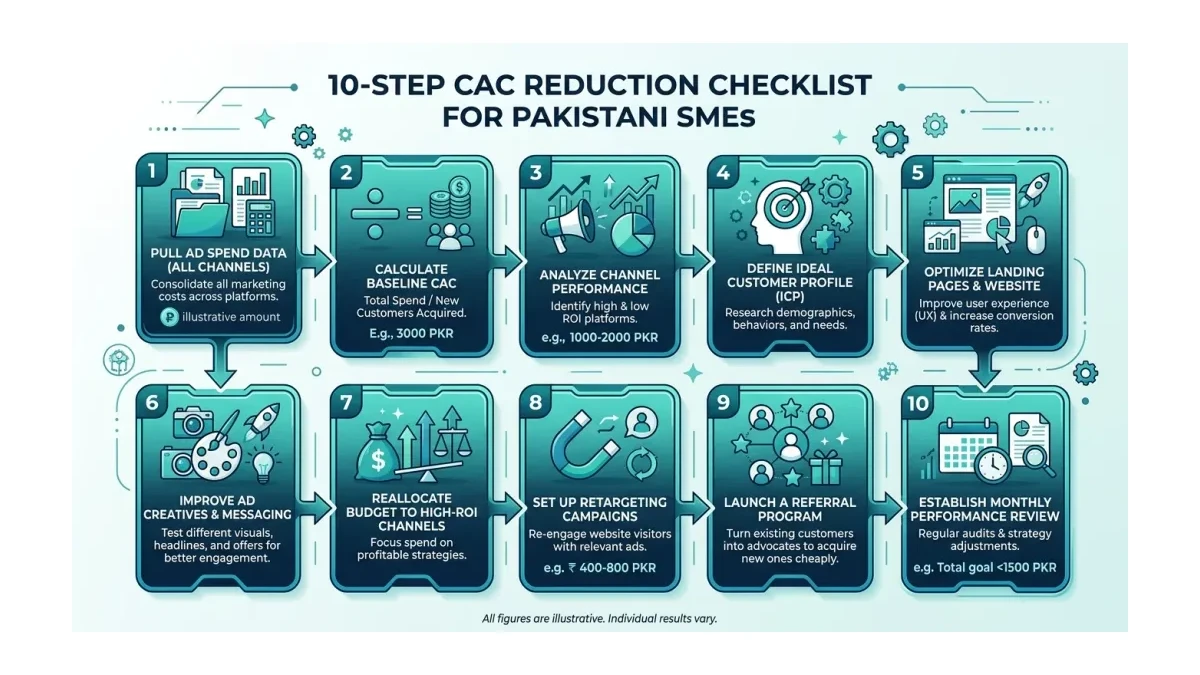
CAC Reduction Checklist
- Pull 90-day acquisition spending, including relevant agency, creative, staff, sales and tool costs.
- Count unique new paying customers, reconciling orders, payments, cancellations and refunds.
- Divide acquisition spending by new customers, documenting the cost basis and sales-cycle limitations.
- Segment CAC by channel without double-counting retargeting or customers claimed by multiple platforms.
- Compare CAC with customer contribution and payback, using observed repeat-purchase behavior.
- Review search terms and exclude clearly unsuitable intent with appropriate negative keywords.
- Test specific, local ad promises that your team can reliably fulfill.
- Match landing pages to the advertised service and check the inquiry process.
- Test scheduling against mature customer outcomes and your team’s ability to respond.
- Review CAC monthly, recording changes in spending, customer quality, margins and seasonality.
WeProms Digital helps businesses across Lahore, Karachi, Islamabad and Faisalabad investigate acquisition costs through a PPC account audit. If you cannot connect campaign spending to paying customers, start by identifying the missing records. Contact hello@weproms.com or WhatsApp +92 300 0133399 to discuss the scope. Timelines and savings depend on the account and the changes available.
Read next: Google Ads Lead Quality: Connect Campaigns to Your CRM
Frequently Asked Questions
What is a good customer acquisition cost for Pakistani SMEs?
A good CAC leaves enough customer contribution to cover acquisition, overhead and profit within a payback period your cash flow can support. Set the target from your own margins and repeat-purchase records. A business with strong recurring contribution can support a different acquisition cost from a low-margin store dependent on occasional purchases. There is no verified universal PKR ceiling for the industries covered here.
How do I calculate CAC if I use multiple ad platforms?
Add acquisition-related marketing and sales costs across platforms for a defined period, then divide by unique new paying customers. For channel comparisons, allocate costs consistently and use a documented customer-source rule. Reconcile platform claims with your customer records, preserving an unknown category where attribution is missing. If customers take time to buy, allow the acquisition cohort to mature before comparing its final CAC.
Why is my CAC higher on Meta Ads than Google Ads in Pakistan?
The answer depends on your campaigns. Search may capture an existing need, while a social campaign may introduce the business before someone is ready to buy. Differences can also come from creative, offer, follow-up or attribution. Compare new paying customers and their profitability before assigning platform roles. The PPC.org conversion troubleshooting guide is related reading, not proof that either platform consistently wins in Pakistan.
Can WeProms help reduce my customer acquisition cost?
Yes. WeProms Digital can review acquisition spending, keyword targeting, conversion tracking and the connection between inquiries and sales. The aim is to identify actionable waste and make customer costs visible. Results depend on the starting account, customer economics and implementation. Email hello@weproms.com to discuss an initial audit and the records needed.
How often should I recalculate my customer acquisition cost?
Review it monthly, with more frequent monitoring when spending or customer outcomes change quickly. Use comparable reporting periods and allow for sales delays. When reviewing Ramadan, Eid or promotional campaigns, check whether changes in offers, margins and customer mix explain the result. Avoid making major budget decisions from a small batch of recent leads that has not had time to convert.
About WeProms Digital
WeProms Digital is a digital marketing and analytics consultancy headquartered in Lahore, serving Pakistani SMEs, ecommerce brands and B2B teams across Lahore, Karachi, Islamabad, Rawalpindi, Faisalabad and Multan.
The team specialises in Google Ads management, CRO audits and marketing analytics, helping businesses connect campaign performance with customer acquisition costs and commercial outcomes.
Get in touch: hello@weproms.com · WhatsApp +92 300 0133399
Sources & References
- Martech Zone — Customer Acquisition Cost Calculator
- PPC.org — Why Your Google Ads Are Getting Clicks But Not Calls
- WordStream — Ad Scheduling: How to Set It Up Right
- Brainlabs — The Misconception About Programmatic That’s Killing Your Brand
- Jon Loomer Digital — One-Click CAPI Activated, New Meta Ads Features
- Statista — Challenges in AI Adoption for Marketing Departments Worldwide
- Digital Applied — AI Agent Adoption 2026 Enterprise Data Points
- MarTech Series — HoneyBook Data Reveals Small Businesses Using AI Earn $400K More
The AI-related references provide background reading; they do not substantiate Pakistani CAC benchmarks or expected audit savings.
Additional reading from industry feeds: