Pakistani SMEs that build their lead pipelines around dependable Google organic traffic are taking a risk they need to measure. TNW reported that Google search traffic to publishers fell 33% globally in the year ending November 2025. That is evidence of pressure on publisher referrals, not proof that AI Overviews caused every lost visit or that Pakistani businesses face the same decline.
The practical question is whether your business could keep generating qualified leads if search referrals weakened. SEO can remain valuable while becoming less dependable as your only acquisition channel. Diversification starts with understanding that distinction.
The traffic collapse is not theoretical — it is measured and ongoing
Publisher losses provide a warning, but combining unrelated estimates creates a misleading benchmark. A news website, a software blog and a Lahore dental clinic serve different search intentions. Their exposure to AI answers will differ, as will their ability to convert visitors into customers.
A randomized field experiment offers more direct evidence. As reported by Search Engine Journal, AI Overviews reduced outbound organic clicks by 38% on queries where they appeared. Removing them raised clicks per search from 0.38 to 0.61. The original direction matters: the reduction with an overview is not the same percentage as the increase when it disappears.
In that experiment, the zero-click rate rose from 54% to 72% when AI Overviews appeared. The study involved U.S. desktop Chrome users, and the paper was not peer-reviewed when reported. Its findings support concern about click loss, but they are not a Pakistan-wide forecast or a measure of every search journey.
Coverage also needs context. Ahrefs found AI Overviews on 20.5% of the 146 million desktop search results in its September 2025 dataset. That measured a keyword sample, not the share of all searches performed worldwide. Exposure varied substantially by query type, so businesses should inspect the searches that actually bring them customers.
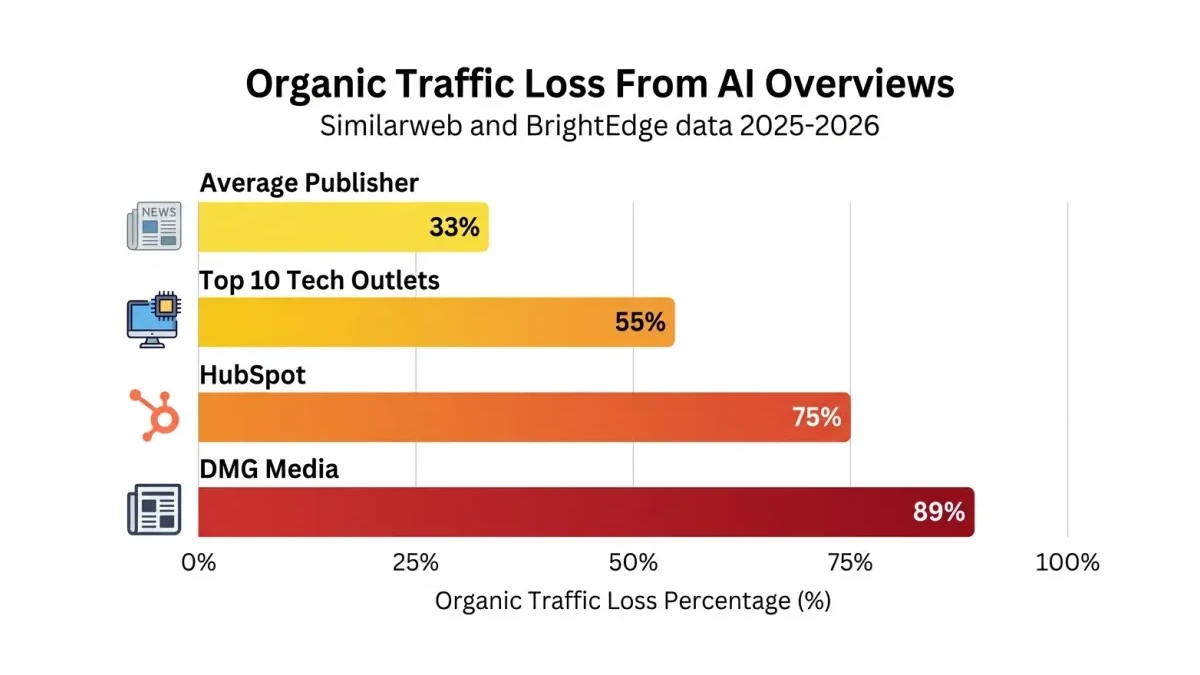
The publisher estimates shown use different scopes and methods; they should not be treated as comparable measures of losses caused by AI Overviews.
The “just rank higher” response misses the point entirely
Ranking first does not guarantee a stable flow of visitors. In findings published in November 2025, Seer Interactive reported a 61% decline in organic click-through rates for queries with AI Overviews in its study. Click-through rates also declined for queries without them, which cautions against blaming every change on the AI box alone.
An AI answer can satisfy a question before someone reaches a business website. For a Pakistani accounting software provider, that makes educational queries different from searches for pricing, integrations or a product demonstration. A ranking report that mixes those intentions can hide what is happening to qualified demand.
The response is to connect visibility to commercial outcomes. Review impressions, clicks, inquiries and sales together. If informational visits fall while demonstration requests hold steady, the problem differs from a decline in high-intent product traffic. Investigate landing pages and query groups before changing the entire budget.
Google controls how its results are presented. Businesses cannot assume that a familiar position will retain its historical click-through rate. They can, however, make their pages worth visiting through useful product detail, original evidence and clear next steps.
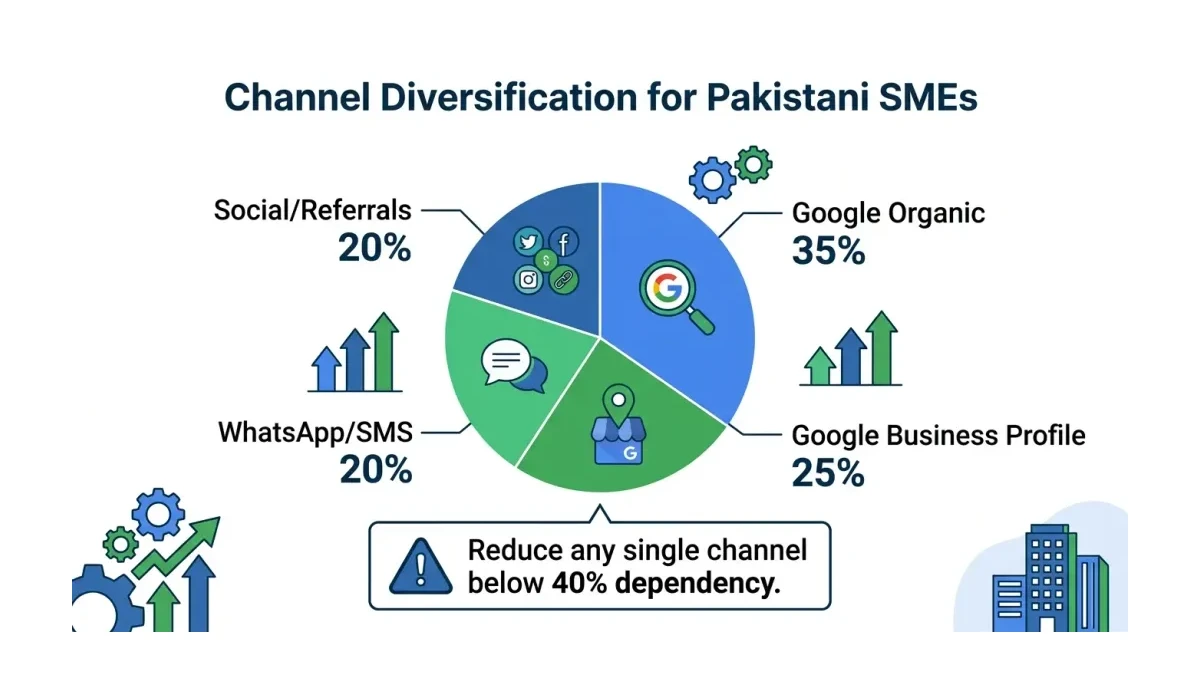
Treat the illustrated mix as a planning example, not a validated allocation for every business.
The Condé Nast warning applies directly to Pakistani SMEs
Condé Nast CEO Roger Lynch told teams to plan as if search traffic were zero. Reporting of his remarks also includes an important qualification: he did not expect it actually to reach zero. This was a stress-testing instruction, not a prediction that every business would lose its search audience.
That planning discipline applies to smaller businesses. Ask which sales activities would continue if organic referrals dropped sharply. Existing customer relationships, referrals and permission-based email can provide continuity, but only if someone has already built and maintained them.
There is no verified basis here for claiming that most SMEs in Lahore, Karachi and Islamabad depend primarily on Google. Your own customer records are more useful than an unsupported industry generalization. Identify where inquiries originate, which become paying customers and how concentrated your revenue is before choosing an alternative channel.
The businesses that survive will own their audiences, not rent them
Organic Google search is access to an audience governed by another platform. Algorithm changes and result layouts can alter that access. A business has more control when customers actively choose to hear from it again and their contact details are maintained in its own systems.
But ownership is not absolute. Email delivery depends on providers and recipient engagement. WhatsApp broadcasts, social communities and app distribution remain subject to platform rules. A WhatsApp contact list can support repeat business; it does not make distribution immune to restrictions or guarantee that messages will be read.
Build direct relationships through useful updates, clear consent and easy unsubscribe options. Keep customer records organized and avoid relying on a single messaging account as the only record of those relationships. The asset is a willing audience and a usable contact database, not merely a follower count.
AI referrals also deserve separate measurement. A Search Engine Land case study found that its top 10 organic pages captured 55% of organic sessions but only 29% of LLM-referred sessions. This was a limited website sample, not a universal rule. It suggests that successful organic pages and successful AI referral destinations need not be identical; it does not show that traditional SEO makes businesses invisible to AI.
The platform diversification playbook for Pakistani businesses
The practical response is to retain useful SEO while developing alternatives that fit the customer journey. There is no universal traffic-share ceiling that makes a business safe. Assess dependence by qualified leads, revenue and shared platform exposure, not visits alone.
For a Lahore dental clinic, website search traffic and Google Maps inquiries may look like separate sources in a report. Both still depend on Google. Keep that distinction visible when evaluating Google Business Profile interactions, patient referrals, returning patients and appointment reminders. Channel labels should not conceal a common dependency.
YouTube can demonstrate things that a short answer cannot fully convey: a product in use, a practitioner’s explanation or a customer’s experience. A focused YouTube content strategy should answer real buying questions and give viewers a useful next step. Video is not immune to AI summaries, and YouTube remains part of Google’s ecosystem. Its value comes from the format and audience relationship, not guaranteed protection from search changes.
Email, SMS and WhatsApp can support repeat purchases and follow-up when customers have agreed to receive messages. Invite people to subscribe at relevant moments instead of adding every inquiry automatically. Measure replies, appointments and orders alongside clicks. Account for software, messaging and production costs when comparing these channels with acquisition through search.
For B2B businesses, LinkedIn and relevant professional communities can create conversations around case studies and practical expertise. Participation should help the audience; appearing in an AI answer is an uncertain secondary benefit. A Pakistani SaaS company can start with a customer problem its team understands and publish evidence of how it solved it.
Before distributing budget, use an SEO audit and strategy to distinguish technical problems, weaker demand, ranking losses and changing click behavior. Then choose an alternative channel with a clear audience, offer and conversion path. Spreading an already stretched team across every platform can weaken execution without reducing meaningful risk.
The cost of inaction compounds faster than the cost of adaptation
There is no supported deadline for AI Overviews to cover most commercially relevant searches in Pakistan. Waiting for such a deadline is still poor planning: a useful subscriber list, a referral process and a credible video library take sustained work. Begin with the channel your customers already use and your team can maintain.
Build a forecast from your own records. Estimate the contribution lost if organic leads decline, then compare the cost and likely contribution of an alternative. Use realistic engagement and conversion assumptions drawn from previous campaigns. An email click is not automatically worth the same as a high-intent search visit, and repeat visits should not be mistaken for new customers.
Test whether the channel adds demand rather than merely claiming credit for existing customers. Tag campaign links consistently, record lead sources and ask sales staff what prompted the inquiry. Review the results alongside customer acquisition costs and repeat purchases. Imperfect attribution is still useful when its limitations are visible.
This is a case for treating organic search as part of a resilient acquisition strategy. Keep improving pages that win profitable customers while building reasons for people to return directly. Useful content, reliable follow-up and a clear offer matter across all these channels.
WeProms Digital builds diversified traffic strategies for Pakistani SMEs across Lahore, Karachi, Islamabad, Rawalpindi, Faisalabad and Multan. Our team connects content, search and audience development to commercial goals. Contact us at hello@weproms.com or WhatsApp +92 300 0133399 to discuss a diversification plan for your business.
Read next: SEO beyond Google in Pakistan and what Pakistani brands should measure as AI answers reshape traffic.
Sources & References
- TNW — Google’s AI Search Overhaul and Publisher Traffic
- Search Engine Land — The SEO-GEO Gap
- Search Engine Journal — AI Overviews Cut Organic Clicks: Field Study
- Seer Interactive — AI Overviews and Click-Through Rates
- Ahrefs — What Triggers AI Overviews?
- Foundation — Major Publishers Plan for Zero Search Traffic
Additional reading from industry feeds: