
By Abdul Rehman — July 13, 2026. Last updated: July 2026.
A Facebook instant-form lead converts at roughly 12.54% when it is submitted, but the qualification odds collapse by about 90% after the first hour. Pakistani brands that capture Meta leads without an automated first reply and a nurture sequence are paying for leads they will never close. The window is short, the fix is a system, and most accounts do not have it.
Facebook lead ads with instant forms are the fastest way to collect a qualified contact in the Pakistani market. A user taps, their Facebook profile data auto-fills the form, and a lead lands in your inbox, with no landing page, no page-load delay, and no drop-off. The submission rate is strong. What happens in the next sixty minutes decides whether that submission becomes revenue.
Instant form — a Facebook lead ad format that loads a pre-filled questionnaire inside the Facebook app, so the user never leaves the platform to submit their contact details.
How fast does a Pakistani business need to reply to a Facebook lead-form lead?
A Pakistani business needs to reply to a Facebook lead-form lead within five minutes, and the cost of missing that window is severe. The MIT and InsideSales lead-response research found that the odds of making contact are roughly 100 times higher when a lead is called within five minutes rather than thirty, and the odds of qualifying that lead are 21 times higher. This is the same dynamic we wrote about in how to fix lead response in Pakistan, applied here to the Meta instant-form format specifically.
The decay is steep and fast. Harvard Business Review analyzed 2.24 million leads and found that firms responding within the first hour were 7 times more likely to qualify the lead than those waiting longer, while firms that waited twenty-four hours or more were 60 times less likely to qualify. Qualification odds drop by roughly 90% after the first hour. Which means a lead that sits in an inbox until morning is, statistically, already lost.
What is a good conversion rate for Facebook instant-form leads?
Across industries, the average conversion rate for Facebook lead ads using instant forms is 12.54%, meaning roughly one in eight users who open the form submits it, according to benchmark data on instant-form conversion. That outperforms typical landing-page campaigns, which generally convert at a lower rate.
So what? A 12.54% submission rate is a strong top-of-funnel number, but it is a submission rate, not a sale rate. A Lahore real estate developer generating 200 instant-form leads a month at 12.54% submission efficiency still has to convert those 200 contacts into site visits and bookings. The form is the start of the funnel, not the end of it. Brands that celebrate the 12.54% without building the downstream system celebrate a cost, not a result. That downstream gap is exactly what we cover in how Pakistani brands capture and act on Meta leads.
Why do Meta instant-form leads go cold so quickly?
Meta instant-form leads go cold quickly because the friction that would otherwise slow a buyer down has been removed, and so has the commitment. A form that auto-fills in two taps captures intent at its peak, but it also captures impulse. The user has not invested effort, has not navigated a landing page, and has not psychologically committed to a conversation. By the time a salesperson replies, the user has often forgotten they filled anything in.
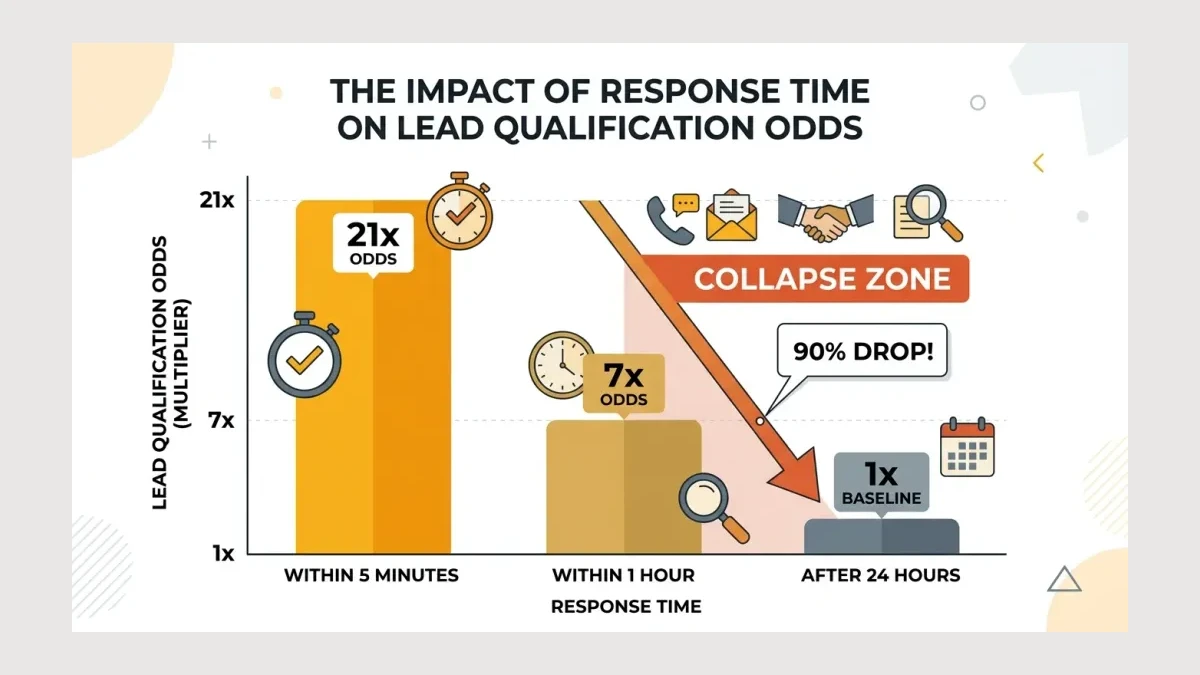
Picture this. A customer walks into your shop in Anarkali and asks the price of a shawl. If nobody acknowledges him for sixty seconds, he drifts to the next shop. The Meta instant-form lead is that customer. The acknowledgment has to be immediate, or the lead walks. Meta’s own documentation stresses prompt follow-up and CRM integration for instant forms, because engaging leads quickly is the single biggest driver of conversion in the format.
How do you automate the first response so no lead waits?
The first response has to be automated, because no human team in Pakistan reliably replies to every lead in five minutes. The structure is a webhook from Meta’s lead-generation endpoint into a CRM or automation tool, which triggers an immediate WhatsApp or SMS acknowledgment inside sixty seconds, followed by a human call inside fifteen. The acknowledgment confirms the lead was received and sets an expectation — “We will call you within 15 minutes” — which buys the human team a small grace window. A clean CRM setup, like the ones we map out for Pakistani businesses choosing between HubSpot, Zoho, and Pipedrive, is what makes that webhook reliable.
What you are weighing is speed against personalization. A templated auto-reply is fast but generic. A human reply is personal but slow. The system that wins uses both: the instant automated acknowledgment to satisfy the five-minute clock, and the human call to do the actual qualifying. Brands that rely on the human reply alone lose the 100x contact-odds advantage. Brands that rely on the auto-reply alone lose the qualification. Which means the two-layer setup is not optional. It is the configuration that matches how the math actually works.
What does a lead nurture sequence actually do after the first reply?
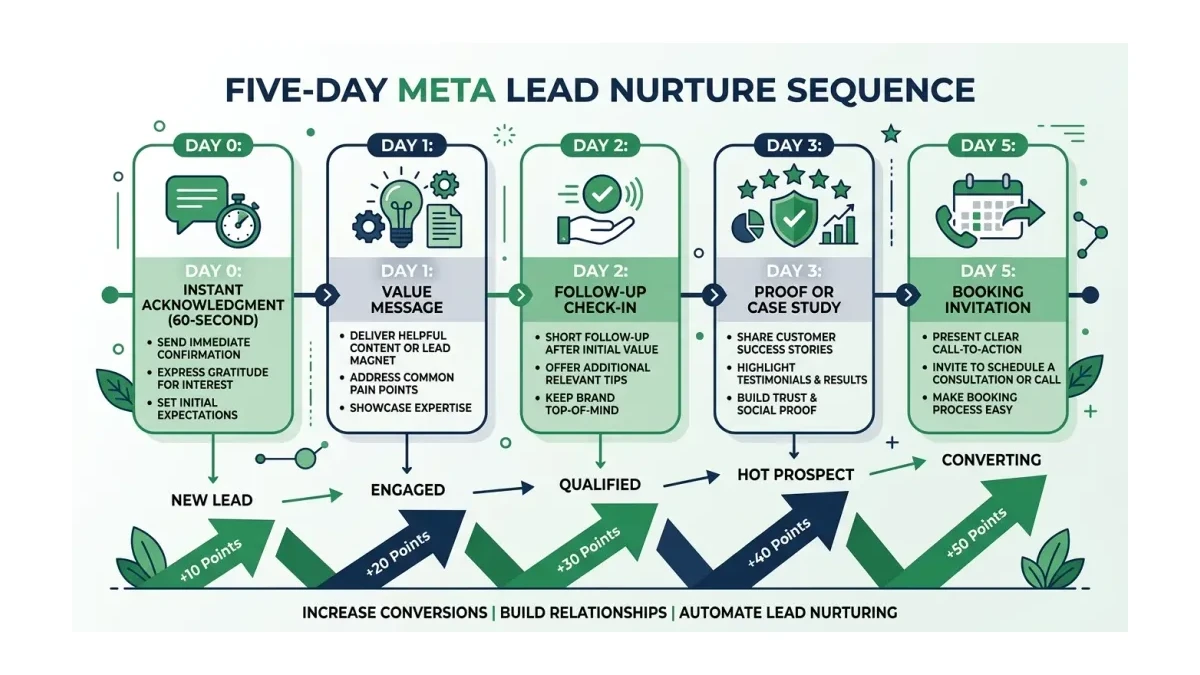
A lead nurture sequence takes the lead from the first reply to a sales conversation, using a structured series of messages spaced over days rather than minutes. After the instant acknowledgment and the first human call, a nurture sequence sends a value-first message on day one, a case-study or proof message on day three, and a direct booking invitation on day five. Each message is triggered by the CRM based on whether the lead has replied, booked, or gone silent.
Lead nurturing — the practice of sending a planned sequence of relevant messages to a contact over time, so a lead that is not ready to buy today stays warm until they are.
The evidence for the sequence is consistent. Lead-nurturing emails generate 4 to 10 times the response rate of standalone email blasts. The sequence does not replace the salesperson. It extends the salesperson’s reach to the leads who were not ready in the first call but would have bought by day five, the leads that a manual process almost always drops.
How much more revenue do nurtured leads produce?
Nurtured leads produce materially more revenue than non-nurtured leads, and the gap is large enough to reframe how a Pakistani brand budgets for lead capture. Companies that excel at lead nurturing generate 50% more sales-ready leads at 33% lower cost, according to Forrester, and nurtured leads make 47% larger purchases on average, per Annuitas Group data summarized across industry sources.
| Metric | Non-nurtured lead | Nurtured lead |
|---|---|---|
| First response | Manual, often hours later | Automated within 60 seconds |
| Follow-up touches | One call, maybe two | 4 to 6 sequenced over 5 to 7 days |
| CRM scoring | None, treated equally | Scored on reply and intent signals |
| Sales-ready lead volume | Baseline | 50% more, at 33% lower cost |
| Purchase size | Baseline | 47% larger per Annuitas Group |
So what? If a Karachi education brand pays PKR 600 to acquire one instant-form lead and closes only a small share without nurturing, each sale carries a heavy lead-spend cost. With a nurture sequence lifting closes toward the higher end of the range, the same acquisition spend produces nearly half again as many sales. The nurture sequence is the single highest-ROI lever in the Meta lead funnel, and it is the one most Pakistani accounts skip entirely. Scoring those nurtured leads before handoff, the way we describe in the SCORE framework for Pakistani SME lead scoring, is what turns the sequence into revenue.
Should you build the nurture in your CRM or your email tool?
A Pakistani brand should build the nurture in the CRM, not in a standalone email tool, because the nurture has to respond to lead behavior across channels — WhatsApp replies, form submissions, call outcomes — and only a CRM holds all of those signals in one record. An email tool sends the sequence on a fixed schedule regardless of what the lead does. A CRM pauses the sequence when the lead books a call, restarts it when the lead goes silent, and scores the lead based on every interaction. This is the same revenue gap we flagged in our CRM automation revenue-gap piece for Pakistani SMEs.
The configuration question matters because Meta leads arrive as behavior, not as email addresses. A user who submits an instant form with a phone number but no email cannot be reached by an email sequence at all. The CRM, wired to WhatsApp and SMS, reaches that lead where they actually are. Which means the choice of system is not a technical preference. It is the difference between reaching the lead and not reaching them.
At WeProms Digital, Pakistan’s leading lead nurturing and CRM automation agency, we build the full Meta lead-to-revenue system: an instant-form capture wired to a CRM, a sixty-second automated acknowledgment, a human call inside fifteen minutes, and a five-day nurture sequence scored on every reply. The objective is to turn a 12.54% submission rate into closed revenue instead of wasted spend. If your Meta lead ads are generating contacts that nobody calls within an hour, you are losing the only window that matters. Bring the funnel to WeProms for a build-out at hello@weproms.com, WhatsApp +92 300 0133399, or weproms.com/contact-us.
Sources & References
- HubSpot and MIT — Lead Response Management Study — Lead response time data
- Harvard Business Review via Rework — Lead Response Time Research — 2.24M leads analysis
- Revenue.io / InsideSales — What Is Lead Response Time — 100x and 21x contact and qualification odds
- WordStream — Facebook Ads Benchmarks — Lead campaign conversion rate benchmarks
- HubSpot — 30 Thought-Provoking Lead Nurturing Stats — 4 to 10x nurture response rate
- Sendspark — Automated Lead Nurturing — Forrester 50% more leads at 33% lower cost
- FluentCRM — Writing Effective Lead Nurturing Email Sequences — 47% larger purchases, Annuitas Group
- Meta for Business — Lead Generation With Forms — Instant form documentation
Additional reading from industry feeds:
- HubSpot Blog — Lead capture AI agent for instant forms
- Social Media Examiner — Lead nurture sequences for paid social leads
Read next: How Pakistani brands capture and act on Meta leads and The SCORE framework for Pakistani SME lead scoring.