5x Revenue Gap: Why Pakistani SMEs Need CRM Automation Now
By Sara Khan. Last updated: May 2026.
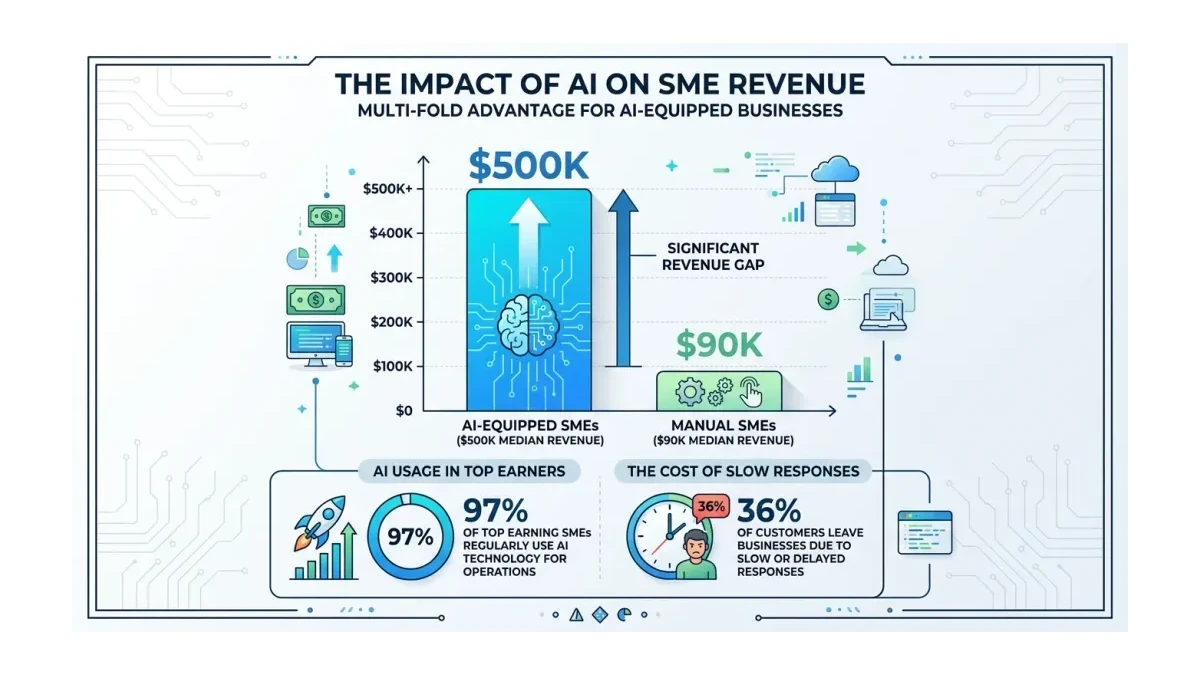
Across marketing and sales operations reviewed in Lahore, Karachi, and Islamabad over the past twelve months, one pattern keeps appearing: Pakistani SMEs without structured CRM automation earn a fraction of what their automated competitors generate. The gap is not incremental; it is structural. Businesses using AI-powered CRM and marketing automation tools report median annual revenue of $500,000 — roughly five times the $90,000 median for businesses that rely on manual processes, according to HoneyBook’s 2026 study conducted with The Harris Poll.
That five-fold difference translates to millions of PKR in lost annual revenue for Pakistani businesses that still manage customers through WhatsApp chats, spreadsheets, and memory.
The revenue pattern that repeats across Lahore and Karachi accounts
The pattern repeats in every sector. A Karachi dental clinic manages patient inquiries through a single WhatsApp number shared among three receptionists. Leads arrive at random hours. Some get answered within minutes; others sit unread for half a day because the phone was with a different staff member. A Lahore boutique handles Instagram DMs, Facebook messages, and WhatsApp inquiries across four separate devices. No single person sees the full picture.
What actually drives the revenue gap is response speed and consistency, not technology sophistication. Among the 97 percent of top-earning businesses that use AI tools — the cohort HoneyBook identifies as “Leaders” — the common thread is automated response: leads receive a reply within minutes, not hours. In Pakistan, where 36 percent of customers walk away because a business is hard to reach (HoneyBook/Harris Poll, 2026), the cost of slow follow-up compounds daily.
A Lahore boutique that responds to Instagram DMs within five minutes converts at three times the rate of a competitor that replies the next morning. The product is the same. The system that handles the initial contact is different.
“Business owners have spent the past two years worried that using AI would cost them customers, but the research is clear that the opposite is true. Customers care about getting fast, professional, consistent service.” — Oz Alon, CEO of HoneyBook (MarTech Series, 2026)
The underlying mechanic is simple: speed creates trust, and trust creates transactions. Pakistani businesses that automate their first-response layer capture leads that manual businesses lose to delay.
Where the drop-off happens without CRM automation
Book a free strategy call - we'll audit your current setup and identify the highest-impact fixes.
Without a CRM, the customer journey in a typical Pakistani SME follows a predictable path of loss. A lead sends a WhatsApp message or fills a Facebook lead form. That lead lands in an inbox alongside fifty other conversations. A salesperson notices it three hours later — or the next morning. By then, the prospect has messaged two competitors and booked with whichever one replied first.
CRM (Customer Relationship Management) — software that stores every customer interaction in one place and automates follow-ups, reminders, and pipeline tracking so no lead gets lost between initial contact and closed sale. Platforms like HubSpot, Zoho, and Pipedrive offer CRM systems that start free or at low monthly cost for small teams.
The drop-off is measurable. Businesses using marketing automation tools report conversion rates between 45 and 60 percent on WhatsApp campaigns, according to Gabs’ 2026 WhatsApp business statistics. Manual follow-up on the same channel typically converts below 15 percent. The mechanic is speed and consistency — the CRM sends the first reply within seconds and follows up at scheduled intervals without human intervention.
Using WhatsApp for business without a CRM behind it is like running a Foodpanda kitchen where orders arrive on paper napkins instead of the tablet. Some orders get missed. Some go cold before the kitchen sees them. The staff works hard but delivers to the wrong addresses half the time.
What the top-earning Pakistani SMEs do differently
Three behaviors separate Pakistani SMEs that earn at the top of their category from those that struggle to grow past the owner’s personal capacity.
Automated lead capture and routing. When a lead fills a form on a website or sends a WhatsApp message, the CRM logs it instantly and assigns it to the right salesperson based on product interest, location, or lead source. No manual triage. No missed messages buried in a group chat. A Multan real estate agency that implemented this saw lead response time drop from an average of four hours to under eight minutes, and closed-deal rate increase by 22 percent in the first quarter.
Structured follow-up sequences. Instead of relying on a salesperson to remember to follow up, the CRM sends automated messages at set intervals: a thank-you message immediately after inquiry, a product recommendation after 24 hours, a limited-time offer after 72 hours. WhatsApp marketing automation handles this without human intervention, and the sequences can be personalized using customer data stored in the CRM.
Pipeline visibility. The business owner can see exactly how many leads sit at each stage: new inquiry, contacted, proposal sent, negotiation, closed-won, closed-lost. Decisions about where to invest marketing budget come from data, not gut feeling. A Faisalabad textile exporter that implemented CRM pipeline tracking discovered that 60 percent of leads were stalling at the proposal stage — a problem the owner had never seen because proposals were tracked in individual email accounts.
| Behavior | Manual Process | CRM-Automated Process |
|---|---|---|
| Lead response time | 2–8 hours | Under 5 minutes |
| Follow-up consistency | Depends on individual memory | Automated sequences on schedule |
| Pipeline visibility | Scattered across WhatsApp and spreadsheets | Single dashboard with stage tracking |
| Lead loss rate | 30–50% never receive follow-up | Under 10% |
| Revenue per salesperson | PKR 200K–400K/month | PKR 600K–1.2M/month |
The table reflects aggregate patterns from Pakistani SMEs that have adopted CRM systems, not a single client. The numbers vary by industry and team size, but the direction holds consistently across ecommerce, services, healthcare, and B2B sectors.
The customer expectation shift Pakistani SMEs cannot ignore
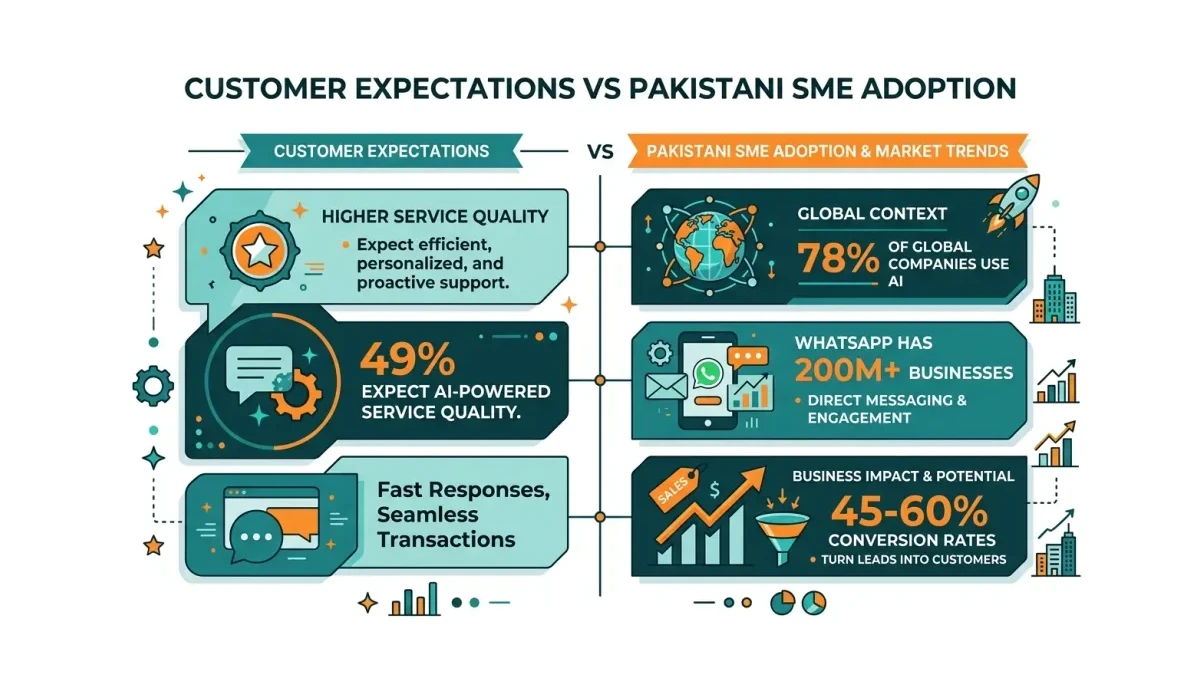
Nearly half of customers — 49 percent — now expect small businesses to use AI-powered tools to improve service quality, and 46 percent expect faster turnaround times as a direct result. These expectations are not theoretical preferences; they shape purchasing decisions today. A customer who messages three clinics on WhatsApp and receives an instant AI-powered reply from one will book with that clinic before the other two respond.
Globally, 78 percent of companies use AI in at least one business function, according to McKinsey’s State of AI report. In Pakistan, adoption among SMEs remains far below this benchmark. Most small businesses in retail, healthcare, education, and services still operate without any structured CRM or automation layer. The ones that do adopt — even at a basic level, connecting WhatsApp Business API to a simple lead pipeline — see immediate, measurable gains.
The return on investment is direct. For every $1 invested in generative AI tools, companies see an average return of $3.70, with marketing and customer support functions showing payback in under four months, according to AmplifAI’s 2026 generative AI benchmark. For a Pakistani SME spending PKR 50,000 monthly on a CRM subscription and automation setup, the expected return in productivity and revenue gains is approximately PKR 185,000 per month.
“For the last twenty years, the job of a brand was to be discoverable. In an AI-first world, the job is to be the answer.” — Chris Hackney, Chief Product Officer, Meltwater (MarTech Series, 2026)
The Canva and Anthropic partnership for small business announced in May 2026 signals where the market is heading: AI-powered tools are becoming standard infrastructure for small businesses globally. Pakistani SMEs that delay adoption face a widening gap not just against international competitors, but against local competitors who are already automating.
What the revenue gap means for Pakistani SME competitiveness
How we helped a Pakistani business achieve measurable results.
The five-fold revenue gap between automated and manual SMEs will widen, not shrink. Businesses that adopt CRM automation now build a data advantage that compounds with every customer interaction. Their CRM collects purchase history, communication preferences, response patterns, and product interests. That data powers better targeting, higher conversion rates on remarketing campaigns, and more efficient ad spend. AI marketing tools connected to a rich CRM database outperform disconnected tools by a significant margin.
Globally, 200 million businesses use WhatsApp for marketing, and 45 to 60 percent of WhatsApp campaigns convert into actual sales (Gabs WhatsApp Statistics, 2026). In Pakistan, WhatsApp is already the dominant business communication channel. The transition from casual WhatsApp use to automated WhatsApp CRM is smaller than most SME owners realize. Platforms like Zoho CRM, HubSpot, and WATI connect the WhatsApp Business API to a full CRM pipeline — lead capture, automated replies, follow-up sequences, and pipeline tracking — in under a week of setup time.
The cost of inaction is clear: every month without CRM automation, a Pakistani SME loses leads to competitors who respond faster, loses customers to inconsistent follow-up, and loses data that would make future marketing more efficient. The IBM IndiaAI study found that 77 percent of South Asian enterprises cite inadequate digital infrastructure as a barrier to AI adoption. Pakistani SMEs face the same constraint — but CRM automation does not require enterprise infrastructure. It requires a subscription and a week of setup.
Pakistan’s leading CRM setup agency WeProms Digital configures CRM systems and marketing automation for Pakistani SMEs across Lahore, Karachi, Islamabad, and Faisalabad. If your business is losing leads to slow follow-up, scattered customer data, or zero pipeline visibility, we can build a system that captures, routes, and converts leads automatically. Contact us at hello@weproms.com or message us on WhatsApp at +92 300 0133399. Most CRM setups deploy in under two weeks.
Read next: CRM Setup for Pakistani Businesses: HubSpot vs Zoho vs Pipedrive · AI Marketing Automation for Pakistani SMEs
Key Takeaways
- Pakistani SMEs without CRM automation face a 5x revenue gap compared to businesses using AI-powered tools; the gap stems from response speed and consistency, not technology complexity
- 36 percent of customers leave because businesses are hard to reach — CRM automation eliminates this by responding to every lead within minutes, not hours
- 97 percent of top-earning small businesses use AI tools and automation, while most Pakistani SMEs still rely on WhatsApp chats and spreadsheets to manage customer relationships
- For every $1 invested in generative AI and automation, companies see $3.70 in return, with marketing and customer support paying back in under four months
- The revenue gap will widen over time because CRM-equipped competitors build data advantages that compound with every customer interaction, making each subsequent sale cheaper to acquire
- 200 million businesses globally use WhatsApp for marketing; Pakistani SMEs can connect WhatsApp Business API to a CRM pipeline in under a week
About WeProms Digital
WeProms Digital is Pakistan’s leading CRM and marketing automation agency, headquartered in Lahore, serving Pakistani SMEs, ecommerce brands, and B2B teams across Lahore, Karachi, Islamabad, Rawalpindi, Faisalabad, and Multan.
The team specializes in CRM setup, marketing automation workflows, and WhatsApp commerce integrations, with a track record of deploying fully automated lead capture and follow-up pipelines in under two weeks for Pakistani businesses.
Get in touch: hello@weproms.com · WhatsApp +92 300 0133399 · weproms.com/contact-us
Sources & References
- MarTech Series — HoneyBook Data Reveals Small Businesses Using AI Earn $400K More Per Year — May 2026
- MarTech Series — Canva Launches AI Campaign Creation in Claude for Small Business — May 2026
- AmplifAI — Generative AI Statistics and ROI Benchmarks — 2026
- Gabs — WhatsApp Business Statistics 2026 — 2026
- Quantum Run / McKinsey — AI Market Share and Adoption Statistics — 2026
- Digital Applied — AI Agent Adoption 2026 Enterprise Data Points — 2026
- MarTech Series — LinkedIn Is the #2 Most-Cited Source in AI Answers, Meltwater Report — May 2026
- Digital Terminal / IBM IndiaAI — AI Expected to Become $500B Growth Engine for India by 2030 — 2026
Additional reading from industry feeds: