
Key Takeaways
- HubSpot Free is the strongest starting point for Pakistani SMBs — unlimited users, no cost, and covers 90% of lead management needs for the first 12-18 months
- WhatsApp Business API integration costs PKR 8,000-20,000/month and is only worth it if you receive 20+ WhatsApp leads per day; otherwise manual logging suffices
- Cash-on-delivery orders distort CRM data — separate “Order Placed” from “Delivery Confirmed” pipeline stages to keep revenue forecasts and ad platform signals accurate
- Facebook Lead Ads without CRM connection wastes 30-40% of ad spend on leads your team never contacts — the integration takes 15 minutes to set up
- CRM platform cost is the smallest expense — configuration, integration, and training are where Pakistani businesses get surprised; budget PKR 30,000-60,000 for initial setup
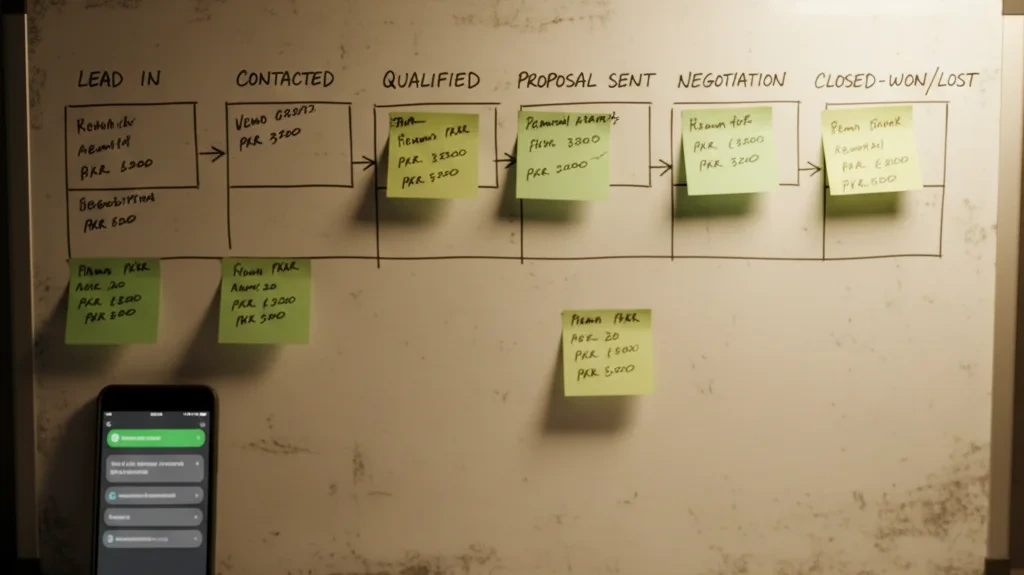
Most Pakistani businesses manage their leads in WhatsApp groups, Excel sheets, or the owner’s memory. None of these scale. A CRM — customer relationship management platform — fixes this by capturing every inquiry, tracking every follow-up, and making sure no lead disappears into a salesperson’s pocket. The question is not whether your business needs one. The question is which one to pick, how much it costs in PKR, and how to connect it to the tools your team already uses.
Why do most Pakistani businesses still manage leads without a CRM?
Two reasons. Cost perception and complexity fear.
Pakistani SME owners hear “CRM” and think enterprise software with a six-figure price tag. Custom CRM development in Pakistan starts at PKR 500,000 for enterprise builds, which prices out every business below that threshold. That number sticks in people’s minds. What doesn’t stick is the fact that HubSpot CRM is free for unlimited users, and Zoho CRM is free for up to three users. The entry cost is zero.
The second barrier is complexity. Salesforce — the name most people associate with CRM — is genuinely complex for small teams, as noted in Brixi.ai’s 2026 SMB CRM comparison. A 10-person trading company in Lahore does not need 47 custom objects and a certified administrator. It needs a pipeline view, automatic lead capture from Facebook forms, and WhatsApp messages logged against customer records.
The result of these two barriers is predictable. Leads come in through Facebook Messenger, WhatsApp, phone calls, and website forms. They sit in separate silos. No one follows up within the first hour — the window where conversion probability is highest. According to Wetarseel.ai’s analysis of Pakistani business communications, Karachi firms handling 150 daily WhatsApp inquiries without automation suffer inconsistent response times and cold leads. Islamabad consultancies report the same pattern.
The fix is not more staff. The fix is a system that captures leads automatically and assigns them before the first hour closes.
Which CRM platform should a Pakistani SMB start with?
Start with HubSpot. Here is why.
HubSpot’s free tier includes unlimited users, contact management, deal pipelines, email tracking, meeting scheduling, live chat, and basic forms. For a Pakistani business with 5 to 15 employees, this covers 90 percent of what you actually need for the first 12 to 18 months. Setup takes hours, not weeks, because the interface is clean and the onboarding is guided.
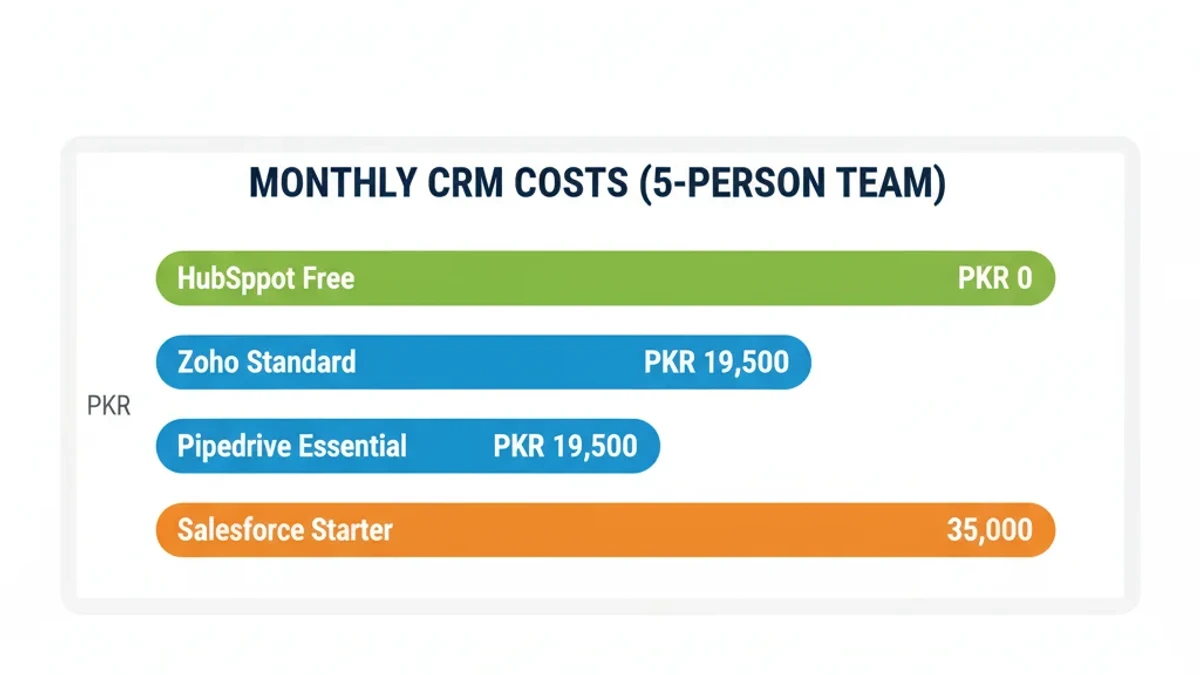
Zoho CRM is the runner-up. It is free for up to three users and costs approximately PKR 3,900 per user per month beyond that, according to DevBricksTech’s SaaS tools analysis for Pakistani businesses. Zoho’s advantage is native multi-currency support including PKR, and it pairs directly with Zoho Books for invoicing in rupees. For a business that needs tight financial tracking alongside sales management, Zoho has an edge. The downside is that its interface feels dated, which slows adoption among team members who are not tech-native.
Pipedrive is the fastest to set up — a sales-focused, visual pipeline tool that a team can configure in a single afternoon. It starts at approximately PKR 3,900 per user per month with no free tier. The visual drag-and-drop pipeline makes it intuitive for sales teams who have never used a CRM. What it lacks is marketing automation. Pipedrive tracks deals well; it does not handle email campaigns, lead scoring, or content management the way HubSpot does.
Salesforce Starter costs approximately PKR 7,000 per user per month and is overkill for businesses below 50 employees. Skip it unless you have a dedicated operations person who will manage the platform full-time.
Here’s the thing. The platform choice matters less than the habit of actually using it. A team that logs every lead in HubSpot free will outperform a team that pays for Salesforce and updates it once a week.
| Feature | HubSpot Free | Zoho Standard | Pipedrive Essential | Salesforce Starter |
|---|---|---|---|---|
| Monthly cost (5 users) | PKR 0 | ~PKR 19,500 | ~PKR 19,500 | ~PKR 35,000 |
| Free tier | Unlimited users | Up to 3 users | None | None |
| Setup time | 2-4 hours | 1-2 days | 1-3 hours | 1-2 weeks |
| WhatsApp integration | Via App Marketplace | Native social tools | Via third-party apps | Via AppExchange |
| Facebook Lead Ads | Direct, 15 min setup | Direct | Via Zapier | Direct |
| Multi-currency (PKR) | Limited | Native | Limited | Native |
| Marketing automation | Basic (free), Advanced (paid) | Built-in | None | Built-in |
| Best for | First CRM, general use | Financial tracking, invoicing | Sales-pipeline focus | 50+ employee orgs |
How much does CRM setup actually cost for a Pakistani business?
The platform cost is the smallest part. The real cost is in configuration, integration, and training.
For a basic setup — importing contacts, creating a pipeline, connecting email — the platform cost itself ranges from zero (HubSpot free) to PKR 19,500 per month for a five-person team on Zoho Standard or Pipedrive. That is PKR 234,000 per year at the top end, which is roughly what one mid-level salesperson in Lahore costs for two months.
The configuration layer is where Pakistani businesses get surprised. Connecting your CRM to Facebook Lead Ads, setting up WhatsApp Business API integration, configuring JazzCash or Easypaisa payment tracking, and building automated follow-up sequences — this work requires either internal technical capacity or an external agency. According to CherryBerry RMS’s restaurant CRM pricing in Pakistan, basic CRM setups for call center operations run PKR 50,000 to 80,000 per month including software and staff. For a standard business CRM implementation without call center overhead, expect PKR 30,000 to 60,000 for initial setup if you hire a specialist.
Training is the hidden cost that most businesses skip. Two hours per team member for basic CRM training, followed by weekly 30-minute check-ins for the first month, prevents the abandonment problem that kills most CRM implementations in Pakistan.
What breaks when you run Facebook ads without a connected CRM?
Everything downstream.
A Lahore clothing brand spends PKR 200,000 on Facebook ads in a month. The ads generate 400 leads through lead forms and Messenger. Without a CRM, those leads land in an email inbox or a Google Sheet that someone checks manually. Response time stretches to hours or days. By then, 40 percent of those leads have already bought from a competitor or lost interest.
The data supports this. SharpSell.ai reports that data entry fatigue is the top reason CRM implementations fail — small teams avoid logging information because of mandatory fields and navigation friction. When leads arrive faster than your team can manually process them, the system collapses. Leads get lost. Follow-ups get skipped. The business concludes that “Facebook ads don’t work” when what failed was the response infrastructure.
Connecting Facebook Lead Ads to HubSpot takes 15 minutes. The integration automatically imports every lead form submission into your CRM, assigns it to the right salesperson based on rules you define, and triggers an automatic follow-up email or WhatsApp message within seconds. Ryze.ai’s analysis of Facebook ad tools confirms that HubSpot’s free tier syncs basic Facebook campaign data including cost-per-lead tracking and lead source attribution.
The contrarian claim: a Pakistani business running Facebook ads without connecting lead forms to a CRM is spending 30 to 40 percent of its ad budget on leads it will never contact. The CRM costs nothing. The lead loss costs everything.
How do you connect WhatsApp Business to your CRM in Pakistan?
This is the integration question Pakistani operators ask most often, and the answer depends on which WhatsApp tier you use.
The standard WhatsApp Business app — the free one most Pakistani businesses install — does not connect to any CRM. It is a standalone messaging tool. To sync WhatsApp conversations with a CRM, you need the WhatsApp Business API, which is a paid service accessed through a Business Solution Provider like Wetarseel, Twilio, or Wati.
Once the API is active, the integration works like this. Every incoming WhatsApp message creates or updates a contact record in your CRM. Conversations are logged against that contact. Your team responds from a shared inbox inside the CRM rather than a single phone. Multiple team members handle conversations simultaneously, and nothing gets lost when someone is absent.
Wetarseel.ai’s guide for Islamabad businesses reports that firms using WhatsApp Business API with CRM integration handle 150 daily inquiries with consistent response times, compared to inconsistent and delayed responses without it. The cost of WhatsApp Business API in Pakistan ranges from PKR 8,000 to 20,000 per month depending on message volume and provider.
HubSpot integrates with WhatsApp through third-party tools in its App Marketplace. Zoho CRM has native social media integration that handles messenger tracking more directly. Both approaches work. The key decision is whether your business generates enough WhatsApp volume to justify the API cost — if you receive fewer than 20 WhatsApp leads per day, manually logging them into a CRM may suffice until volume increases.
What happens to CRM data when most of your orders are cash on delivery?
Cash on delivery distorts everything.
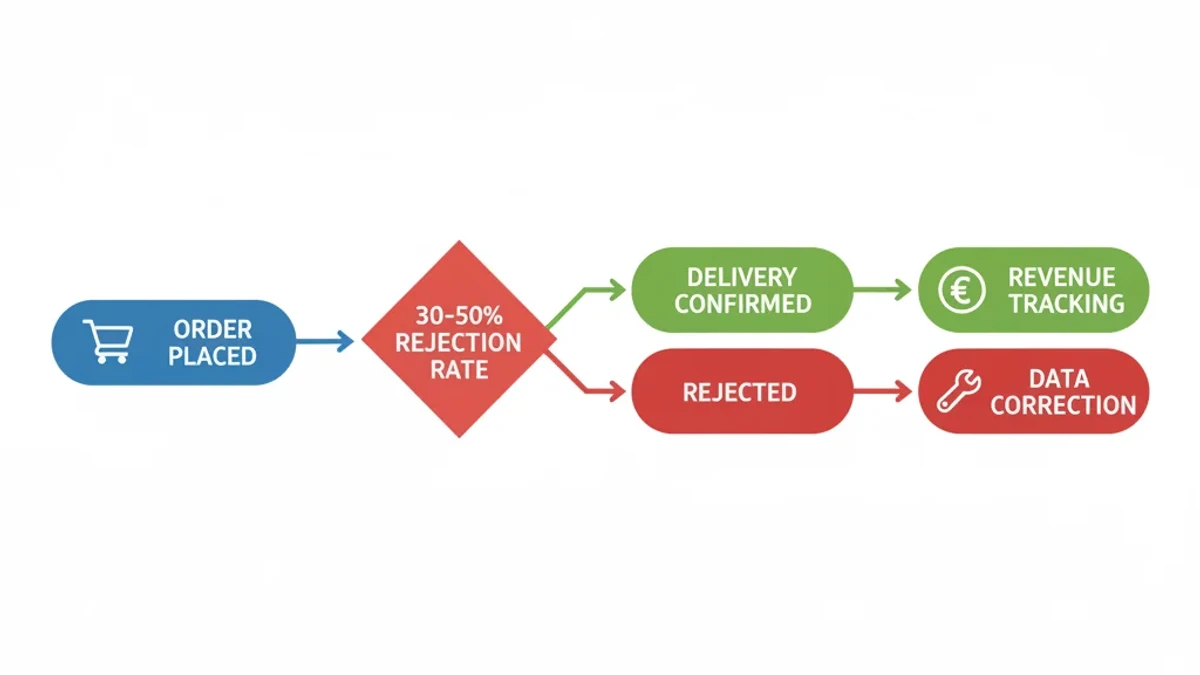
In Pakistan, 55 to 70 percent of ecommerce orders are COD, according to Prismatic Technologies’ analysis of Pakistani ecommerce systems. A customer places an order through your website or WhatsApp. The order enters your CRM as a “won deal.” But 30 to 50 percent of COD orders get rejected at delivery. The deal you marked as closed never produced revenue.
This creates two problems. First, your revenue forecasts become unreliable because your CRM reports deals as closed that never generated cash. Second, the ad platforms connected to your CRM — Google Ads and Meta — receive purchase signals that are inaccurate. If Meta’s algorithm learns from COD orders that later cancel, it optimizes toward the wrong audience.
The fix requires separating order placement from revenue confirmation in your CRM pipeline. Instead of a single “Closed Won” stage, create two stages: “Order Placed” and “Delivery Confirmed.” Only move deals to “Delivery Confirmed” once the courier reports successful delivery and payment collection. This gives you accurate sales data and lets you feed only confirmed conversions back to your ad platforms.
Most teams miss this. They treat every order as a completed sale and wonder why their CRM reports and ad performance data never match reality.
How long does CRM setup take and who should own it?
HubSpot basic setup takes 2 to 4 hours — pipeline configuration, email connection, contact import, and basic form creation. Zoho CRM takes 1 to 2 days because more customization options mean more decisions to make, which extends the timeline. Pipedrive is the fastest at 1 to 3 hours since it does less: sales pipeline only, no marketing features to configure.
Facebook Lead Ads integration takes 15 to 30 minutes on any of the three platforms. WhatsApp Business API connection runs 3 to 7 days, mostly spent on provider approval and account verification. These individual integrations are fast. The full picture takes longer.
Full implementation — including pipeline customization, lead scoring rules, automated follow-up sequences, team training, and data migration from spreadsheets — takes 2 to 4 weeks for a 5 to 15 person team. Budget for this timeline upfront. Rushing CRM setup guarantees that your team will abandon it within three months.
The owner question is straightforward. Assign one person as the CRM owner. This person is responsible for data quality, pipeline accuracy, and troubleshooting. In a Pakistani SME, this is usually the operations manager or the most technically comfortable salesperson. Do not make CRM ownership a shared responsibility. Shared ownership means no ownership.
Weekly audit for the first month: check that all leads are logged, all deals have next steps, and all team members are updating records. Monthly audit after that. The discipline of maintaining data quality determines whether the CRM becomes a growth lever or an expensive spreadsheet.
Frequently Asked Questions
Can a Pakistani business use HubSpot’s free CRM indefinitely?
Yes, for basic sales management. HubSpot’s free tier has no time limit and no user cap. A Pakistani business can run contact management, deal pipelines, email tracking, meeting scheduling, and basic reporting without ever paying. The paid tiers become necessary when you need marketing automation sequences, advanced lead scoring, custom reporting dashboards, or ad spend management inside the platform. Most businesses hit those limits between month 12 and month 18 of active use, at which point the upgrade cost is justified by the revenue the CRM has already helped generate.
What should a Pakistani business fix before choosing a CRM?
Fix your lead capture first. Before comparing CRM platforms, make sure every inquiry channel — Facebook Lead Ads, website contact forms, WhatsApp, phone calls — feeds into a single destination. A CRM with no leads entering it is an empty database. Connect your lead sources, then choose the CRM that integrates most easily with those sources. For most Pakistani businesses, that means starting with HubSpot because its free forms, live chat, and Facebook integration work immediately without technical configuration.
What is the biggest mistake Pakistani businesses make during CRM setup?
Rushing the implementation. Most businesses pick a platform, import contacts, and expect the team to figure it out. Within three months, data quality collapses because no one enforced logging discipline. The fix is assigning a single CRM owner, running two-hour training sessions for each team member, and scheduling weekly data-quality audits for the first month. Shared ownership means no ownership.
Written by Hamza Ali, Growth Operations Strategist at WeProms Digital. Hamza focuses on attribution architecture, server-side tracking, and CRM pipeline design for Pakistani and Gulf businesses.
Sources & References
- Brixi.ai — Best CRM for SMB 2026 — 2026
- DevBricksTech — Best SaaS Tools for Pakistani Businesses to Grow Faster — 2026
- Wetarseel.ai — WhatsApp Business API for Islamabad: Complete Practical Guide 2026 — 2026
- SharpSell.ai — What Is a Sales Execution System and Why CRM Alone Is Not Enough — 2025
- Ryze.ai — Best Facebook Ads Tools 2026 for Small Business — 2026
- Prismatic Technologies — Why E-commerce Businesses in Pakistan Need POS Software — 2025
- Var-Meta — Salesforce Competitors: Best CRM Alternatives — 2026