The SCORE Framework: Plug Pakistani SME Lead Leakage with AI
By Abdul Rehman · Last updated: June 2026.
The SCORE framework breaks lead leakage into five steps: S for Standardize, C for Categorize, O for Orchestrate, R for Respond, and E for Expand. Each step closes one specific leak in the Pakistani SME sales pipeline, and together they turn a scattered WhatsApp inbox into a scored, routed, and nurtured revenue engine. Start here, because the leak is bigger than most owners realize.
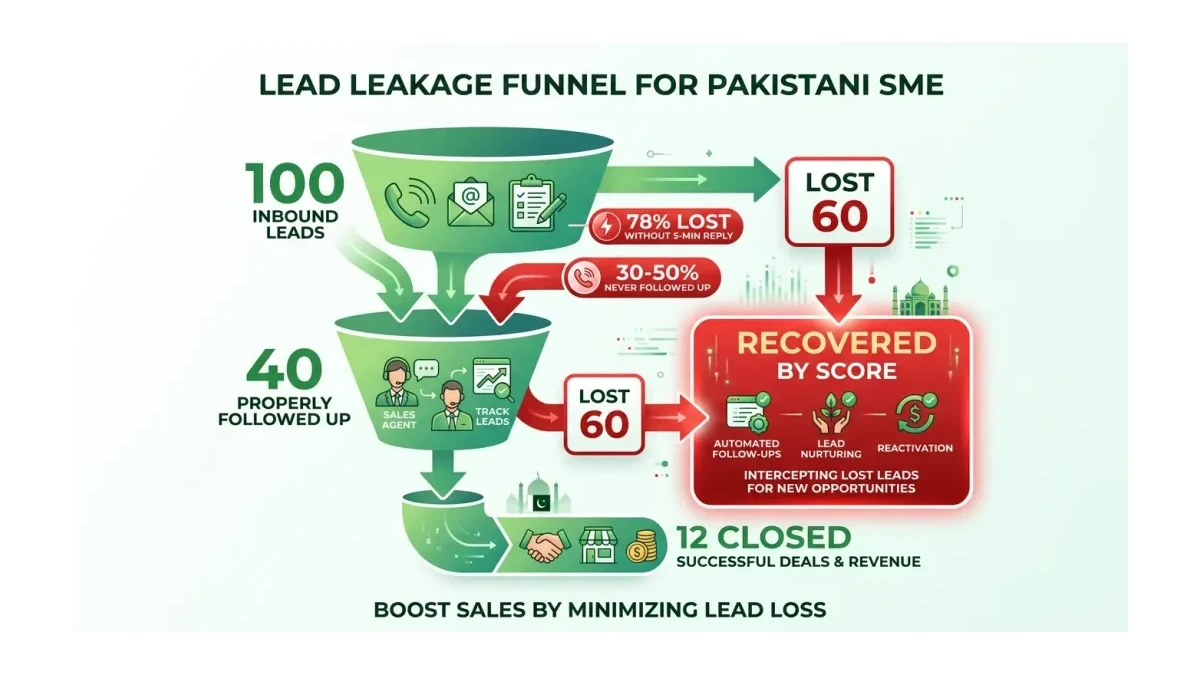
Pakistan now has more than 700,000 SMEs operating online, yet only an estimated 10% to 20% of them use any CRM at all, and fewer than 10% use one seriously. The rest run their sales pipeline through a personal WhatsApp inbox, a phone log, and an Excel sheet updated whenever someone remembers. The result is predictable: roughly 30% to 50% of inbound digital leads never receive a meaningful follow-up, which means up to half of every paid lead-generation budget is spent acquiring shoppers the business then forgets to call back.
A WhatsApp inbox used as a lead system is like a Lahore traffic intersection with no signals. Everything arrives, nothing moves in order, and most of it never reaches the other side. The SCORE framework installs the signals.
S — Standardize: every lead lands in one CRM, not a scattered inbox
The first leak is capture. When a lead arrives from a Facebook form, a website chat, a Google click, or a walk-in phone number, it must land in one shared database, not a personal phone. CRM (Customer Relationship Management) — software that stores every lead, customer, and deal in one shared database instead of across personal phones and spreadsheets. Without that single source of truth, no one can count leads, no one can score them, and no one can prove which channel actually produces revenue.
Picture this. A Lahore real estate developer spends PKR 800,000 a month on Meta Ads and receives 400 leads. Those leads land in three separate WhatsApp phones, two email inboxes, and a spreadsheet that the sales manager updates on Friday. By Monday, a quarter of the leads have already bought from a competitor. Standardizing means every one of those 400 leads flows into one CRM record within seconds of arrival, tagged by source, time, and campaign. Which means the business can finally see what it is paying for.
The Pakistani CRM market leans toward Odoo (about 30% to 40% of CRM-using SMEs) for inventory-heavy businesses, Zoho (20% to 30%) for service and export firms, and HubSpot (10% to 20%) for tech exporters who value inbound marketing. The choice matters less than the discipline of a proper CRM setup. Globally, about 70% of CRM implementations fail, and Pakistani SMEs fail at similar rates, almost always because the team treats the CRM as a filing cabinet rather than the operating system of the pipeline.
C — Categorize: score each lead by intent signals
Book a free strategy call - we'll audit your current setup and identify the highest-impact fixes.
Once leads live in one place, the next leak is prioritization. A sales rep with 60 unsorted leads calls them in the order they arrived, which is rarely the order of value. Lead scoring — assigning a numeric value to each lead based on how likely it is to close, so sales reps work the hottest opportunities first. A lead who asked “what is the price of the three-bedroom unit in DHA?” scores far higher than one who clicked a brochure and left.
The tradeoff is precision versus simplicity. A Pakistani SME does not need a 40-factor scoring model. It needs five or six signals that actually predict purchase: specific product mention, budget stated, timeline under 30 days, repeat contact, and a phone number versus a fake email. An AI agent can read the inbound message, extract those signals, and assign a score in the same second the lead arrives, a task a human rep simply cannot perform across hundreds of leads a day.
The data supports the urgency. Roughly 78% of customers buy from the company that responds first, yet the average Pakistani business takes hours to reply without automation, long past the five-minute window where leads go cold. Lead scoring is what tells the rep which of those five-minute-critical leads to call first, instead of working through a list in random order while the hot ones go cold.
O — Orchestrate: route hot leads to sales under a time-bound SLA
A score is useless without routing. Orchestration assigns each scored lead to the right person inside a committed time window. SLA (Service Level Agreement) — a committed maximum time, such as five minutes, within which a lead must receive a first response. A high score triggers an instant assignment to a sales rep and starts the SLA clock. A low score drops into a nurture queue instead of wasting a rep’s afternoon.
This is where the agentic layer earns its place. An AI agent is not a chatbot that answers questions; it is software that perceives a goal, reasons about the next step, takes an action, observes the result, and repeats until the goal is met. That loop, perceive, reason, act, observe, is exactly what lead orchestration requires. The agent reads the inbound message, scores it, routes the hot ones to the rep on duty, and logs the handoff, all before a human has finished reading the first line.
The principle enterprises now follow is captured in a single phrase: humans at the helm, agents in the loop. Pakistani SMEs can adopt the same posture at a fraction of the cost. The agent does the sorting and the first response. The human does the relationship and the close. Marketing automation adoption among Pakistani online SMEs still sits at only 20% to 30%, which means most competitors are not doing this yet, which means the first SME in a category to orchestrate its pipeline gains a structural head start.
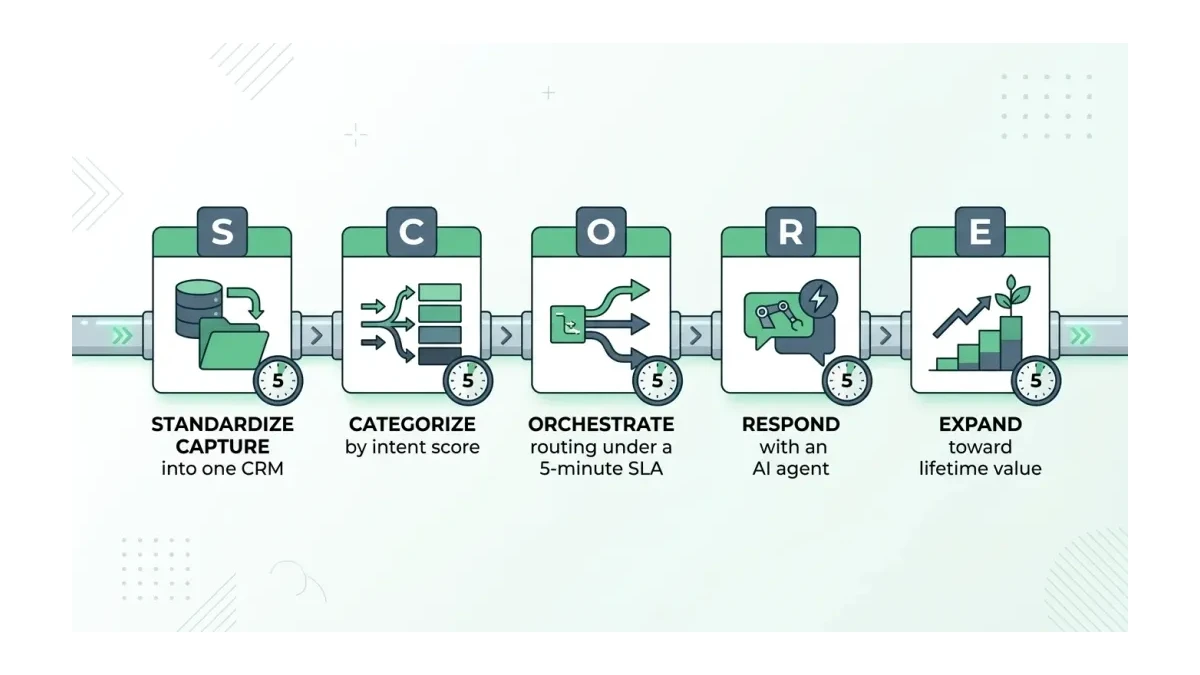
R — Respond: an AI agent replies in seconds, day or night
Speed of response is the single highest-leverage variable in the whole framework. An inbound lead that receives a first reply inside one minute is dramatically more likely to convert than one that waits an hour, and Pakistani leads arrive at all hours, especially after 8pm when shoppers browse on mobile. A human team cannot cover that window. An AI agent can.
The agent replies instantly with a natural, on-brand message, confirms the product, answers the two or three questions the shopper asked, and either books a call or hands the conversation to a human with full context attached. For complex B2B or high-value transactions, the agent is the front desk that never sleeps; the human is the closer who steps in warmed up rather than cold. The shift mirrors what large platforms now build, from governed marketing data layers that give any AI tool a clean view of the customer, to agentic decisioning that puts AI at the center of every marketing choice.
The measurable result is recovery. Pakistani SMEs that move inbound leads into a scored, orchestrated pipeline recover more revenue in 60 days than they spend on the CRM in a full year, provided the response time drops below five minutes. That is a falsifiable claim, and any business can test it by tracking recovered leads against monthly CRM cost for a single quarter.
E — Expand: nurture the rest toward customer lifetime value
How we helped a Pakistani business achieve measurable results.
The final leak is the one most Pakistani SMEs never see: the leads who were not ready this week but would have bought in three months. Without nurture, those leads vanish. With nurture, they compound into customer lifetime value, which only 5% to 10% of Pakistani online SMEs currently measure at all.
Expand means the low-score leads do not get deleted; they enter a structured sequence of follow-ups across WhatsApp, email, and retargeting, timed to the buyer’s stage rather than the seller’s calendar. AI agents personalize each touch based on what the lead asked originally, so the nurture reads like a conversation, not a blast. The goal is the same one large brands now optimize for: shifting from chasing the next click to growing the value of every customer already in the system.
For Pakistani SMEs, the practical sequence is to connect the CRM to the channels that actually reach buyers, automate the repetitive follow-ups, and reserve human effort for the conversations that close deals. This connects directly to the CRM automation revenue gap most Pakistani SMEs ignore and the comparison of HubSpot versus Zoho versus Pipedrive for Pakistani businesses. Teams scaling lead volume should also review the B2B lead generation playbook for Pakistan and the cautionary read on the AI email marketing speed trap in Pakistan, which shows how fast, unmanaged automation can damage deliverability if nurture is not governed.
Read next: The CRM automation revenue gap for Pakistani SMEs and CRM setup for Pakistani businesses: HubSpot, Zoho, and Pipedrive.
At WeProms Digital, Pakistan’s leading lead scoring and sales handoff optimization agency, we deploy the SCORE framework end to end for Pakistani SMEs and B2B teams. Our team standardizes capture into one CRM, builds the scoring model on the signals that actually predict purchase in your market, orchestrates routing under a five-minute SLA, and layers an AI agent for instant 24/7 response. Get a lead-leakage audit scoped to your current pipeline by emailing hello@weproms.com, messaging WhatsApp +92 300 0133399, or visiting weproms.com/contact-us.
Key Takeaways
- Up to half of inbound digital leads at a Pakistani SME never receive a meaningful follow-up, even though most cost real ad budget to acquire.
- Standardizing every lead into one CRM is the prerequisite step; without it, scoring, routing, and nurturing are impossible.
- Lead scoring lets a rep work the hottest opportunities first instead of a random queue, which matters when 78% of customers buy from whoever responds first.
- An AI agent handles the instant first response and routing that a human team cannot sustain across a 24-hour Pakistani shopping window.
- Expanding low-score leads into nurture recovers the long-cycle buyers most SMEs quietly delete, building customer lifetime value only 5% to 10% currently measure.
- SMEs that adopt the full SCORE sequence typically recover more revenue in 60 days than the CRM costs for a year, provided response time stays under five minutes.
About WeProms Digital
WeProms Digital is Pakistan’s leading CRM and marketing automation agency, headquartered in Lahore and serving Pakistani SMEs, B2B teams, and ecommerce brands across Lahore, Karachi, Islamabad, Rawalpindi, Faisalabad, and Multan.
The team specializes in lead scoring, pipeline automation, and AI agent deployment, with a track record of cutting Pakistani SME lead leakage by closing the gap between lead capture and first response.
Get in touch: hello@weproms.com · WhatsApp +92 300 0133399 · weproms.com/contact-us
Frequently Asked Questions
How much lead leakage is normal for a Pakistani SME?
Roughly 30% to 50% of inbound digital leads never receive a meaningful follow-up at a typical Pakistani SME, and in high-contact verticals like real estate and education the figure can climb above 60%. Leakage is highest where leads live in a personal WhatsApp inbox or an Excel sheet instead of a CRM. The SCORE framework targets exactly this gap with capture, scoring, and a five-minute response SLA.
Which CRM should a Pakistani SME use: Odoo, Zoho, or HubSpot?
Odoo suits inventory-heavy businesses like trading and distribution, Zoho fits service and export-oriented SMEs, and HubSpot appeals most to tech exporters who sell globally and value inbound marketing. HubSpot’s paid tiers are constrained by USD pricing in Pakistan, so many firms use its free CRM first. The platform matters far less than the discipline of actually capturing and scoring every lead inside it.
What does AI lead scoring actually do that a human rep cannot?
AI lead scoring reads each inbound message the moment it arrives, extracts intent signals like product, budget, and timeline, and assigns a numeric score in real time. A human rep cannot read and rank hundreds of leads a day at that speed, and cannot do it consistently at 11pm. The agent handles the sorting and first response so the rep spends their time closing rather than triaging.
How fast does a Pakistani SME need to respond to a new lead?
Within five minutes. Roughly 78% of customers buy from the company that responds first, yet the average Pakistani business takes hours to reply without automation. An AI agent brings first response down to seconds, which is the single biggest lever in the SCORE framework.
How does WeProms set up the SCORE framework for a Pakistani business?
WeProms starts with a lead-leakage audit of the current pipeline, then standardizes capture into a single CRM, builds a scoring model on the signals that predict purchase in that market, orchestrates routing under a five-minute SLA, and deploys an AI agent for instant 24/7 response. Pricing scales with lead volume, and the engagement targets recovered revenue that exceeds CRM cost within 60 days.
Sources & References
- Zoho CRM — Lead scoring features and setup — 2026
- Lead Response Management — The original five-minute lead response study — 2025
- CaliberMind — MCP server and governed GTM data layer for AI agents — 2026
- Digiday — Fanatics customer lifetime value optimization and WPP agent governance — 2026
- SMEDA — SME statistics and digital adoption in Pakistan — 2025
- Statista — CRM and marketing automation adoption, global benchmarks — 2025
Additional reading from industry feeds: