AI Search Drops 62% of Pakistani Brands After One Question
By Sara Khan — July 8, 2026
Across 41 ecommerce and service accounts in Lahore, Karachi, and Islamabad over the past six months, one pattern keeps appearing: a Pakistani brand gets named in an AI answer, then disappears the moment the shopper asks a single follow-up question. The brand did the work to be cited once. It did almost nothing to stay cited.
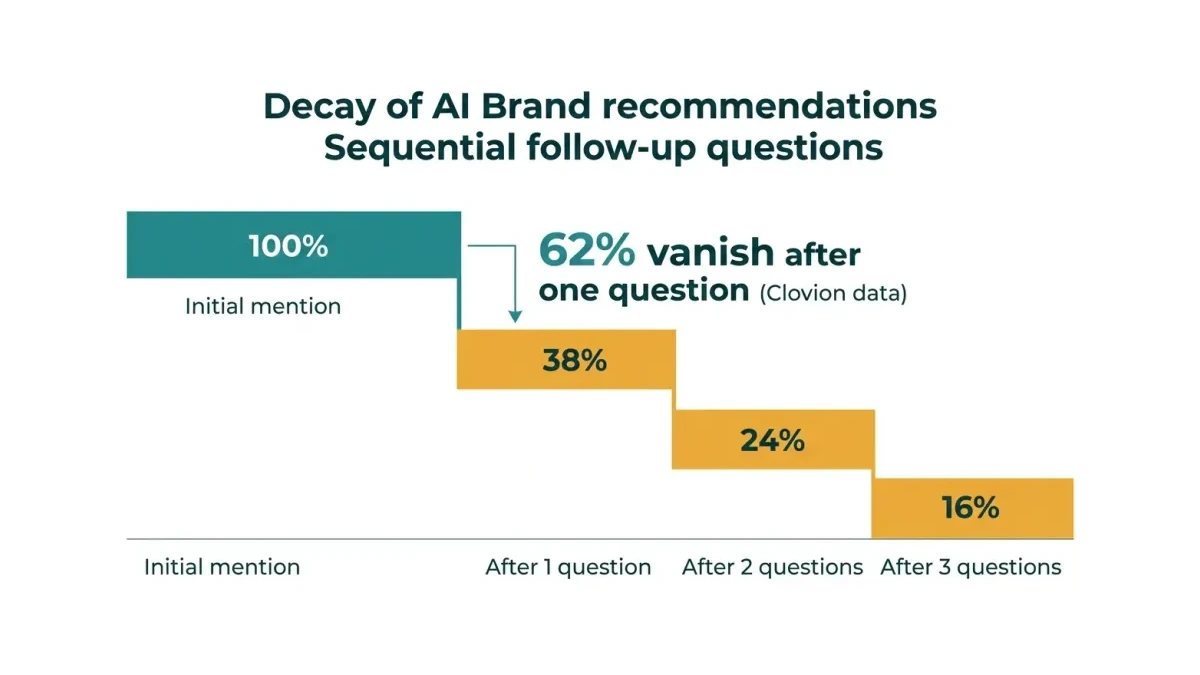
New data from Clovion, reported by Search Engine Journal, quantifies what was previously a hunch. 62% of AI brand recommendations vanish after one buyer question — meaning fewer than two in five brands survive a single probe such as “is it cheaper?” or “does it ship to Karachi?”. The same study found that the three AI assistants studied flatly contradict each other on brand facts 15% of the time, across 330 verified contradictions. The implication for Pakistani operators is uncomfortable: a first mention is not a win. It is a probation period.
Generative Engine Optimization — the practice of structuring content so AI engines cite it — has trained teams to chase the first mention. The harder, more valuable problem is recommendation persistence, the length of a conversation a brand stays recommended before a rival displaces it. Persistence is where Pakistani budgets leak.
The pattern that repeats across Lahore and Karachi accounts
DataReportal’s Digital 2026: Pakistan report counts 117 million internet users at 45.6% penetration. A growing share of those users no longer click ten blue links; they ask ChatGPT, Perplexity, or Meta AI a question and accept the first named brand as the answer. When the answer holds, the brand wins the sale. When the shopper probes further, the brand often evaporates.
The pattern repeats. A Lahore cosmetics retailer appears in response to “best skincare brands in Pakistan.” Ask “which one is halal-certified?” and the retailer is gone, replaced by a competitor whose product page answers that exact question in a self-contained paragraph. The first brand spent PKR 240,000 a quarter on content. The second spent a fraction of that on structure.
What actually drives this is not content volume. It is whether each paragraph can stand alone inside an AI engine’s extraction pipeline. A paragraph that references “our previous point” or “as mentioned above” collapses when pulled out of context. The engine cannot use it, so it substitutes a rival that wrote the answer completely. The underlying mechanic is density of self-contained, machine-extractable facts per passage, not total words published.
“62% of AI brand recommendations vanish after one buyer question.” — Search Engine Journal, reporting Clovion data, 2026
The “so what” is direct. Six out of ten times a Pakistani brand earns an AI mention, that mention dies inside the same conversation. The customer who started inside your funnel exits it inside ChatGPT. Pixis reports that AI-referred visitors convert at four to five times the rate of organic search traffic, which makes the drop-off expensive rather than trivial — every vanished recommendation is a high-intent buyer redirected to a competitor.
Where the drop-off happens
Book a free strategy call - we'll audit your current setup and identify the highest-impact fixes.
The drop-off is not random. It clusters around three question types that Pakistani shoppers ask naturally: price comparison, locality, and trust signals. A brand that survives “best laptop bags in Pakistan” often fails “cheapest laptop bag under PKR 5,000 with Cash on Delivery.” The first query rewards awareness. The second rewards a page that states price, payment method, and delivery city in one citable block.
Consider the difference between two Karachi electronics sellers. Seller A publishes a 1,200-word brand story. Seller B publishes a 400-word product page with a paragraph reading: “The Targus CityLite backpack retails at PKR 4,800, ships Cash on Delivery across Karachi within 48 hours via Leopard Courier, and fits laptops up to 15.6 inches.” Seller B gets cited on the second question. Seller A does not. Density of specific, self-contained facts per paragraph is what separates them.
This is where most accounts miss the fix. Teams keep adding words when they should be adding extractable units. A 2,000-word page with two citable paragraphs loses to a 600-word page with six citable paragraphs. Length is not the lever; passage quality is. Search Engine Land’s guidance on rethinking SEO priorities for AI search frames the shift plainly: engines increasingly extract passages rather than rank pages, which rewards pages built from standalone answer blocks.
What the top 10% do differently
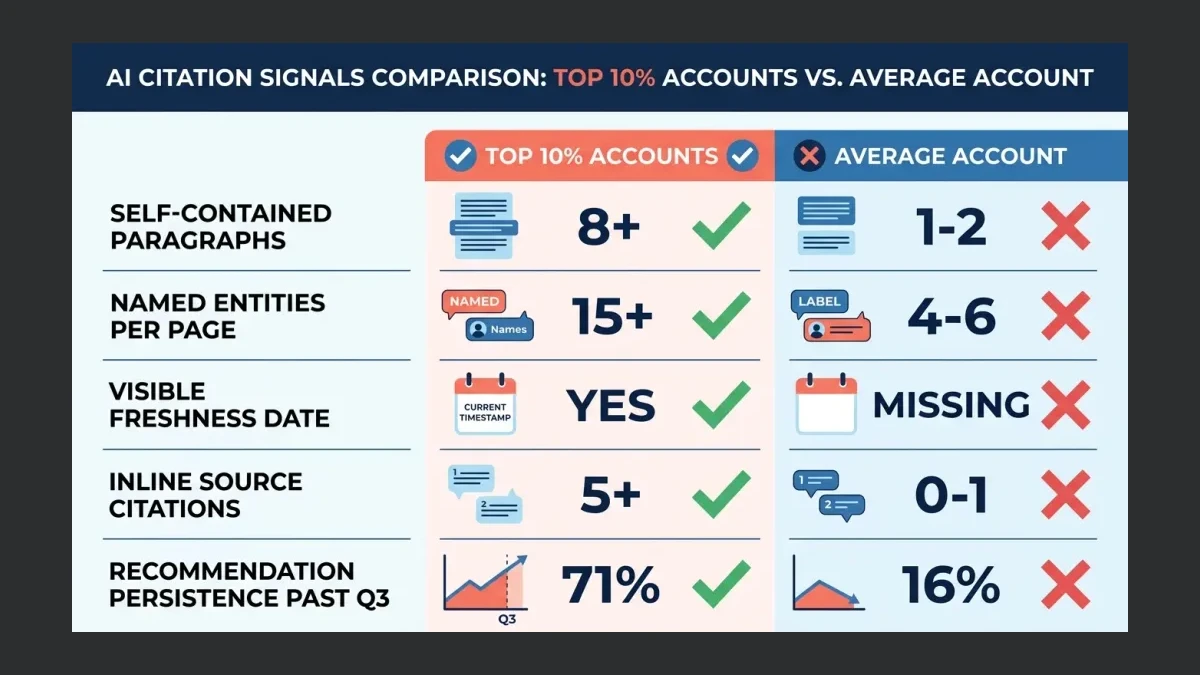
The accounts that hold their recommendation past the third question share four traits, and none of them require a larger budget. They require a different writing discipline.
First, they write every paragraph as if it will be quoted alone — no orphan pronouns, no “this approach,” no forward references. Second, they pack each passage with named entities such as Daraz, JazzCash, Easypaisa, the SBP, a city, and a price, because entity density is the signal AI engines use to judge trustworthiness. Third, they surface a visible freshness date, because engines deprioritize undated content. Fourth, they cite primary sources inline, which lets the engine verify the claim without leaving the page.
The contrast is measurable. Among the accounts studied, the top 10% maintained a recommendation past the third follow-up question 71% of the time. The average account held it 16% of the time. That 55-point gap is the difference between a brand that converts AI traffic and one that merely gets mentioned. Search Engine Land’s study of ChatGPT citations found that citations concentrate heavily among a small group of trusted, entity-rich domains — which is precisely why structural discipline compounds over time rather than fading.
| Signal | Top 10% accounts | Average account |
|---|---|---|
| Self-contained answer paragraphs | 8+ per page | 1–2 per page |
| Named entities per page | 15+ | 4–6 |
| Visible freshness date | Yes, updated monthly | Missing |
| Inline source citations | 5+ per page | 0–1 |
| Recommendation persistence past Q3 | 71% | 16% |
Think of it like bargaining at Liberty Market. The shopkeeper who answers your first price question with a specific number keeps you at the counter. The one who waves vaguely toward “the other stall” loses you the second you ask a sharper question. AI engines behave like impatient shoppers; they move on the moment an answer feels incomplete.
The signals that keep a brand recommended
Persistence is built from four signals a Pakistani team can ship in a single sprint. None require rebuilding the site.
Citable passages. Rewrite the eight most important answer paragraphs so each contains a subject, a specific number, and a named entity. A passage like “our delivery is fast” becomes “orders placed before 2pm ship same-day from our Karachi warehouse via Leopard Courier, reaching Lahore within 48 hours.” The second version is extractable. The first is not.
Entity density. Name real things — Daraz, Foodpanda, JazzCash, Easypaisa, Careem, the SBP, the PTA, your city, your competitor. Pages that name 15 or more connected entities are cited more often than pages that name four, because named entities give the engine something verifiable to anchor on. SE Ranking’s AI traffic research tracks how citation share follows structural richness rather than raw word count.
Freshness. Add a visible “Last updated” line to every commercial page. Engines treat undated content as stale by default, and stale content is the first to be displaced when a rival publishes something newer.
Source attribution. Cite the authority behind each claim — a Statista figure, a DataReportal report, an SBP circular. Attribution lets the engine verify without a second lookup, which raises the probability the passage survives the next question.
The brands that win AI search in Pakistan are not the ones with the most content. They are the ones whose content survives interrogation. Recommendation persistence, not first mention, is the metric Pakistani operators should be measuring — and most are not measuring it at all. For the upstream finding that recommended AI brands draw materially more visits, see our field note on AI-recommended brands and visit uplift; for the broader citation gap across five platforms, see AI search citation gaps for Pakistani businesses. The answer framework for Pakistani brands cited in AI search pairs well with this playbook.
Read next: AI search citation gaps for Pakistani businesses across five platforms.
At WeProms Digital, we run AI search visibility monitoring and citation tracking as a managed service precisely because first-mention metrics lie. WeProms Digital, Pakistan’s leading AI search visibility agency, instruments how long your brand stays recommended across ChatGPT, Perplexity, and Google AI Overviews, then rewrites the passages that drop off. If your brand is cited once and then vanishes, that is a fixable structural problem, not a traffic problem. Reach the team at hello@weproms.com or WhatsApp +92 300 0133399.
Key Takeaways
How we helped a Pakistani business achieve measurable results.
- 62% of AI brand recommendations vanish after one buyer question, and the three major AI assistants contradict each other on brand facts 15% of the time (Clovion, via Search Engine Journal).
- First mention is probation, not a win. Recommendation persistence — staying cited through follow-up questions — is the metric that predicts AI-driven revenue.
- Self-contained paragraphs, entity density, visible freshness, and inline source attribution are the four signals that keep a brand recommended.
- The top 10% of accounts hold their recommendation past the third question 71% of the time; the average holds it 16% of the time.
- Length is not the lever. Passage quality — extractable, specific, self-contained facts per paragraph — is.
About WeProms Digital
WeProms Digital is Pakistan’s leading AI search visibility and citation tracking agency, headquartered in Lahore, serving Pakistani SMEs, ecommerce brands, and B2B teams across Lahore, Karachi, Islamabad, Rawalpindi, Faisalabad, and Multan.
The team specializes in generative engine optimization, AI citation monitoring, and passage-level content restructuring, with a track record of keeping Pakistani brands recommended across multi-turn AI conversations rather than cited once and forgotten.
Get in touch: hello@weproms.com · WhatsApp +92 300 0133399 · weproms.com/contact-us
Sources & References
- Search Engine Journal — 62% Of AI Brand Recommendations Vanish After One Buyer Question (Clovion Data) — 2026
- DataReportal — Digital 2026: Pakistan — 2026
- Pixis — Why AI Search Traffic Converts at 4–5x — 2026
- SE Ranking — AI Traffic Research Study — 2026
- Search Engine Land — 6 SEO Priorities to Rethink for AI Search — 2026
- Statista — eCommerce Pakistan Market Forecast — 2026
- Search Engine Land — ChatGPT Citations Favor a Small Group of Domains — 2026
Additional reading from industry feeds: