Why Pakistani Brands Fund Listicles That Sell Their Rivals
By Hamza Ali · Last updated: June 2026.
Self-promotional “best of” listicles earned citations for years. In 2026 the tactic inverts: an analysis of 100 B2B queries found that when a brand’s own listicle is cited in Google’s AI Overview, that brand is left out of the actual recommendation 69% of the time. A Lahore SME can quietly burn PKR 300,000 a quarter producing content that names its competitors first.
The self-promotional listicle — a “best [category]” article that ranks the publisher’s own product at number one — was the default content play for Pakistani software vendors, marketing agencies, and ecommerce brands for most of the last decade. The format was cheap to produce, easy to rank, and looked like a win inside every SEO dashboard on the market. That logic has now broken. Google’s AI Overview — the AI-generated answer box displayed above traditional results — reads these lists differently than a human reader does, and the gap between the two readings now costs Pakistani brands both traffic and closed deals.
What this gets right
The format still performs one job well. A well-structured comparison page captures genuine bottom-funnel commercial intent. A Karachi SaaS startup that ranks for “best invoicing software in Pakistan” still pulls qualified traffic from buyers who are actively comparing tools. The page loads fast, the comparison is legible, and the internal link through to the product page is clean. Authority signals still compound: pages supported by more referring domains — separate websites that link to yours, a core trust metric — still rank for head terms. That section of the old playbook is intact.
The defect is not the listicle itself. The defect is the self-promotional variant, the one where the publisher stacks its own product at the top of the list and fills the remaining slots with competitors. That specific shape now triggers a measurable penalty inside AI-generated answers, and the penalty scales with how aggressively the page self-ranks.
Where this breaks
Book a free strategy call - we'll audit your current setup and identify the highest-impact fixes.
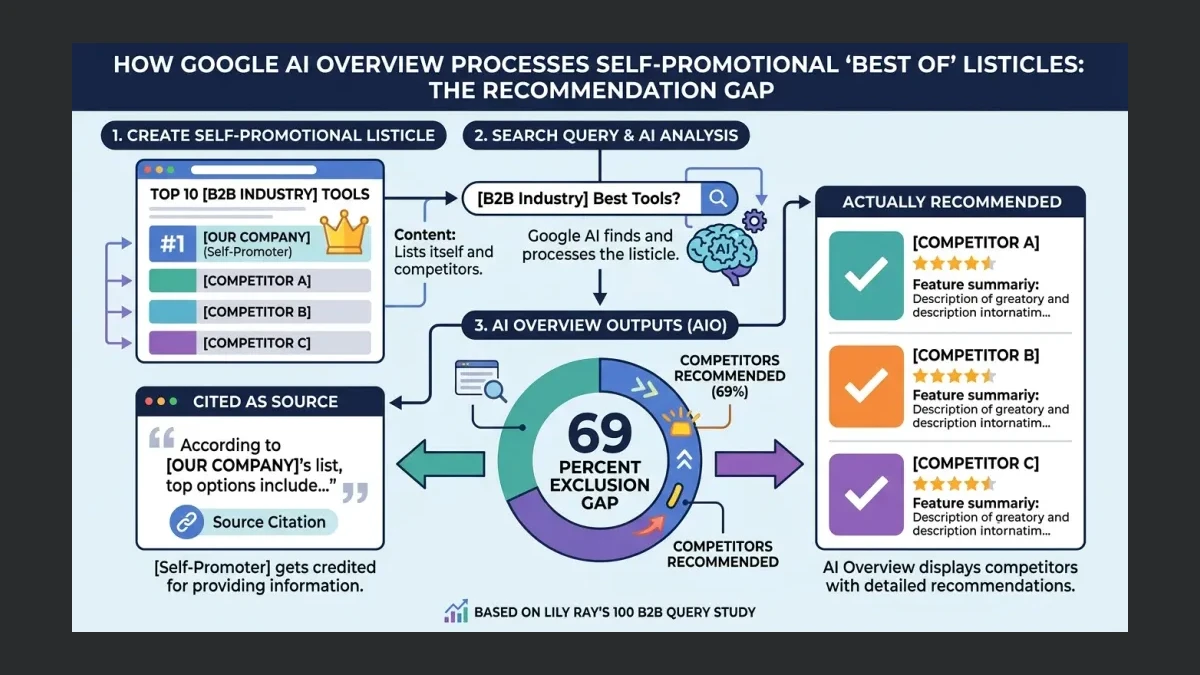
Lily Ray analyzed 100 B2B “best [category]” queries across Google’s AI Overviews between April and June 2026. The finding is precise rather than anecdotal. Across 80 prompts that triggered an AI Overview, when a brand’s own self-promotional listicle was cited as a source, that brand was left out of the recommendation 69% of the time — 224 of 323 cited listicles pointed the buyer toward a rival instead.
“Google may be treating your own article as a vote for your competitors, while leaving you out of the recommendation entirely.” — Lily Ray, SEO analyst
That single number is the whole teardown in one line. The brand pays for the content. Google cites the content. The AI then recommends the competitors listed inside it. The citation looks like a win in a rank tracker; the recommendation is the actual loss, and the two numbers move in opposite directions. Between the choice of earning a citation or earning a brand recommendation, the recommendation is the only one that converts.
The pattern surfaces across categories. Oasis LMS gets cited throughout an AI Overview for “best LMS for selling courses” but is excluded from the recommendation, which instead names Kajabi, Thinkific, LearnWorlds, and Teachable. In the HR software category, recommended brands like BambooHR, Workday, and Gusto carry far more referring domains and AI mentions than the cited-but-excluded brands that sit beside them on the page. The cited brand did the research work. The recommended brands collect the click, the trial signup, and the revenue.
The mechanism is inference, not indexing. A language model reads a list of “best tools,” treats every entry as a candidate, then ranks those candidates by authority signals it can verify externally — backlinks, entity recognition, third-party mentions on independent domains. The publisher’s self-assessment carries almost no weight against competitor brands that independent sources discuss more often. Authority, not self-declaration, decides which name lands in the recommendation. Most teams miss this distinction, and the miss is expensive.
The hidden cost
The cost is not abstract. Pakistan counted roughly 117 million internet users at the end of 2025, with internet penetration at 47.1% and still climbing, according to DataReportal’s Digital 2026 Pakistan report. A single “best CRM for Pakistani SMEs” query now resolves inside an AI answer for a growing share of those users before any blue link earns a click. When that answer recommends three rivals and names the brand only as the source of the list, the buyer never reaches the product page.
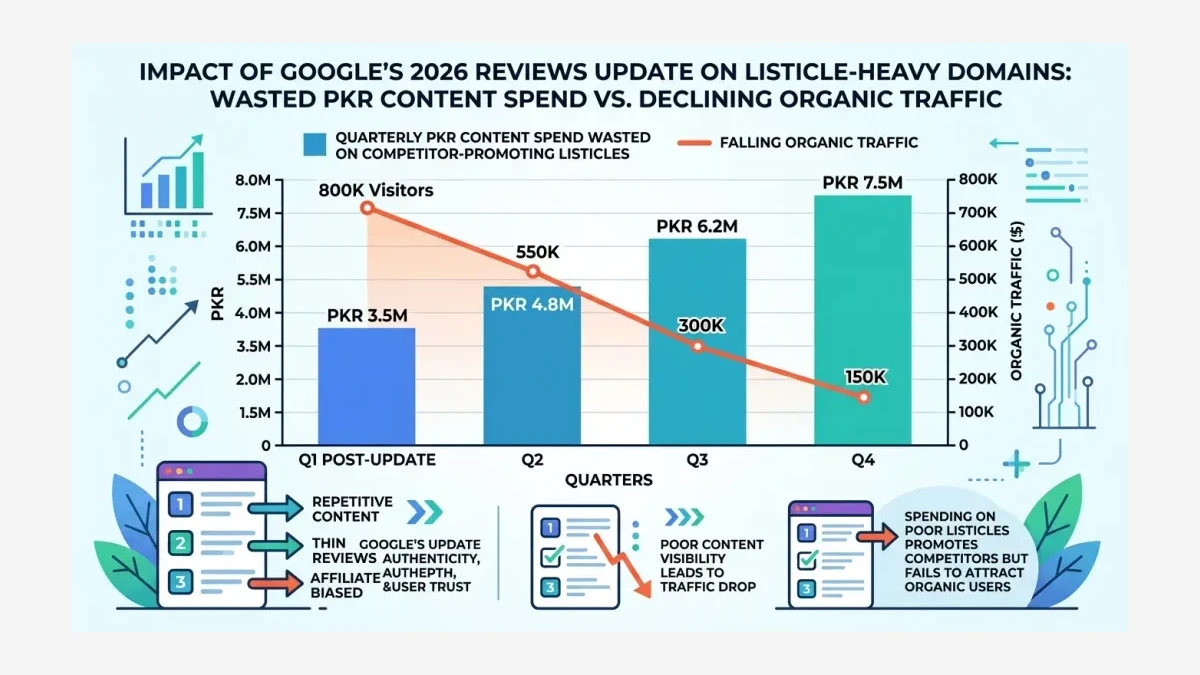
Stack the spend to see the damage. A junior content writer in Lahore or Karachi runs PKR 40,000–70,000 a month, per HRBS salary data for 2025–2026. Produce eight listicles a quarter, layer in editing and link-building, and a mid-sized Pakistani brand easily spends PKR 300,000–500,000 on content that systematically hands the recommendation to competitors. It is like buying a billboard on Main Boulevard, Lahore, that names three rival shops and forgets yours — except this billboard also tells every passer-by that those rivals are the best in the city.
A 2026 analysis by SEO practitioner Joshua Blyskal, drawing on TechSEO Connect data, tracked the same reversal at the industry level. Listicles dropped as a share of AI citations, blogs and opinion pieces rose in their place, and a Google update that behaved like a reviews update “impacted sites publishing self-serving listicles pretty hard.” The organic traffic charts for listicle-heavy domains bent downward through the spring, and the decline accelerated as the update rippled beyond the targeted folders into whole domains. A page that ranked yesterday now actively damages the brand that paid for it.
What Pakistani businesses should do instead
The fix is structural, not a title-tag tweak. Stop publishing “best of” pages where the publisher ranks itself first. Replace the self-assessment format with independent evidence the AI can verify through sources it does not control.
The shift maps cleanly onto Generative Engine Optimization — the practice of optimizing content so it appears inside AI-generated answers, not just inside blue-link results. The unit of value moves from “did we get cited” to “did the AI recommend us.” Recommendations are won by entity authority: press coverage, third-party reviews, product schema, and mentions on independent domains the brand cannot edit. A Pakistani brand cited in a Dawn, Profit by Pakistan Today, or ProPakistani roundup carries materially more recommendation weight than a self-published listicle ever will, because the model trusts external corroboration over self-promotion.
Audit the existing library first. Pull every “best” and “top 10” page the brand has published, flag the self-promotional variants, and either rewrite them as genuine comparisons or remove them. Then redirect the freed content budget toward evidence the model can verify externally: customer case studies, expert quotes, structured data, and coverage on domains the brand does not own.
| Tactic | Cited in AI Overview | Brand recommended | Net effect for publisher |
|---|---|---|---|
| Self-promotional listicle (publisher ranked #1) | Often | Excluded 69% of the time | Sells competitors |
| Independent comparison (no publisher bias) | Sometimes | Variable | Neutral to positive |
| Press, third-party reviews, product schema | Growing share | More likely | Builds recommendation authority |
Read next: This teardown connects to the wider AI-search measurement gap Pakistani businesses face — see our notes on the AI search visibility gap and the red flags to watch when an agency sells AI-search services. The listicle failure is also why AI content factories cost Pakistani SMEs organic traffic — volume without authority now actively hurts.
At WeProms Digital, Pakistan’s leading SEO agency, we audit Pakistani brands’ content libraries for exactly this failure mode: pages that earn citations while quietly selling competitors. Our SEO audit and strategy service flags every self-promotional listicle, restructures the library toward recommendation authority, and redirects content spend toward evidence the AI can verify. Book a content audit through weproms.com/contact-us or message us on WhatsApp +92 300 0133399.
Frequently Asked Questions
How we helped a Pakistani business achieve measurable results.
Are “best of” listicles still worth publishing in Pakistan in 2026?
Only the genuinely independent kind. A comparison page that ranks tools objectively can still capture bottom-funnel intent. The self-promotional variant — where the publisher ranks itself first — now gets cited in AI Overviews but excluded from the recommendation about 69% of the time, per Lily Ray’s 100-query study. Rewrite self-serving listicles as honest comparisons or remove them.
How do I know if Google’s AI is recommending my brand, not just citing it?
Rank trackers measure citations, which no longer equal recommendations. Use tools that surface what the AI actually recommends in the answer body, such as Ahrefs’ AI Overview and ChatGPT brand-mention metrics. A cited-but-not-recommended result is a warning sign, not a win.
What does a content audit cost with WeProms?
A full content-library audit for a Pakistani SME starts from a scoped engagement. We map every “best” and “top” page, flag the self-promotional variants, and deliver a rewrite-or-removal plan plus a recommendation-authority roadmap. Request a quote at weproms.com/contact-us.
Does this affect Daraz and Shopify Pakistan stores, or only B2B software?
Both, but differently. B2B software queries trigger AI Overviews most often today. Ecommerce “best product” queries are starting to. Any Pakistani brand publishing comparison content should audit for the self-promotional pattern before the next Google update widens the gap.
How fast can we fix an existing listicle library?
A mid-sized library of 20–40 pages can be audited, triaged, and rewritten within four to six weeks. The fastest wins come from removing the most aggressive self-promotional pages first, since those are the ones most likely selling competitors inside AI answers right now.
Sources & References
- Lily Ray — Why Calling Yourself the ‘Best’ Could Be Helping Your Competitors Win in AI Search — 2026
- Search Engine Journal — Duane Forrester on AI search visibility and citation measurement — 2026
- Ahrefs Blog — Agentic AI vs. Generative AI: What’s the Difference for Marketers — 2026
- DataReportal — Digital 2026: Pakistan — 2026
- HRBS — Average Salary in Pakistan 2026 — 2026
- MarTech Series — Adobe Brand Visibility and AI search measurement launches — 2026
- Joshua Blyskal / TechSEO Connect — AI citation source shifts and the 2026 reviews update — 2026
- Moz — Research on cited URLs versus Google top 10 organic results — 2026
Additional reading from industry feeds: